
Tour Experiences for the 14 Day Biblical Israel Tour
January 10-23, 2026
(This trip is now updated through Day 13 – Thursday, January 22)
Downloads:

"Life transforming Israel tours & teaching in the context of the land of the Bible"
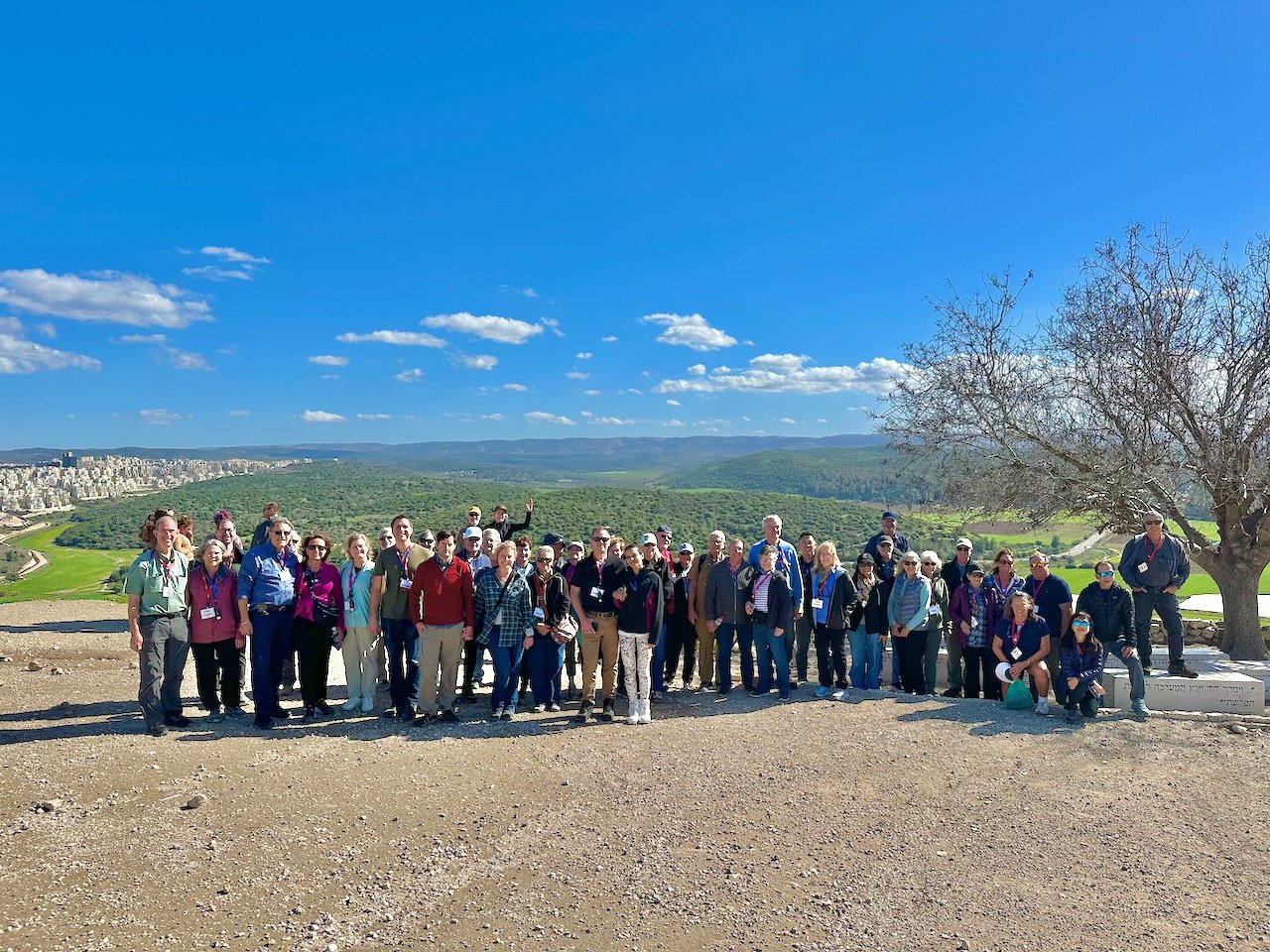
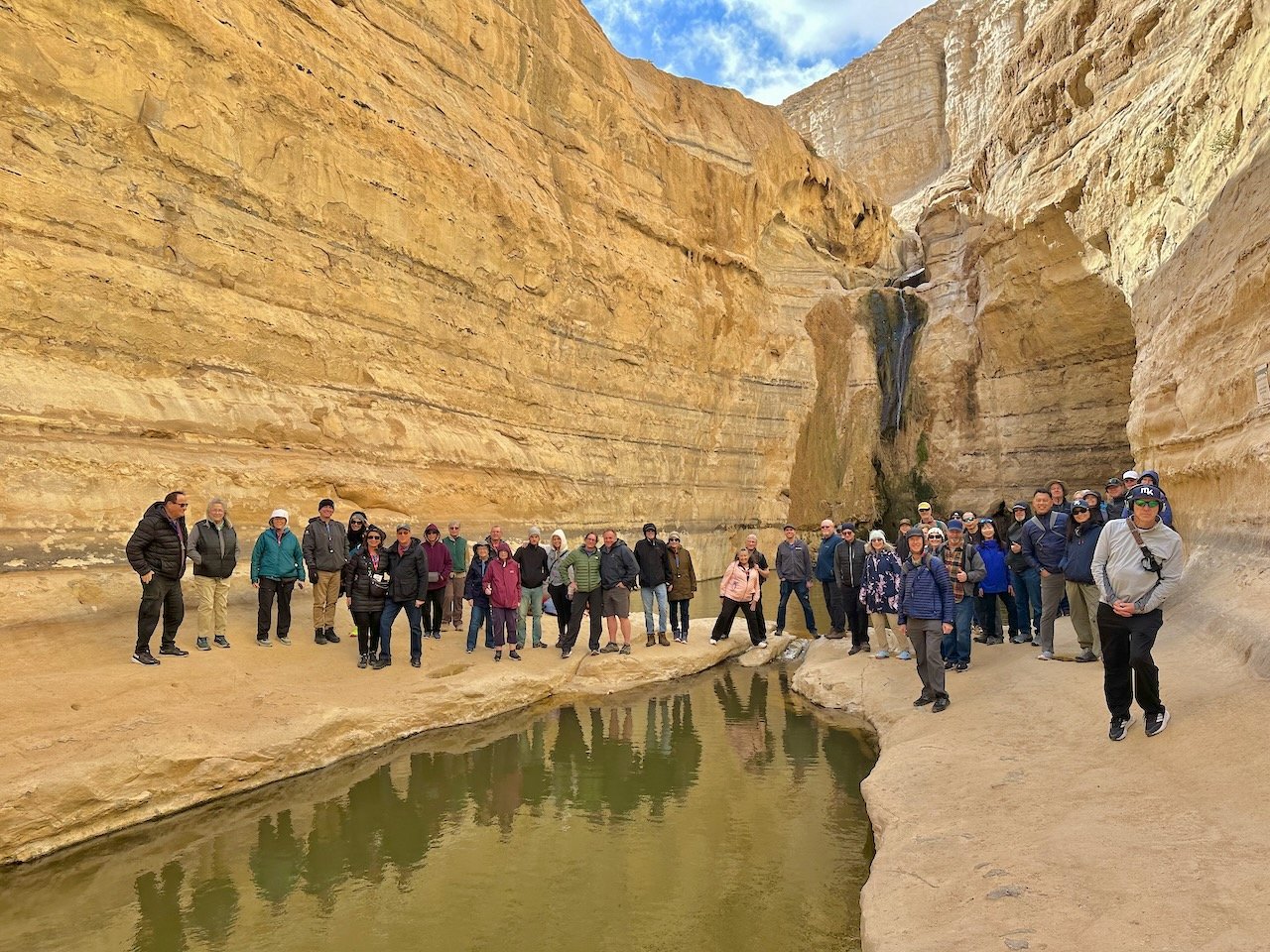
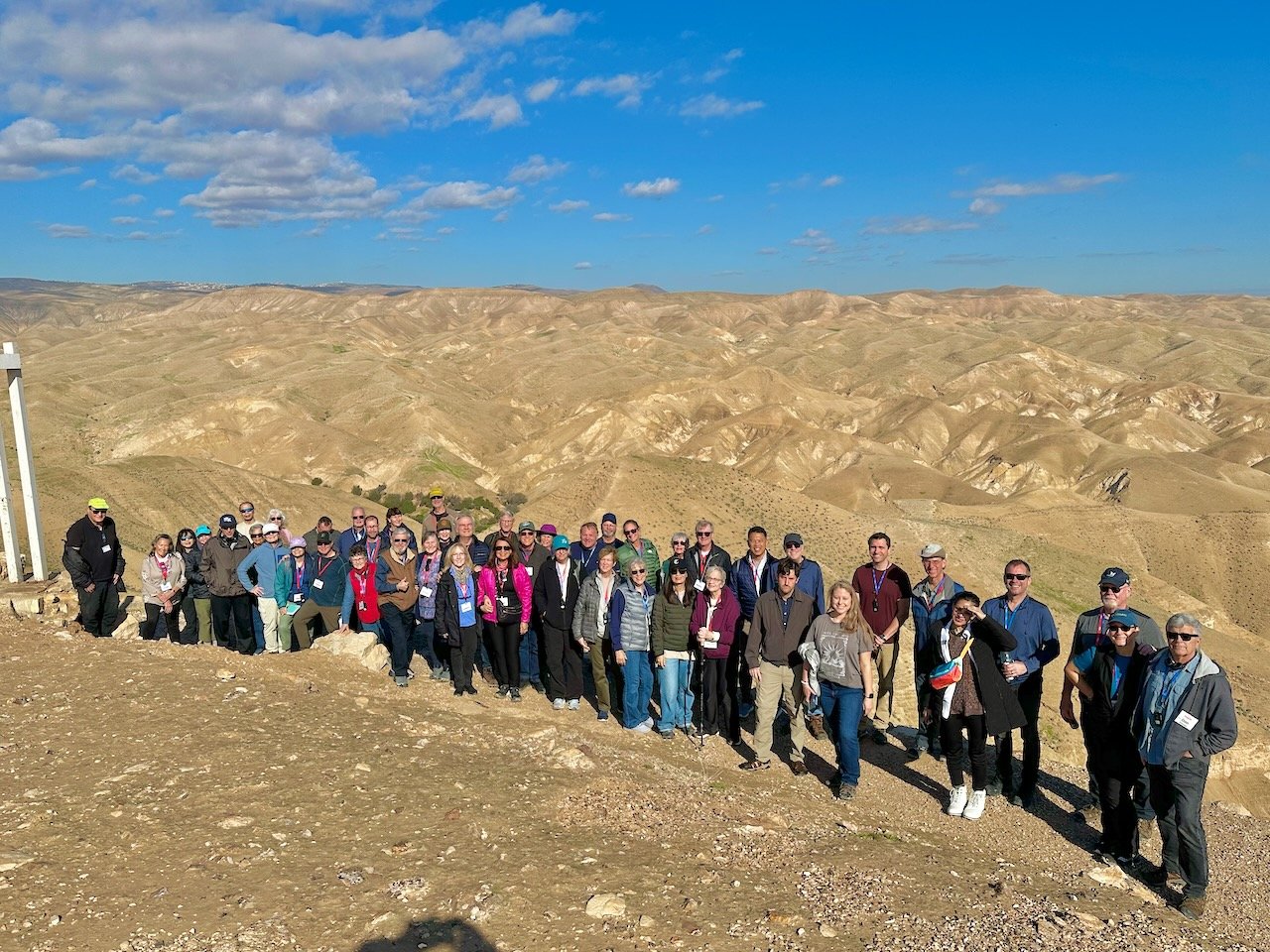
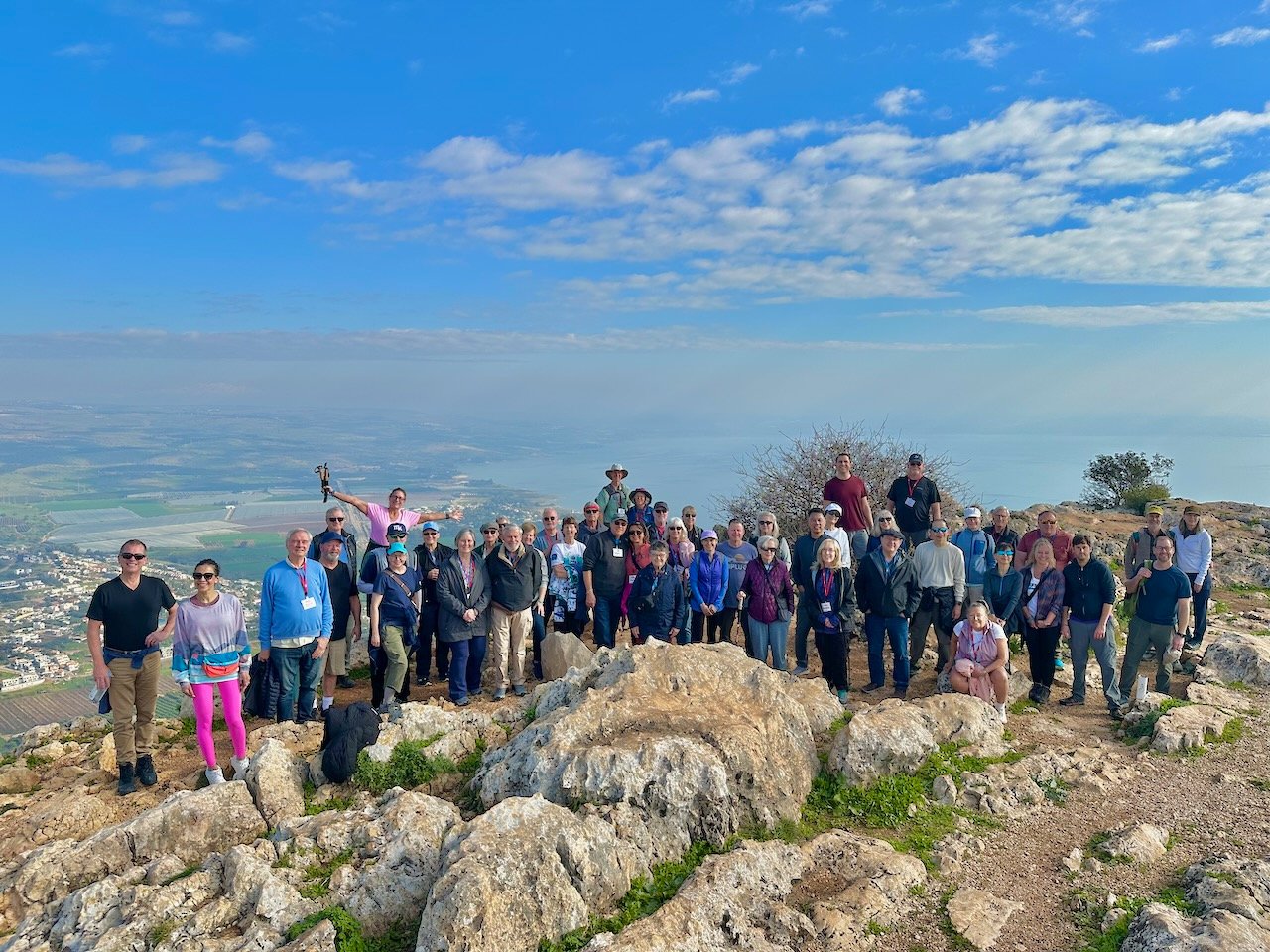
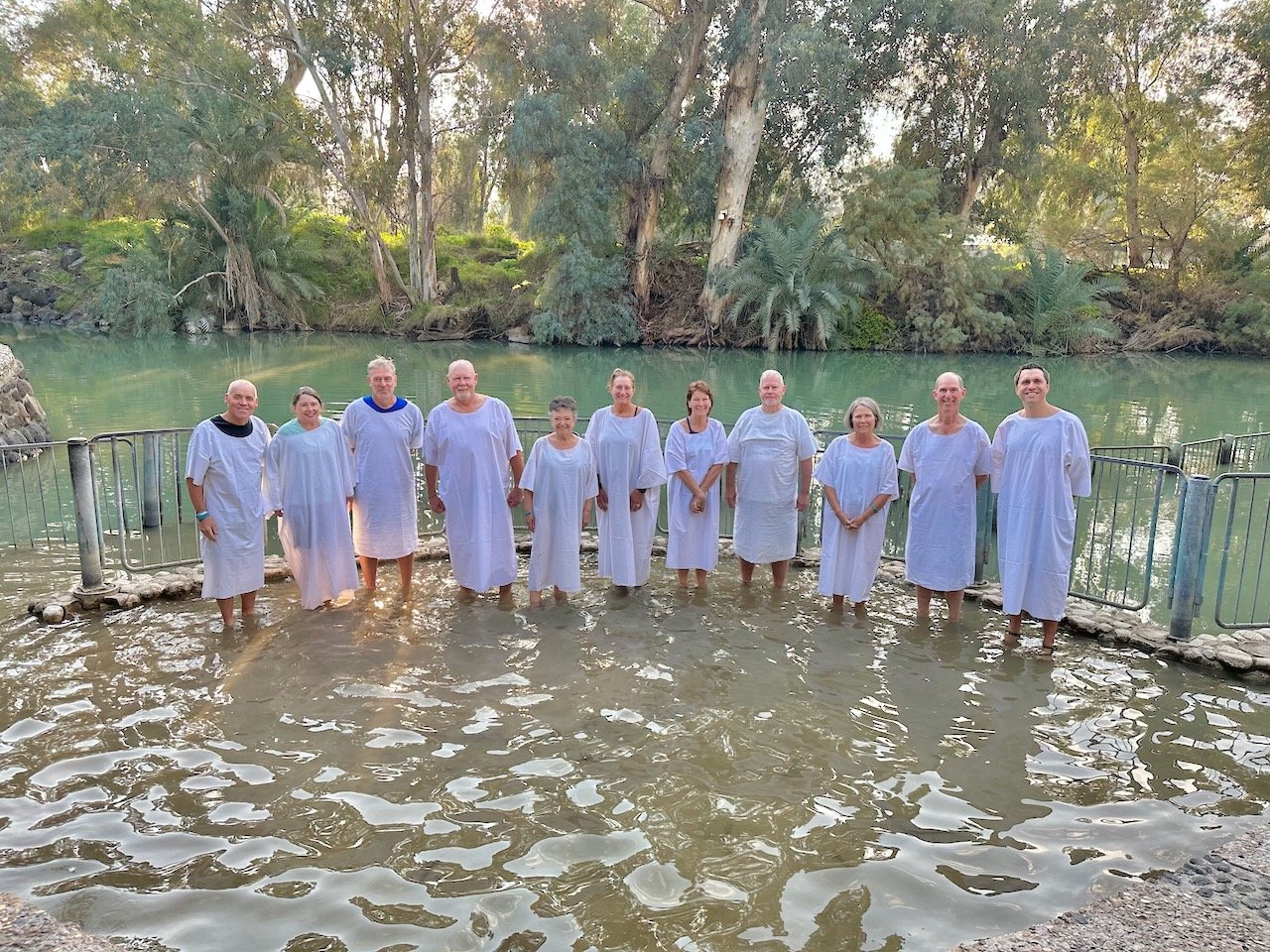
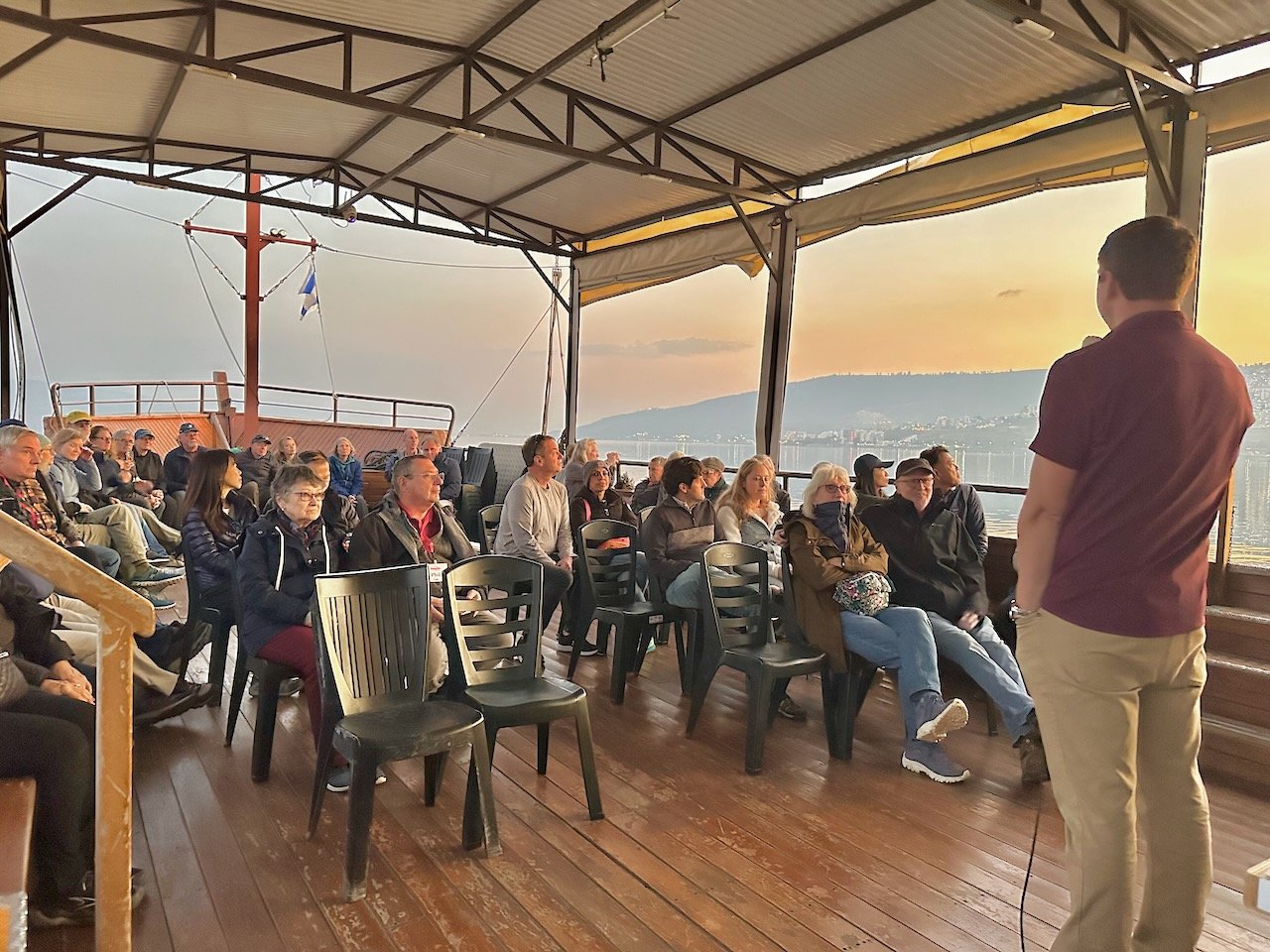
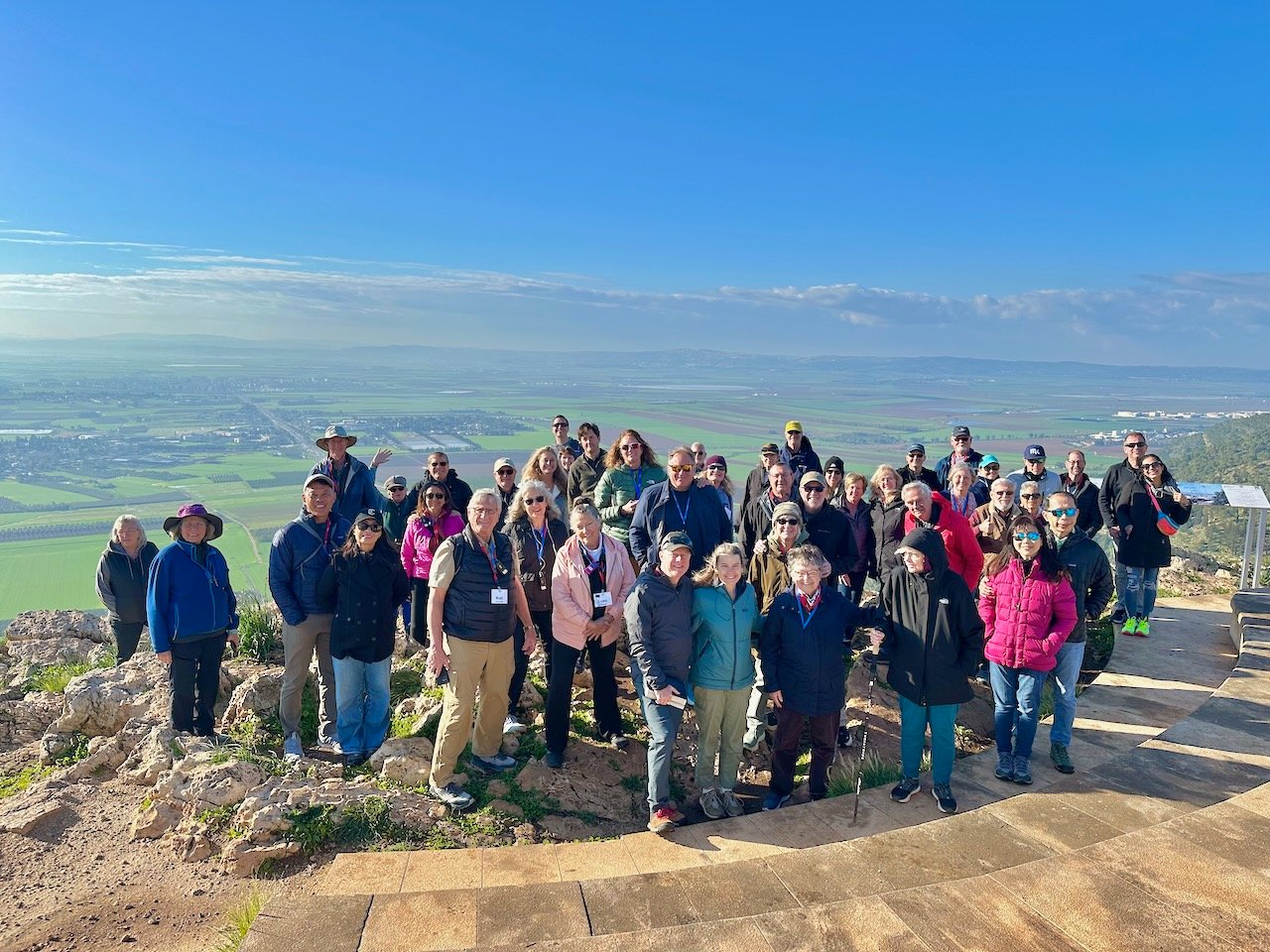
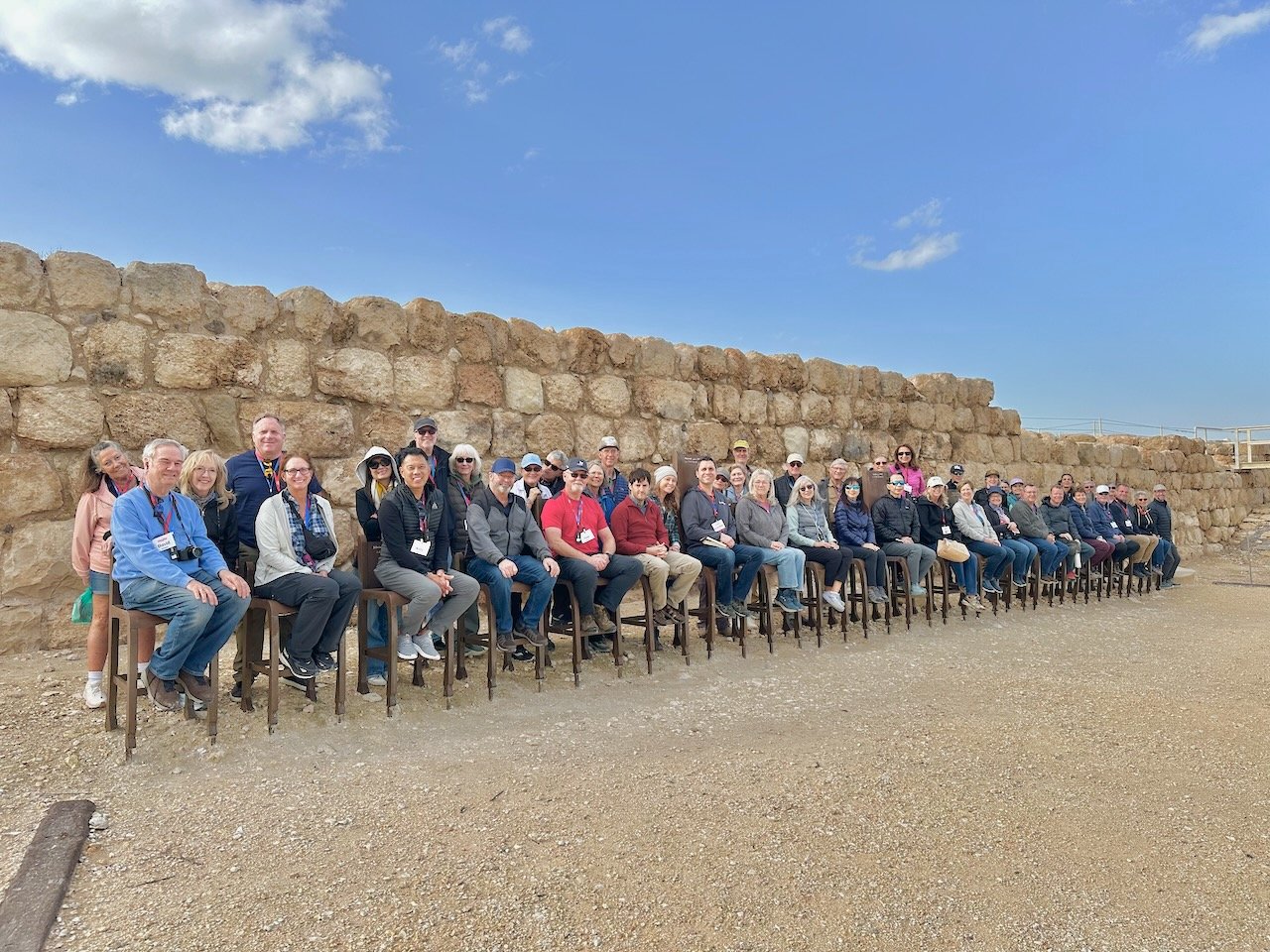
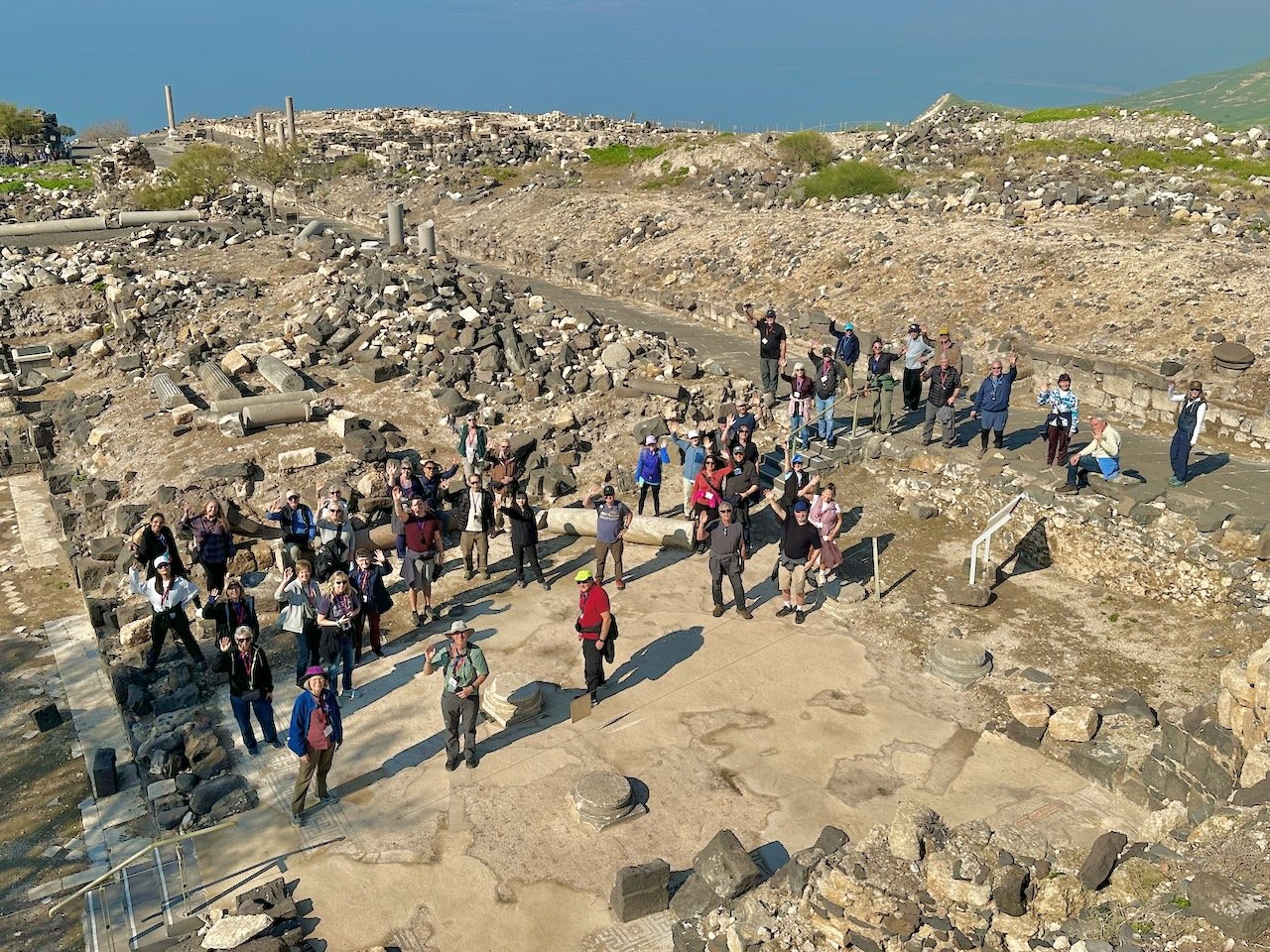
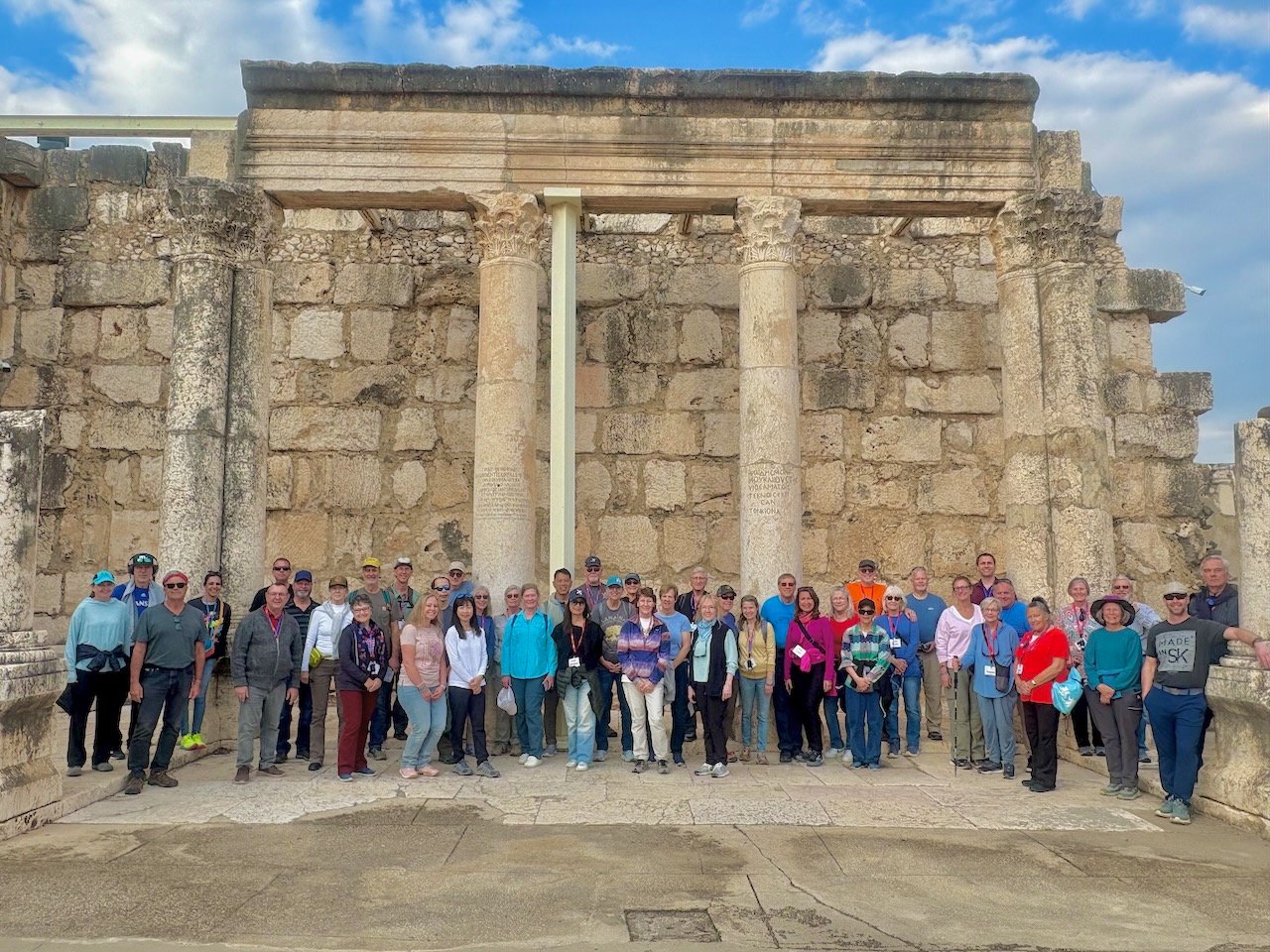
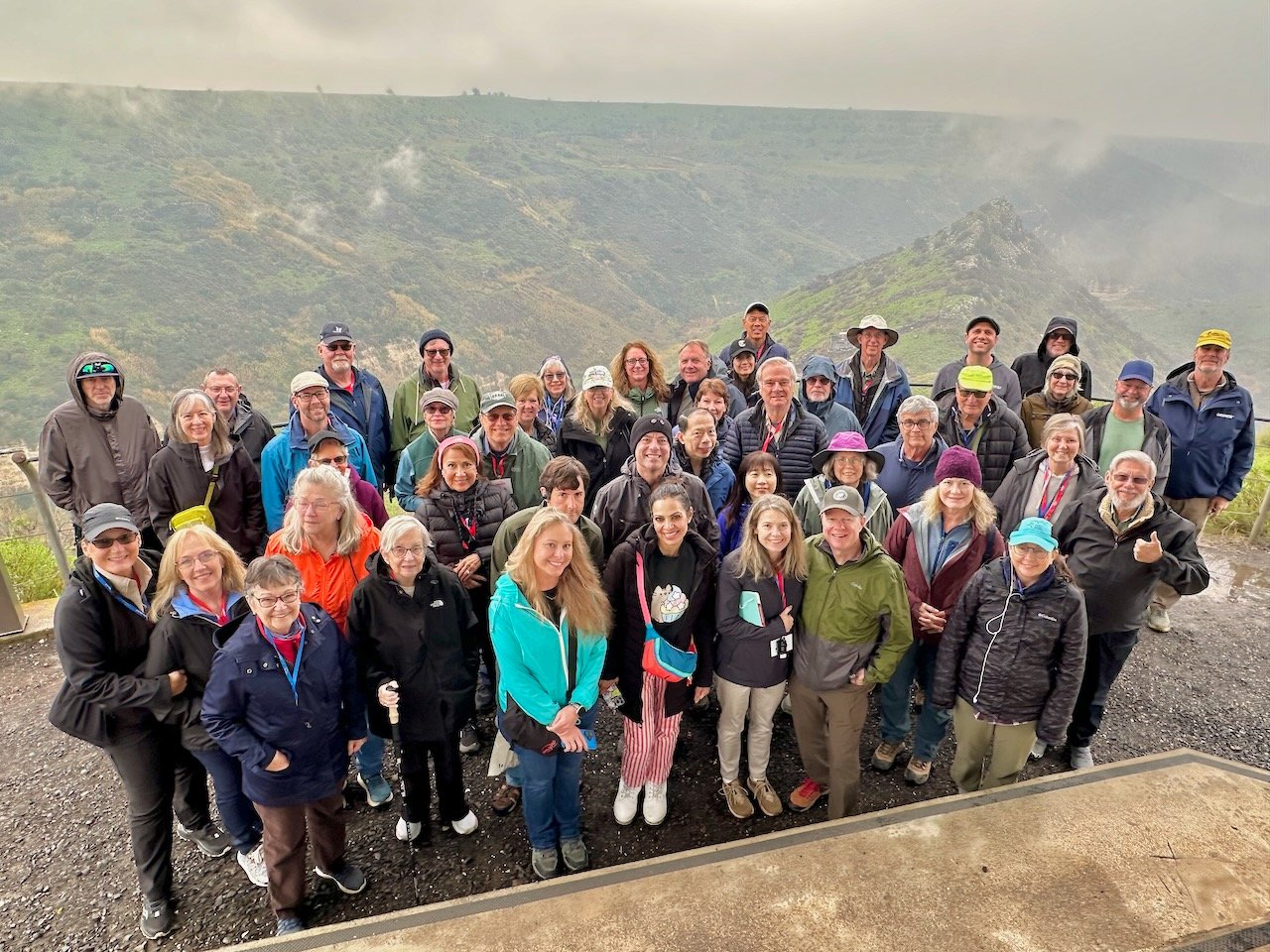
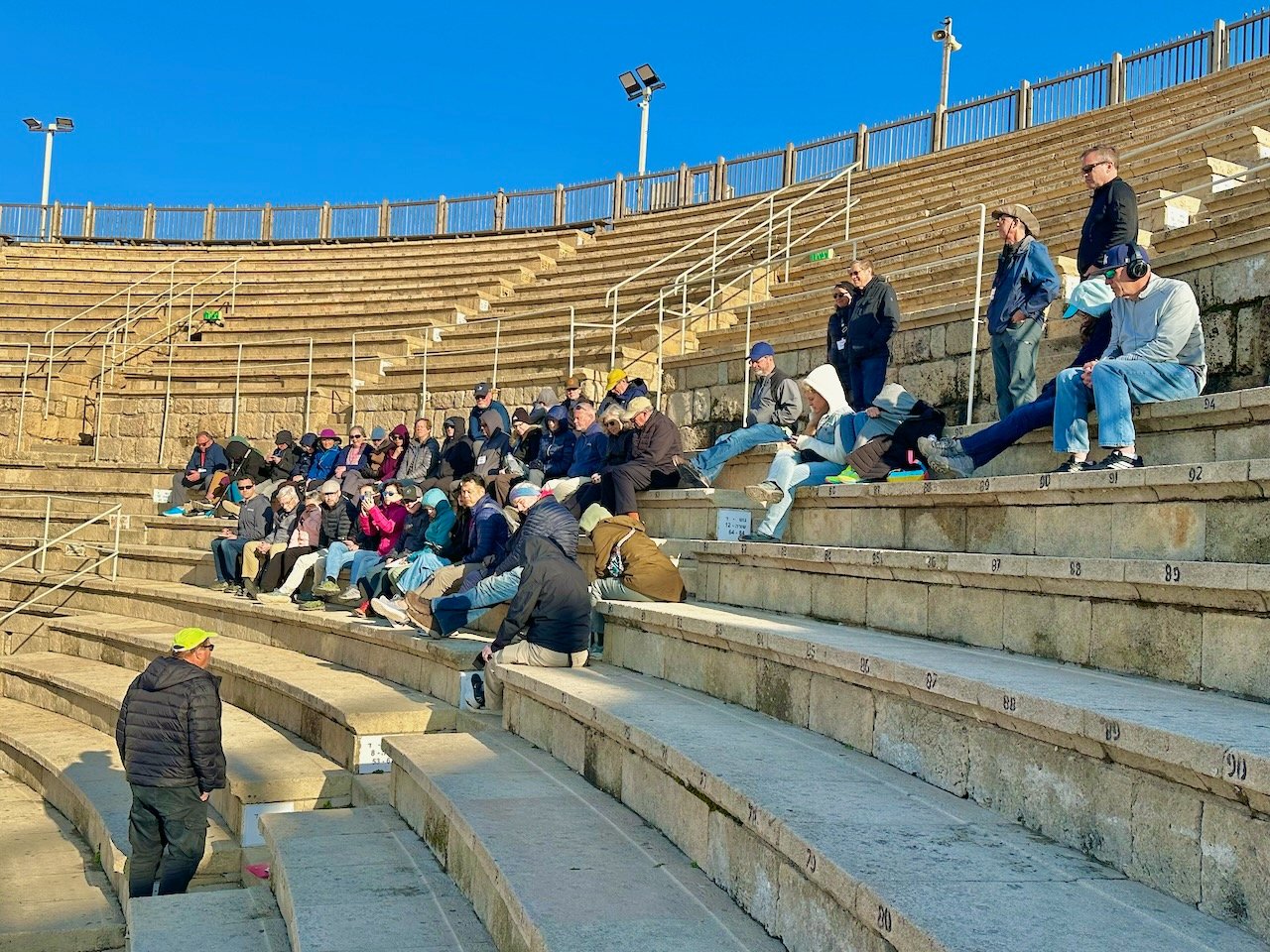
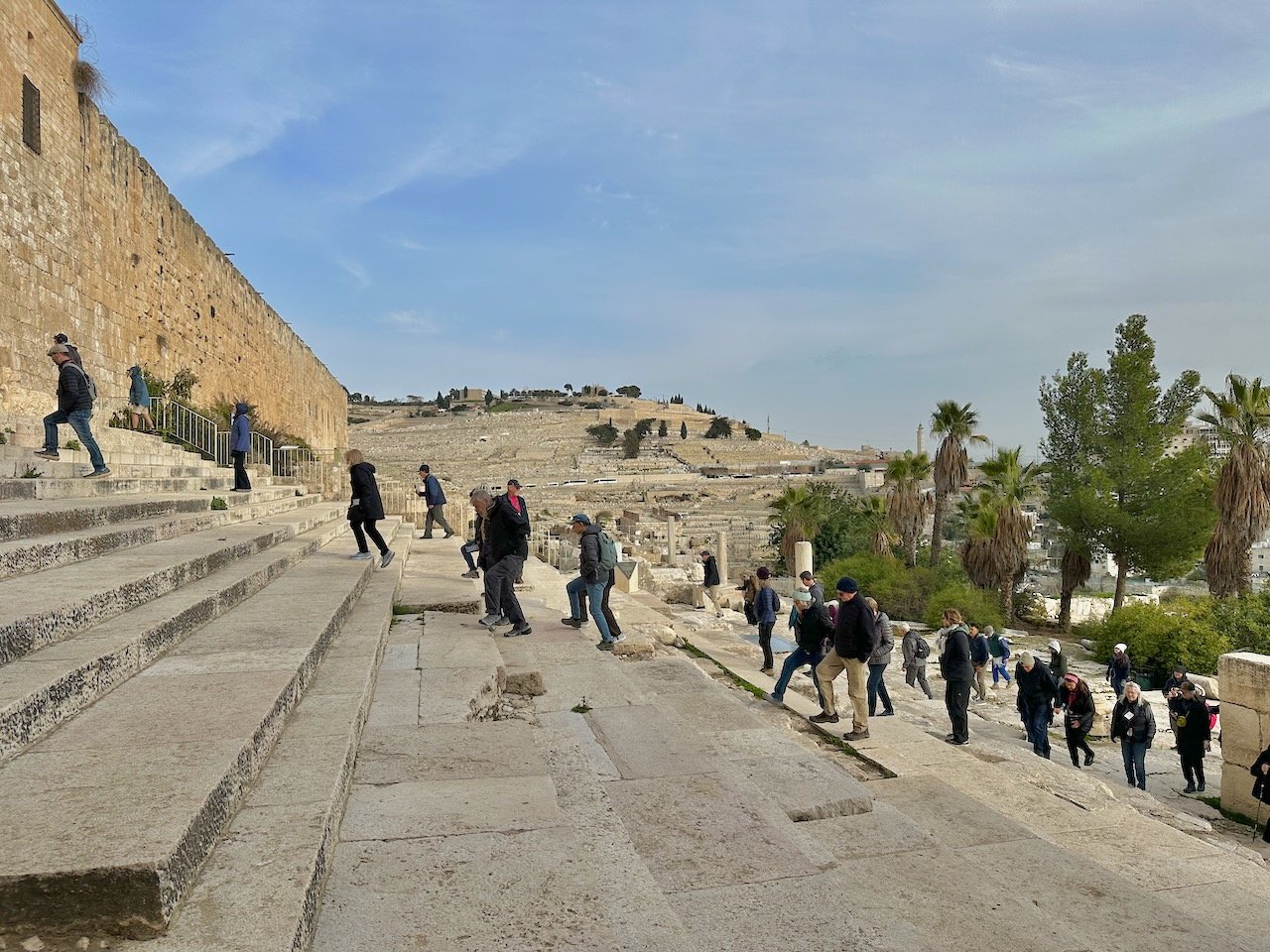
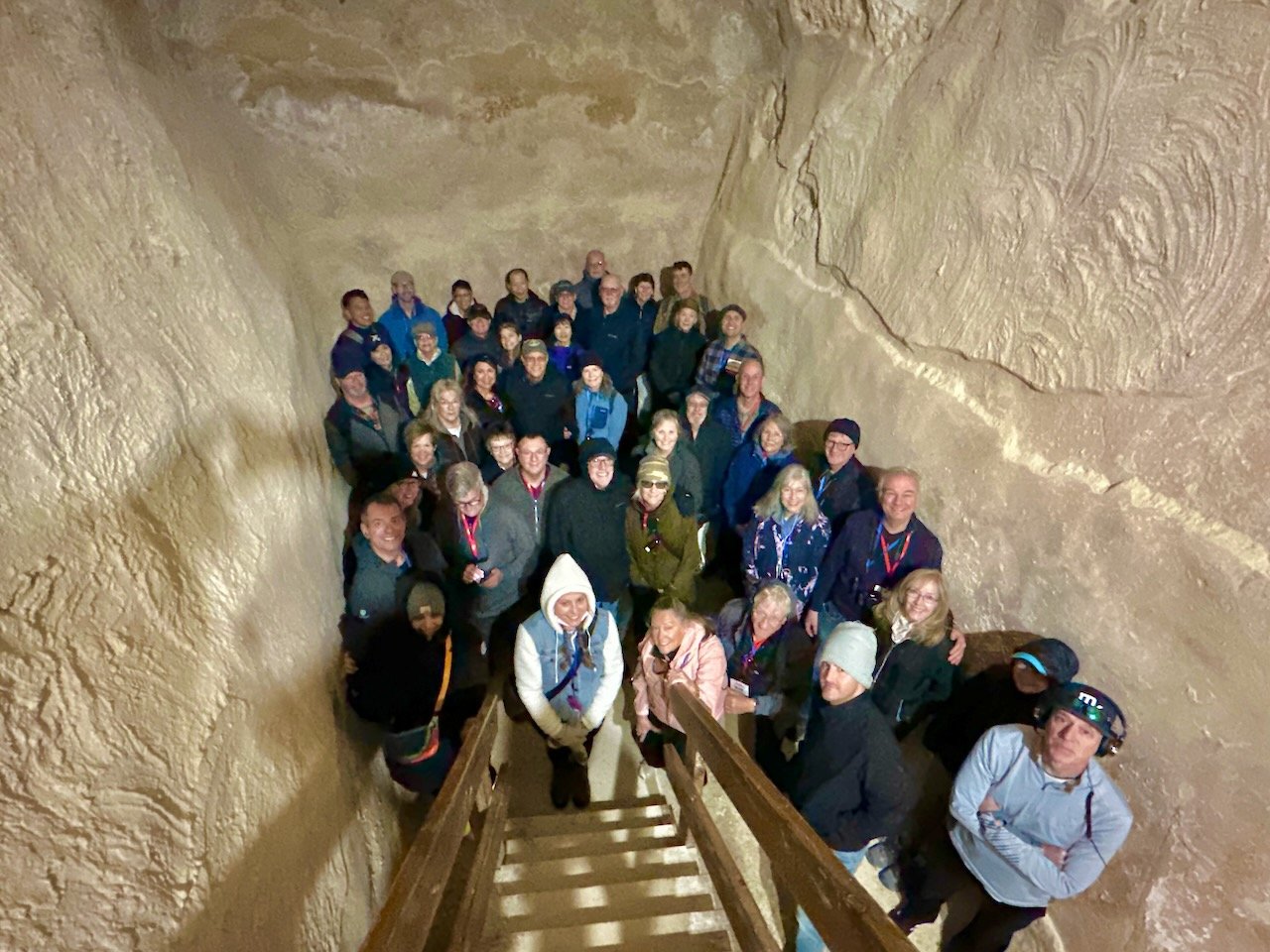
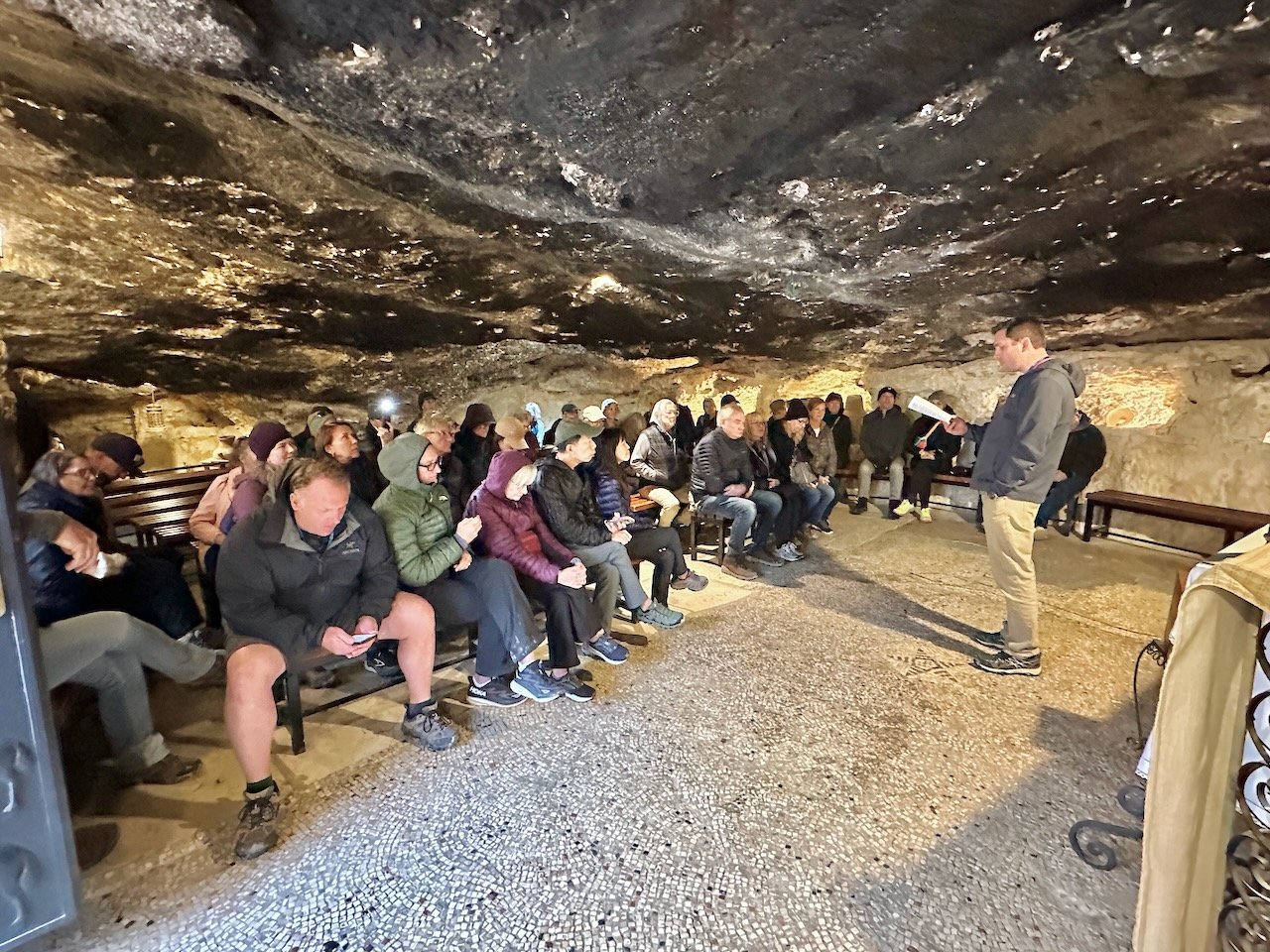
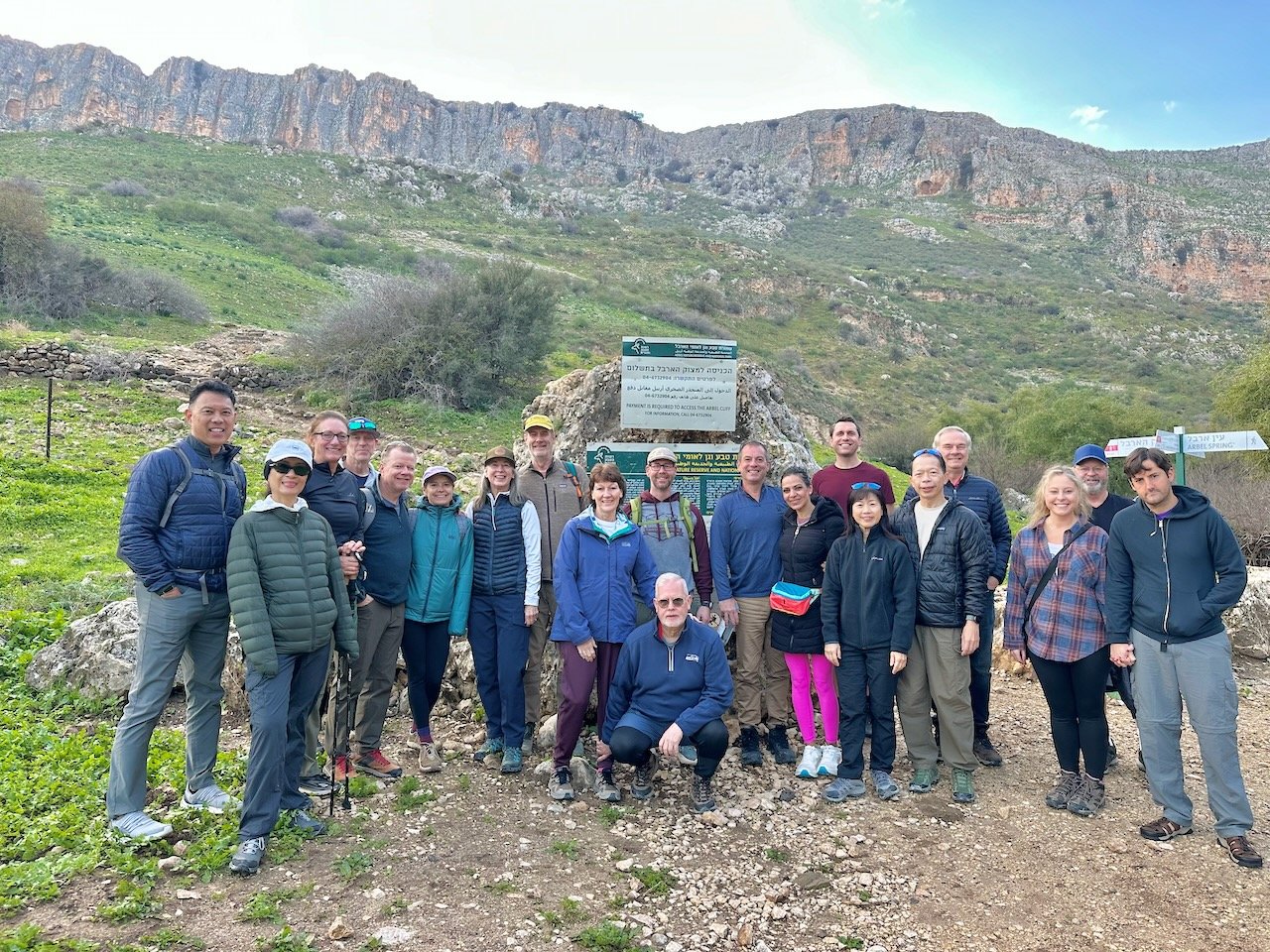
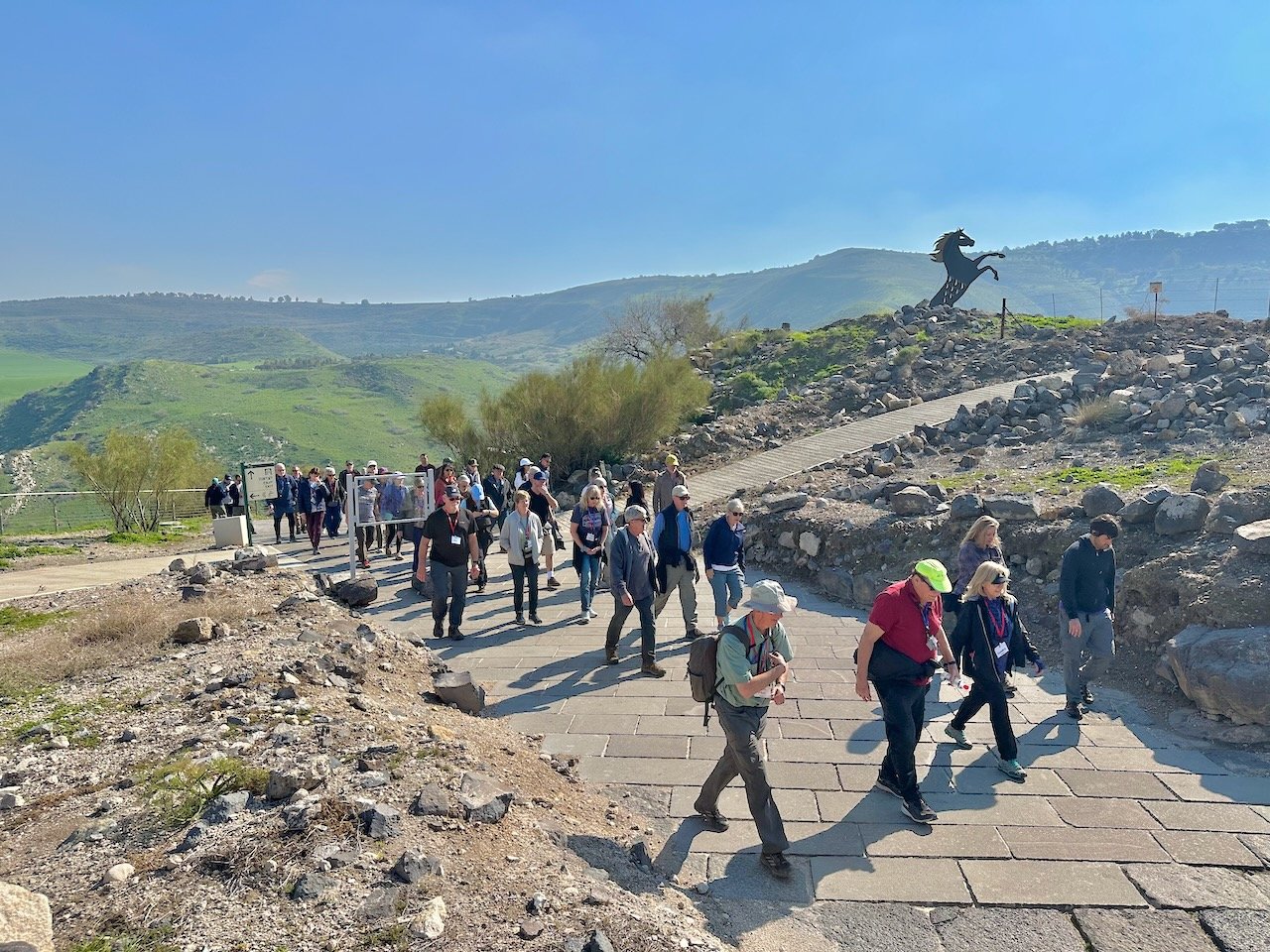
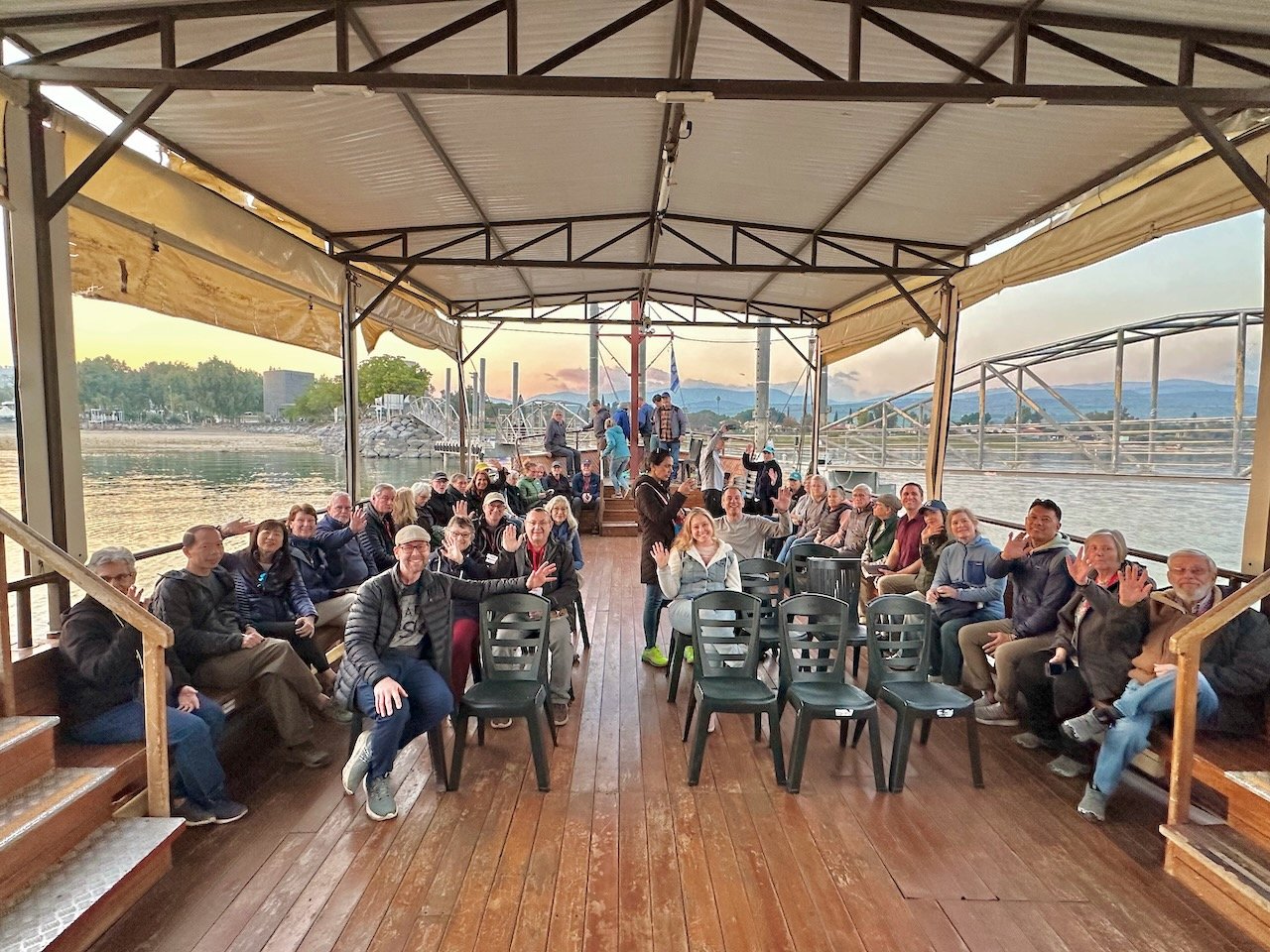
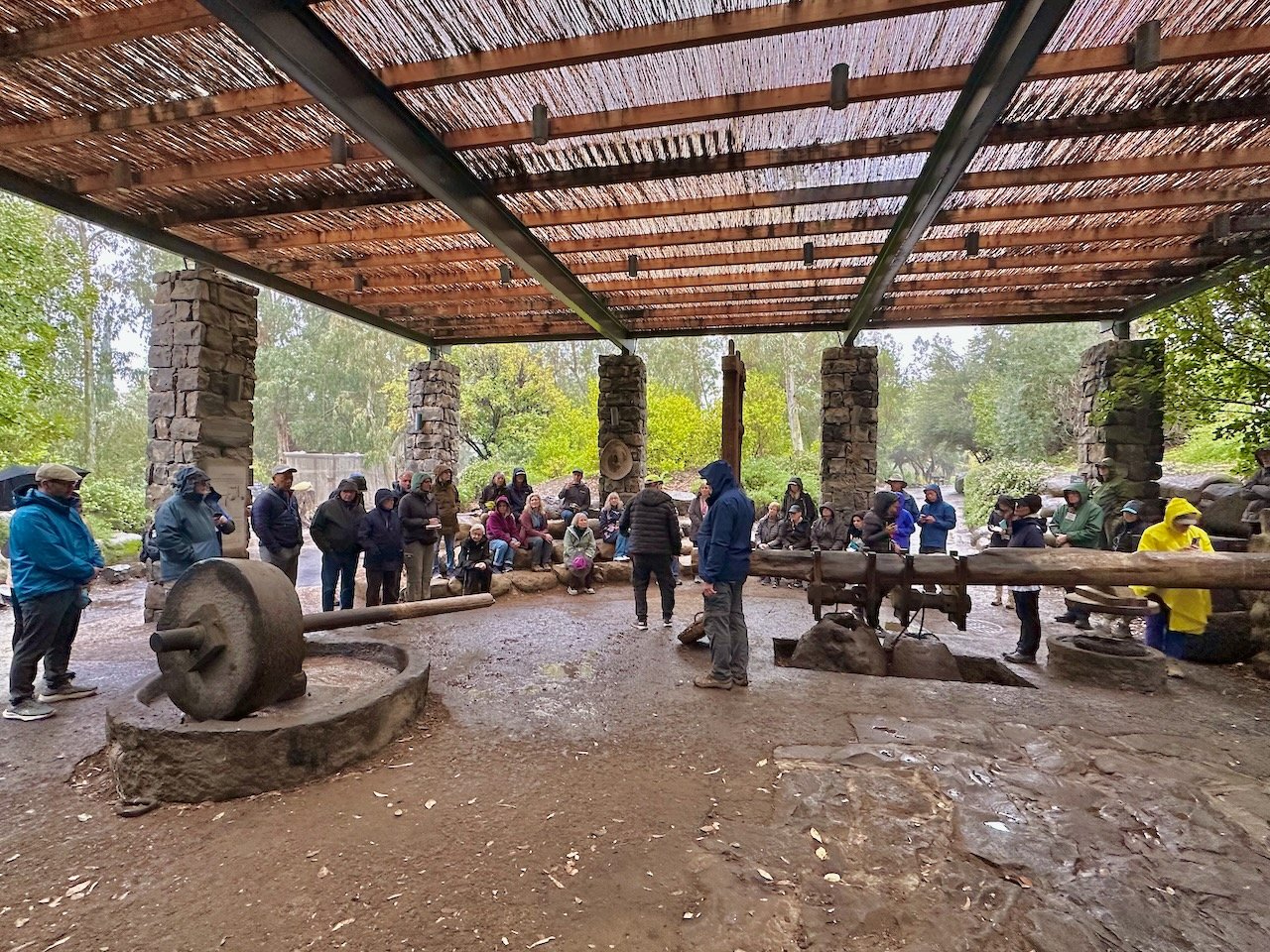
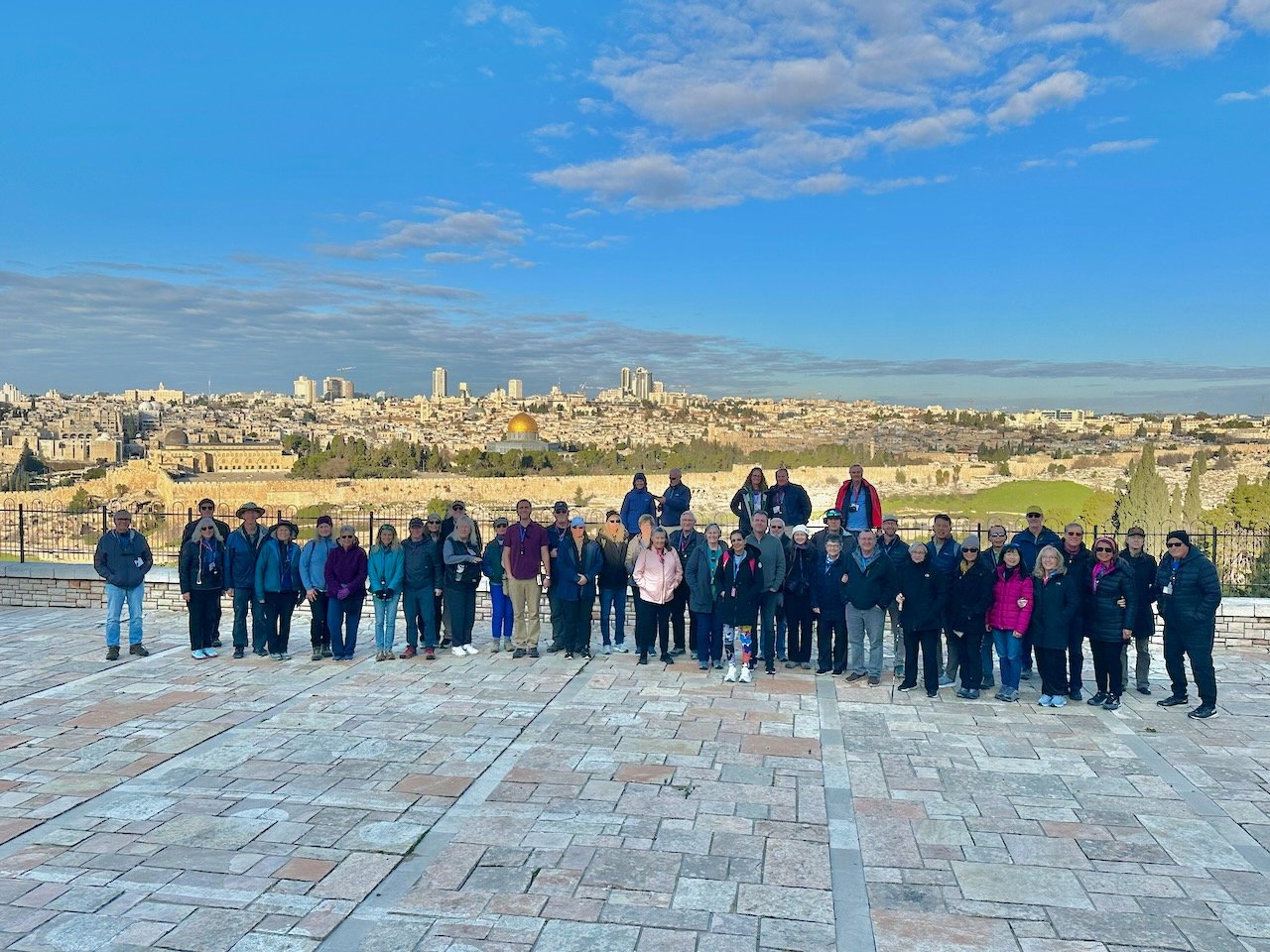
Group Photos
360 Photos
The Israel Tour Experiences:
Days 1 & 2 – Saturday/Sunday, January 10-11: Depart from US, Arrival in Israel, Tel Aviv
The day of departure for our trip finally came. God brought together a total of 48 for this January 2026 Israel trip. The group includes folks from the Canyon Hills Church in Washington as well as others from around the country who signed up under BIMT.
Tel Aviv
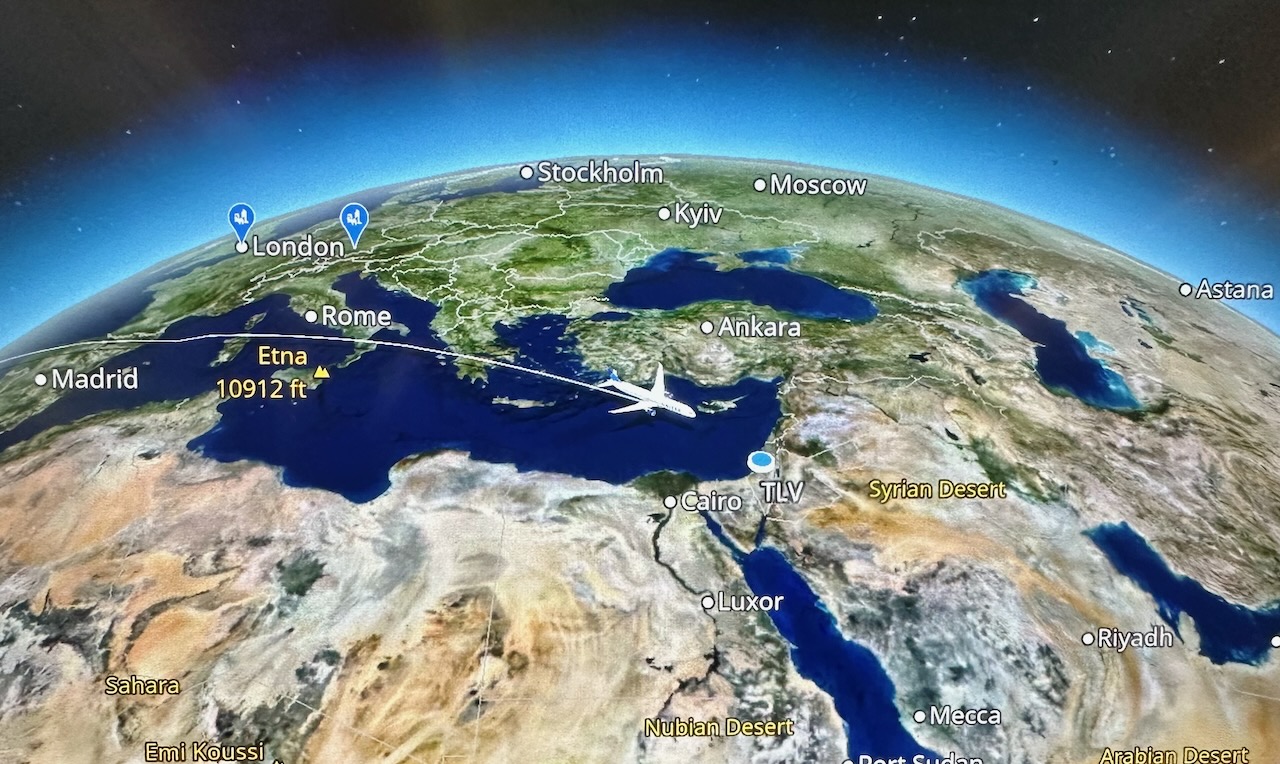
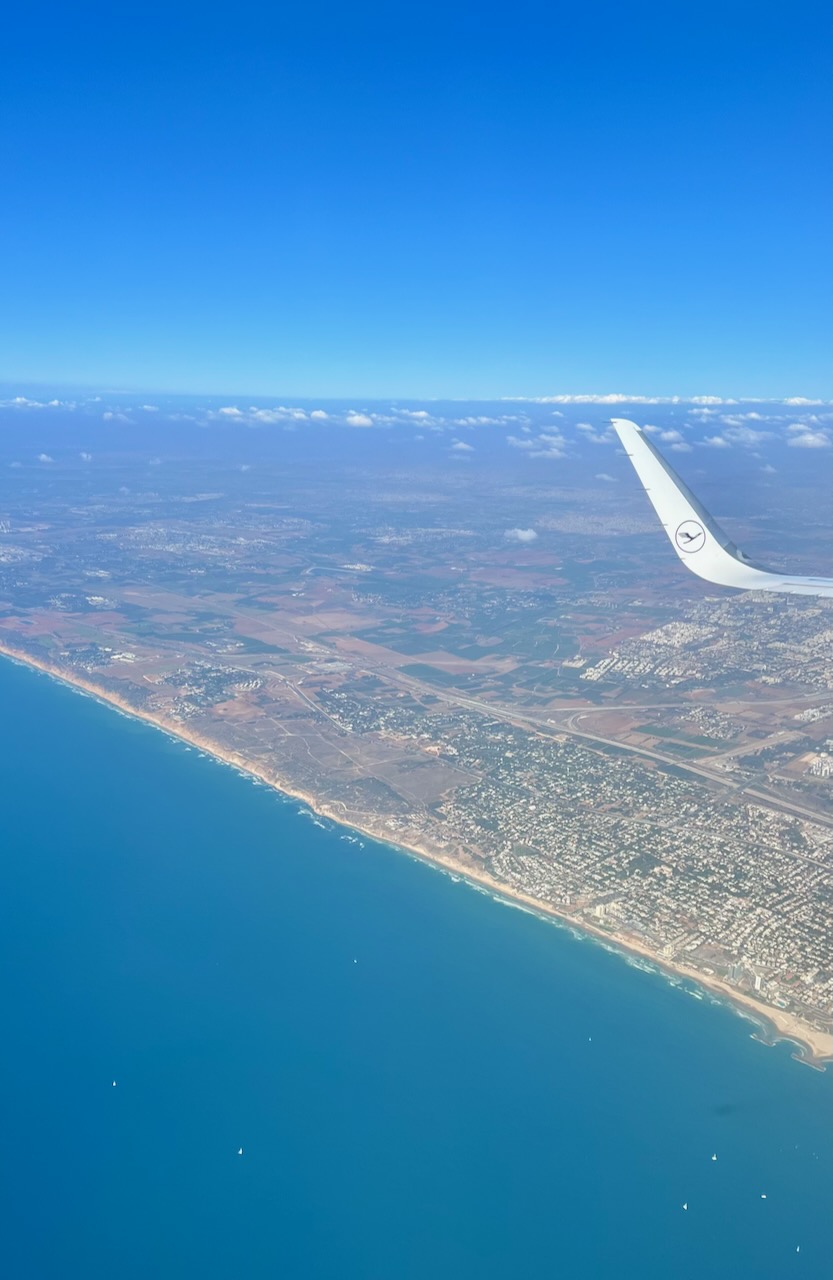
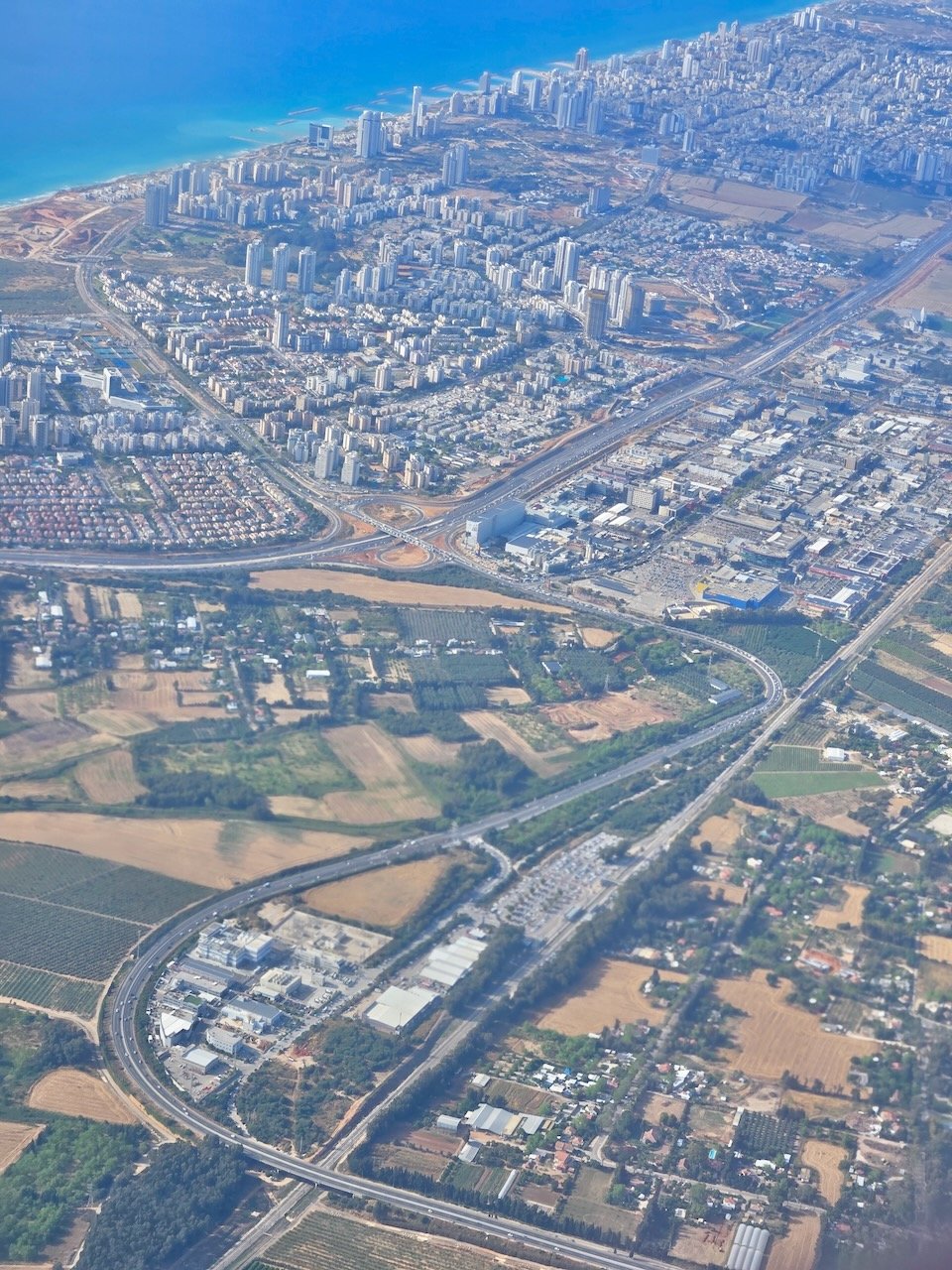
The group used a few various flights and connections, with everyone finally making it to the Ben Gurion Airport in Tel Aviv. Some enjoyed dinner at 7 while those who arrived later had a 9:30 p.m. dinner before retiring for the night.
We are all thankful to God for the safe trip, the on-time flights, and all our luggage that arrived with us! We are all looking forward to our first full day as we cross into Israel tomorrow!



Day 3 – Monday, January 12: Gezer, Beth Shemesh, Azekah, Beit Guvrin, Lachish, Beersheba
Today was the first full day here in Israel. We were greeted by partly sunny skies, with temps in the 50s (with highs in the mid 60s in the afternoon). Following breakfast at 6:30, we loaded the bus at 7:20 and left by 7:35. We read from Joshua 10 as we departed the hotel en route to our first site of the day in the Shephelah (lowlands) of Judah.
Tel Gezer
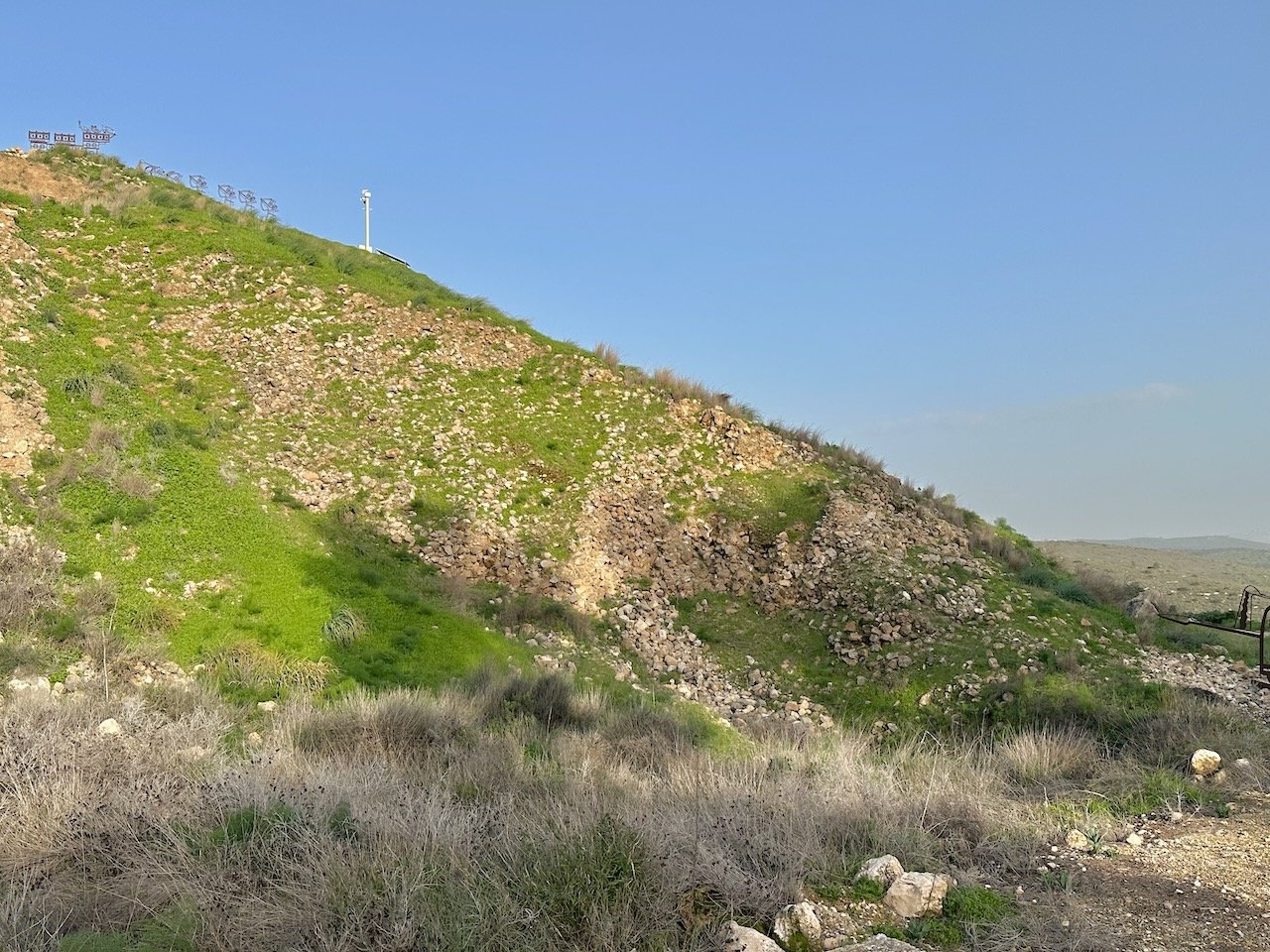
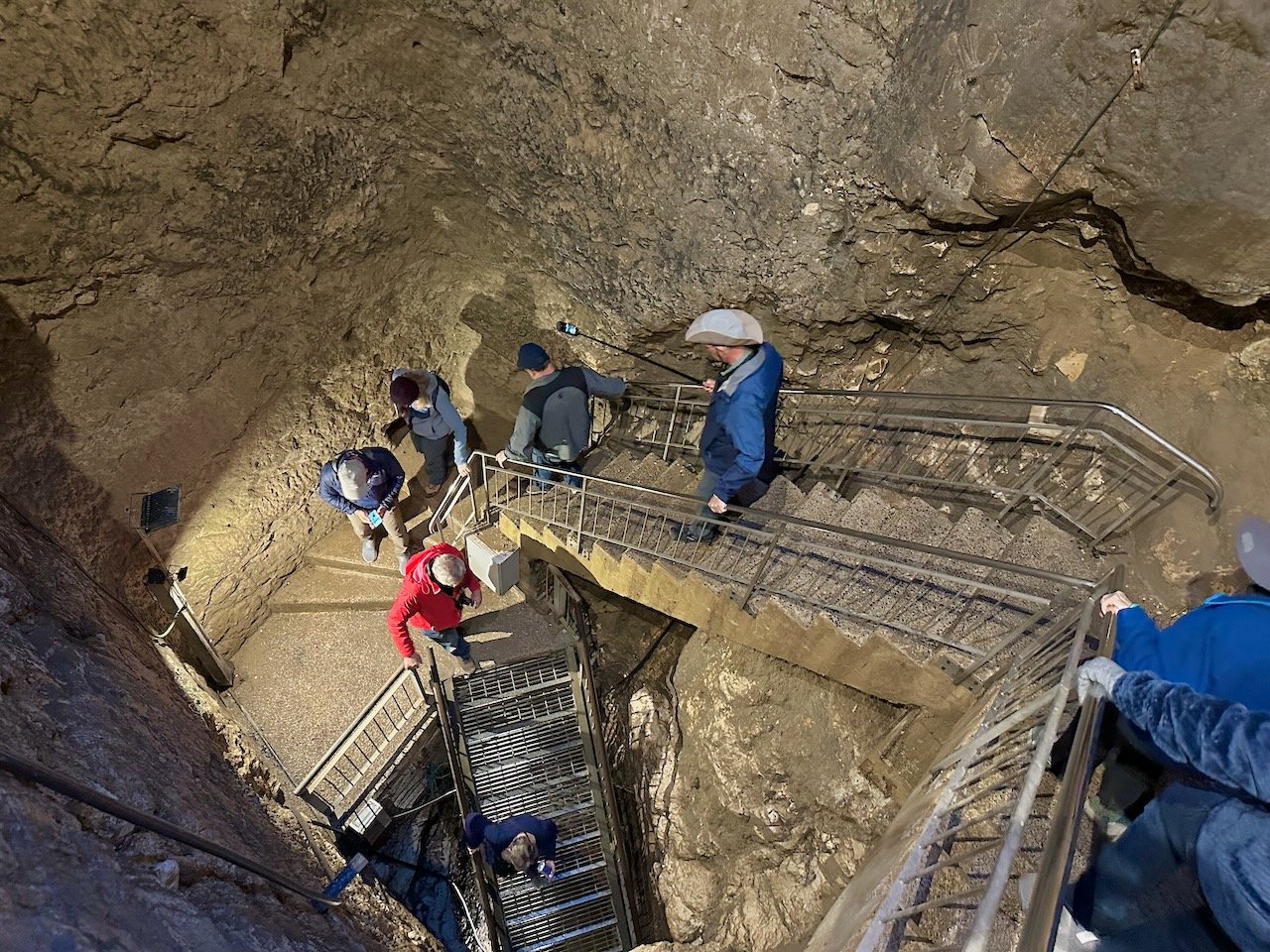
Our first stop was Tel Gezer. This off-the-beaten-path site located along the Aijalon Valley was both a Canaanite and Israelite city, full of walls, towers, and gates. We saw the replica of the “Gezer Calendar.” We also recalled Solomon’s reference to the “seasons of life” from Ecclesiastes 3. From the observation mound we saw the Aijalon Valley mentioned in Joshua 10. Among the Middle Bronze ruins most of us used the steel stairway to see the water system (175 steps down). This water system was originally used by Canaanites (dating to around 1600 BC). We then left these Canaanite ruins and continued to the Israelite (Iron Age) area to see ancient house structures and a chambered gate dating to Solomon (1 Kings 9). Walking back to the bus we saw the Canaanite high place and standing stones.
Beth Shemesh
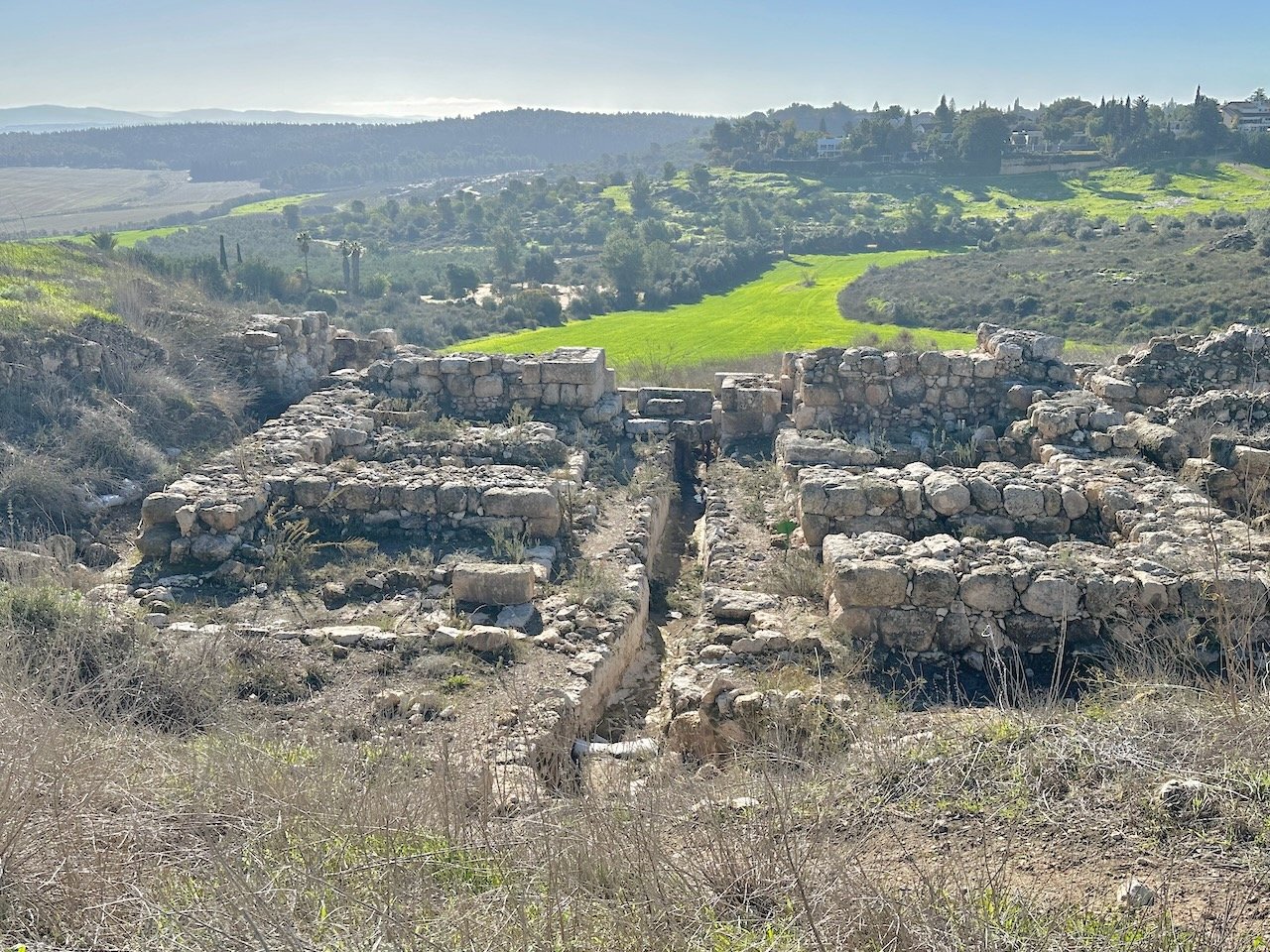
From here we continued south to visit the site of Beth Shemesh. Located along the Sorek Valley, Beth Shemesh was a prominent Israelite town known for their many water cisterns. Across the valley is Zorah, the hometown of Samson. Further west down the valley was the Philistine city of Timnah where Samson’s first wife was from (only 4 miles away). We also read the narrative of 1 Samuel 6 about the Ark of the Covenant being returned to Israel by the Philistines living in Ekron. We could see the story unfold right before our very eyes! We also referred to the story of 2 Kings 14 about Amaziah and Jehoash battling here.
Tel Azekah
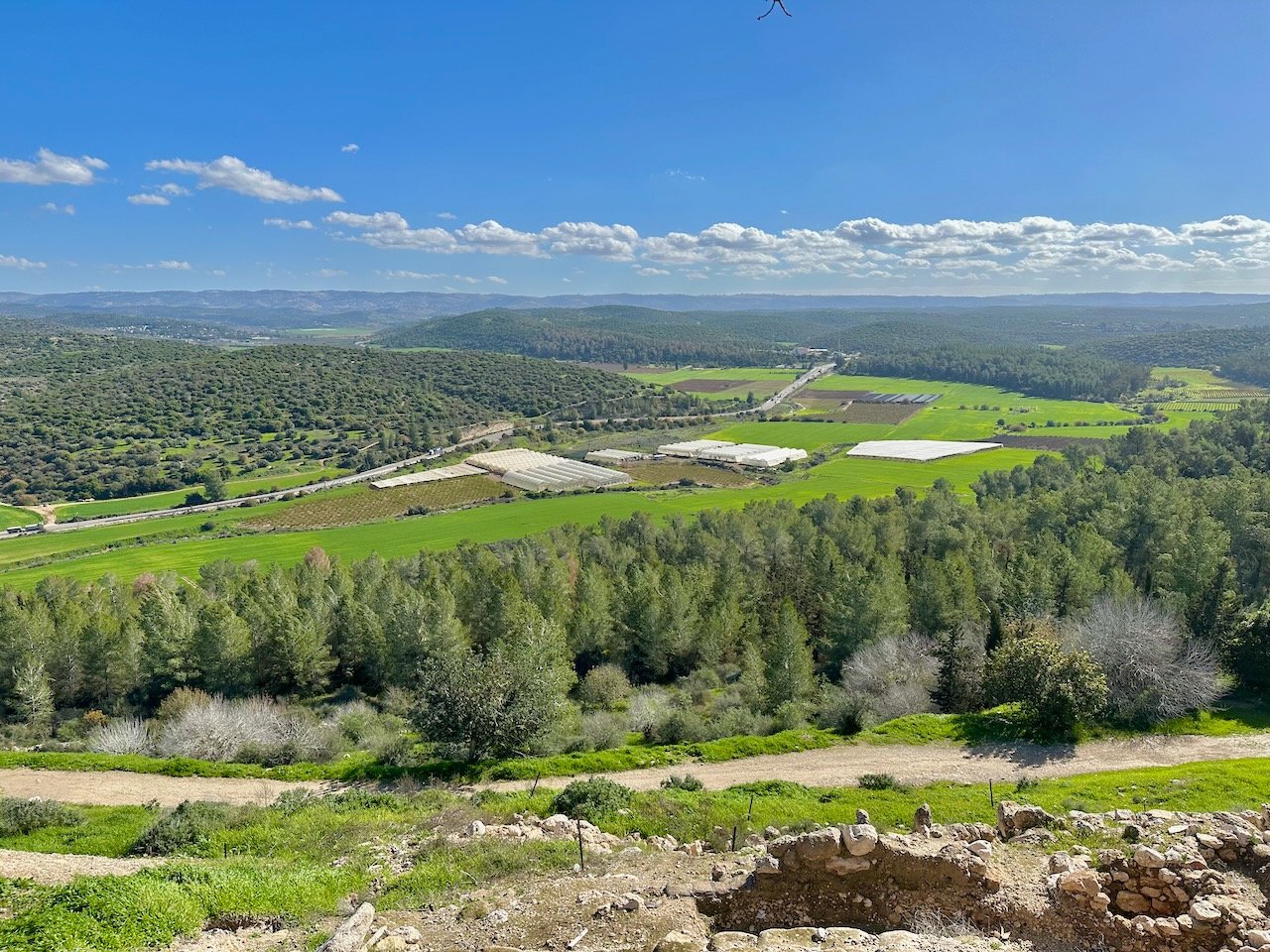
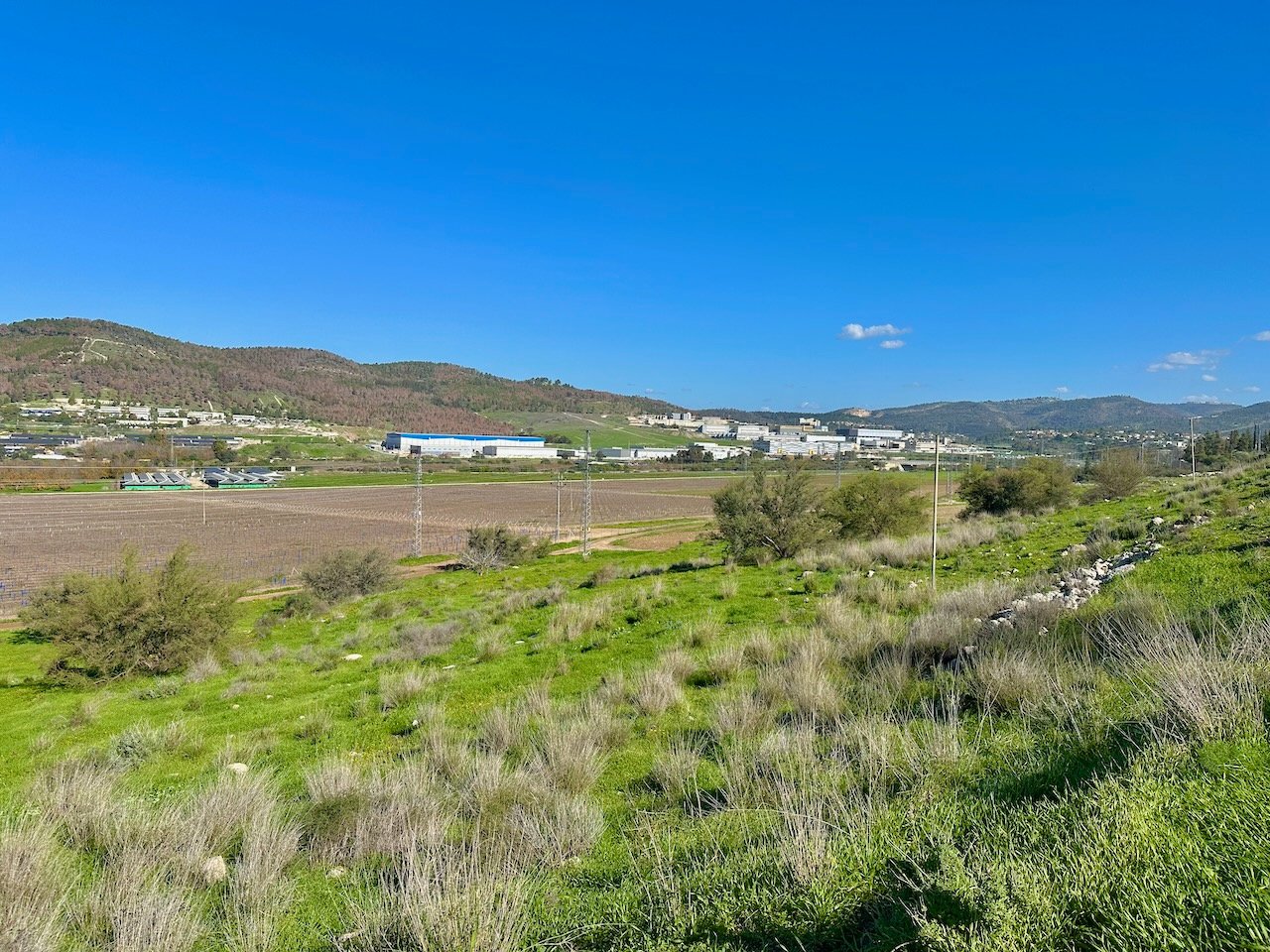
Continuing south, we climbed the site of Azekah. On the drive to the top, we could see biblical Gath (the hometown of Goliath) to the west only about 5-6 miles away. This ancient city that has been excavated in recent years is located along the Elah Valley. Azekah is mentioned in the story of 1 Samuel 17 (the Philistines camped on the ride between Azekah and Socoh further east. It was in the narrow part of the valley (“gai”) where David battled Goliath. David faced the battle with this giant in the confidence of the Lord!
Beit Guvrin
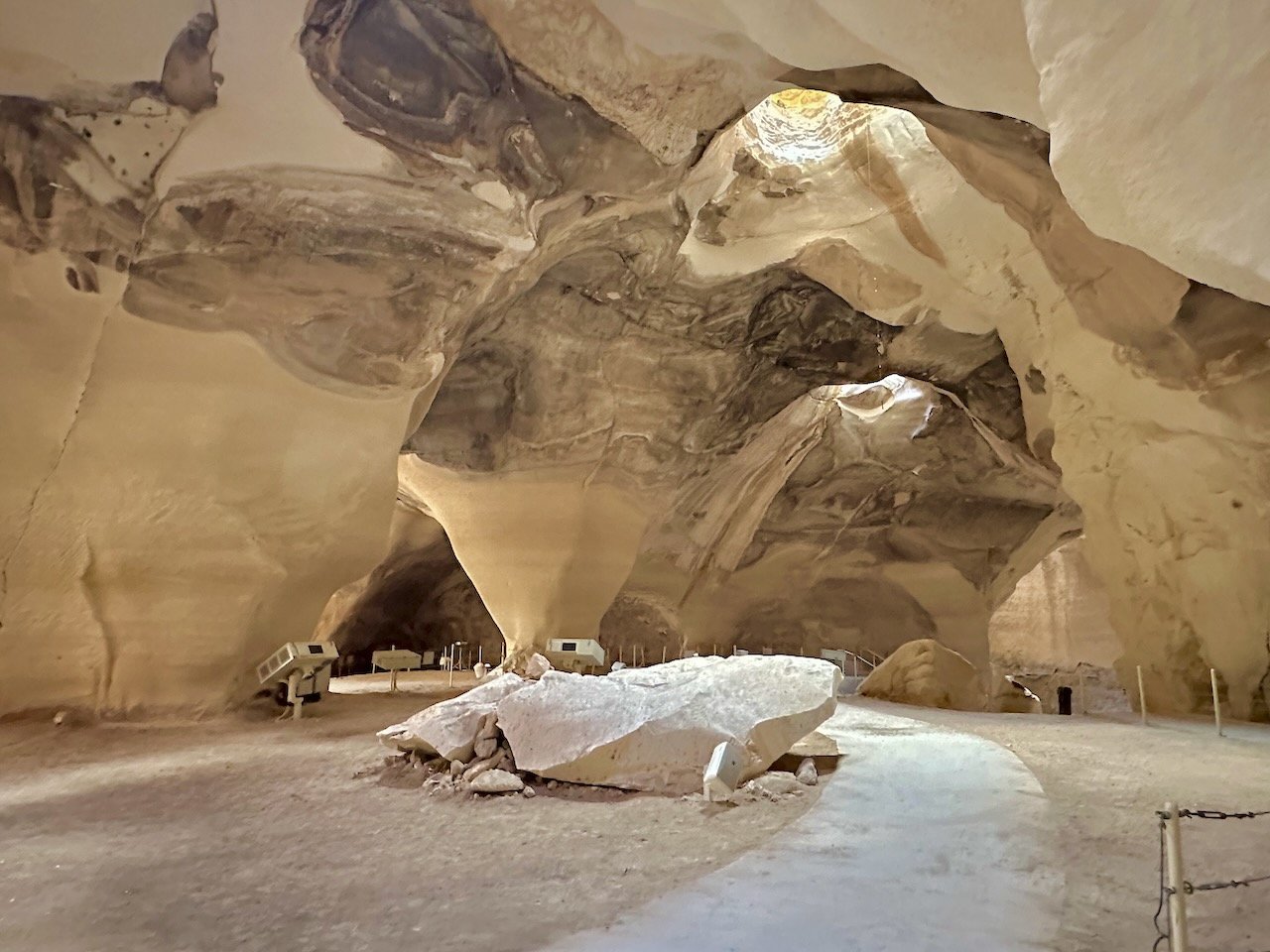
While we enjoyed our own “bag lunch” on the bus, we continued our drive south to the site of Beit Guvrin. In the days of the Old Testament, the site was called Mareshah. It was the home of Micah, the prophet. Together we walked to one of literally 1000s of caves carved out of the soft limestone of this area. This large caved, called the “Bell Cave” was so interesting to see. Shlomo sang a song for us, after which we read portions of Micah 1 and 5. We then joined our voices and sang a few worship songs ourselves.
Lachish
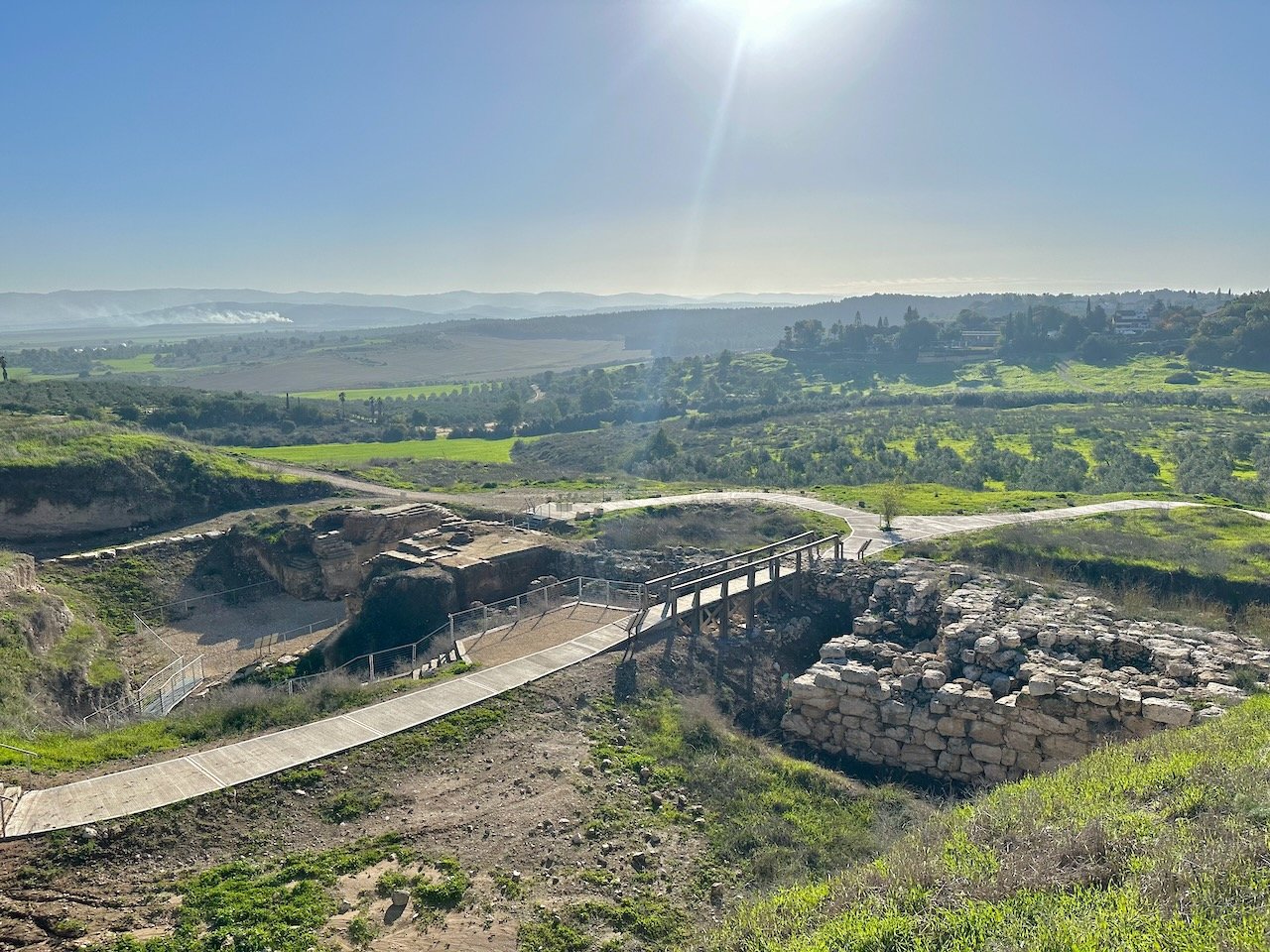
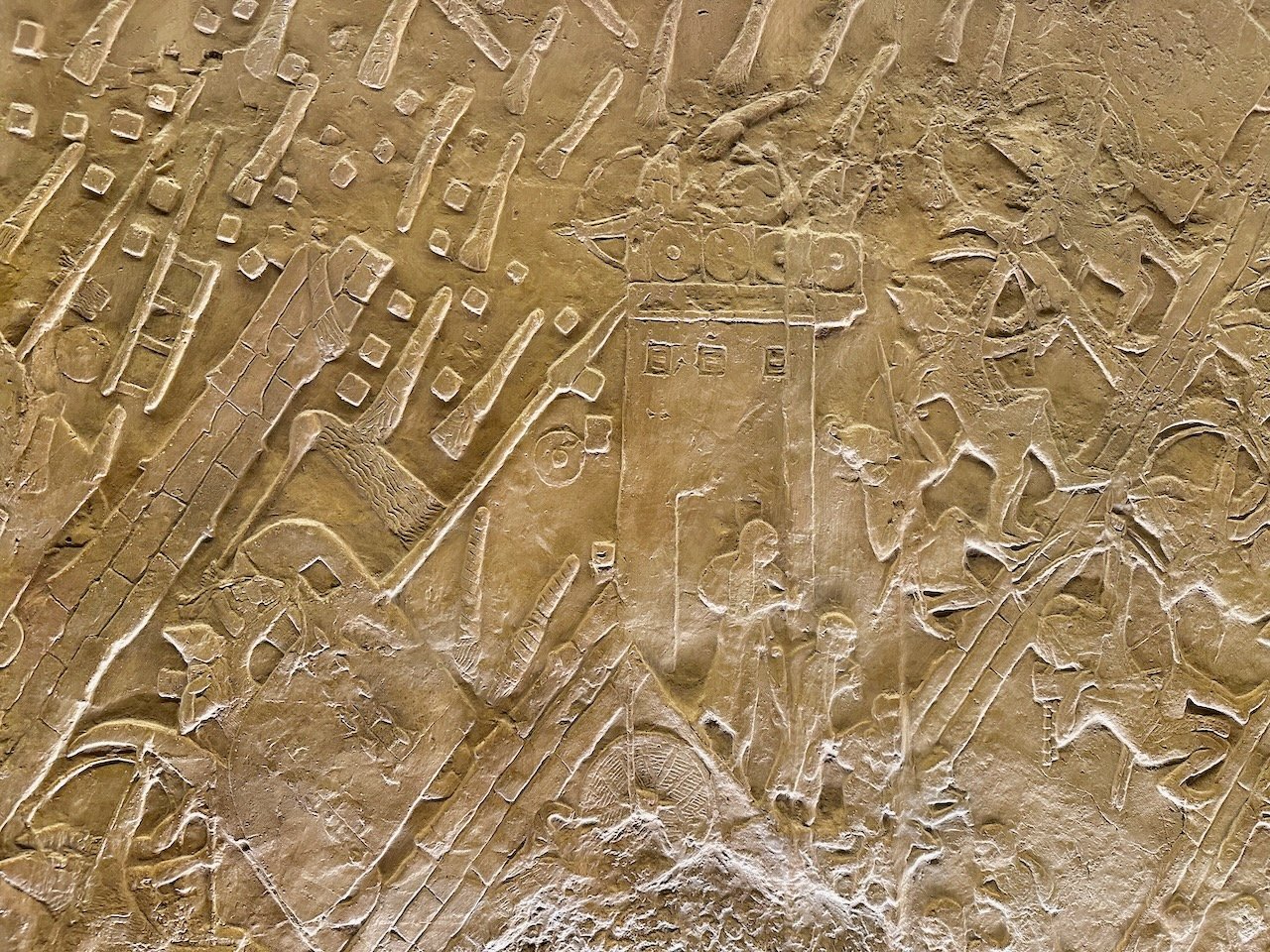
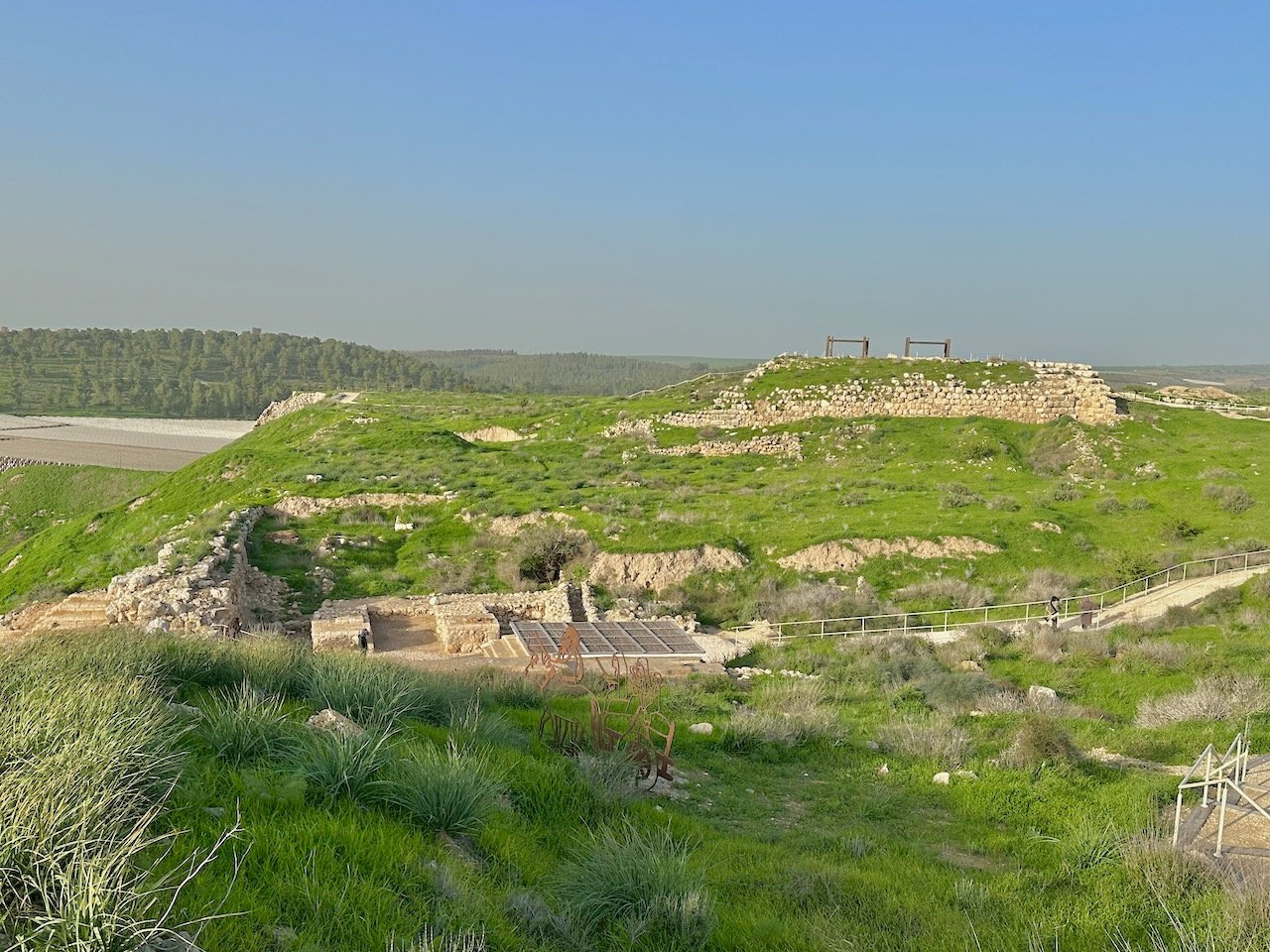
Our last site of the day was Lachish. When we arrived, we first saw a 15 minute movie in the newly-constructed (from last year) about the siege of Lachish by the Assyrians. From here we climbed the site.
Lachish was first a Canaanite city taken by Joshua in two days (Joshua 10). Later, it became an important well-fortified city under the leadership of Rehoboam (2 Chronicles 11). The Judean city saw two destructions, one at the hands of the Assyrians in 701 BC (2 Kings 20, Isaiah 36), and later by the Babylonians in 587 BC. We saw a replica of the Lachish Letter #4, one of about 18-20 ostraca (pottery with inscriptions). It mentions Azekah and Lachish as two Judean cities holding out. Jeremiah 34:7 says the same thing. Among the ruins we saw the double walls and gates (including the inner chamber gate where there was a “cultic – high place”), the Assyrian siege ramp, and the palace.
Beersheba
From Lachish we drove about 55 minutes to Beersheba where we checked in to our hotel about 4:30. We enjoyed dinner together, followed by a brief gathering to prepare for the next two days. It was a great first day!
Day 4 – Tuesday January 13: Beersheba, Sde Boker, Wilderness of Zin, Arad, Judean Desert
Today was our second full day as we explored the region of the Negev. After a good night’s rest in Beersheba and breakfast, we checked out of our hotel and began our day at about 7:35. We read from Psalm 126 (about the “watercourses of the Negev”) to begin the day. The weather was nice and partly sunny n the morning, but very very windy. In the afternoon the rains from the western coast reached this region, with occasional sheets of rain, and wind gusts as high as about 60 mph! Very unique for this area!
Tel Beersheba
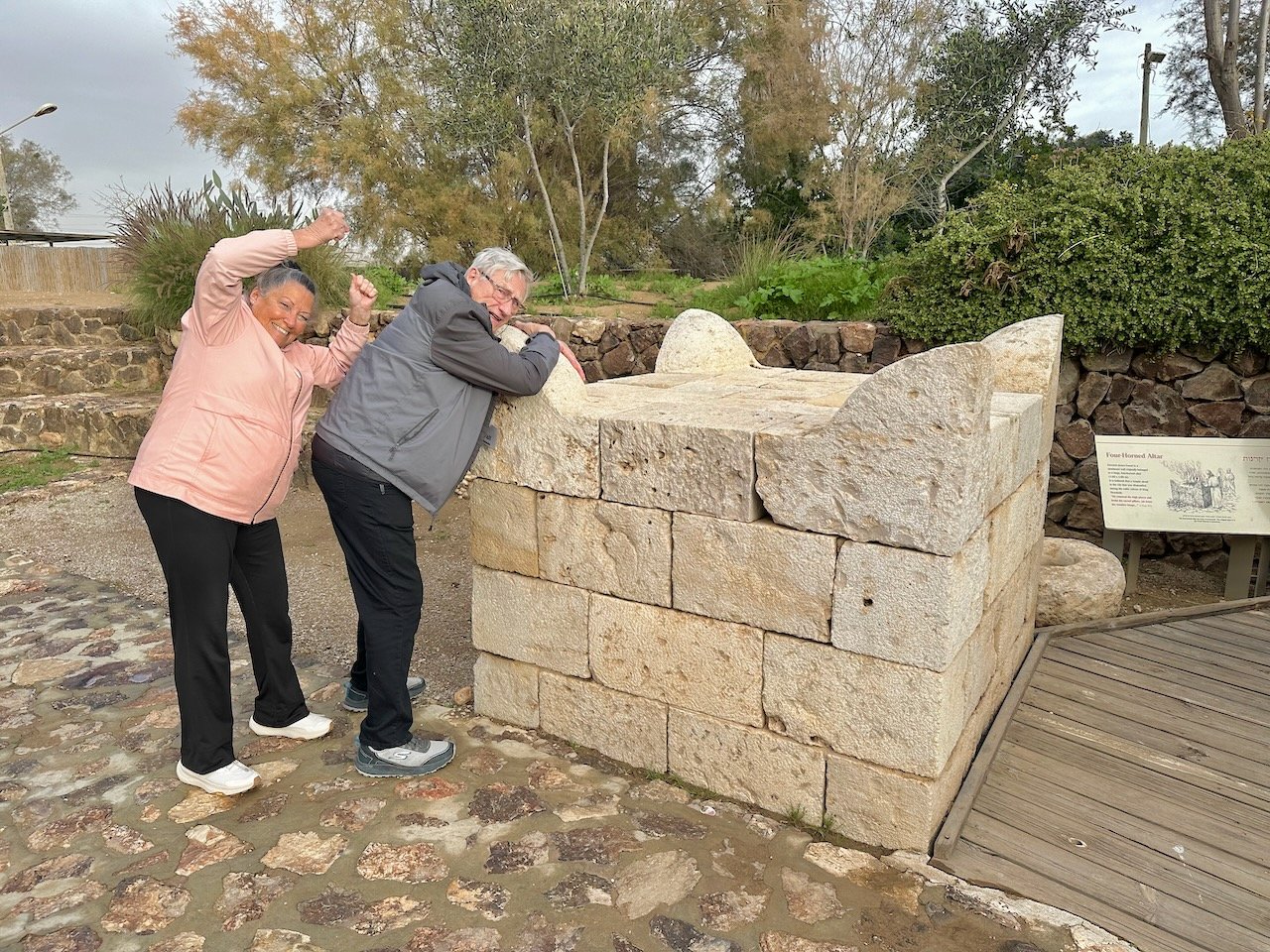
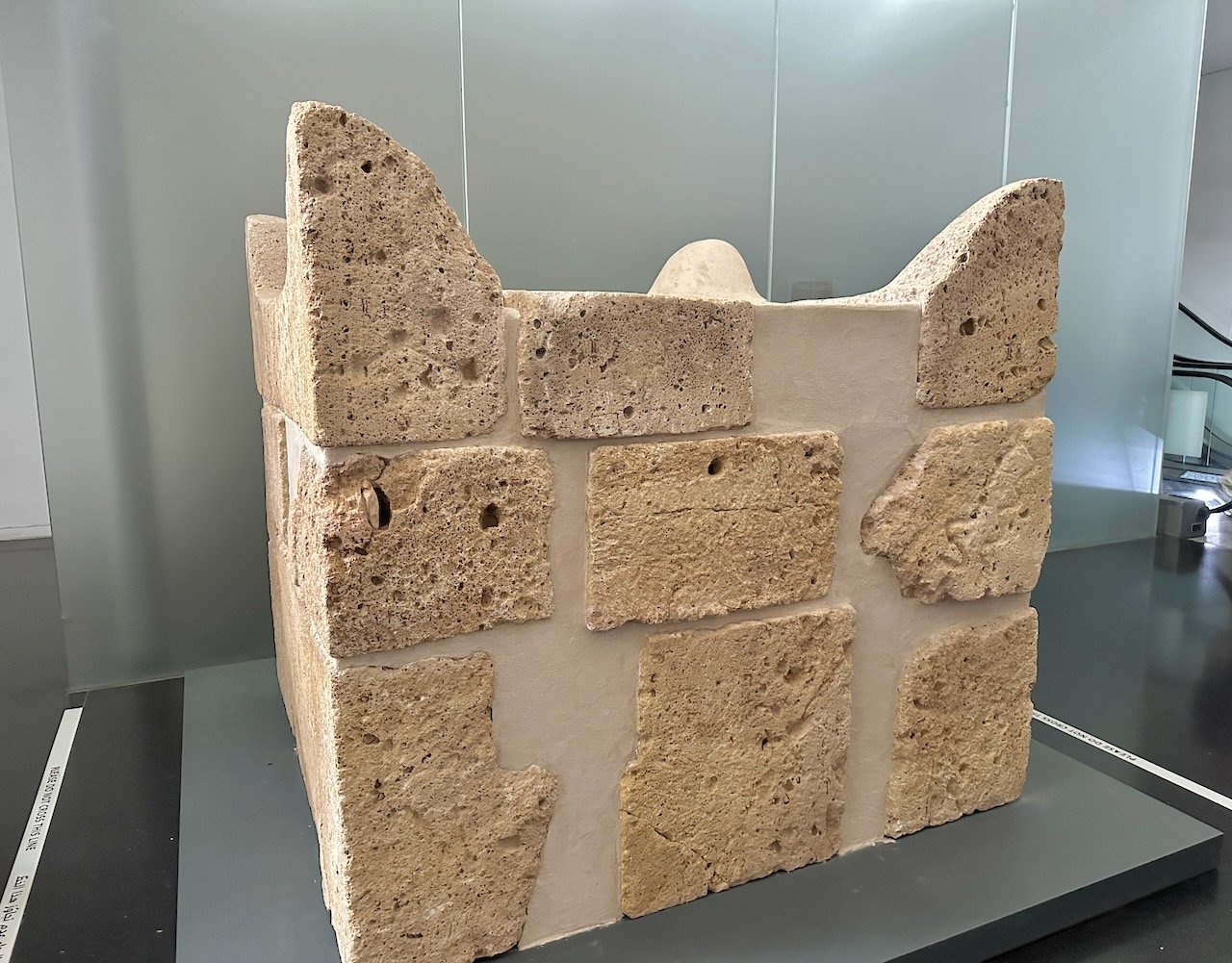
We arrived at Tel Beersheba at 7:50 a.m. This is a small but interesting archaeological site. We saw a replica of a 4-horned altar found, the city well, walls, gates, and a few Israelite “four-room houses. We read from Genesis 21 about Abraham. Isaac (Gen. 26), Jacob (Gen. 46), and Elijah (1 Kings 19) who were all here as well. We left the site by walking through the impressive cistern water system. The engineering of this was fascinating!
Sde Boker / Gravesite of David & Paula Ben Gurion, Zin Desert
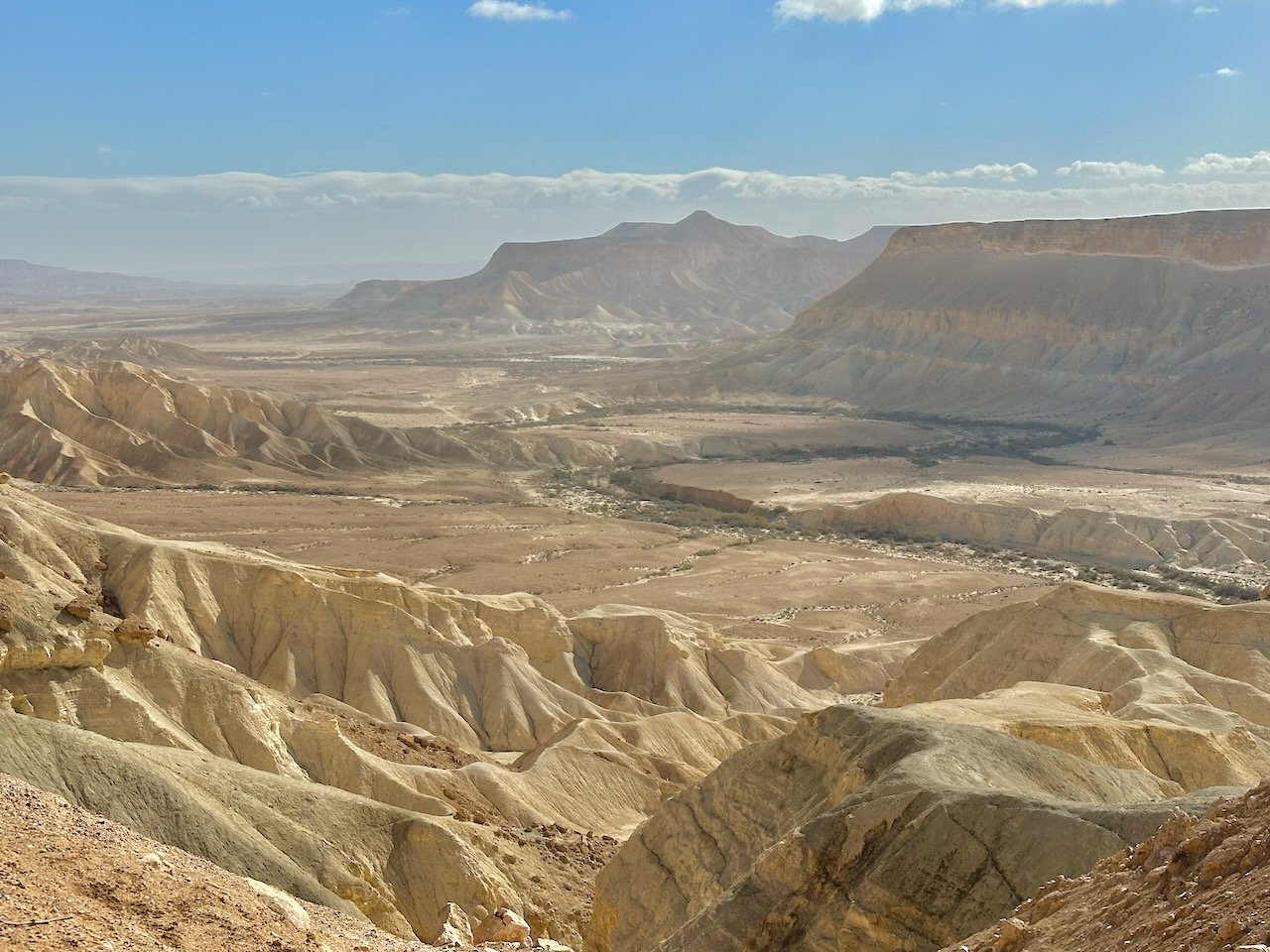
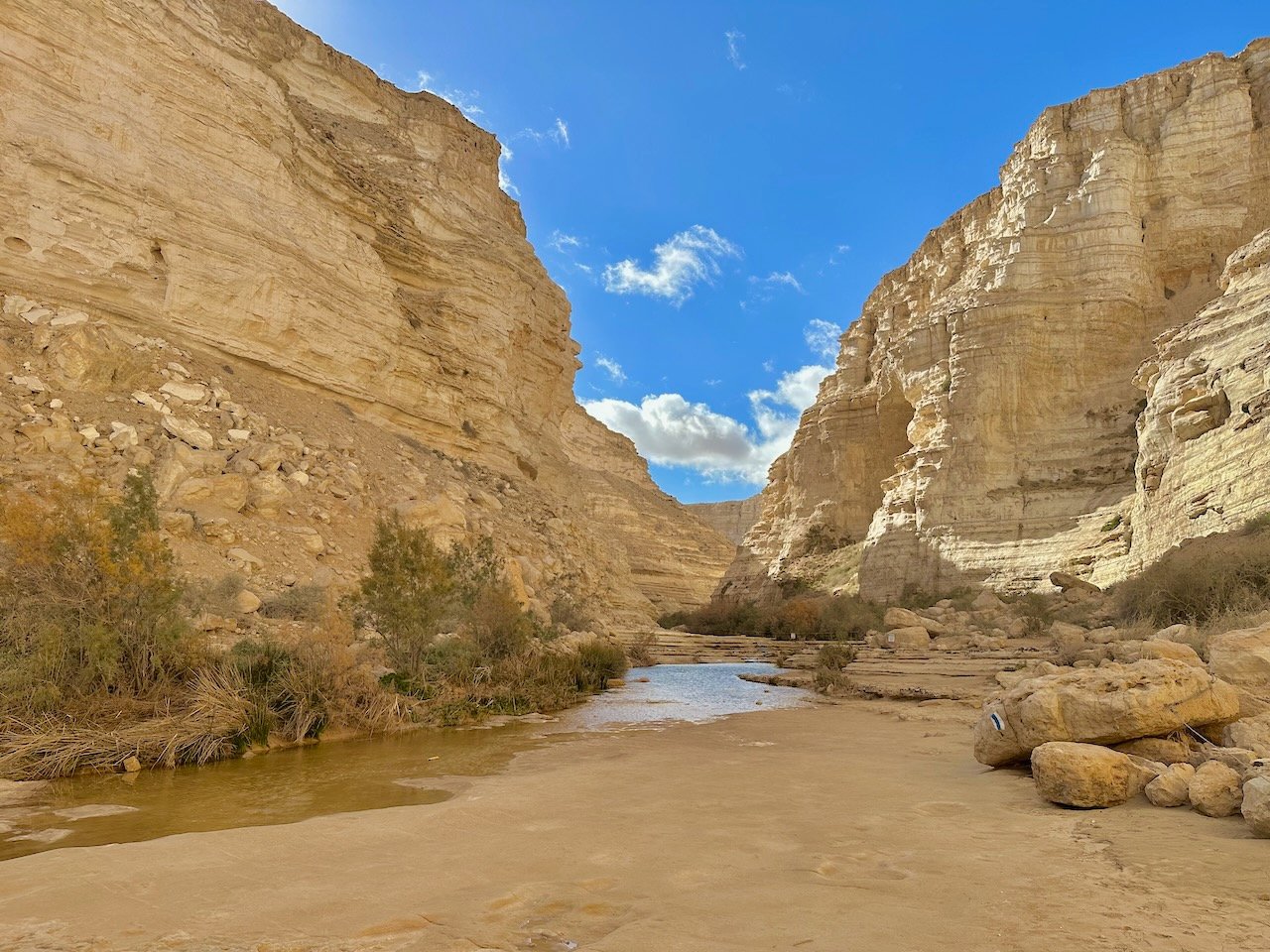
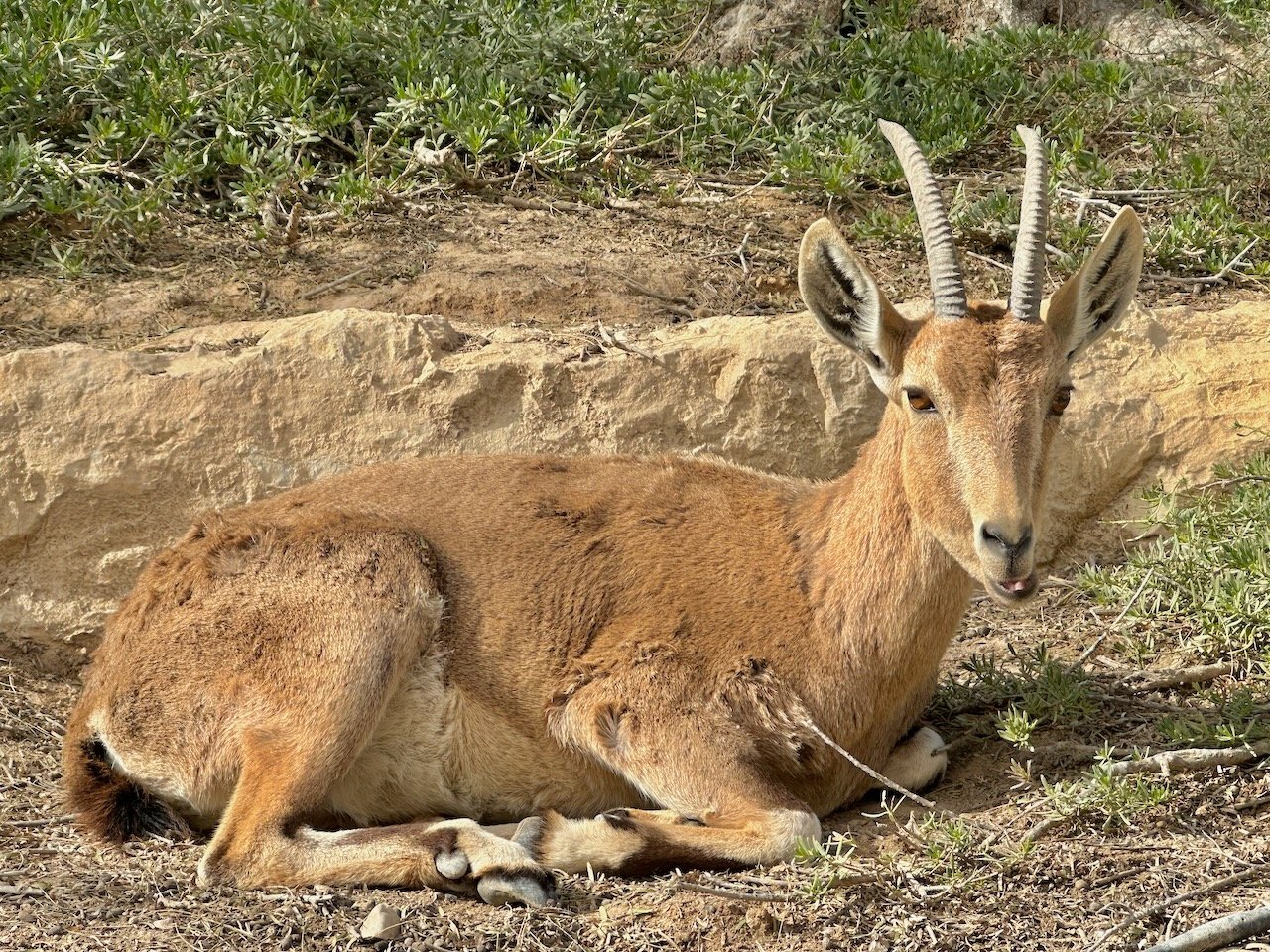
Next, we drove about 50 minutes south to the Zin Desert. The small community of Sde Boker overlooks the beautiful canyon of the Zin. This is where the graves of David Ben Gurion (Israel’s first Prime Minister) are located. His wife Paula is also buried here. We saw a number of ibex here (referred to in Psalm 104). From here we drove down into the Zin canyon for a hike to the water falls and back. Many in the group continued the hike, ascending to the far rim. The 12 spies came through the Zin Desert (Numbers 13) and Moses struck the rock somewhere here as well (Numbers 20). The weather was still partly sunny, but with higher winds.
Tel Arad
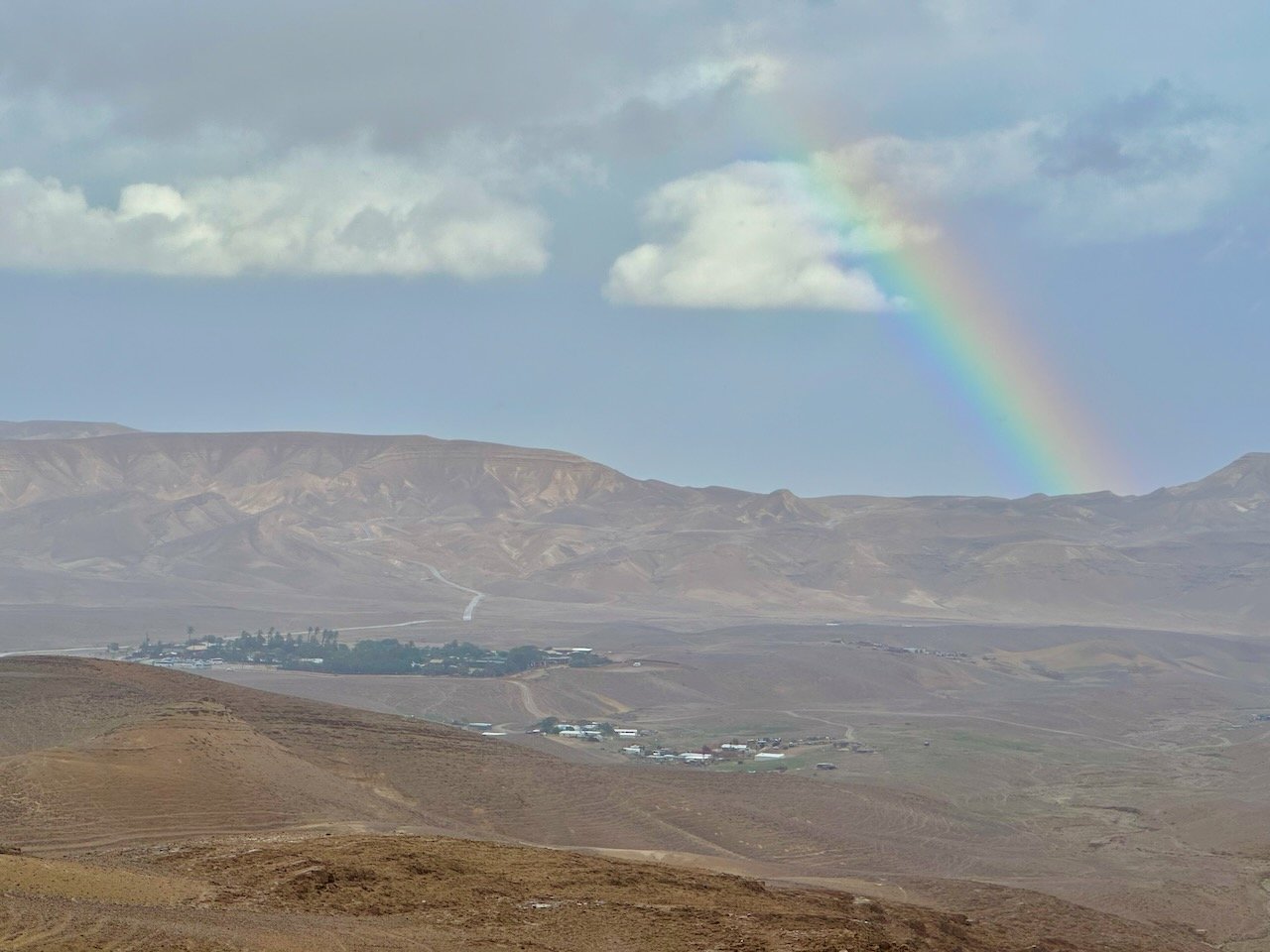
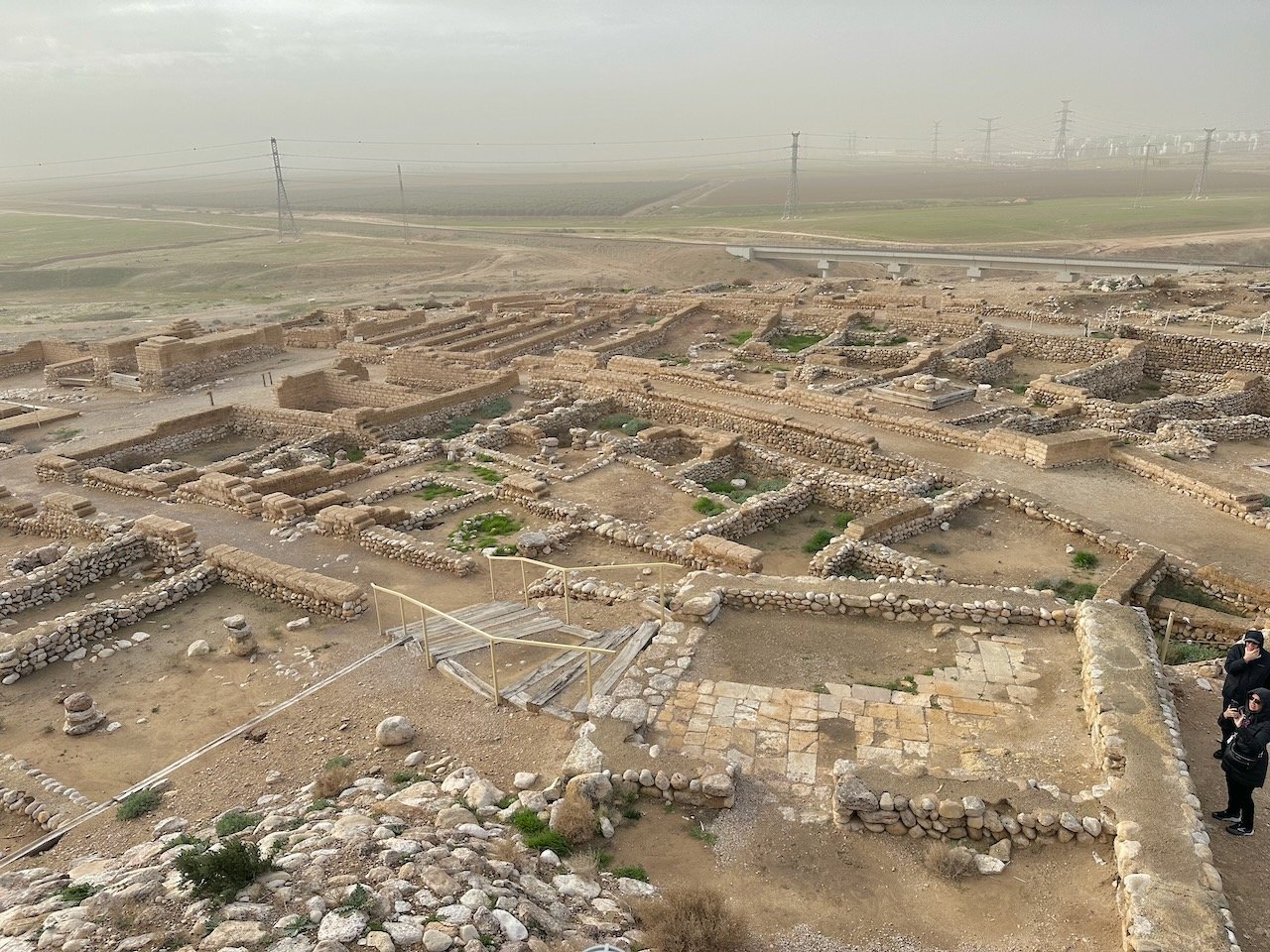
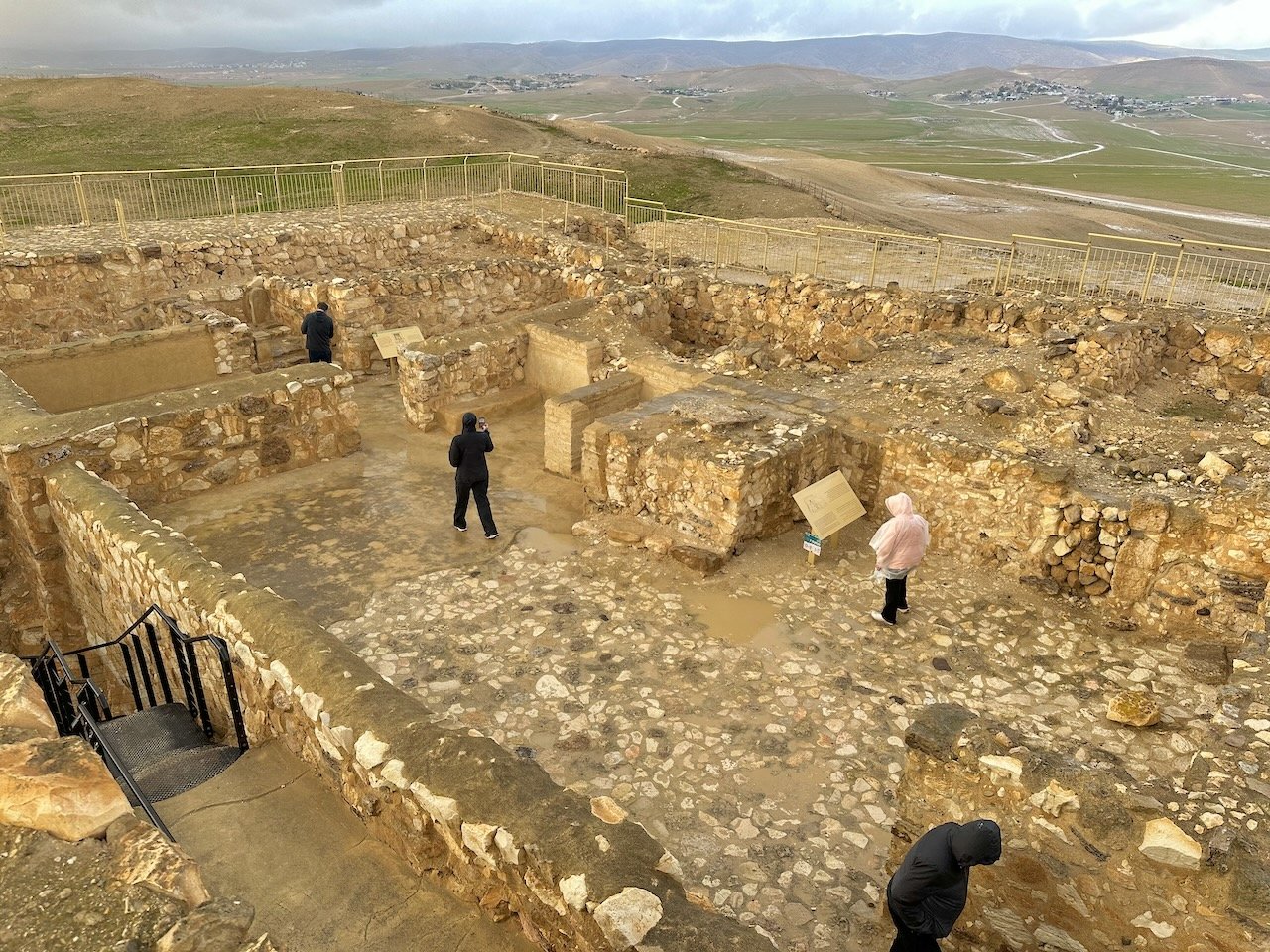
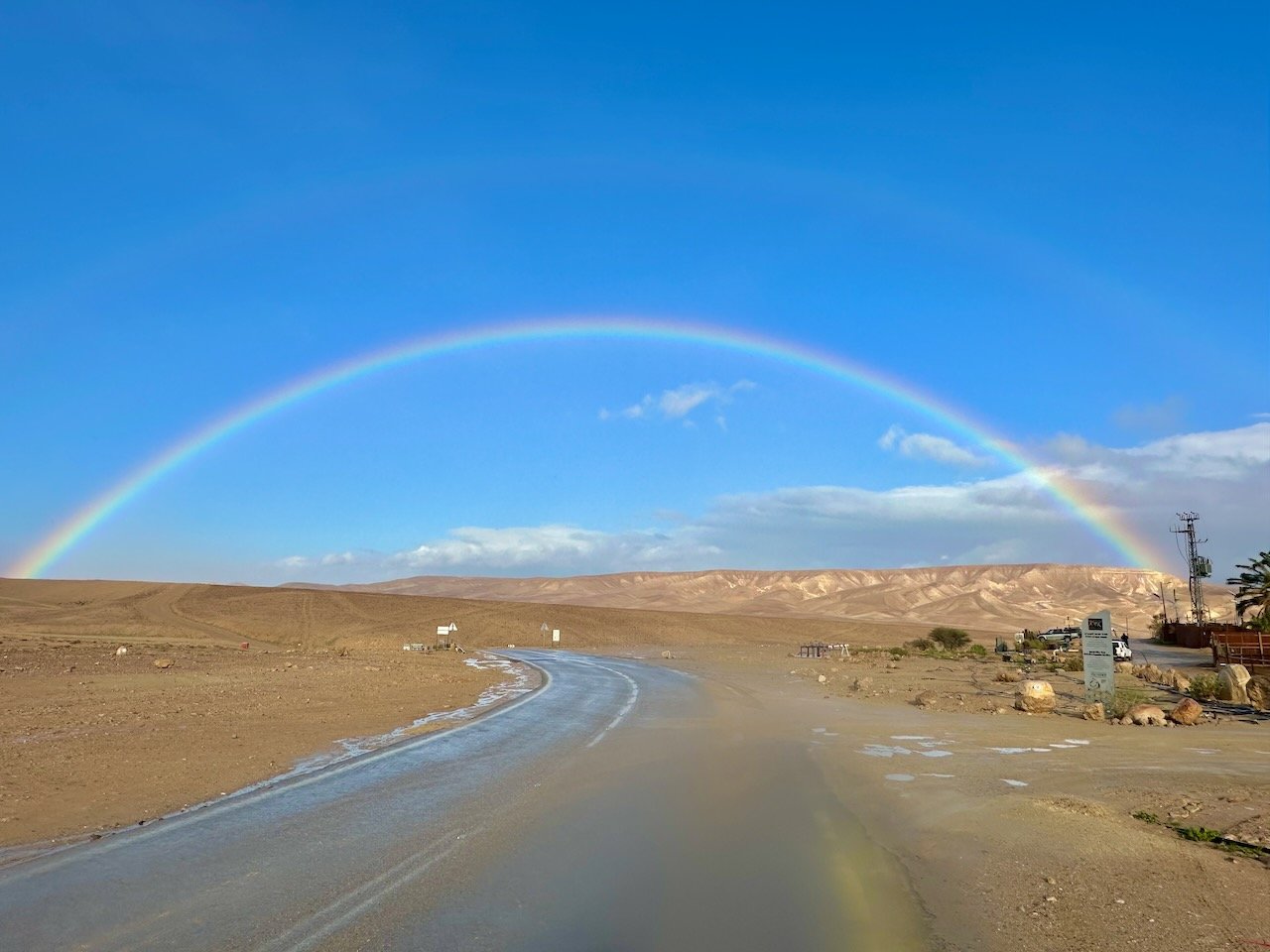
We drove about an hour back north to Tel Arad, an early Canaanite (i.e. Early Bronze) and Israelite/Judean (Iron Age) site. By this time the sheets of rain began, blowing sideways with the gusts of 40-60. Arad was a city whose king opposed the Israelites at the time of Moses (Number 21). The city would later be conquered by Joshua (Joshua 12). Because of the weather, we drove to the top (the “citadel”) by bus. Here, we went immediately saw an rainbow before entering the “false worship center/temple,” complete with a courtyard, sacrificial altar, and a “Holy of Holies” inner chamber. King Hezekiah (and later Josiah) brought an end to these high places (2 Chronicles 31 & 34). To get out of the rain and wind, we descended down to the cistern where we reflected upon how we are to be a “living sacrifice” to God by laying ourselves on the altar of His purpose and will for our lives (Romans 12:1-2).
Hanokdim
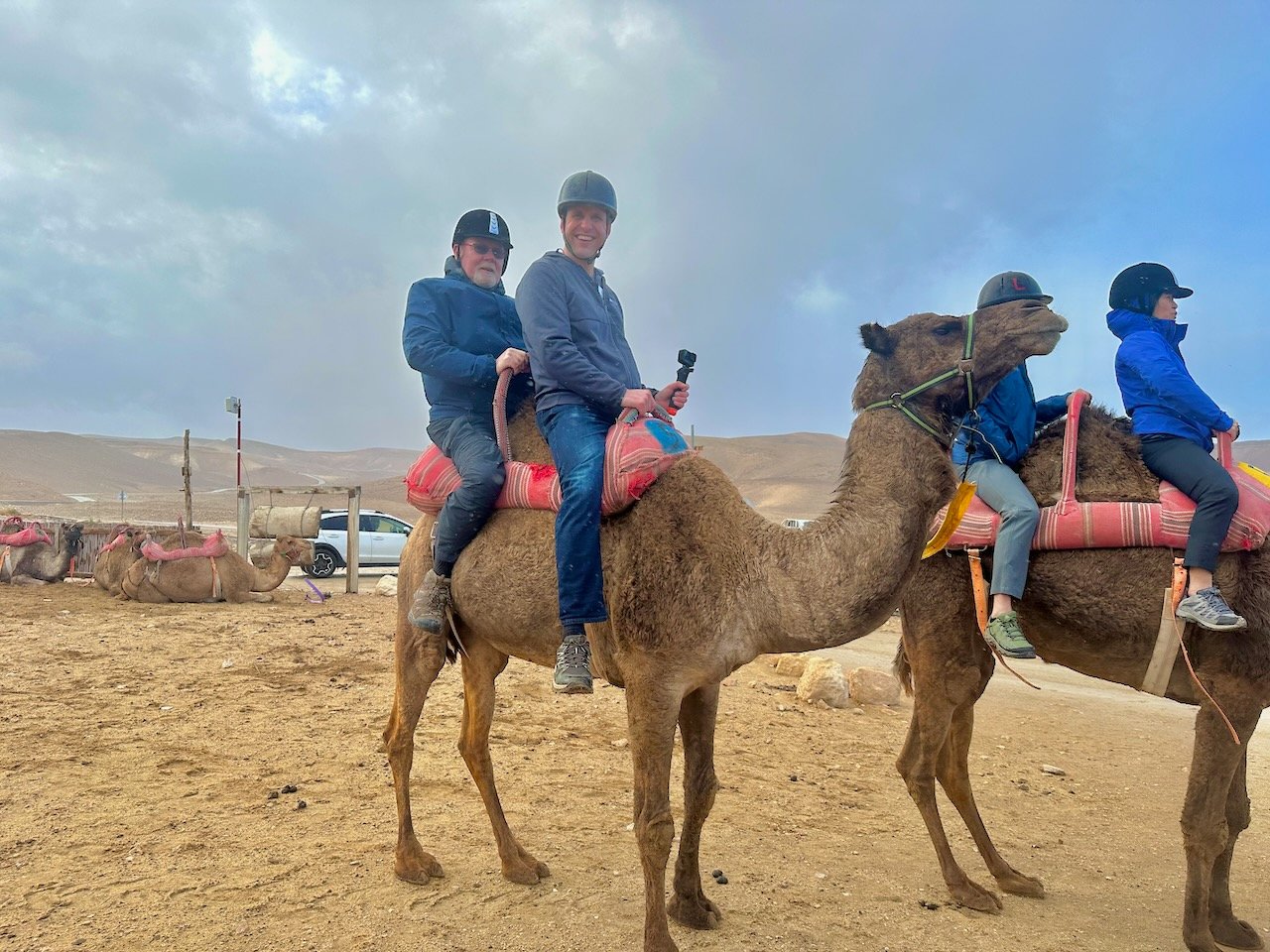
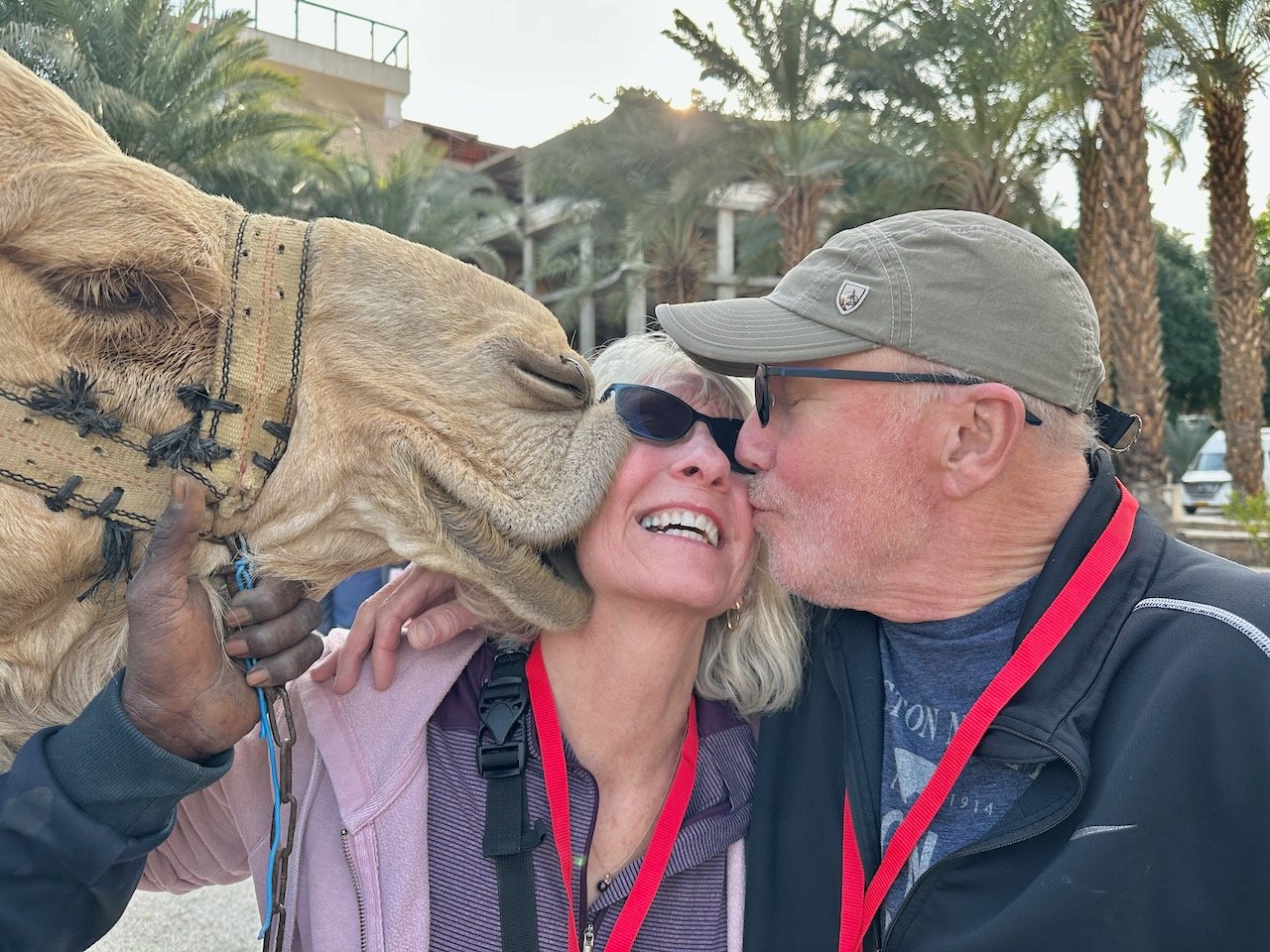
From here we drove through modern-day Arad to the eastern side of this large modern city. We stopped for a brief view of the Judean Desert. Winds howled here about 60 mph, nearly blowing us over. We boarded back on the bus and drove on a windy road into the Judean Desert and to Hanokdim, our “bedouin-style tent hotel” for the night. Upon arriving we enjoyed (despite the rain showers and wind) a camel ride through the desert. We checked into our private cabins. At 6:45 we gathered in a tent to listen to a bedouin share about his lifestyle. This was followed by a tasty dinner. We retired for the night in this unique place!
(NOTE: Because of flash floods closing the Dead Sea road today due to heavy rains in Jerusalem and in the desert, tomorrow’s program will most likely need to be altered. It is dependent upon the road opening.)
Day 5 – Wednesday, January 14: Masada, Drive Through Southern Judean Hill Country, Herodium, Shepherds’ Fields, Bethlehem, Kalya Hotel (near Qumran)
Due to the closed road along the Dead Sea (because of more flash floods), we had to change our program today. Our final destination would stay the same (our hotel near Qumran on the NW corner of the Dead Sea), but we would head through the Hill Country of Judah after our first visit at Masada. The morning was windy but rain free as we up and down Masada, but we had off and on rain and showers in the afternoon. Temps reached only in the low 50s.
Masada
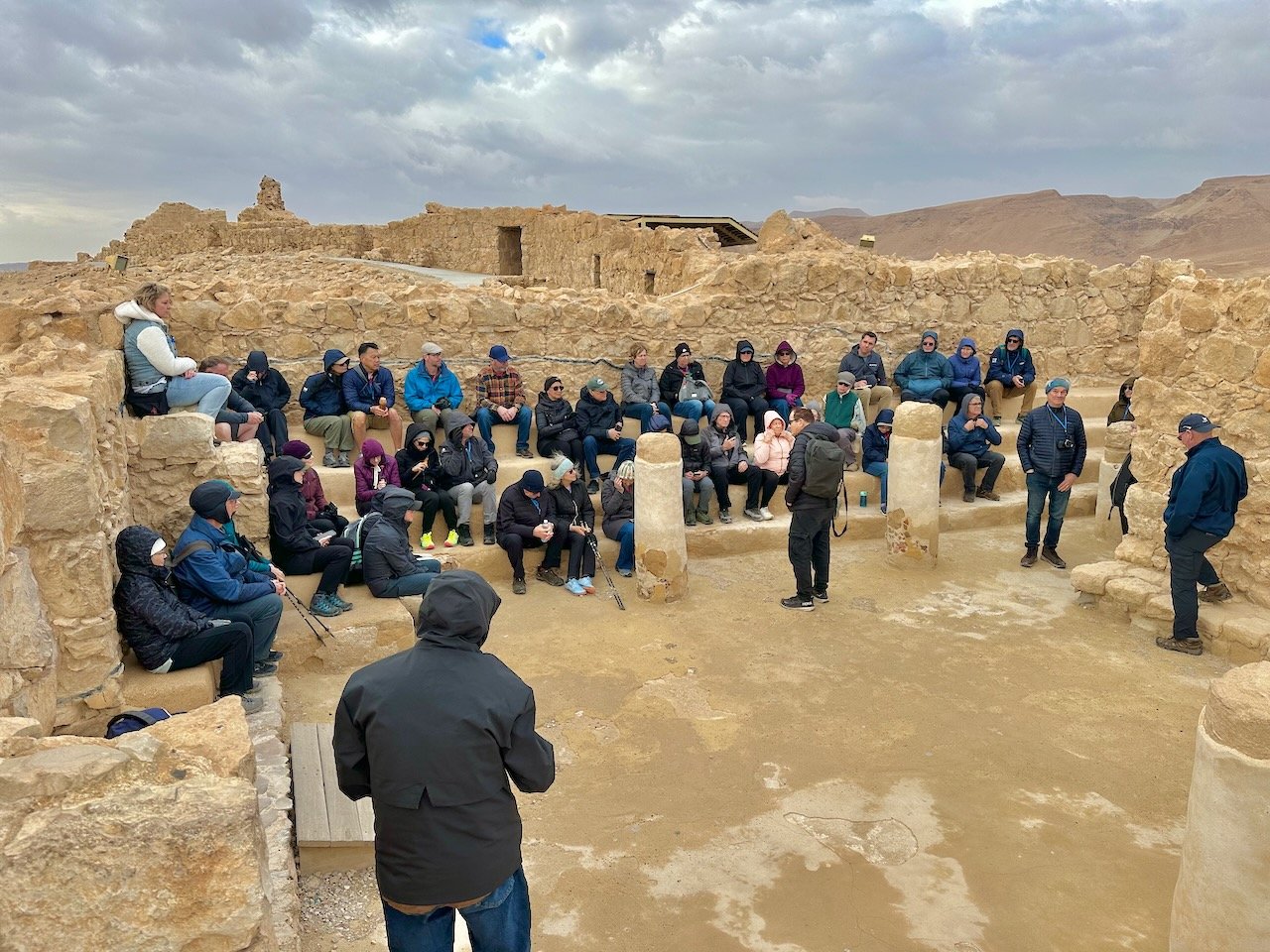
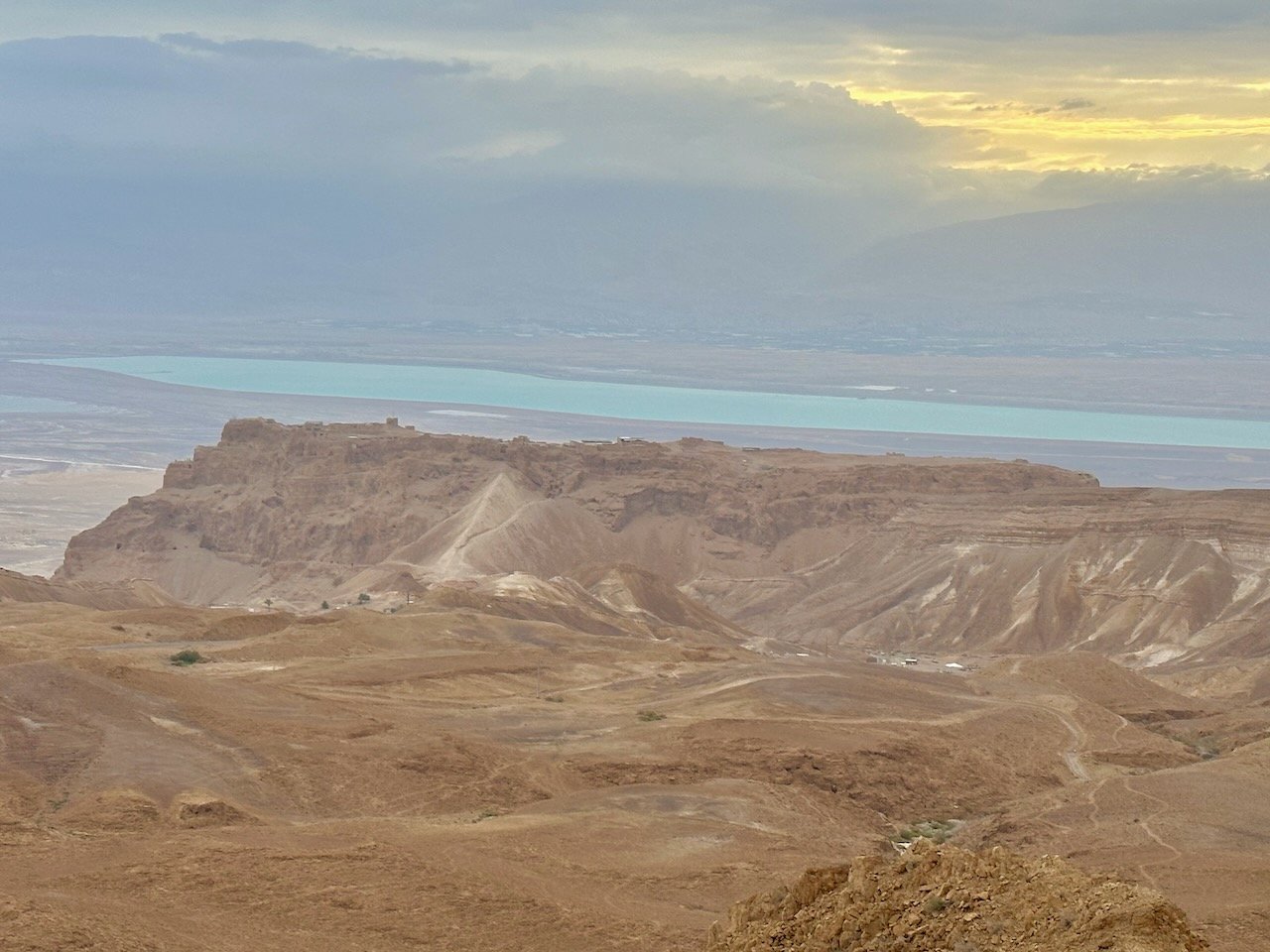
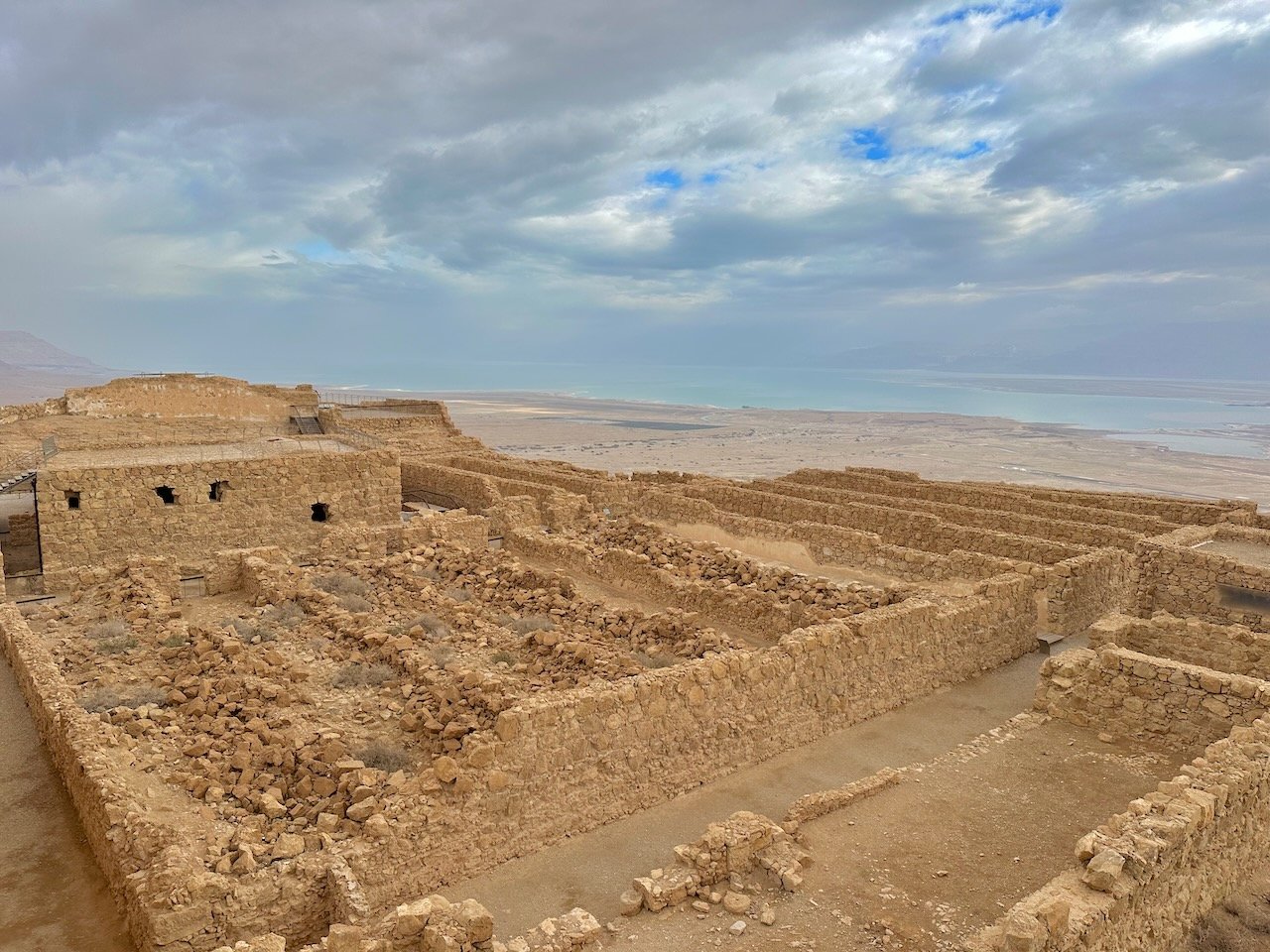
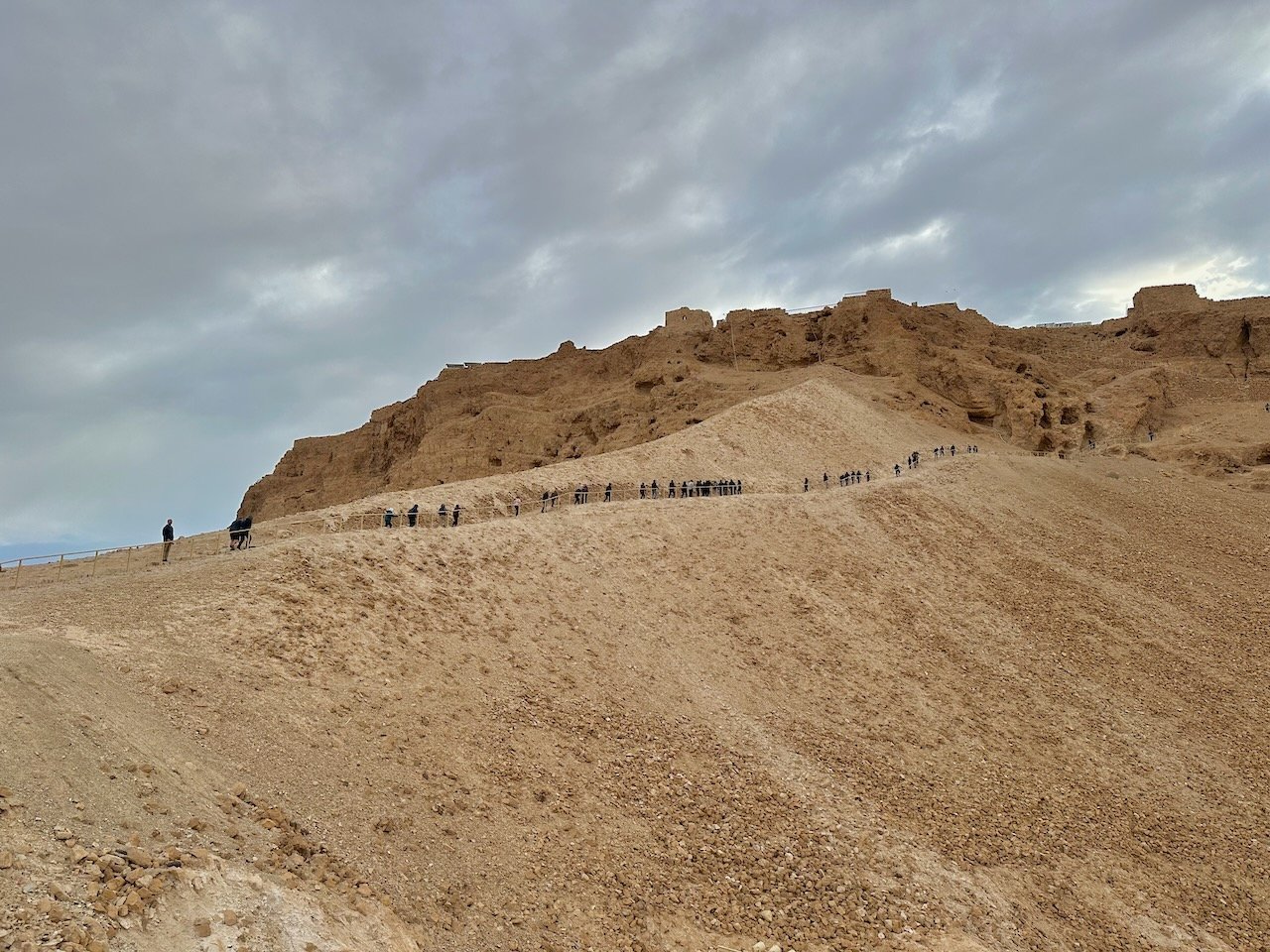
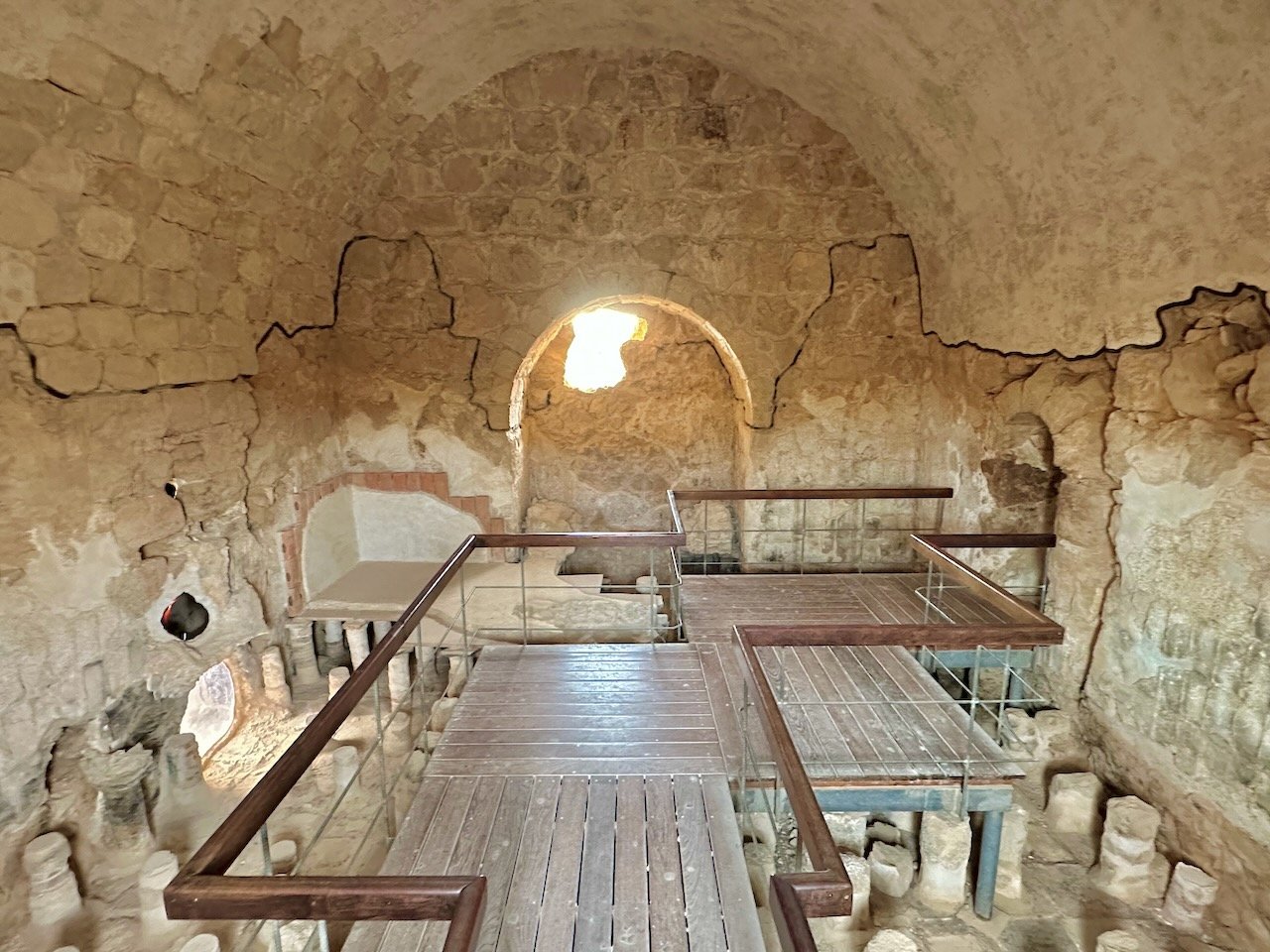
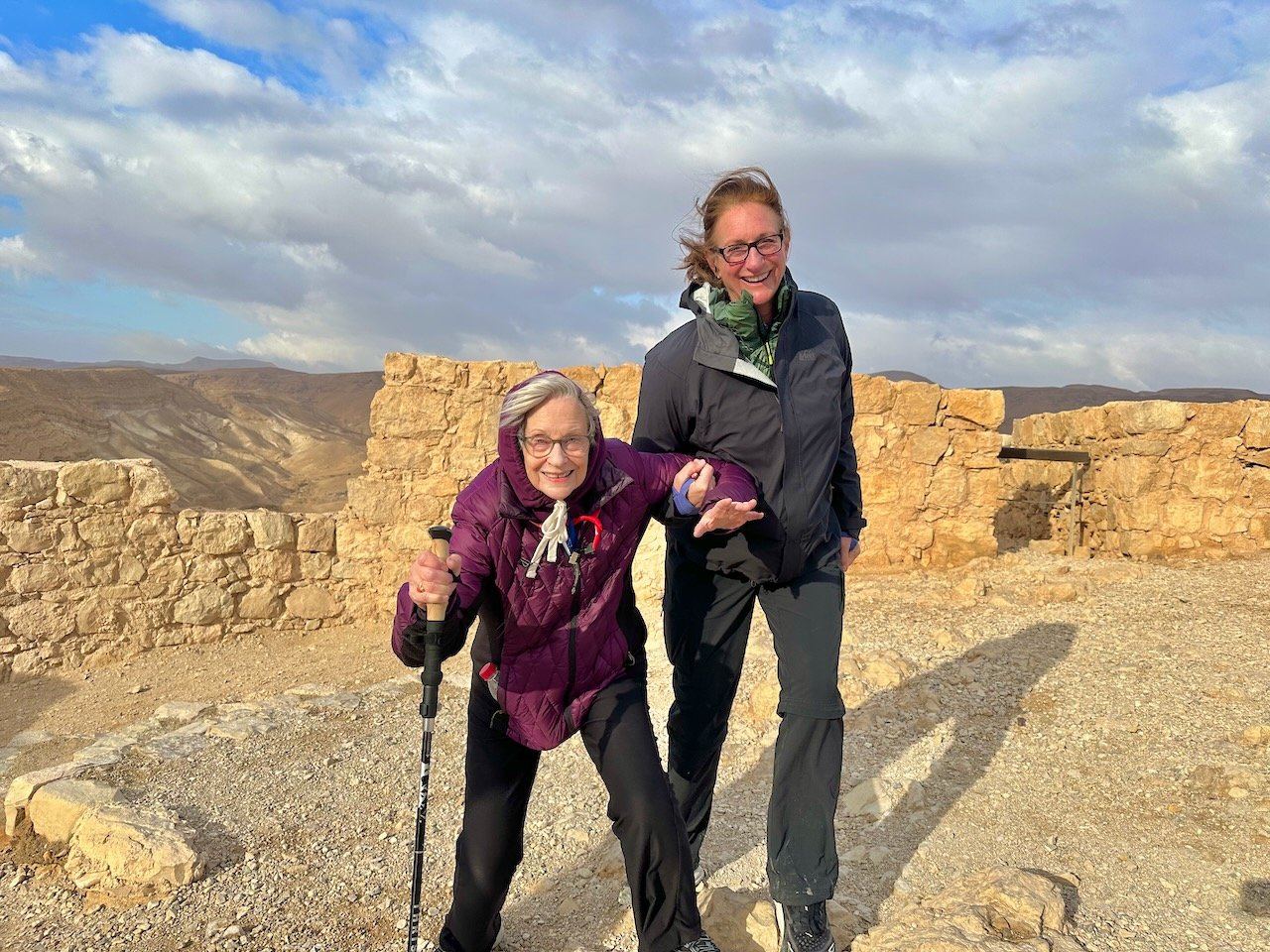
We drove east about 8 miles to get to the western side of Masada, a palace-fortress built by King Herod in the 30s BC. Everyone in the group hiked up the Roman ramp. Upon cresting the site we saw the casemate wall, huge cisterns, the synagogue, the western and northern palace, storehouses, and the bathhouse. The courageous story of Masada (with 967 using the site as a place of refuge) is both incredible and inspiring! Leaving the site, about half the group walked down the steep Snake Path while others took the cable car down.
Drive North Through Southern Judean Hill Country
Because of Route 90 (the road along the western coastline of the Dead Sea) was still closed due to flash floods, we took a unique road past Tel Arad and up into the southern Hill Country of Judah. The road took us past such places as Maon and Carmel (2 Samuel 25) and Ziph (2 Samuel 23). Also, the 12 Israelite spies came up through this region to Hebron. Speaking of Hebron, as we passed by this ancient city, we recalled that the Patriarchs (except Rachel) were all buried here in the Cave of Machpelah.
Herodium
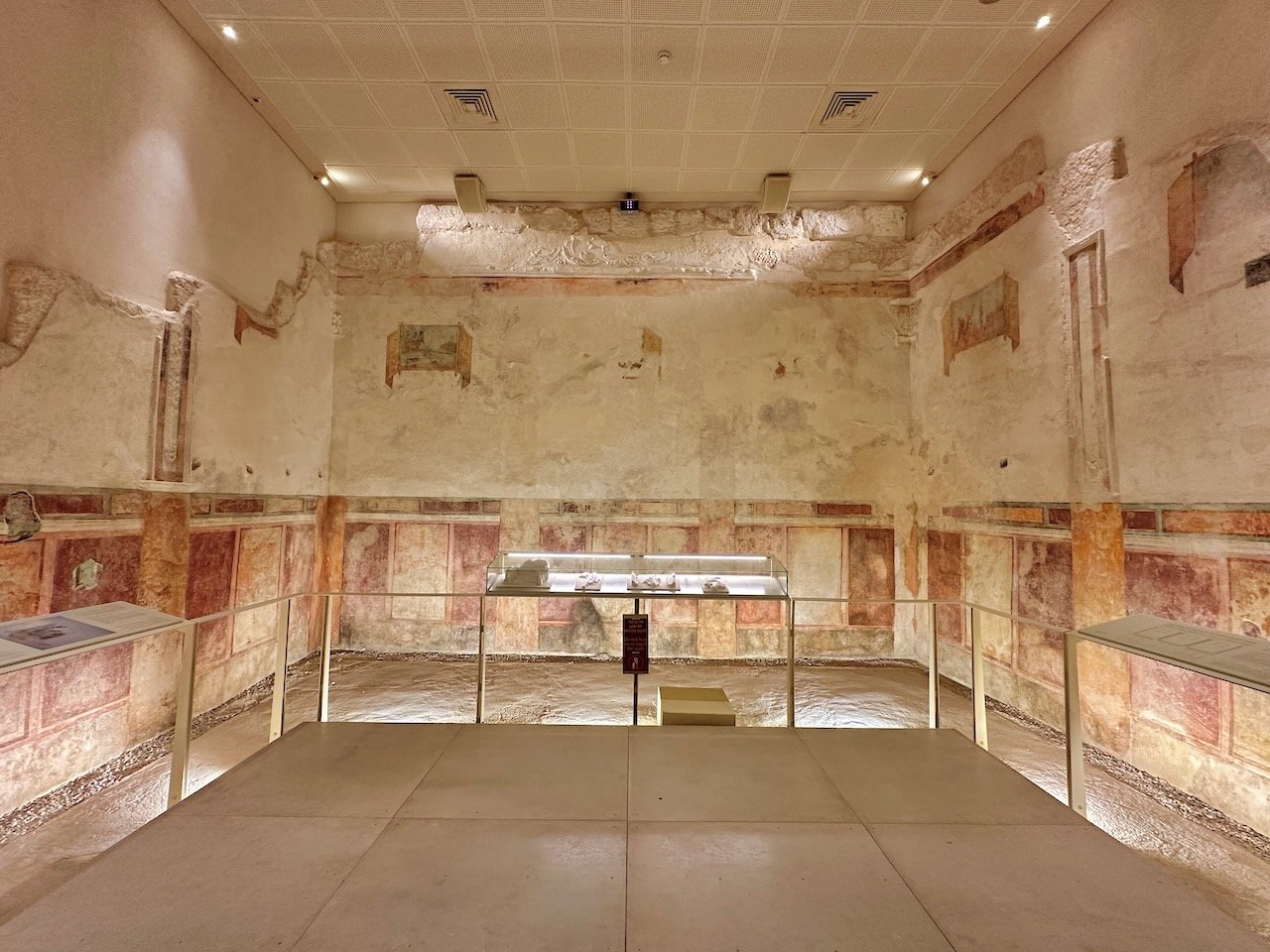
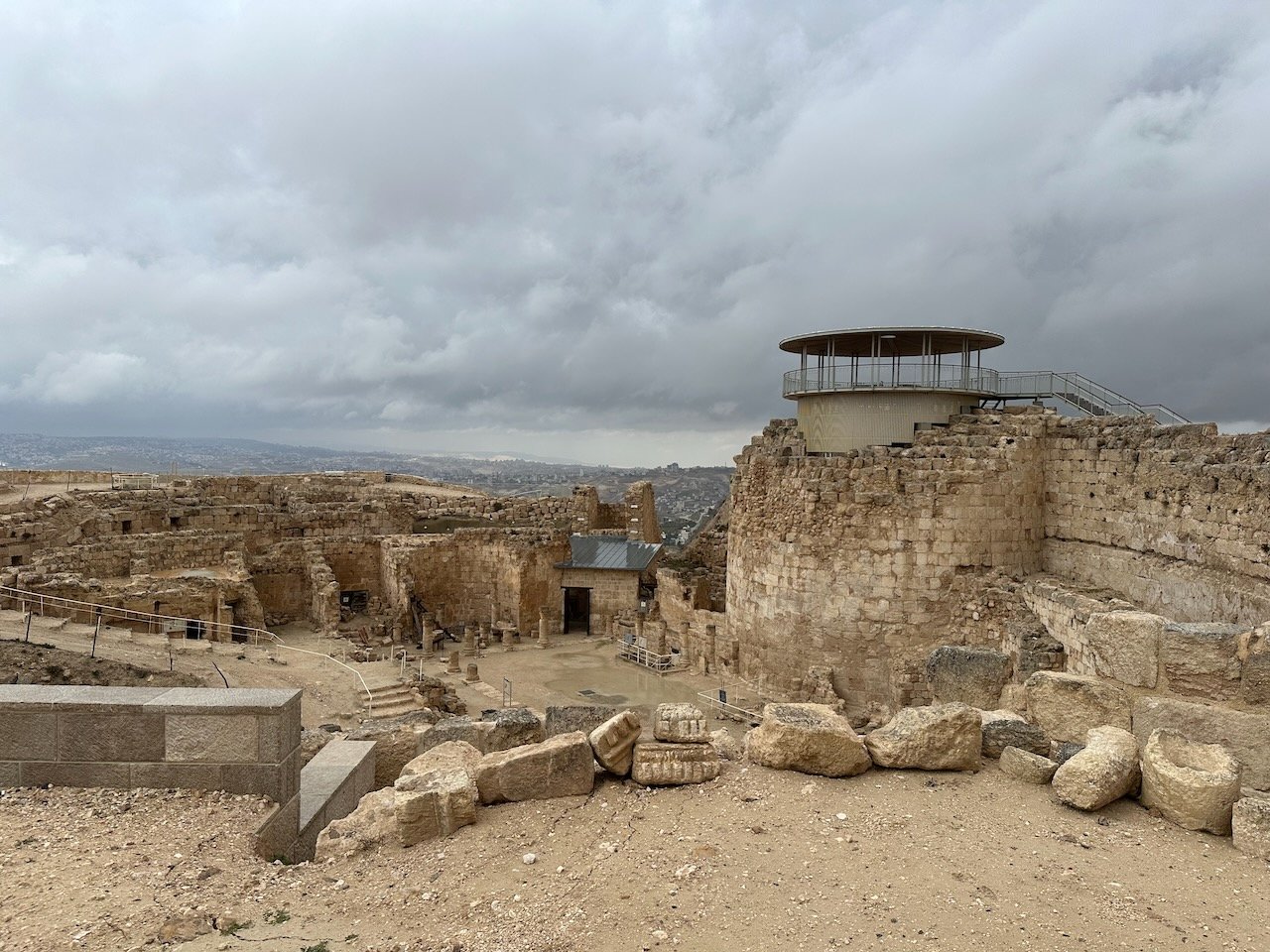
The road passed Hebron eventually took us further north and east to Herodium. This was a palace-fortress built by Herod the Great. He was also buried in 4 BC. The site was incredible, with many new renovations and displays. Inside the well-preserved official’s chamber (i.e. reception hall) we saw a wonderful presentation. Then many in the group walked up 150 steps through the royal arches to the top where we saw the bathhouse, synagogue, impressive frescoes, and a great view of Jerusalem from the highest of the four towers. We left the site by walked down through the cistern system.
Bethlehem/Shepherds’ Fields
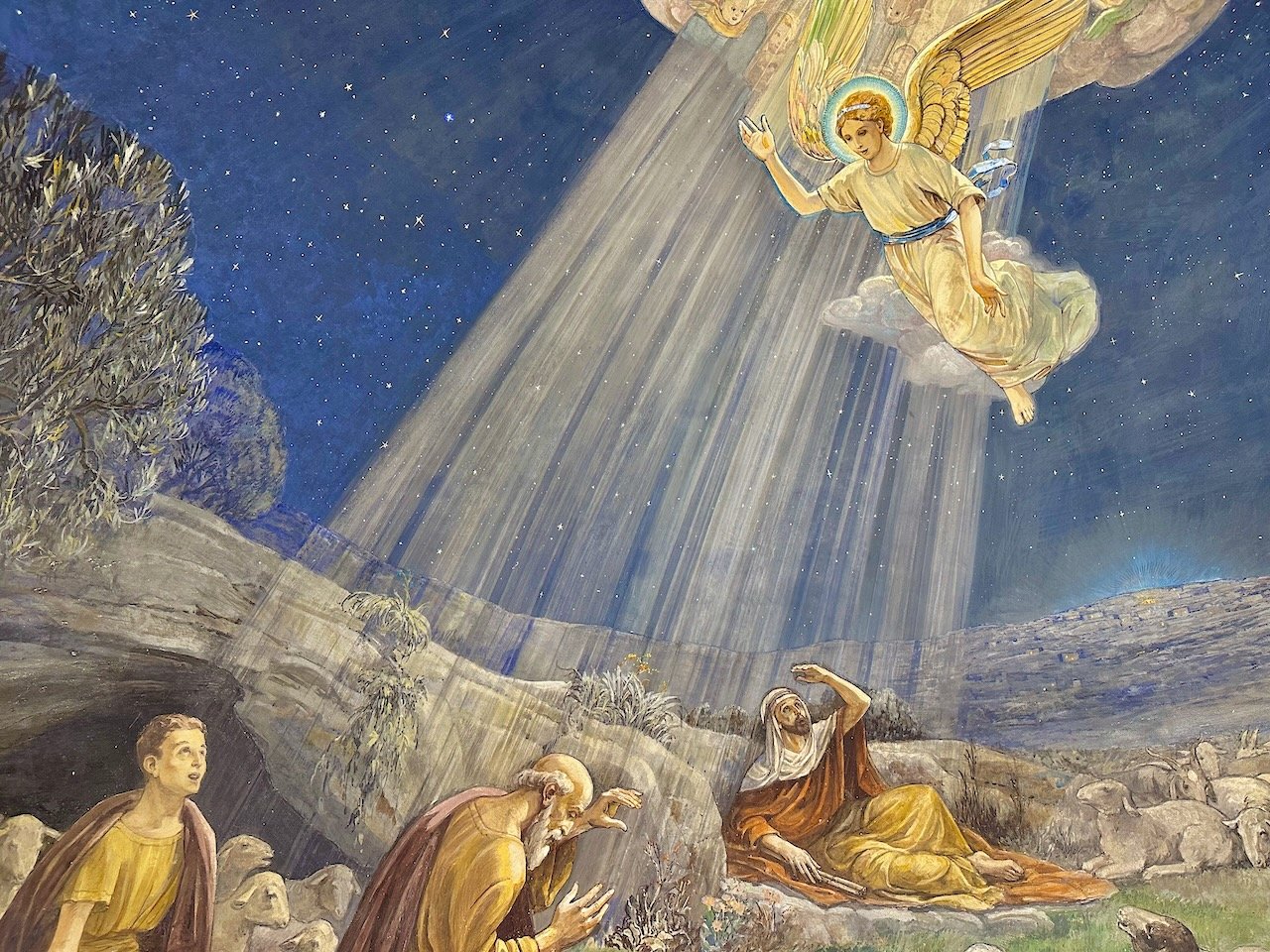
Just to the west of Herodium is Bethlehem. On the way we first made a stop in Beit Sahour (an eastern adjacent Arab town). Following a quick but great falafel lunch, we enjoyed singing Christmas carols in the Shepherds’ Fields. We read from Luke 2 about the birth of Jesus. It was “just at the right time God sent His Son” (Galatians 4:4). The shepherds were probably tending their sheep at Migdal Eder (between Bethlehem and Jerusalem, Micah 4) before the angelic host informed them of the birth of Jesus as prophesied (Micah 5). From here we drove into Bethlehem where we visited an olive wood factory and story. These olive wood products were impressive.
Dead Sea/Kalya
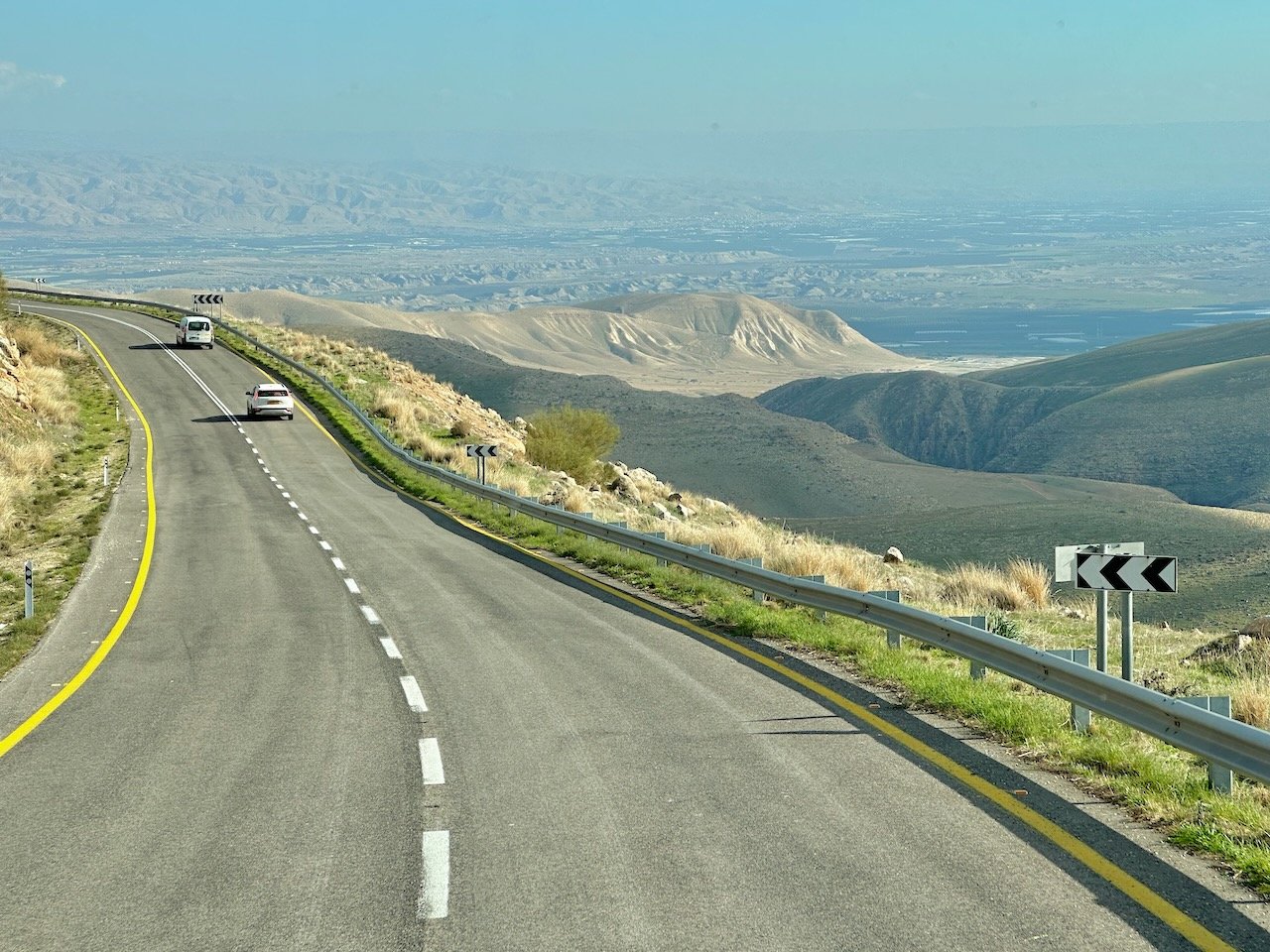
To end the day we drove out of Bethlehem through Beit Jala to Jerusalem before descending down through the Judean Desert to the Dead Sea. We arrived at Kalya, our “kibbitz-hotel” located near Qumran. We expect to get back on our scheduled program tomorrow (we will visit Jericho and Ein Gedi next week).
Day 6 – Thursday, January 15: Qumran, Judean Desert/Wadi Qelt, Shiloh, Beth Shean, Tiberias
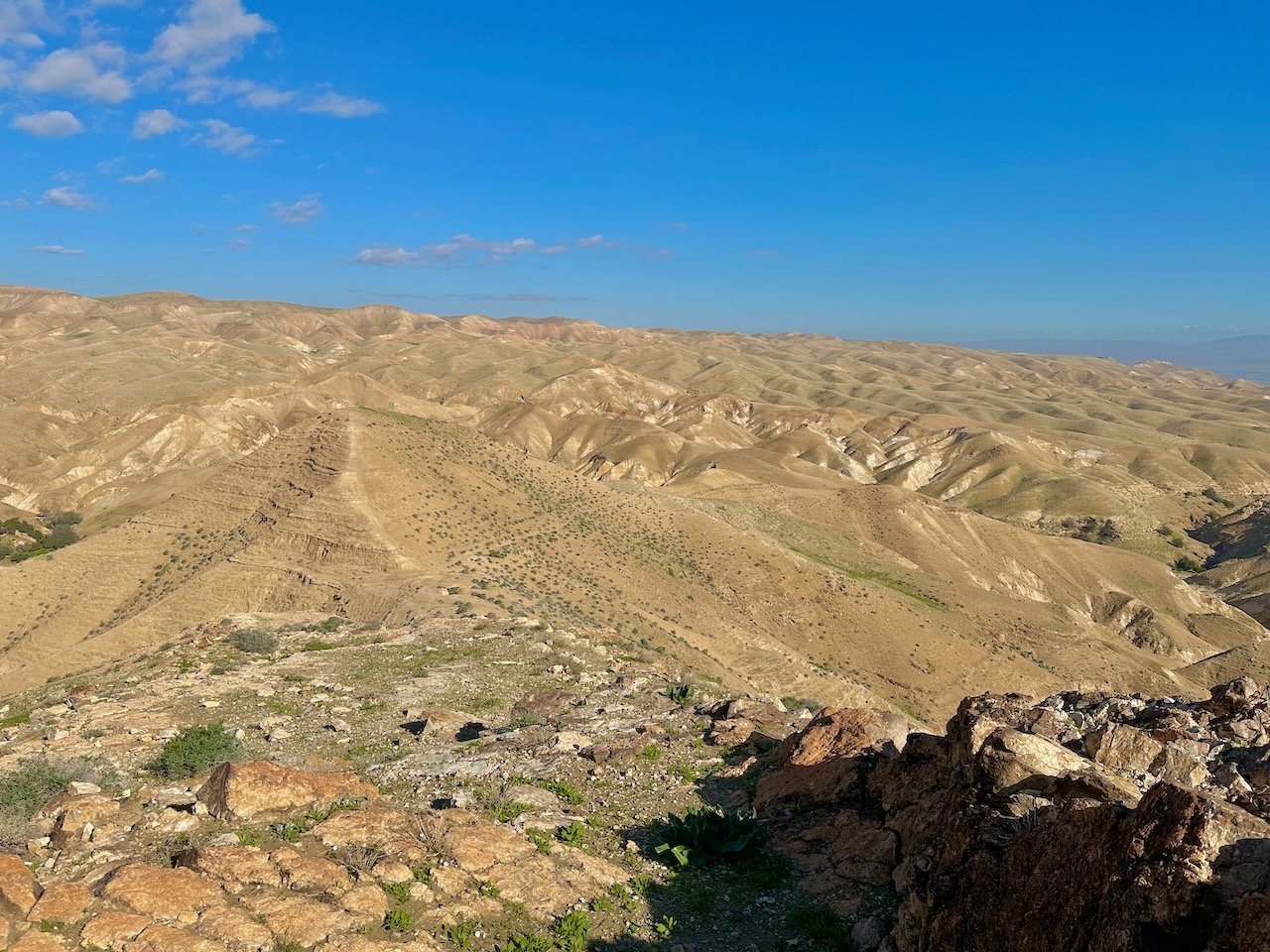
Today was a brilliantly sunny day, with temps around 60 (a bit cooler at Shiloh). We appreciated having a sunny day today after the wind and colder rain yesterday. After breakfast at Kalya, we headed to Qumran, only two minutes away. We read from Jeremiah 32:14 (about putting documents into clay jars to preserver them) as we drove to Qumran’s entrance. We arrived at 8 a.m.
Qumran
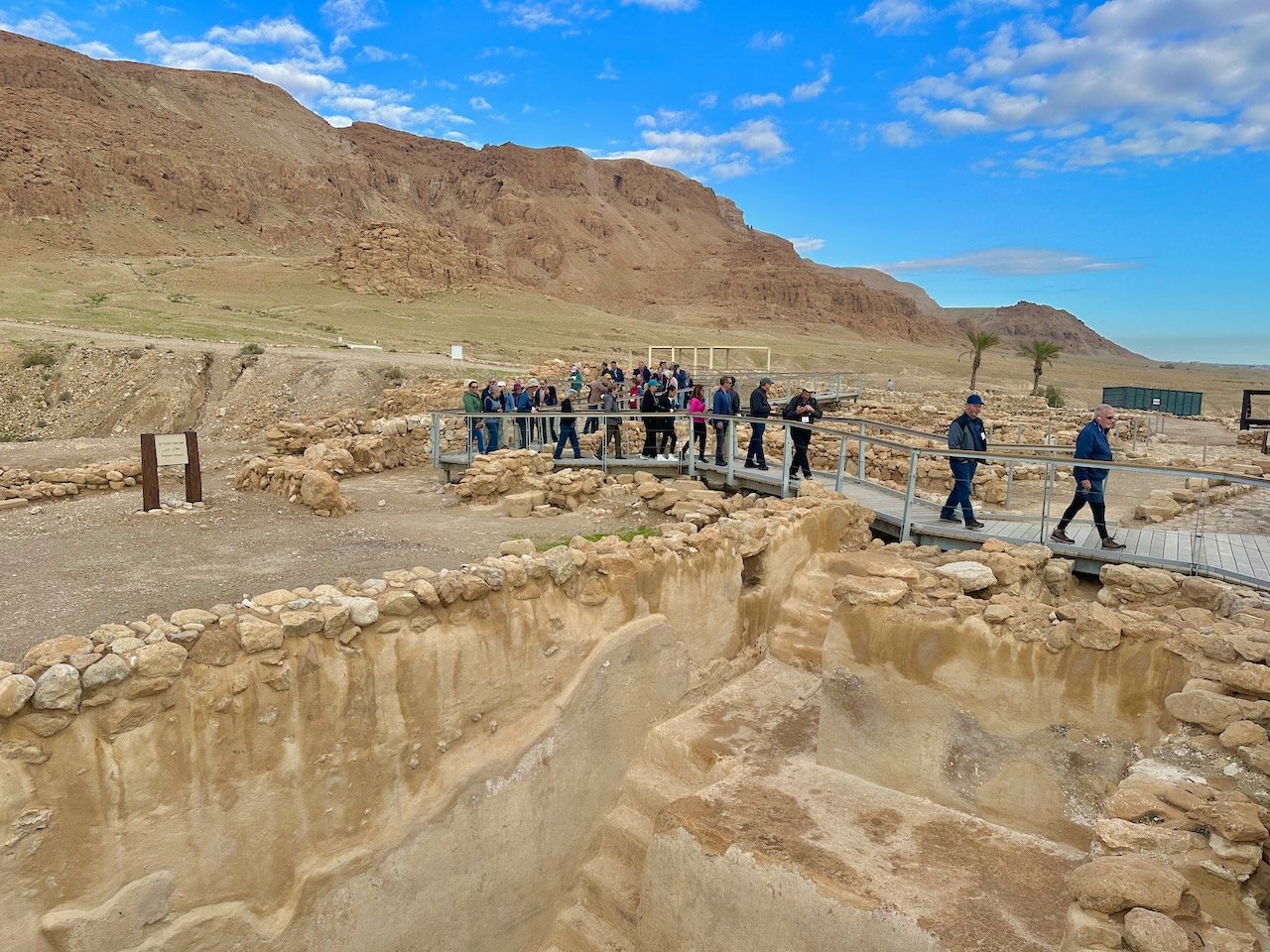
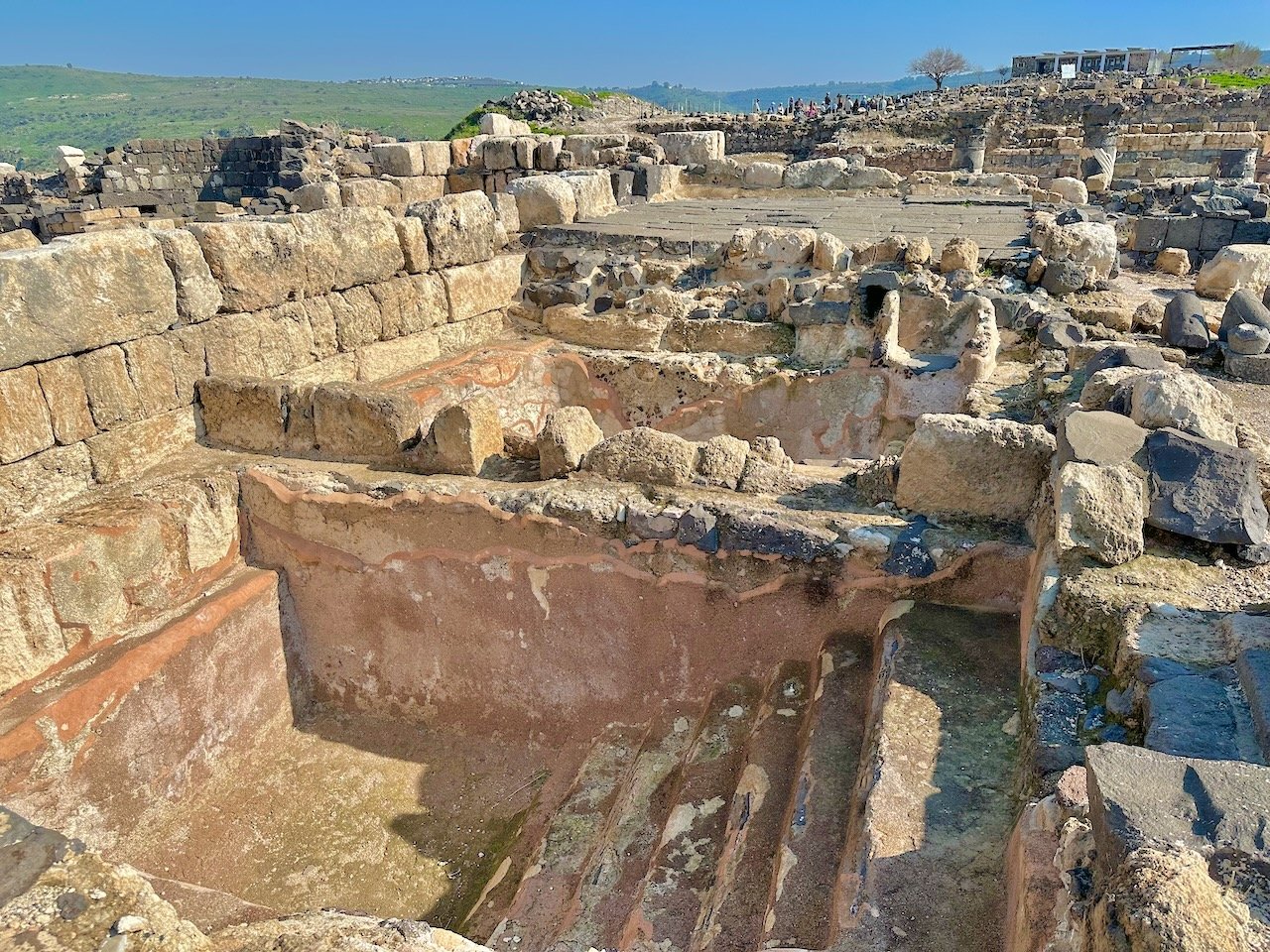
The most significant discovery in all of Israel was the Dead Sea Scrolls that were found here at Qumran in 1947. We walked up towards the edge of the cliffs of the Judean Desert (we saw Cave 6 form a distance). In a total of 12 caves fragment of scrolls or artifacts were found. These ancient texts of Scripture and other sectarian texts were written by the Essenes. At the site itself we saw many ritual baths (miqveot, plural; miqve, singular), cisterns, and the scriptorium. In front of Cave 4 (and 5 & 10), we read from Psalm 19 and “151,” an extra psalm found here. We also read from the Essene “Beatitudes.” These were written in the same format as Jesus’ Beatitudes (Matthew 5). We also remembered 2 Timothy 3:16 about God’s inspired Word. Thanks be to God for the preservation of His Word and the joy, instruction, direction, and hope it provides us!
Wadi Qelt/Judean Desert
We drove back past Jericho and began our ascent towards Jerusalem. We turned off the road for a fabulous view of the Wadi Qelt, part of the Judean Desert. Here we heard “Isaiah the prophet” share from chapter 40 of his book. We also heard Shlomo sing Psalm 23 in Hebrew. The experience was incredible.
Desert of Parat/Shiloh
Next, we drove through the Desert of Parat. Jeremiah hid a linen belt here (Jeremiah 13). The beauty of the desert (and the few gazelles we saw) was impressive. We drove into the Central Benjamin Plateau, passing my Michmash (1 Samuel 13-14), and eventually Bethel (Genesis 12, 28), Ai (Joshua 7-8). These sites are located in the Hill Country of Ephraim.
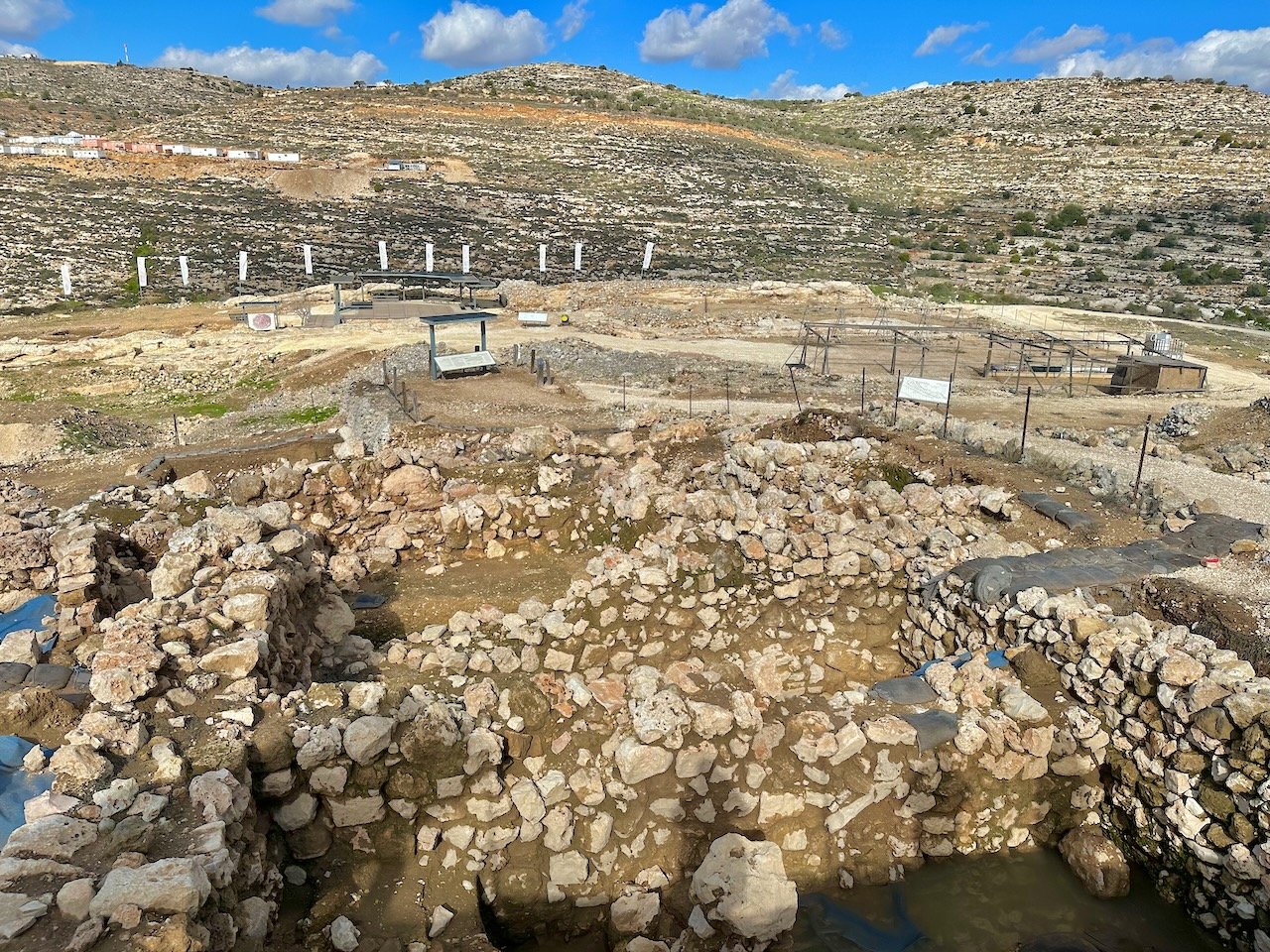
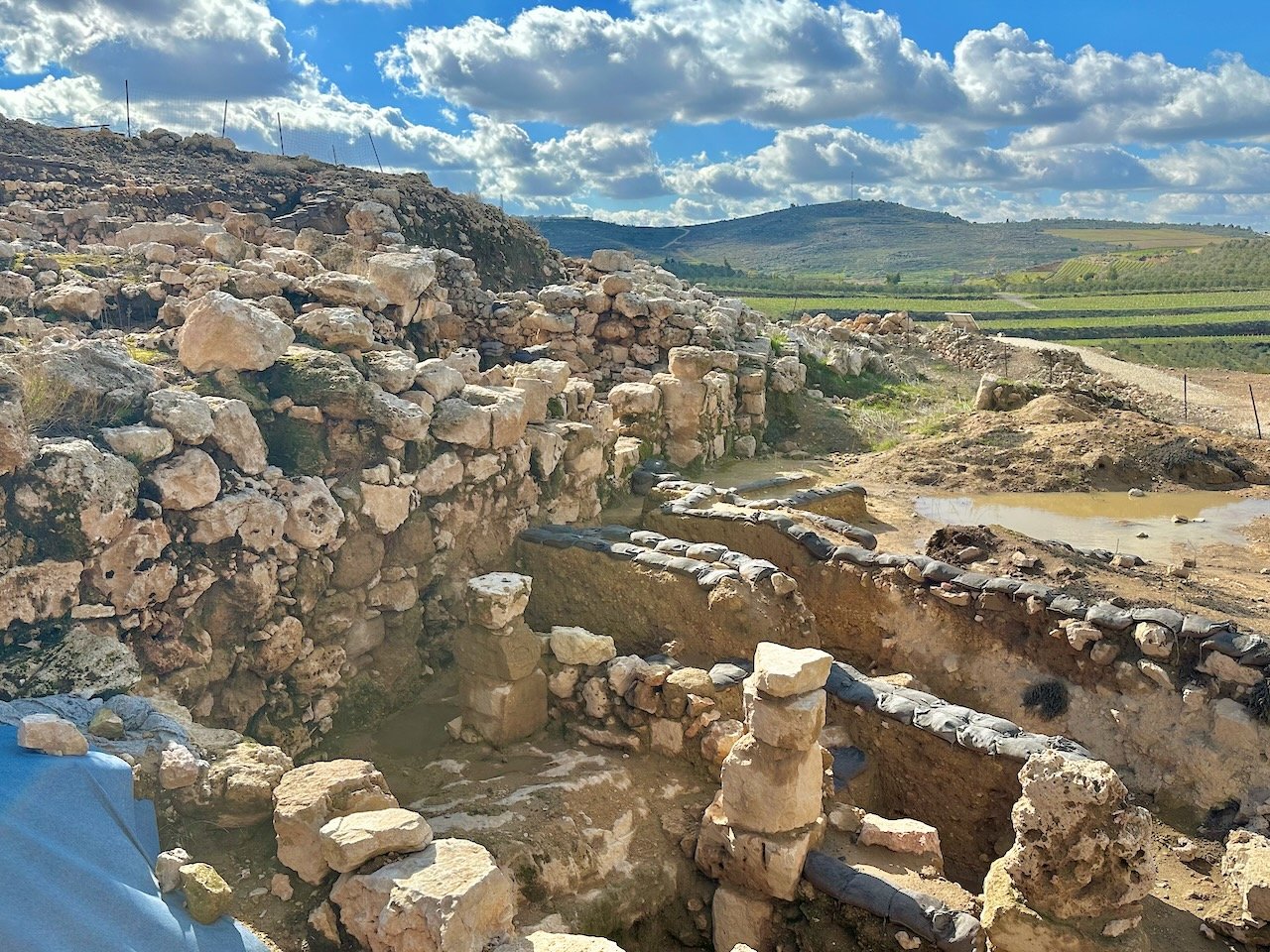
We eventually made it to Shiloh (located 20 miles north of Jerusalem ). When we arrived, we first saw a hologram about the Tabernacle. Then we made our way up this ancient site where the Tabernacle once stood here for over 300 years. It was destroyed by the Philistines (1 Samuel 4). After walking to the top of the site, we watched a short movie about the biblical events that took place here. Among the ruins we saw the suggested “Holy of Holies.” Further below, we saw the massive Middle Bronze wall and gate complex that was incorporated into the Israelite site.
Additionally, we remembered the story of young Samuel responding to the voice of God. It was young Samuel who said, “Hineni” (“Here I am!”) When God called Him into service. Abraham, Jacob, Moses and Isaiah also used this meaningful word in response to God’s calling upon their lives. It may be that Jesus also used the word (Hebrews 10, quoting Psalm 40). What an amazing site.
Beth Shean
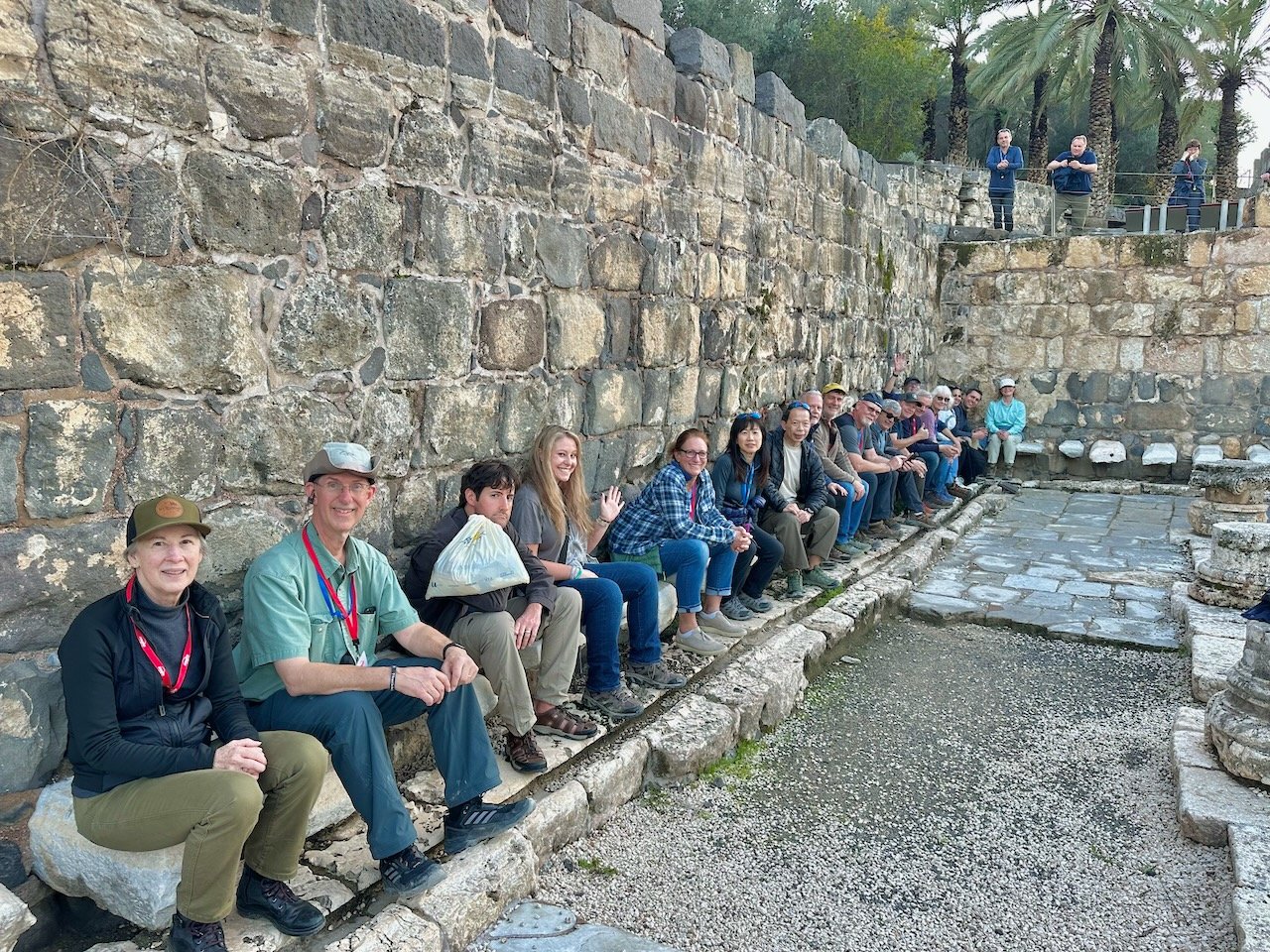
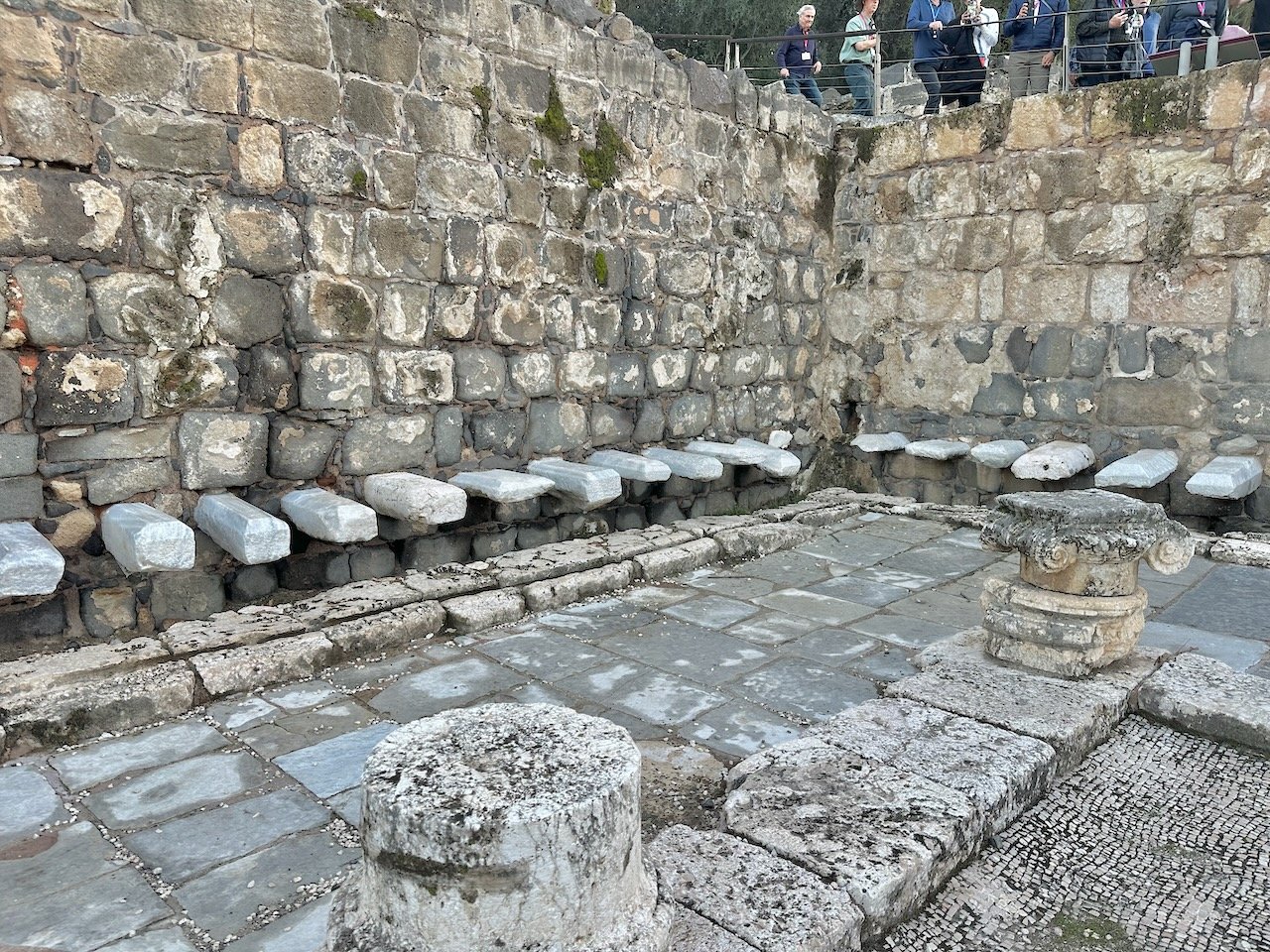
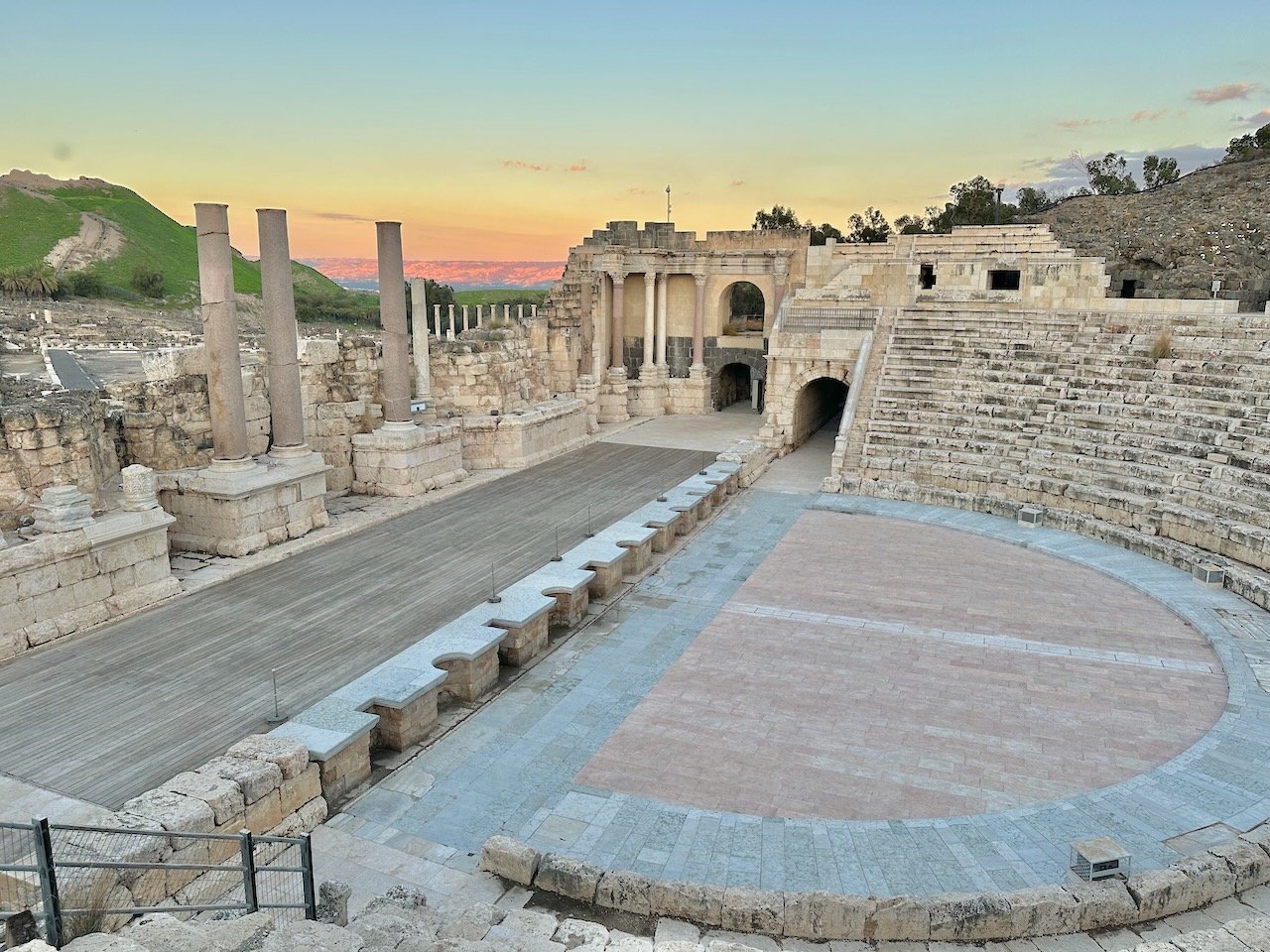
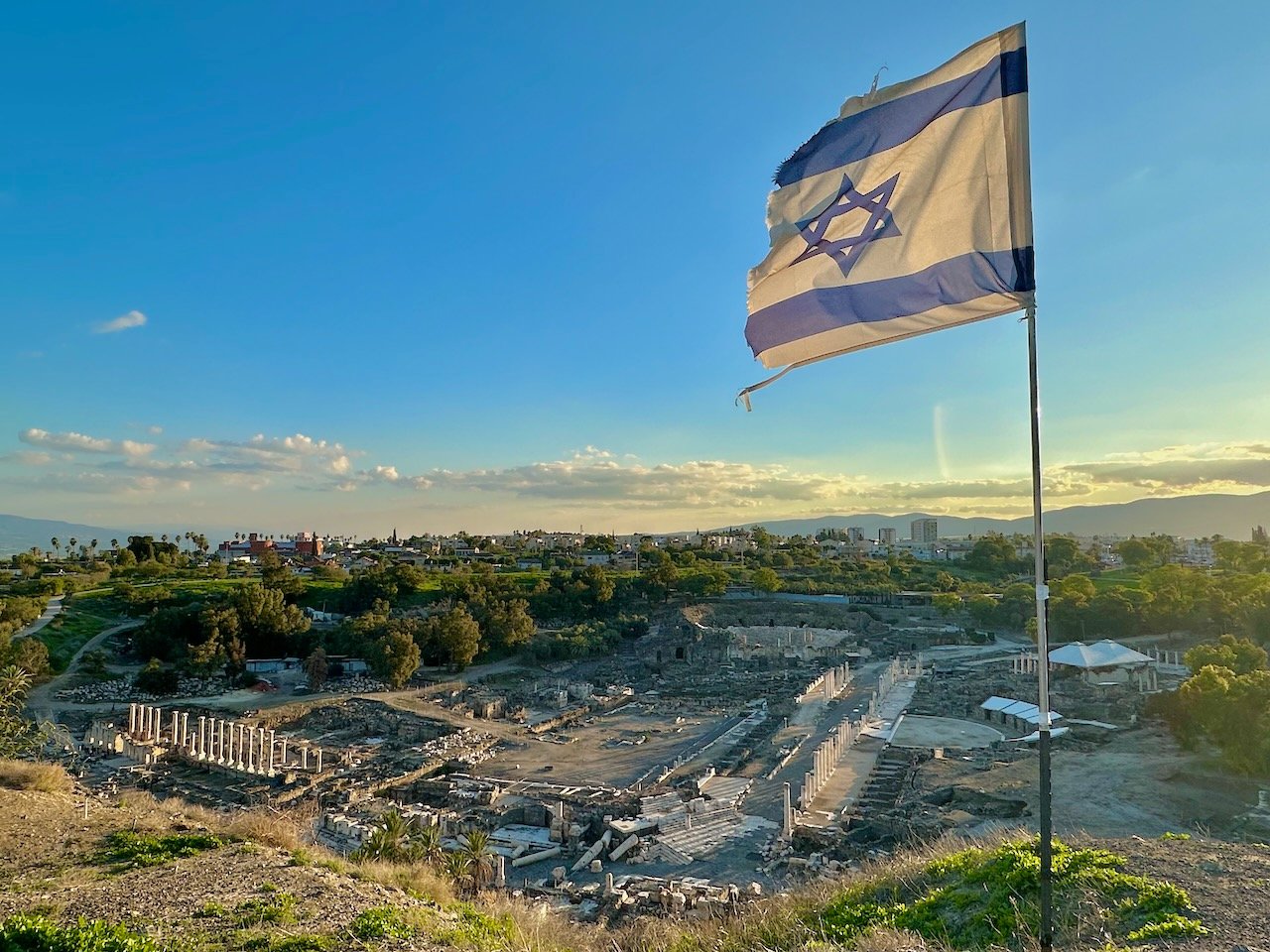
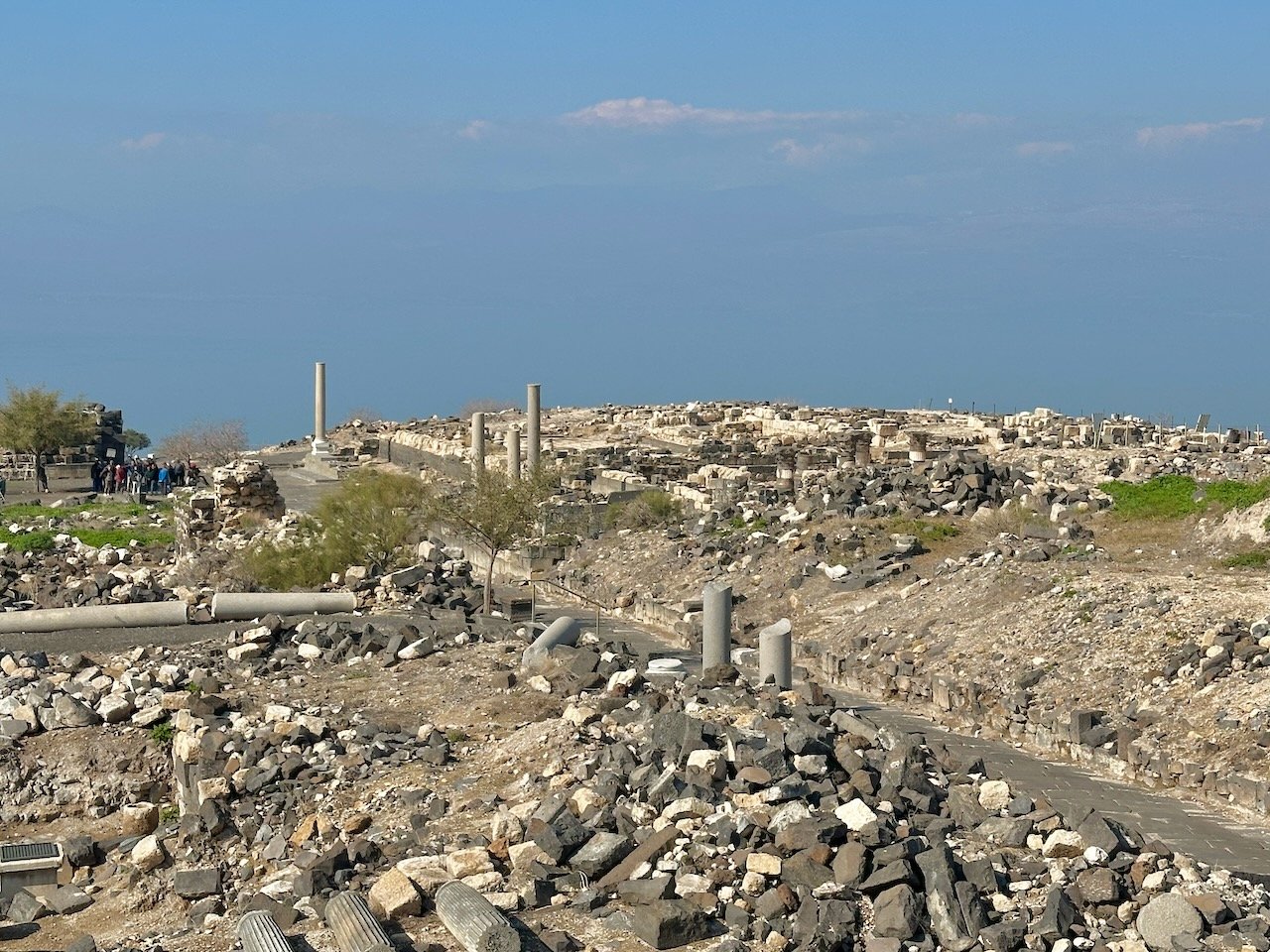
We traveled north from here along the Jordan Valley to Beth Shean. The ride took about an hour and a half. Since we arrived late, we were allowed to stay well beyond the closing time. This ancient site is an incredibly large site, with many ruins from the Roman Period. We saw colonnaded streets, the bathhouse, agora, public latrenes, and the theater. Many in the group climbed to the top of the OT site (with the outstanding visibility, we could see as far west as the Carmel Range). According to 1 Samuel 31 (and 1 Chronicles 10), the body of Saul was hung on the walls of the town square after he died on near by Mt. Gilboa. The men from Jabesh Gilead (located on the east side of the Jordan Valley), came at night to rescue the body of Saul.
Tiberias
At 4:45 p.m. we drove about 18 miles to the southern end of the Sea of Galilee, and then another five to Tiberias. We checked into our hotel (Ron Beach, located right on the water’s edge), followed by a wonderful dinner (with chocolate sufley and ice cream!) and a restful evening. We are staying here four nights!

Day 7 – Friday, January 16: Arbel, Hippos, “Hill 713” (Har Mitzpe ha-Yamim)
Because of the wet forecast for Sunday, we decided to change around our Sunday program for today. This meant we began and ended the day with amazing views! The sunrise over the Golan Heights was spectacular! The sunset from “Hill 713” was just as nice! The weather was perfect, with mostly sunny skies all day long, with highs in the mid 60s. We left the hotel at 7:35 following a very full breakfast! We read Matthew 4 as we drove to the trailhead of Arbel.
Mt. Arbel
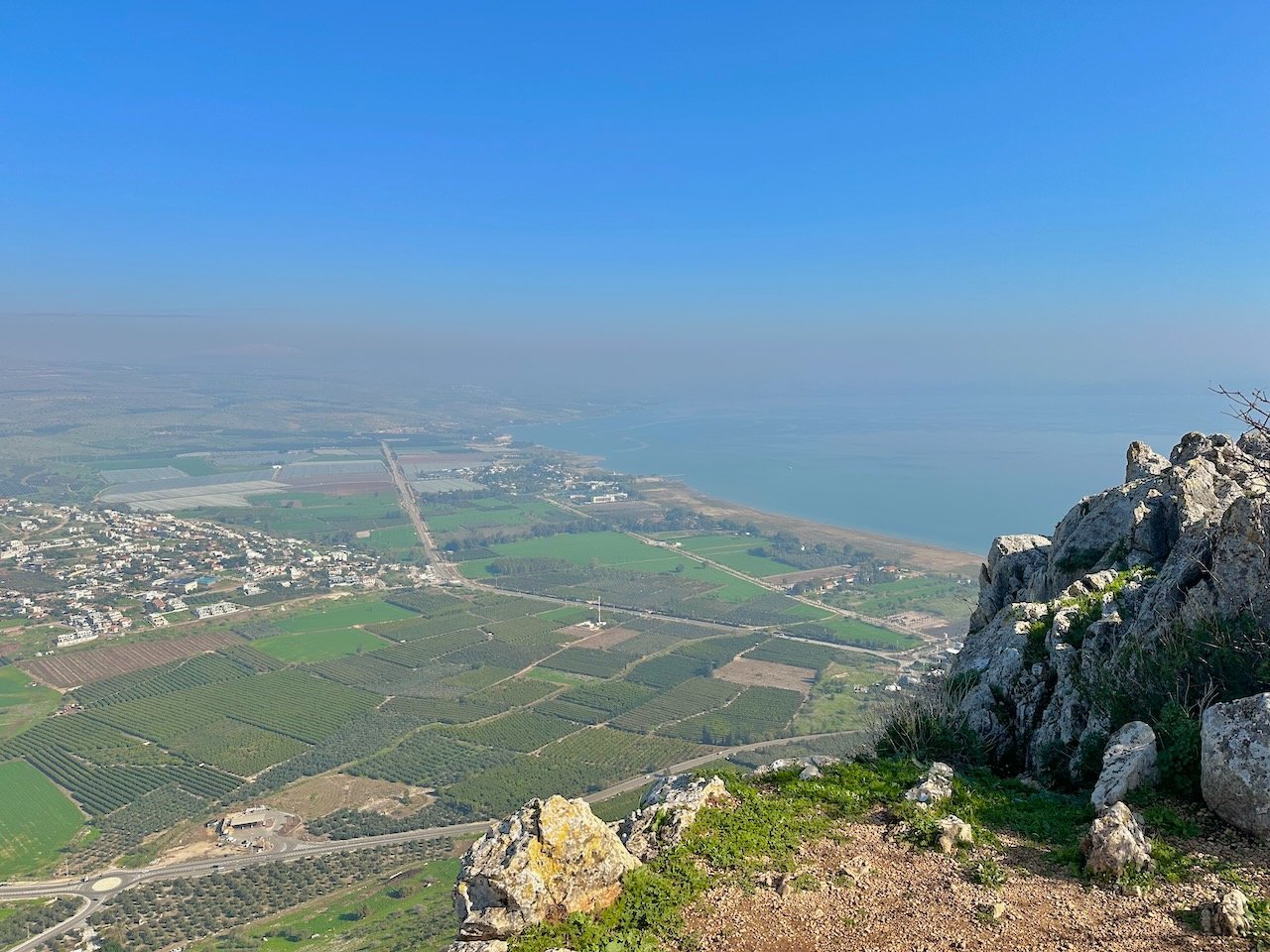
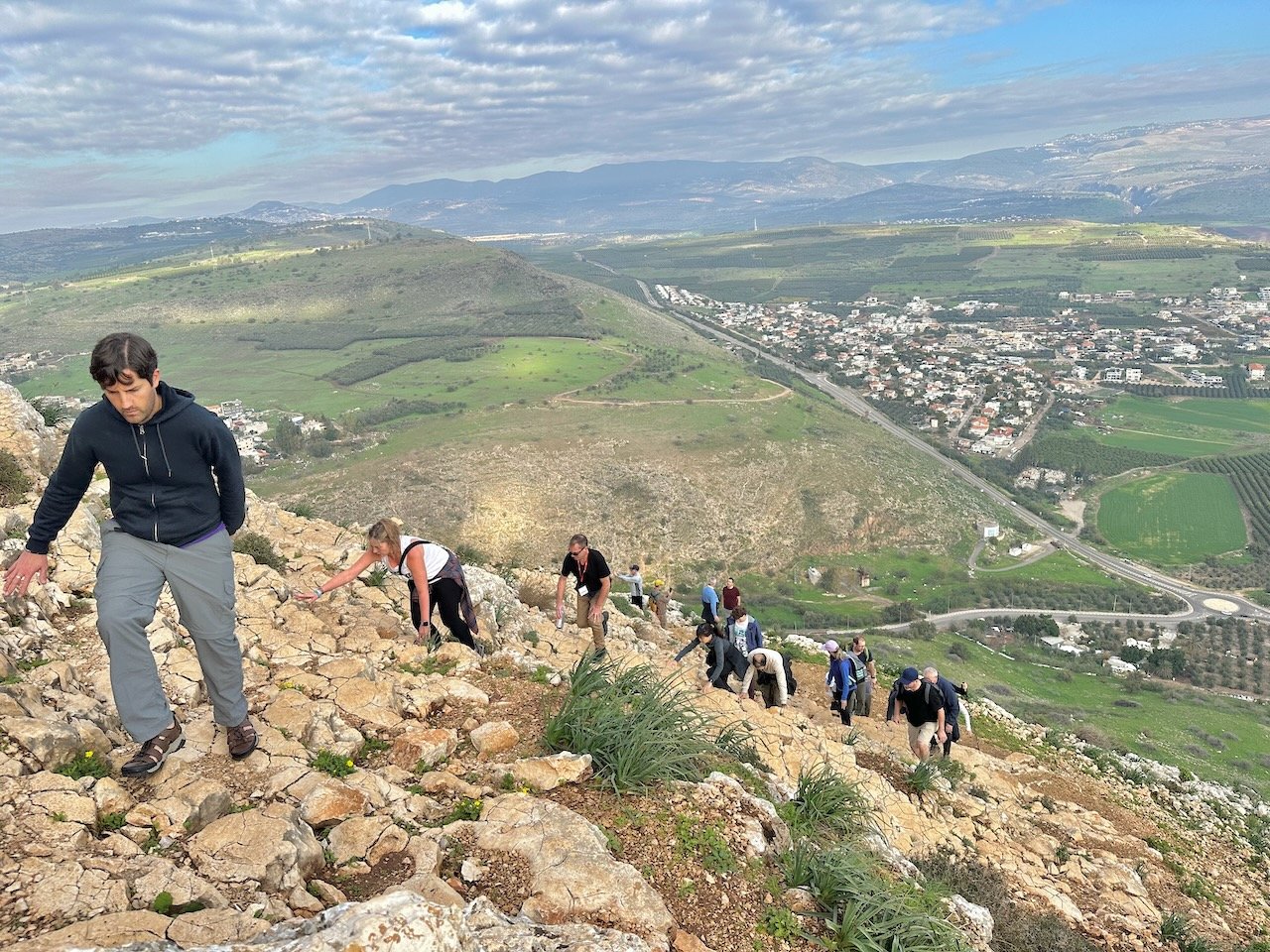
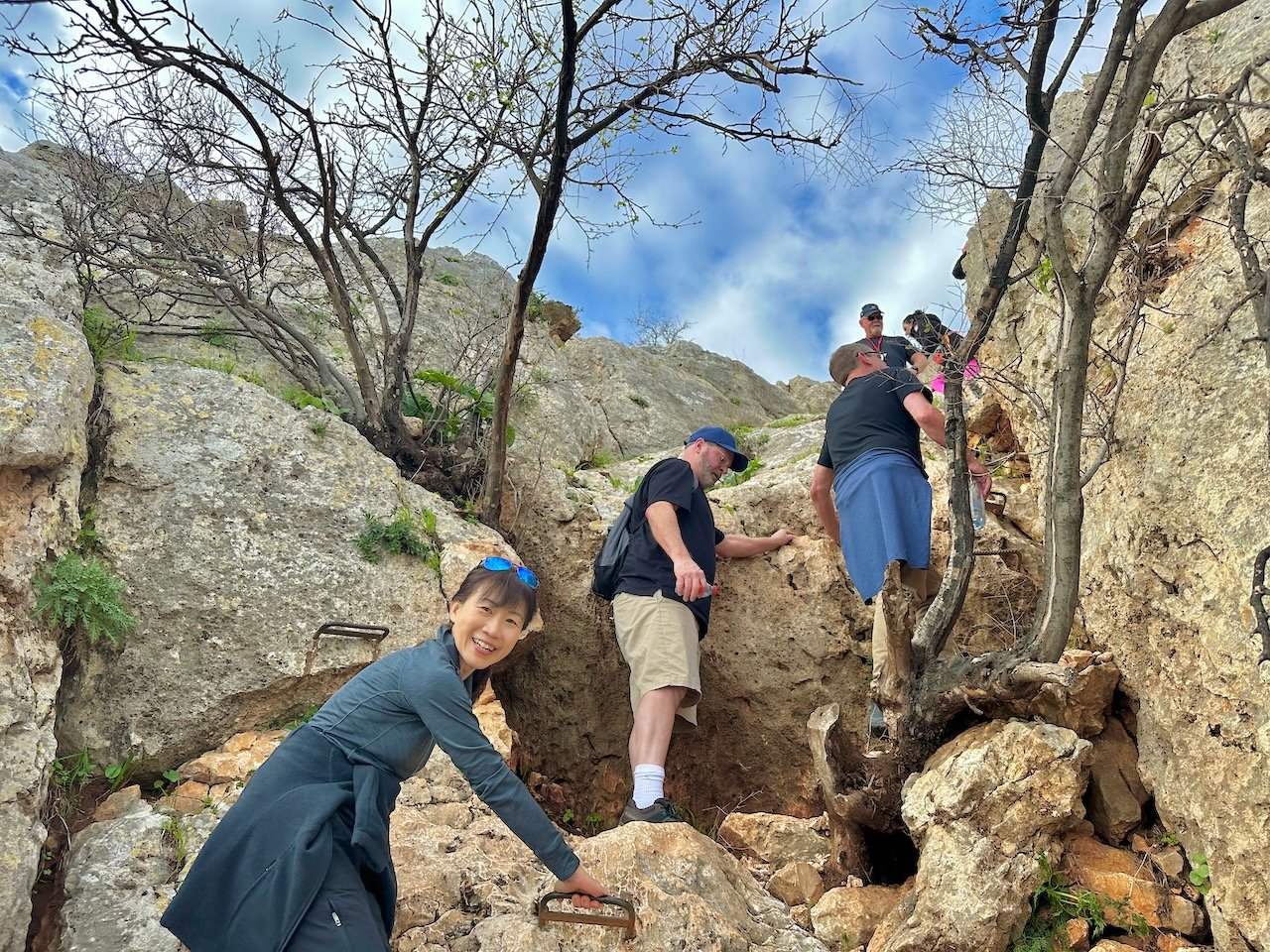
We arrived at the trailhead of Mt. Arbel in 10 minutes. Twenty one (21) in the group hiked to the top on the 1.5 mile with an elevation rise of over 1,000 feet). It was an uphill trail that included handholds at the top. Everyone else in the group bussed around to the other side and ascended to the top from there. The view for everyone was stunning! The snow-capped Mt. Hermon was clearly visible! While we cannot be sure, perhaps this was where the Jesus’ Transfiguration took place (Mt. 17), or perhaps it was on the lower slopes of the cliff where he taught the Sermon on the Mount (Mt. 5-7). Additionally, perhaps this is where Jesus met His disciples following His resurrection (Mt. 28). We also heard Shlomo read Matthew 5 in Hebrew. We intentionally spent some solitary time here, considering the invitation, “Lech Acharia” (Come, follow me). We then walked back down to the busses. We were treated to ice cream before we loaded the bus (thanks Amiel, our Israeli land agency).
Hippos/Sussita
From here, we traveled around south end of the lake to get to Hippos/Sussita. It is actually located on the eastern side of the lake. At Hippos (a Decapolis city), we saw many Roman ruins. During the Byzantine Period (4th-6th centuries AD), there were no less than a half a dozen churches were built here. Upon leaving the site, we read the transformational story of the demoniac from Mark 5.
Optional Visit & Hike – “Hill 713” (Har Mitzpe ha-Yamim)
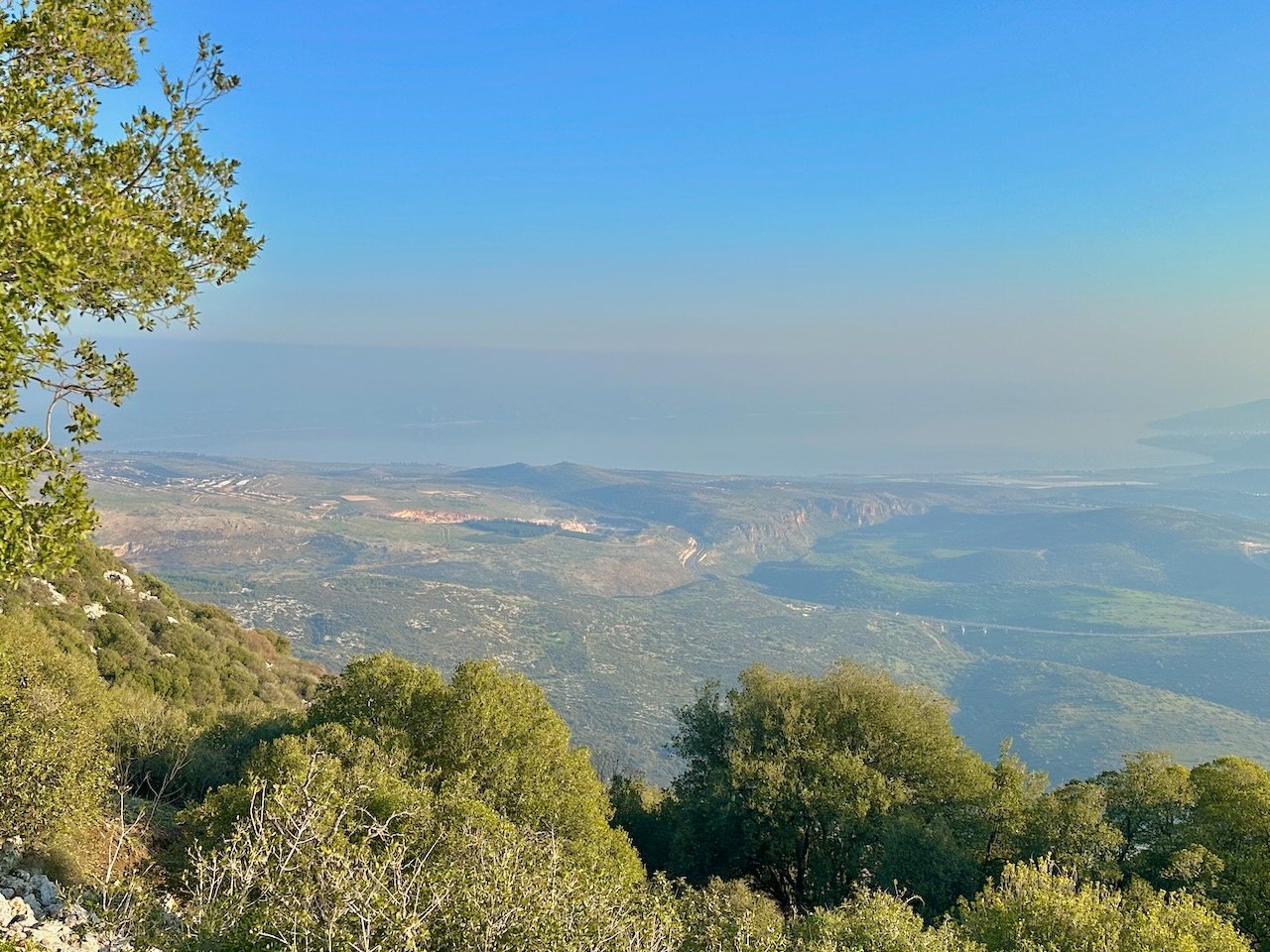
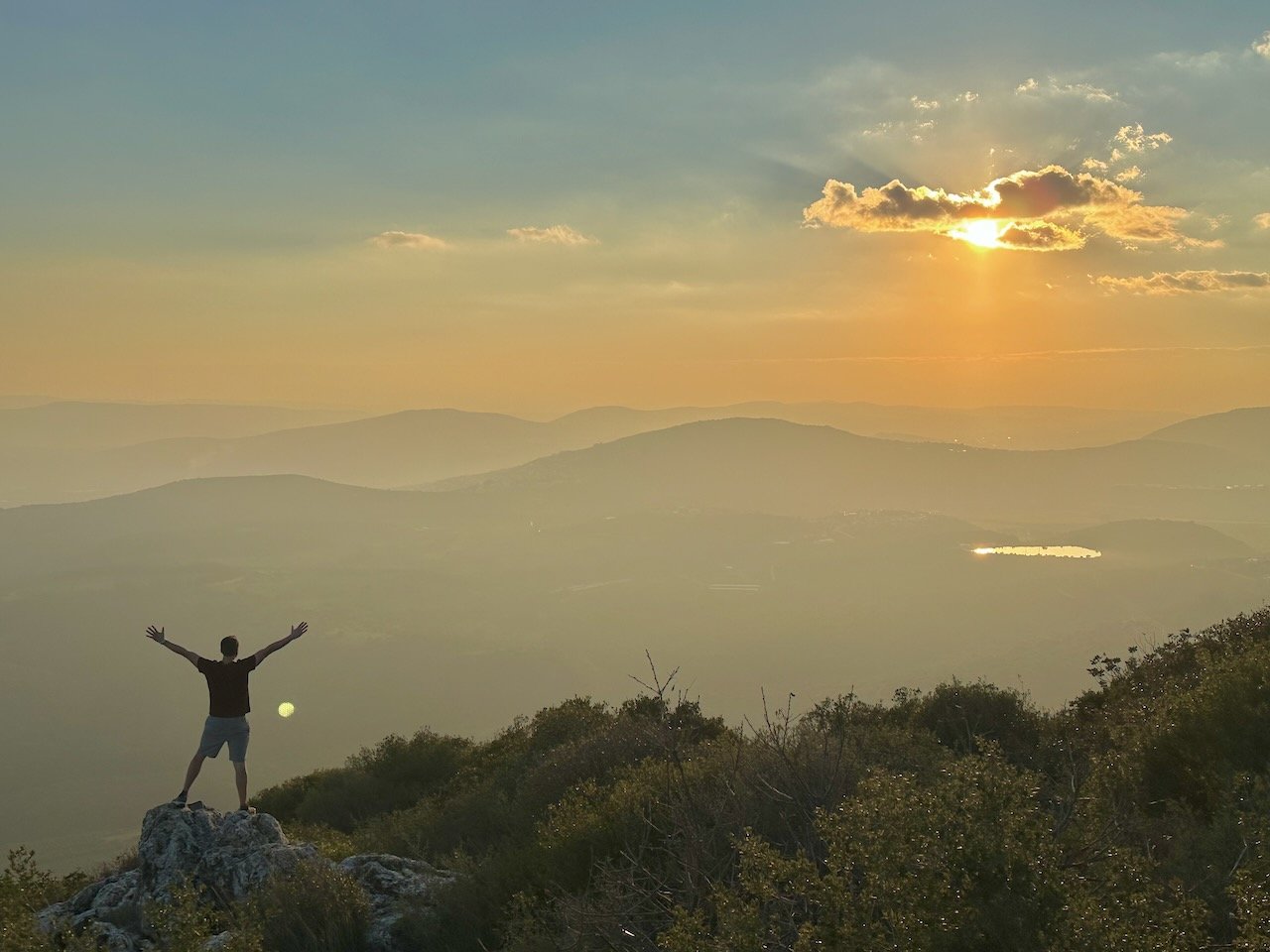
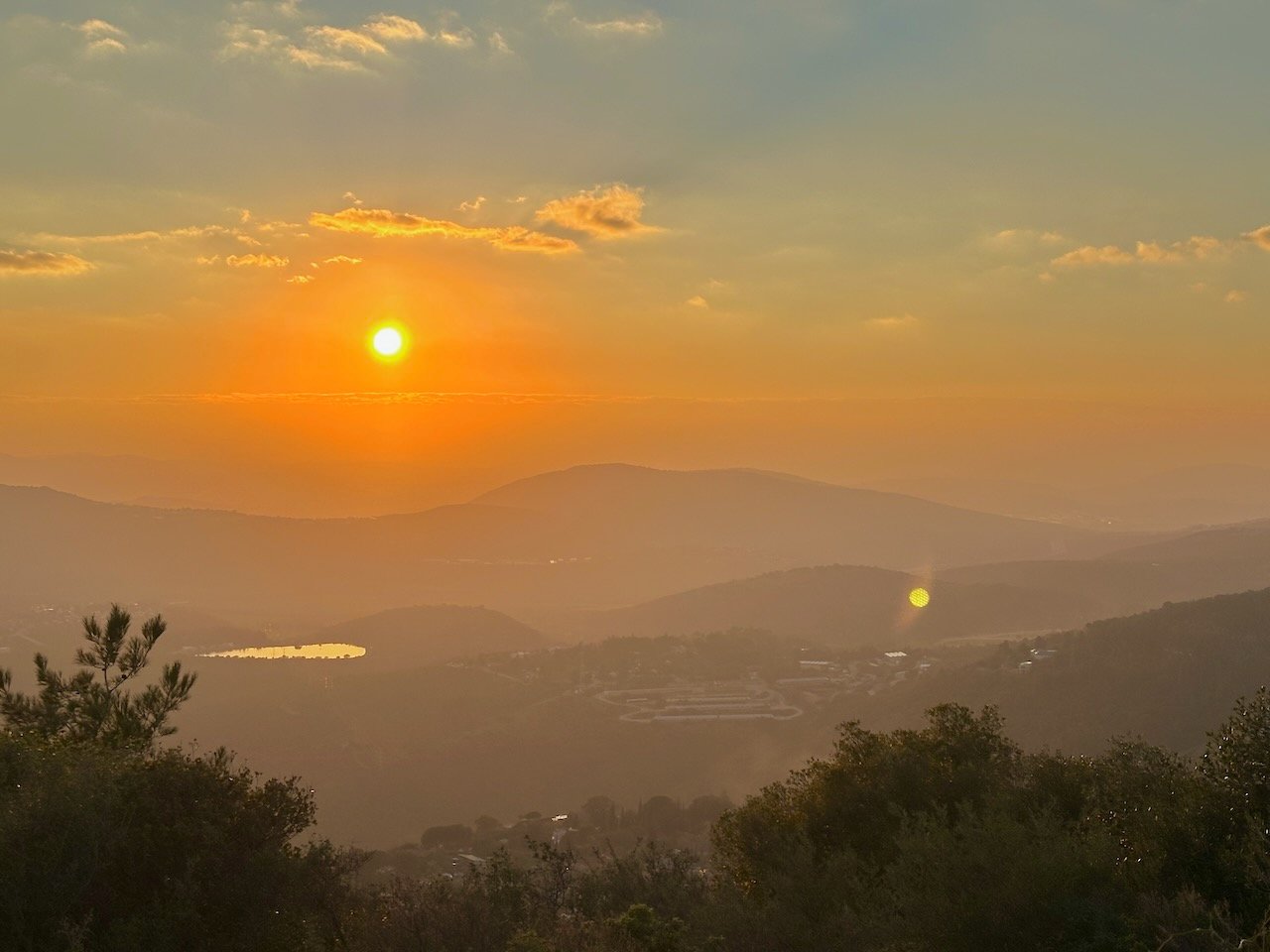
In the mid-afternoon, we dropped some of our group back at the hotel, while the rest of us (37 of us) drove north to the Mt. Merom range, and specially to “Hill 713” (in Hebrew, Har Mitzpe ha-Yamim, the view of two seas). The visibility was descent enough, but the haze was limiting. From here we could literally see across the width of the country, from the Golan Heights and the Sea of Galilee to the east, to the Carmel Range, Haifa, and the Mediterranean Sea (although the haze prevented us from seeing it). Looking south from here we could at least see Tiberias, the Arbel, Mt. Tabor, Mt. Gilboa, and the Nazareth Ridge. It was a special experience. We returned to the hotel for dinner and our another overnight here. We spend the entire day around (and on) the Sea of Galilee.
Day 8 – Saturday, January 17: Magdala, Chorizim & Walk to Capernaum, Jordan River Baptism, Ancient Boat, Sea of Galilee Boat Ride
Day 8 – Saturday, January 17: Yardenit/Jordan River Baptism, Kinneret Cemetery, Magdala, Chorizim & Trail Hike to Capernaum, Tabgha, Peter Primacy, Ancient Boat, Sea of Galilee Boat Ride
Today was another beautiful day. We enjoyed mostly sunny skies again, with highs in the 60s. It was a day of a complete focus on Yeshua/Jesus as we spent time around the lake and on the lake at the end of the day. We even enjoyed a brand new walk from Chorazim to Capernaum. We read from Matthew 13 (about the kingdom parables) as we left the hotel at 7:30.
Jordan River/Yardenit
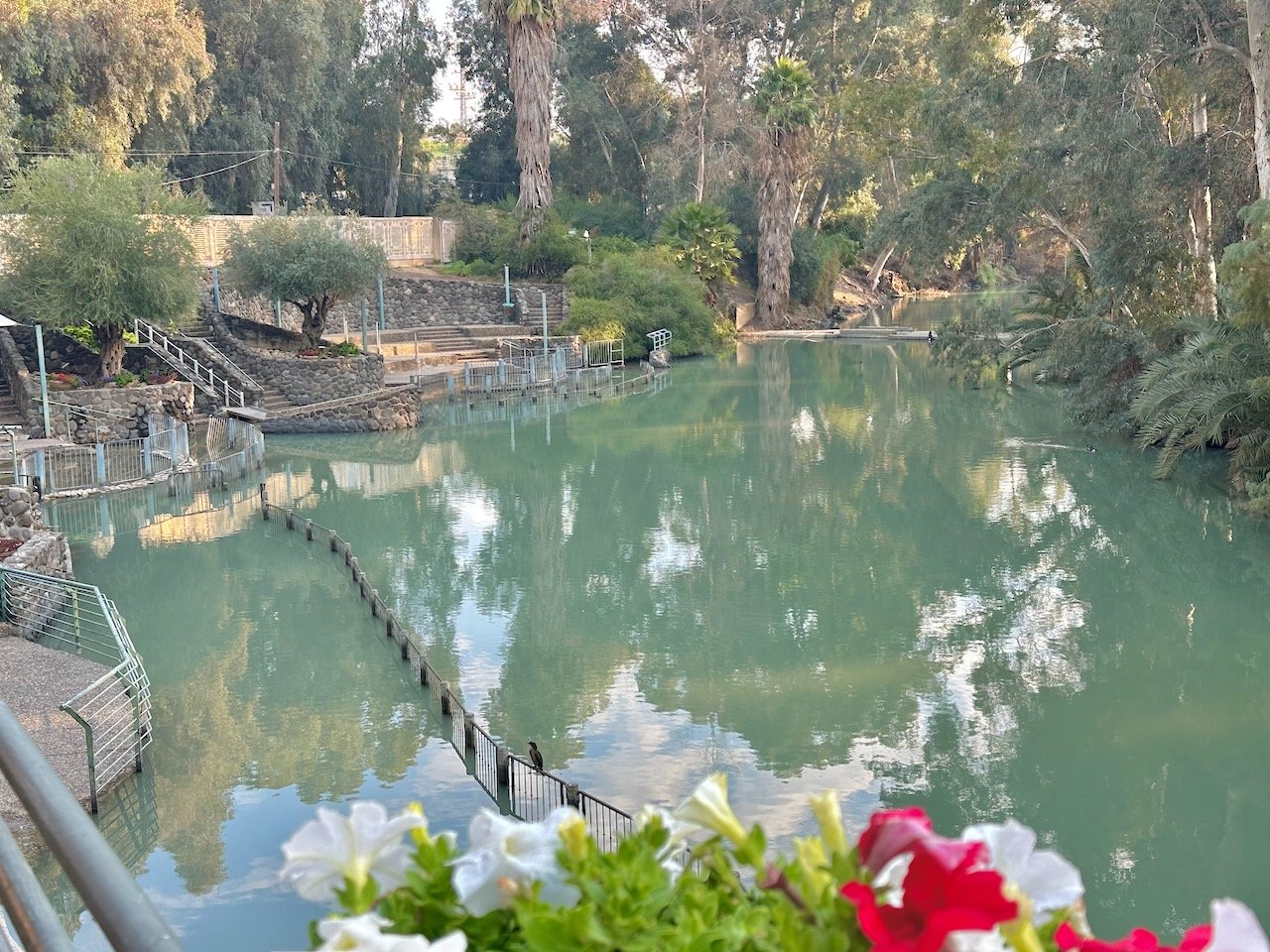
We began the day by driving to the southern end of the lake and to the place called Yardenit. A total of eight in the group reaffirmed their faith as they were immersed in the waters of the Jordan River. There was one who was baptized for the first time! The water was a bit cold, but the experience warmed our hearts. Praise be to God for setting us apart for His kingdom purposes!
Kinneret Cemetery
From the southern end of the lake we now drove north along the western shoreline of the lake. We included an extra stop at the Kinneret Cemetery. This is where an early Jewish pioneer woman named “Rachel” is buried. She was an Ukrainian Jew who wrote poems, some of which were put to songs. She died in 1931.
Magdala
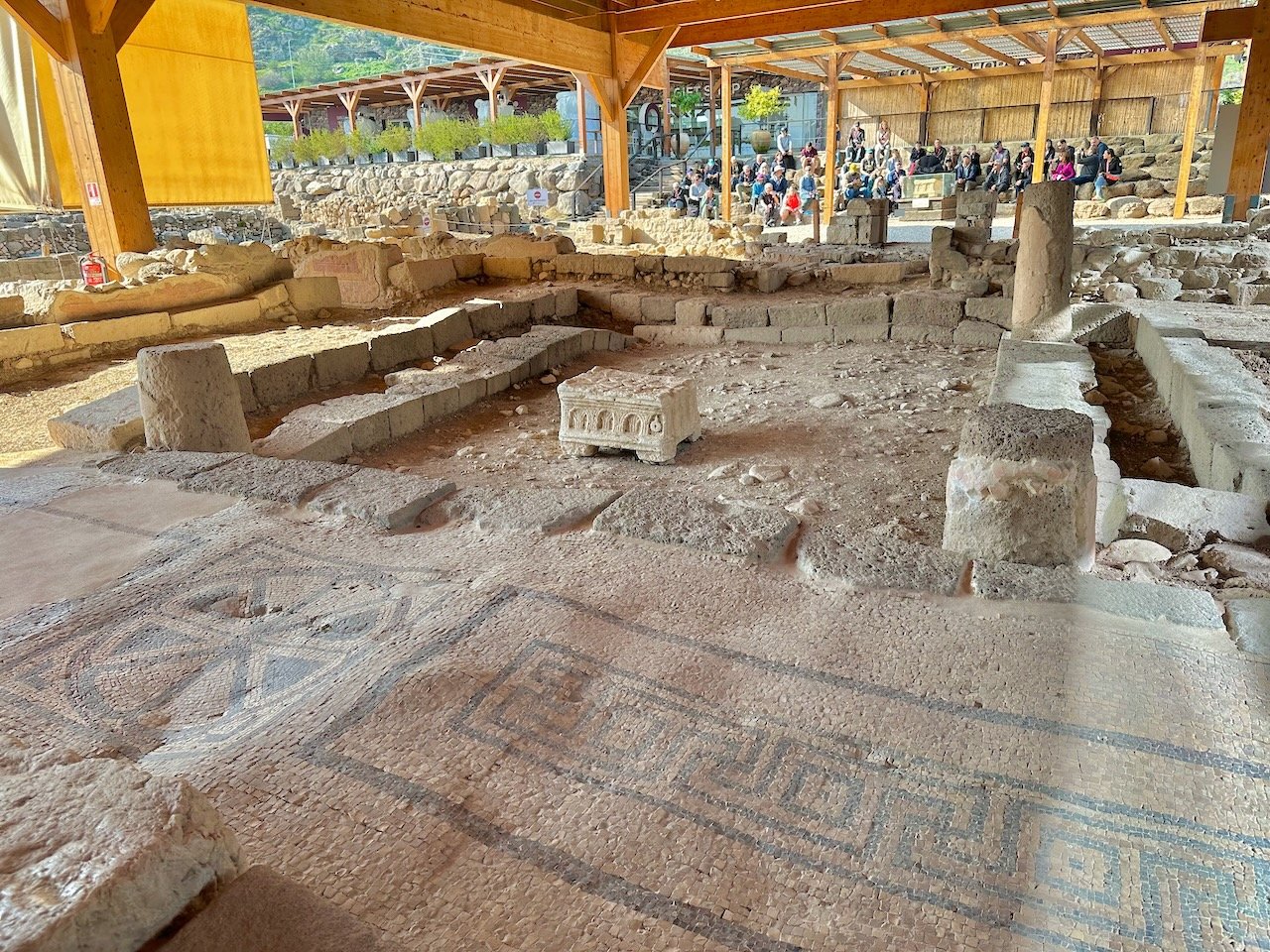
From here we drove to the Plain of Genesseret. Here we visited the ancient city of Magdala. This was a large Jewish city in the days of Jesus. We saw a modest 1st century synagogue here. Although the city is only mentioned once (at the end of Matthew 15), Jesus must have taught here. We also saw qa few ritual baths. We then walked over the chapel and saw wonderful mosaic murals of scenes from the life of Christ, including the Luke 8 story of the woman healed by Jesus. We sounded like angels as we sang a few worship songs in the rotunda. The acoustics were amazing!
Chorazin
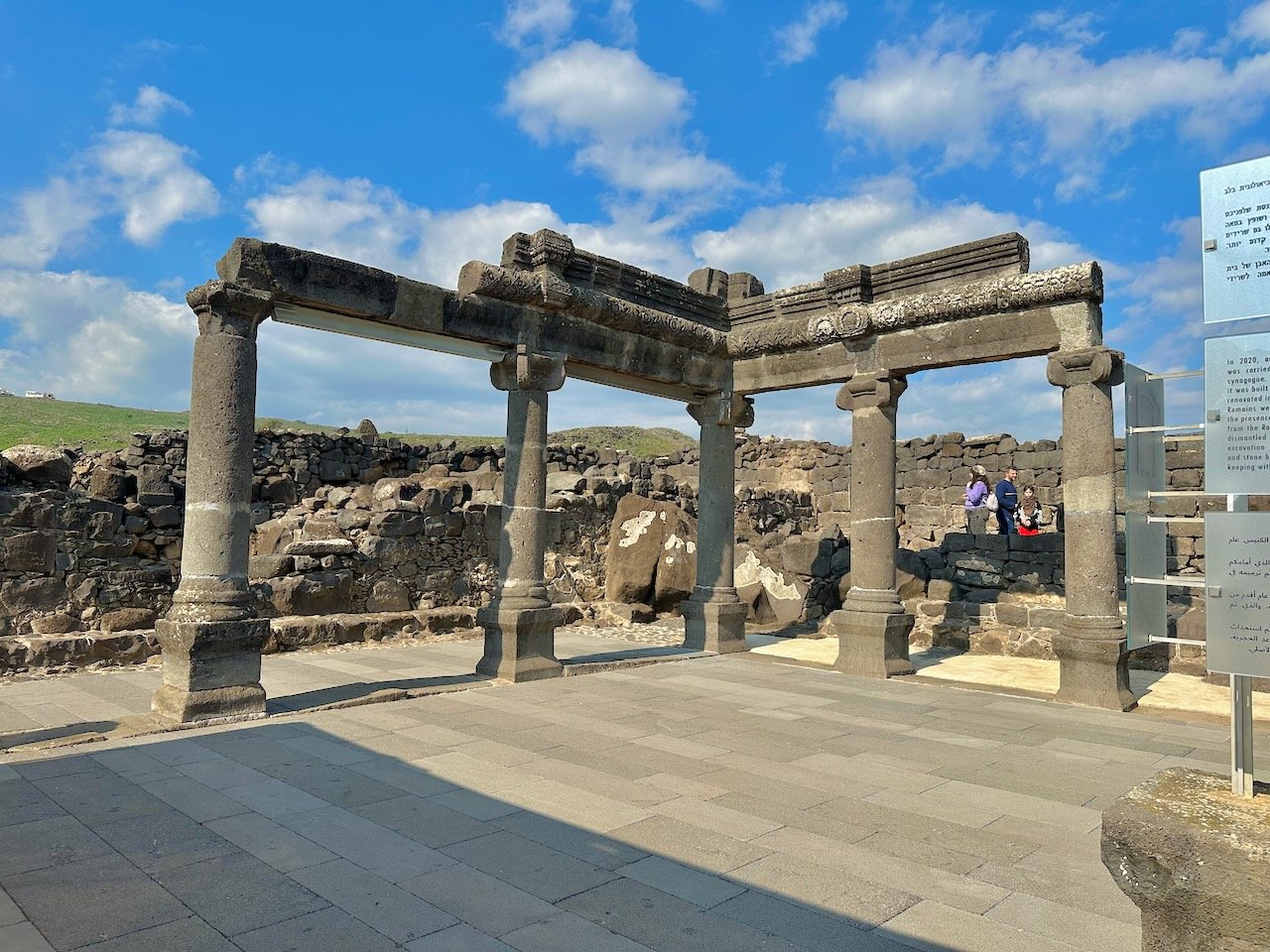
Driving to the northwest corner of the lake and located up on a hill is Chorazin. The visible ruins from this archaeological site are primarily from a 3rd century AD. We saw a wine press as well as the synagogue. During Covid, archaeologists excavated below the 3rd century level of the synagogue and exposed most likely the 1st century level. Chorazin was one of three cities condemned by Jesus because of their unbelief (Matthew 11). We also read from Matthew 23 about the Moses Seat found here about 75 years ago.
Chorazin-Capernaum Trail Hike / Tabgha, Peter Primacy
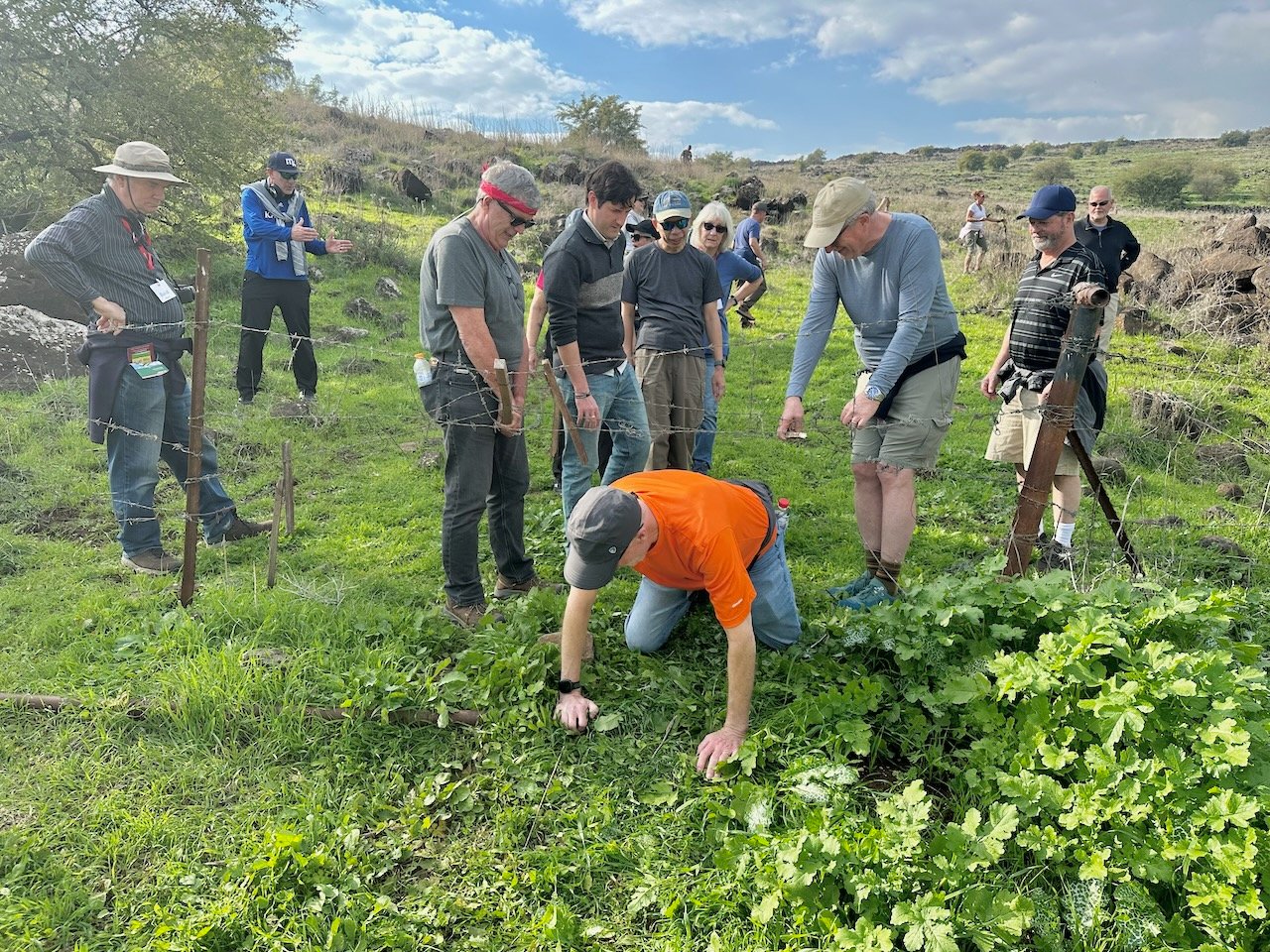
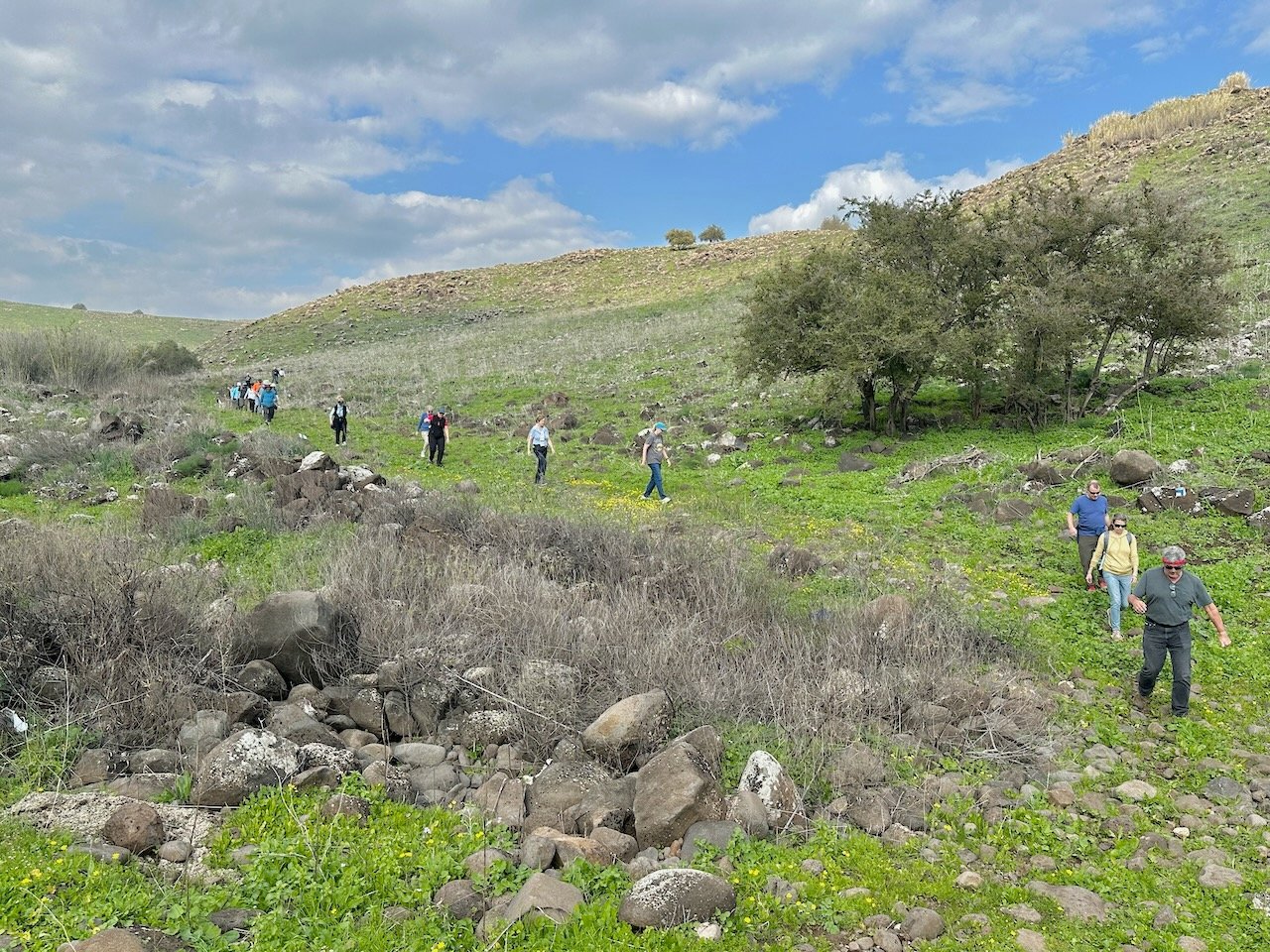
Since last year, a brand new trail that connects Chorazin with Capernaum was made. This is the very first time one of Pastor John’s groups tried it. The first half was incredible, with the trail (downhill pretty much the whole way) well marked. Then we encountered a barb-wire fence. We safely all went under the fence, however, the trail sort of disappeared after this (overgrown and not used). So the 2.5 mile hike turned into about a 3.5 mile hike as we used dirt roads the rest of the way. However, we all enjoyed the walk through the mango and citrus orchards. We made it to Capernaum in about and hour and forty minutes.
Those who did not hike the trail to Capernaum visited Tabgha and Peter’s Primacy with Shlomo. These are traditional sites established by the Byzantine Christians. Tabgha preserves the story of the Feed of the 5,000 (John 6), while Peter’s Primacy marks the post-resurrection narrative of Jesus meeting Hs disciples on the shoreline of the lake (John 21).
Capernaum
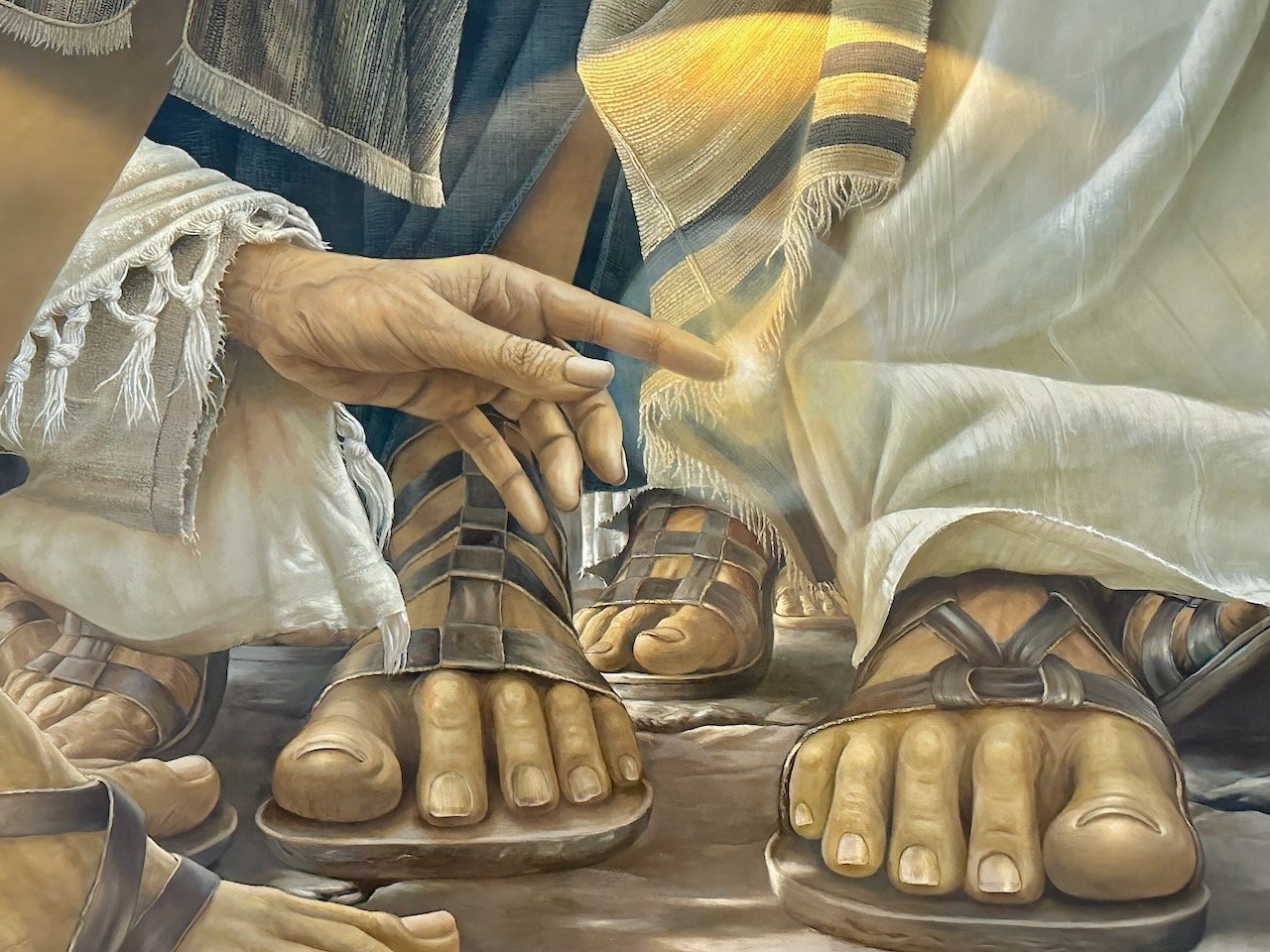
Both groups converged at the ruins of Capernaum. This was the “home base” for his ministry here in the Galilee. Sitting in the late 4th / early 5th century synagogue, we read from Mark 1, 2; Luke 7; and John 6. We also saw many 1st century house structure ruins dating to the time of Jesus. Before we left the site, we spent some time down on the shoreline of the lake where we read the tender passage recored in Mark 9. The miracle of John 4 also involved a royal official from Capernuam as Jesus heals his son from a “distance” ( namely, from Cana 13 miles away). We also remembered it was along the shoreline here where Jesus called His first disciples (Matthew 4). Here at Capernaum Jesus also called Matthew/Levi (Mark 2). In Hebrew, Jesus said “Come, follow me!” (Lech Acharai – (לֶךְ אַחֲרָי) – literally meaning, “Walk after me/imitate me.”
Ancient Boat / Boat Ride
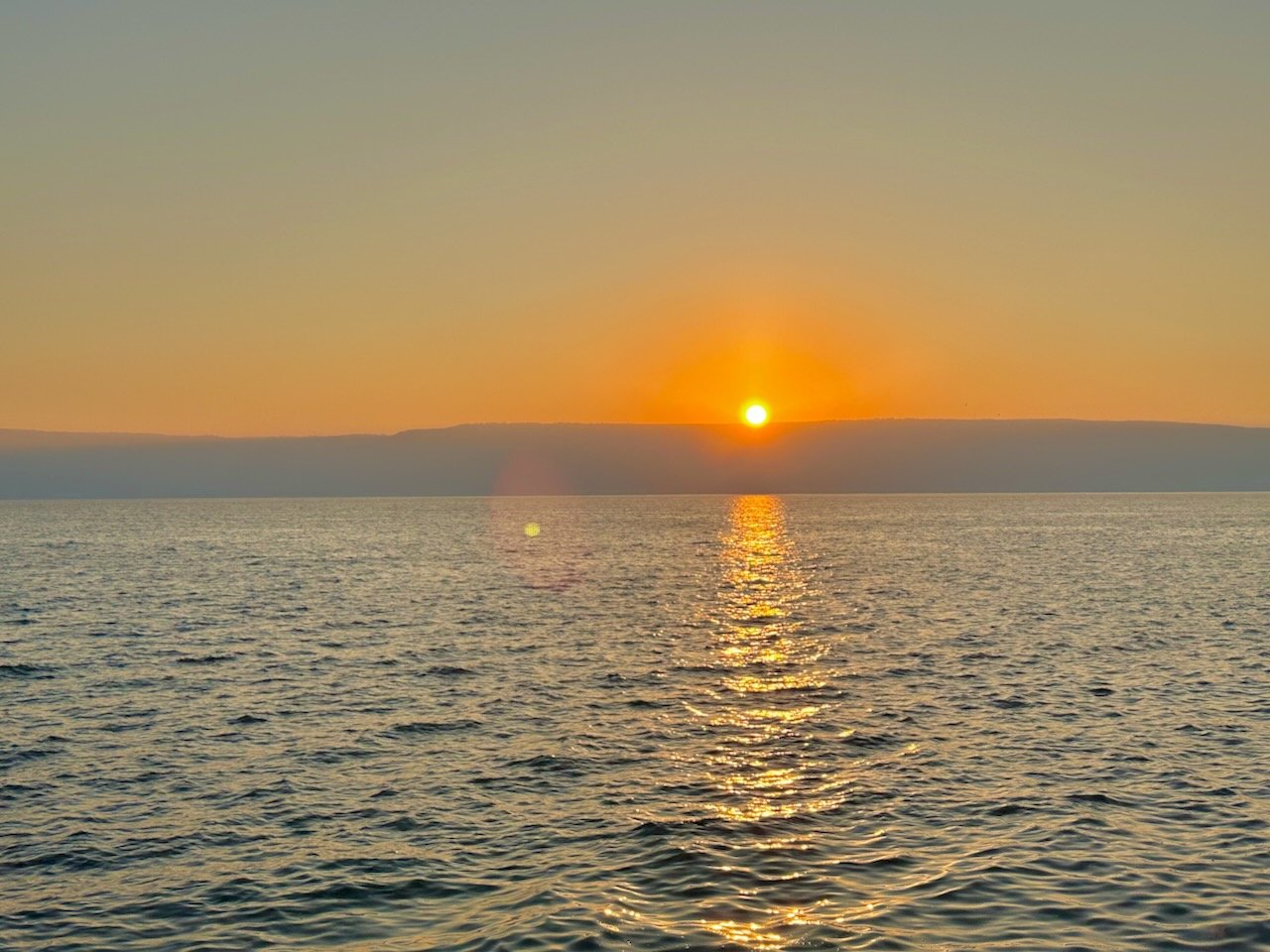
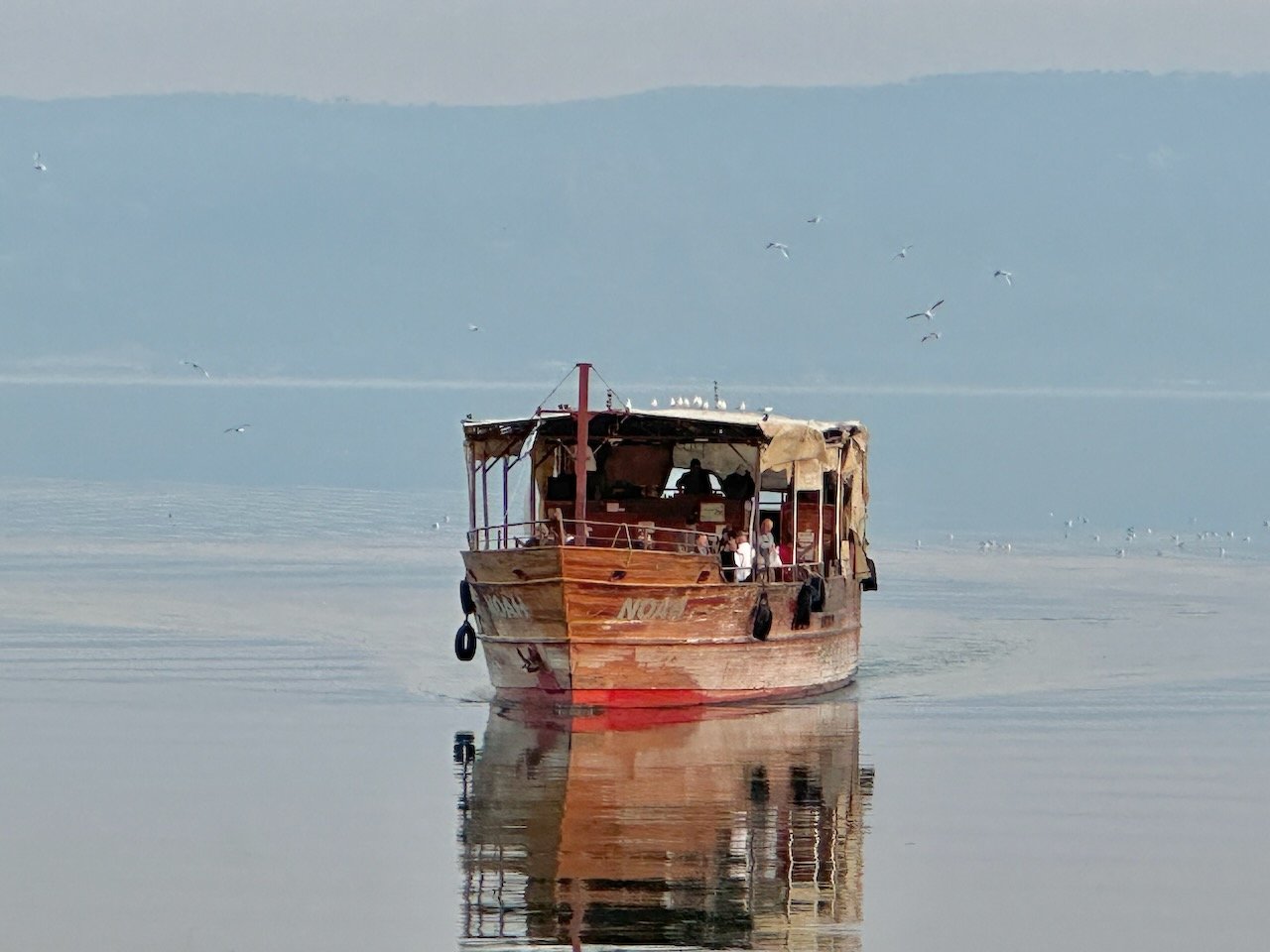
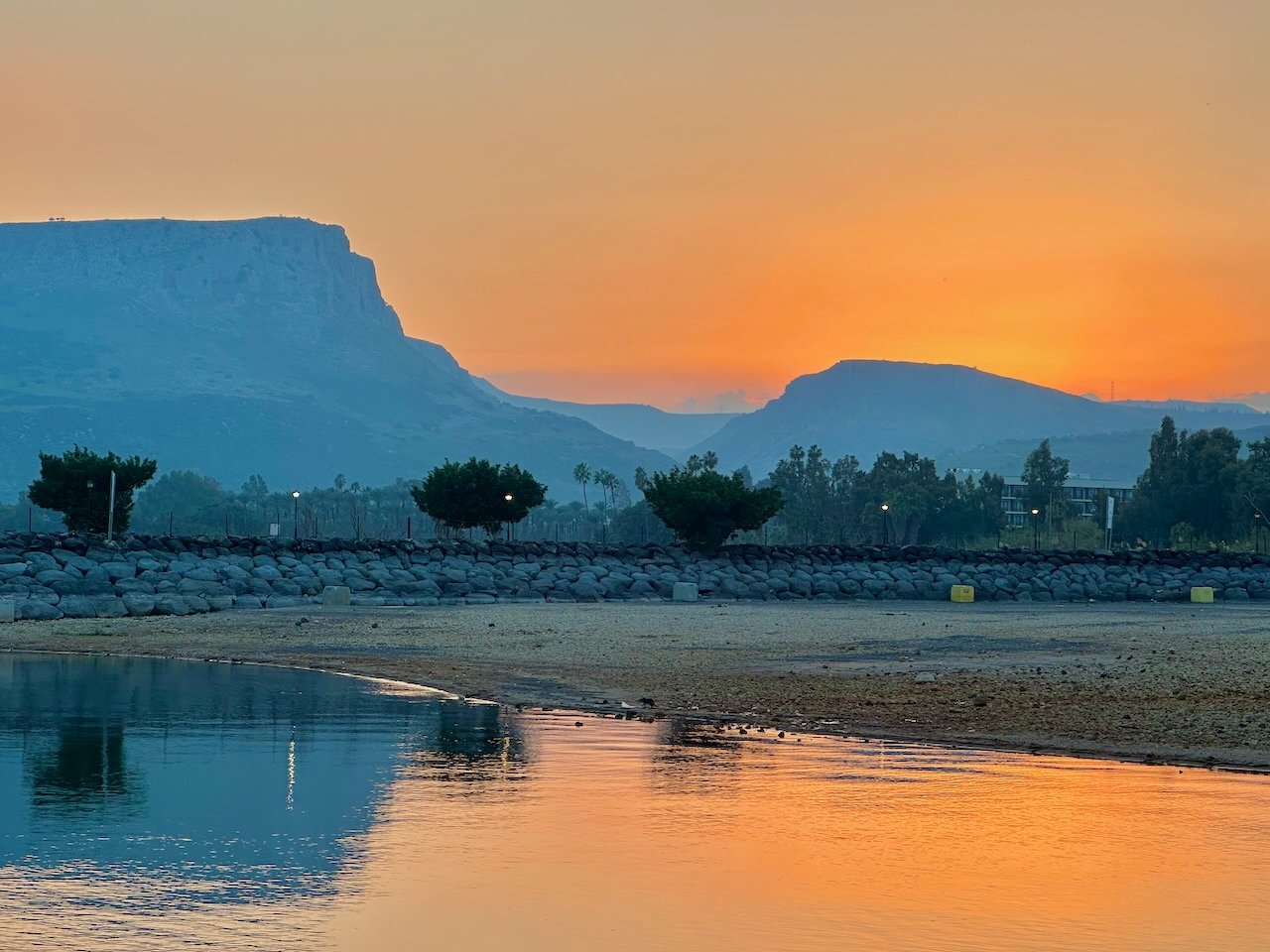
We ended the day towards sunset to Nof Ginnosar. In the museum here we saw an ancient 1st century wooden boat that was discovered in 1986. We then walked out to the dock for our own boat ride. We enjoyed a time of worship and the reading of Mark 4 and Matthew 14, the two storm narratives. We keep our eyes on Jesus! He is the One who brings peace to our lives! The experience was ideal, with calm and quiet waters, and a beautiful sunset over Arbel. We also enjoyed the lights of Tiberias as we docked here.
We drove back to our hotel rooms for dinner and another free evening of leisure. It was another great day with a wonderful group!

Day 9 – Sunday, January 18: Gamla, Qatzrin, Syrian Border, Caesarea Philippi, Dan, Metula (Lebanon Border)
Today we spent the day in the Golan Heights. This region extends 38 miles east from the southern end of the Sea of Galilee up to the slopes of Mt. Hermon and the Syrian border. We encountered cloudy and rainy skies all day long (with heavy fog in some places). Temps were in the high 50s. We left the hotel after another hearty breakfast at 7:35, reading Matthew 5.
Gamla
We drove around the northern part of the lake and began our ascent to the Golan Heights. As we climbed we stopped briefly to look down to the Plain of Bethsaida where the Feeding of the 5,000 took place (Luke 9). The view was very limited because of the fog. We also read Mark 8 (the Bethsaida blind man healed by Jesus).
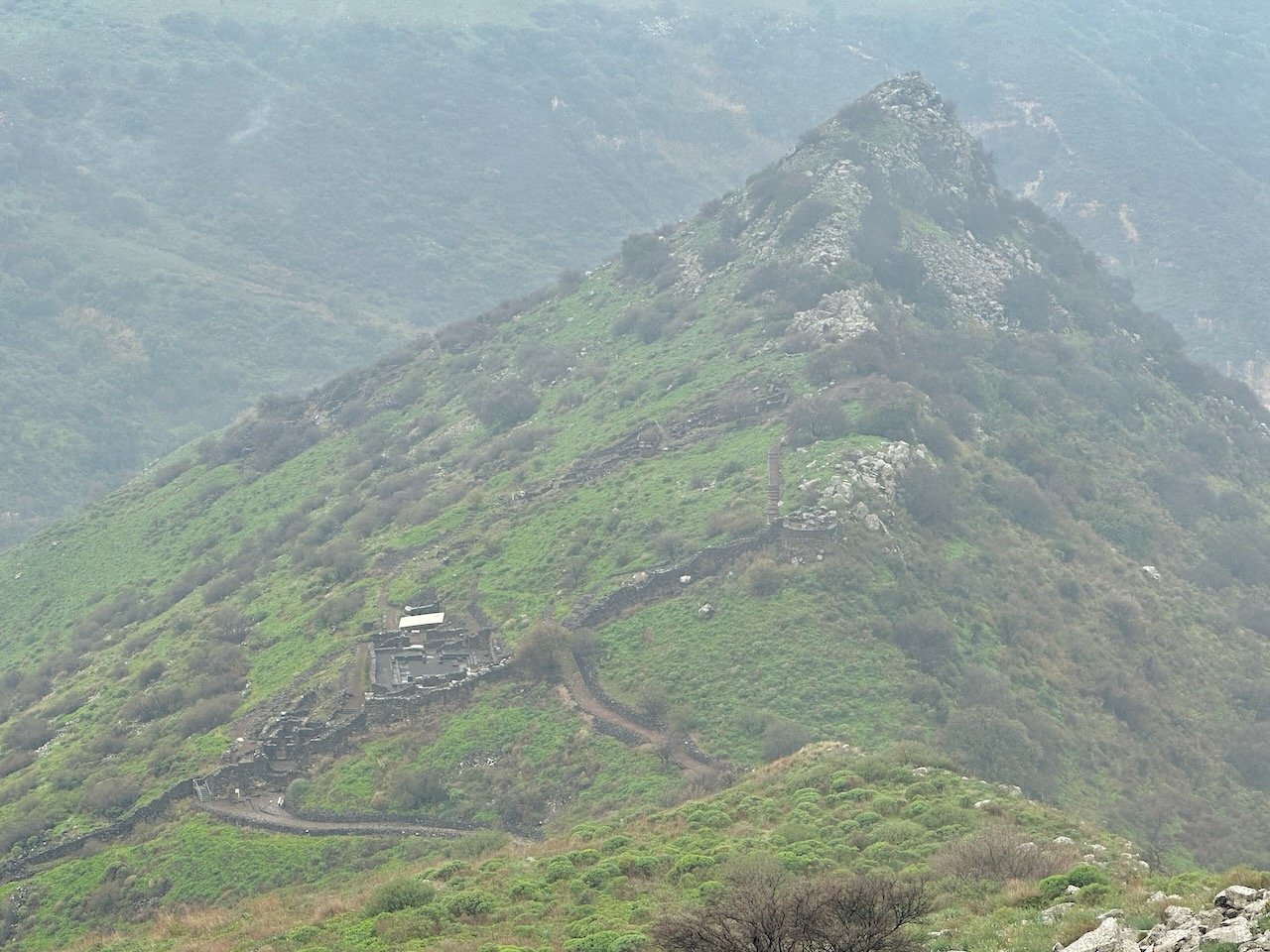
Once we arrived at Gamla, we walked to the overlook of this camel-hump shaped city. Even with the cloudy skies, we could see down to the 1st century synagogue. There is a high probability that Jesus taught here (Matthew 4 & 9). This was a city that was destroyed in 67 AD in the 1st Revolt against the Romans in 67 AD.
Katzrin
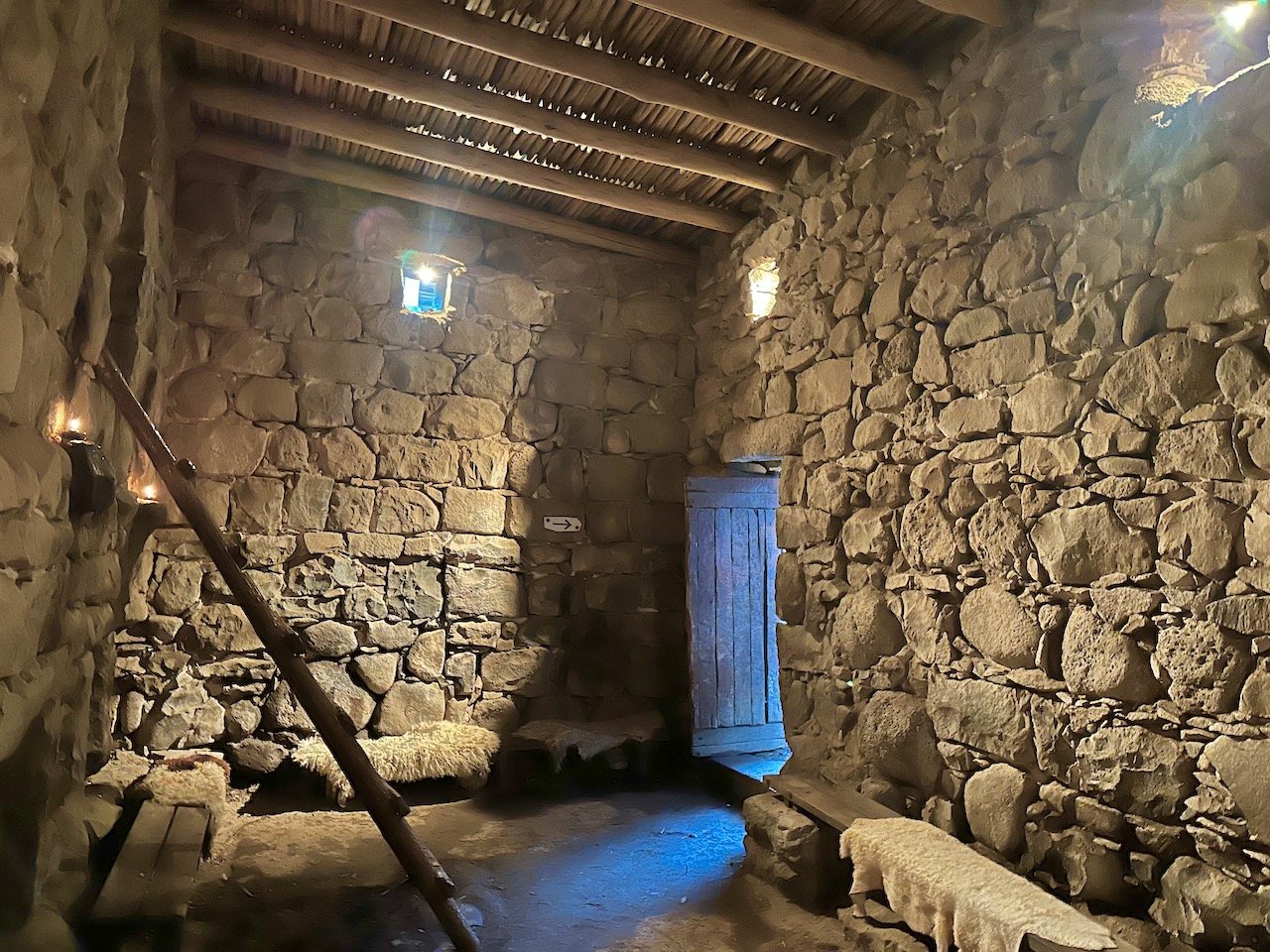
From Gamla we drove to Katzrin. Here we visited this Talmudic Village (3rd-7th century AD) where there were houses, olive presses, and a synagogue discovered. One of these houses (labeled the “House of Rabbi Abun”) has been completely restored. The house is complete with a “kitchen” room, a main residential/living quarters, an upstairs sleeping area, and a flat roof. We heard the story of the paralytic being lowered down from the roof (Mathew 9, Mark 2, Luke 5). Jesus heals him not only physically but his sins are forgiven too.
Syrian Border
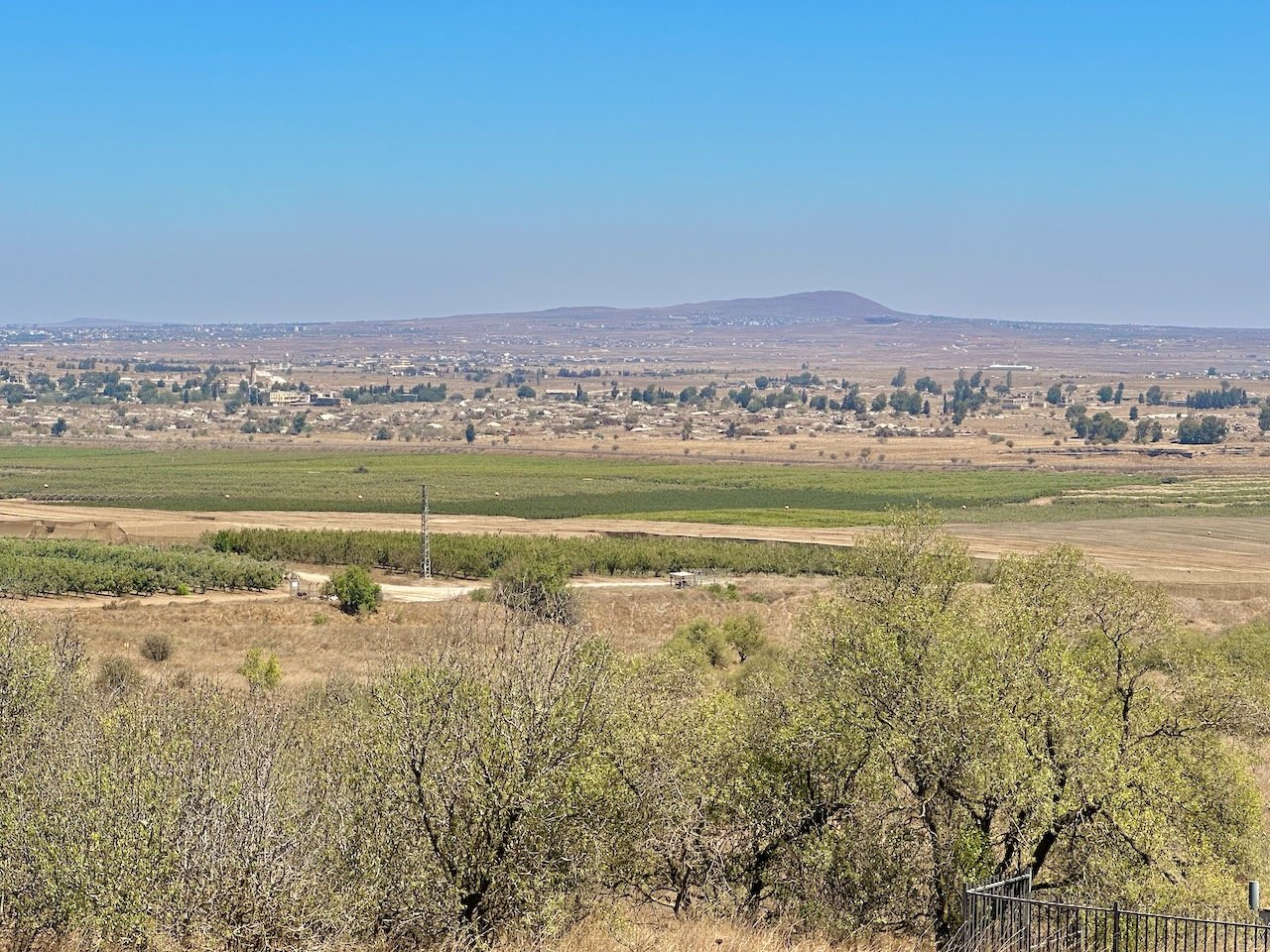
Continuing northward, we stopped for a brief stop to look over into Syria. In the bus Shlomo shared with us some of the recent history with Syria. The heavy fog prevented us from seeing the actual border. As of last year, Israel now controls more of the buffer area, including the outskirts of Quneitra as well as the highest peak of Mt. Hermon (9,200 feet). NOTE: The picture of the Syrian border is from Sept 2025 when the visibility was good.
Saar Falls / Caesarea Philippi
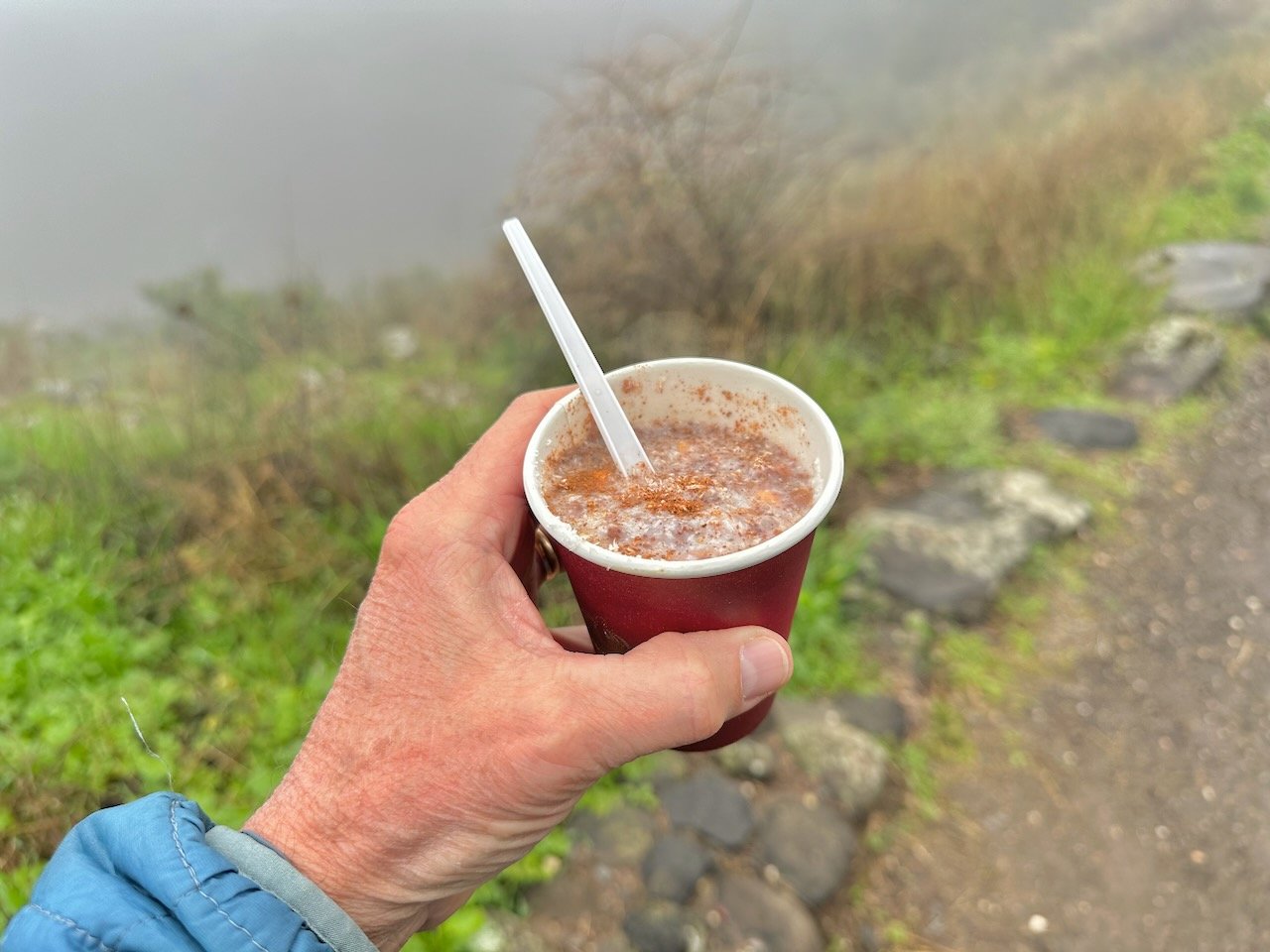
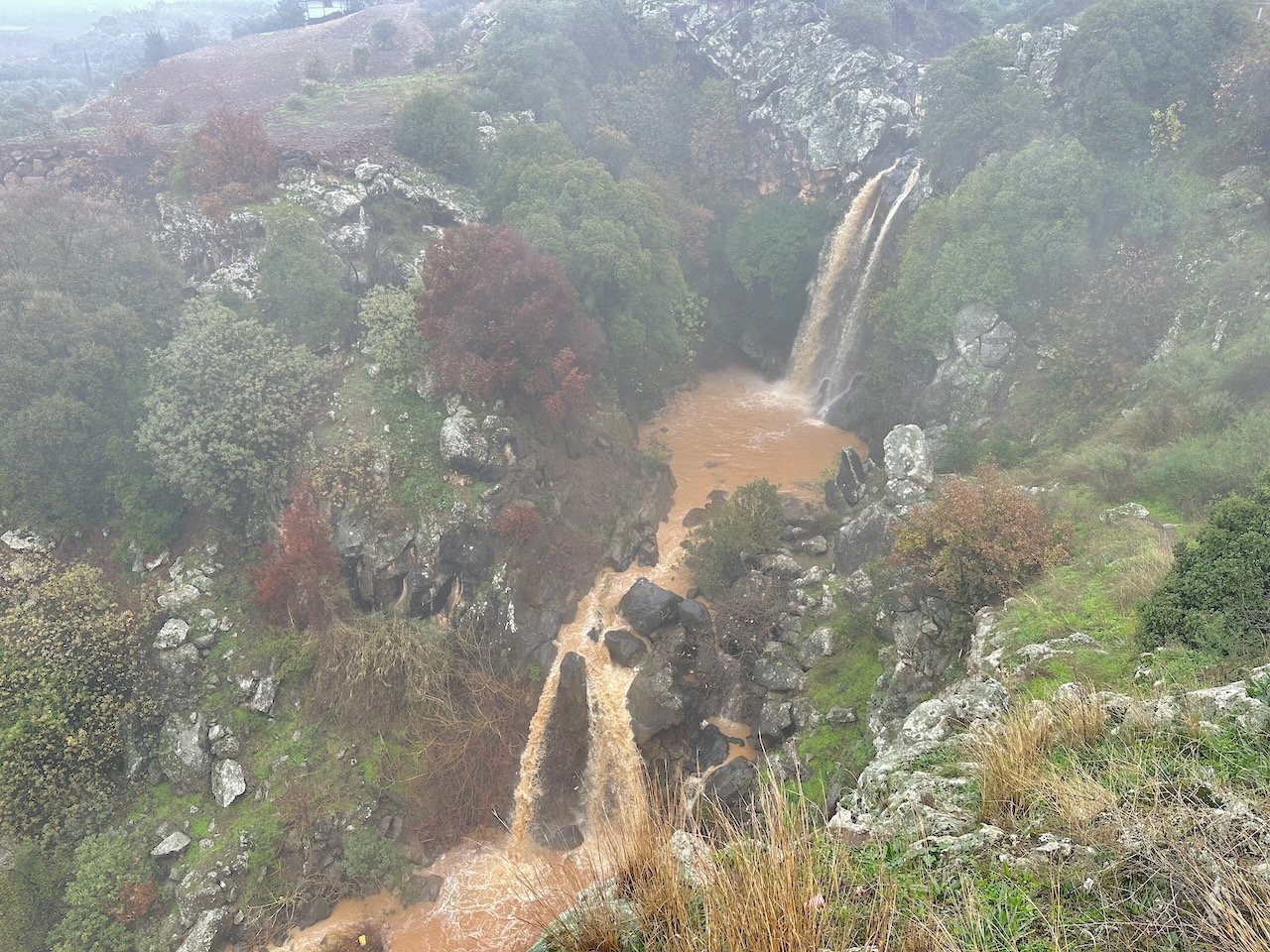
Driving past the snow-capped Mt. Hermon (not visible because the clouds) we drove down off the Golan Heights to the Saar Falls. There was an abundance of water flowing here. We also enjoyed saklab, a unique warm drink of the Druze.
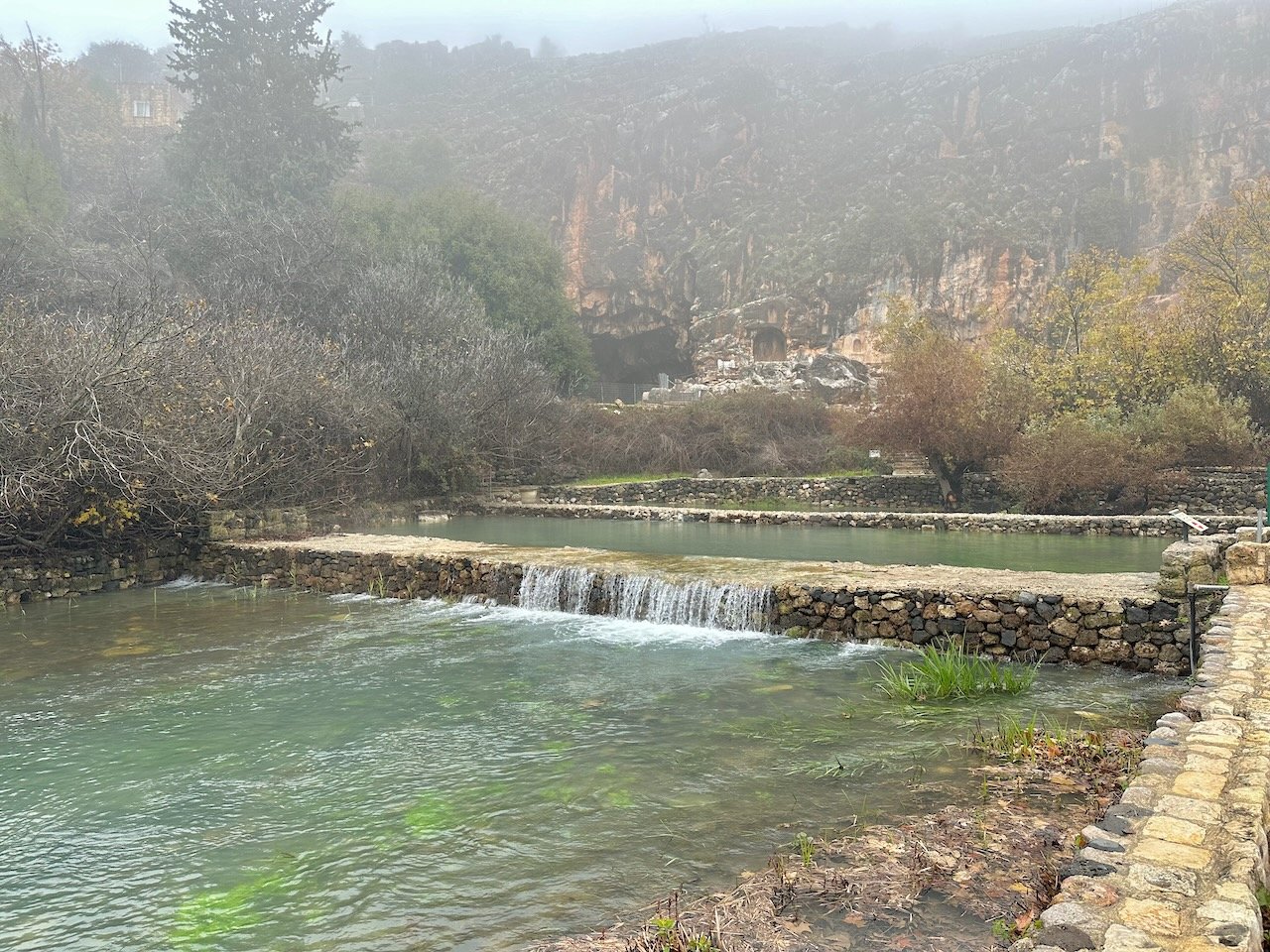
We then continued to Caesarea Philippi. This was a pagan city in the days of Jesus that included temples to Augustus, Zeus (Jupiter), and Nemesis. The Pan deity was especially honored here. It was good to see that recent excavations of the Augustus Temple revealed amazing mosaics and other structures. The Banias Spring begins here, one of the three tributaries of the Upper Jordan River. It was in the region of this city that Jesus asked, “Who do you say I am?” (Matthew 16). We also recalled the Transfiguration of Jesus (Matthew 17) that took place perhaps on the slopes of Mt. Hermon, or further south (on Nimrod? Arbel?).
Tel Dan
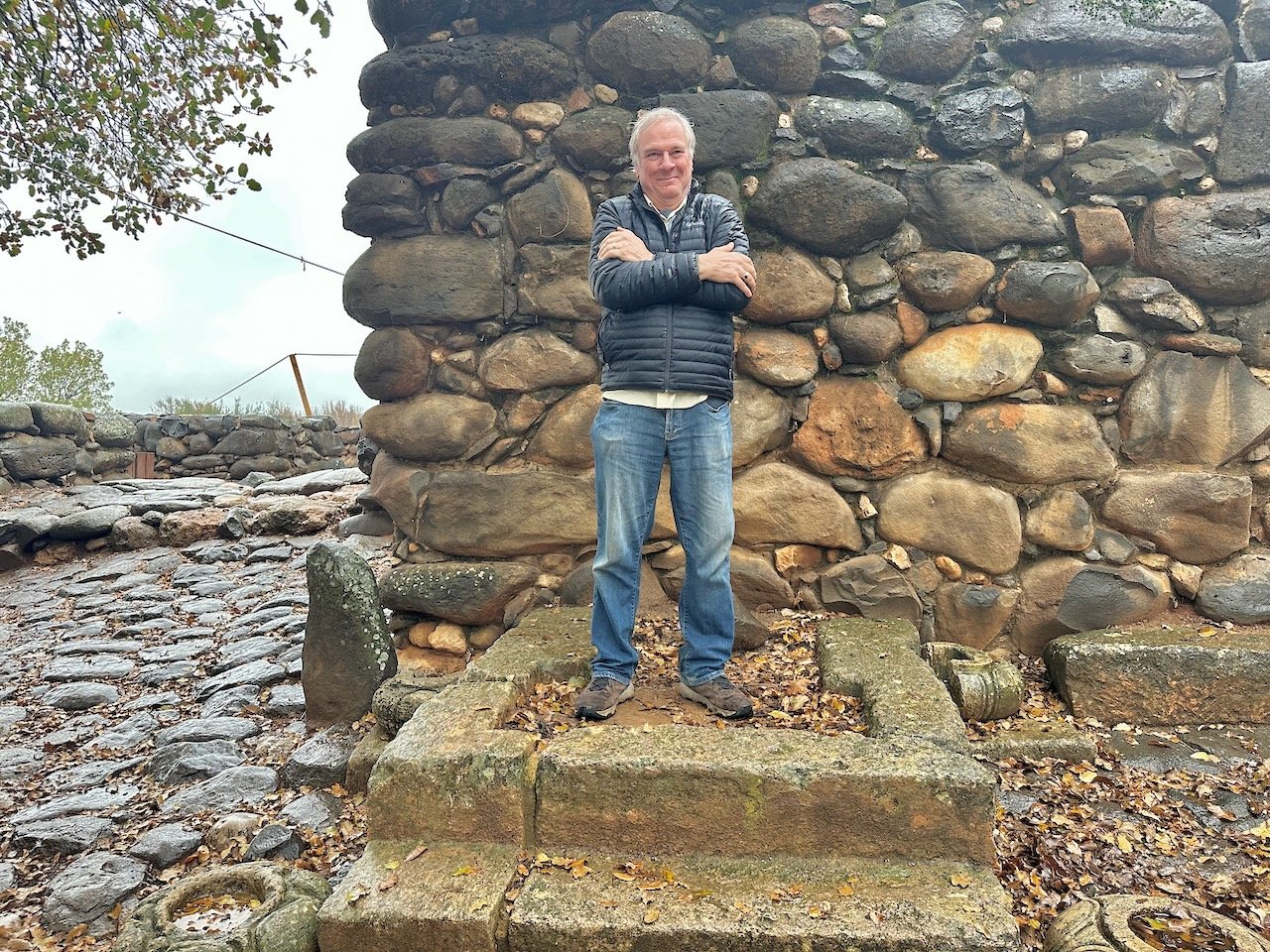
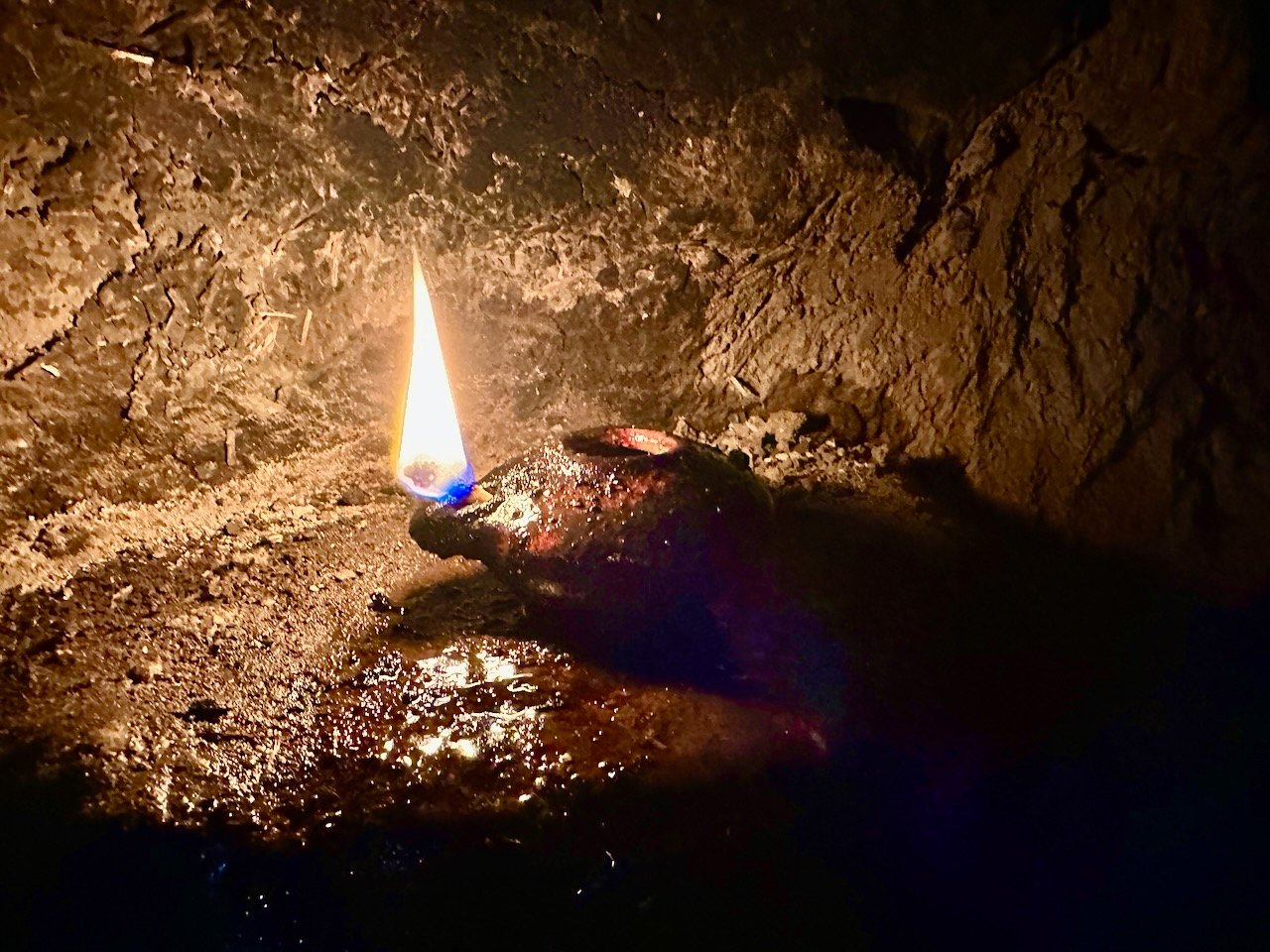
Our last site of the day was Tel Dan. It was not raining when we started the walk, but it was at the end of our visit. First, we walked through the beautiful nature preserve along the Dan Spring. A lot of water was flowing here! The trail led us to the archaeological ruins of the site. Here, Jeroboam built an altar and set a golden calf on the high place. We read from both Judges 18 and 1 Kings 12. A pattern of disobedience here led to the end of Dan in 734 BC. Before leaving, we saw the Canaanite mud brick gate (that was most likely a ceremonial gate built after the time of Abraham) and the Israelite gate complex (9th century BC) where the famous “Dan Inscription” was found in July, 1993.
Metula/Lebanon Border
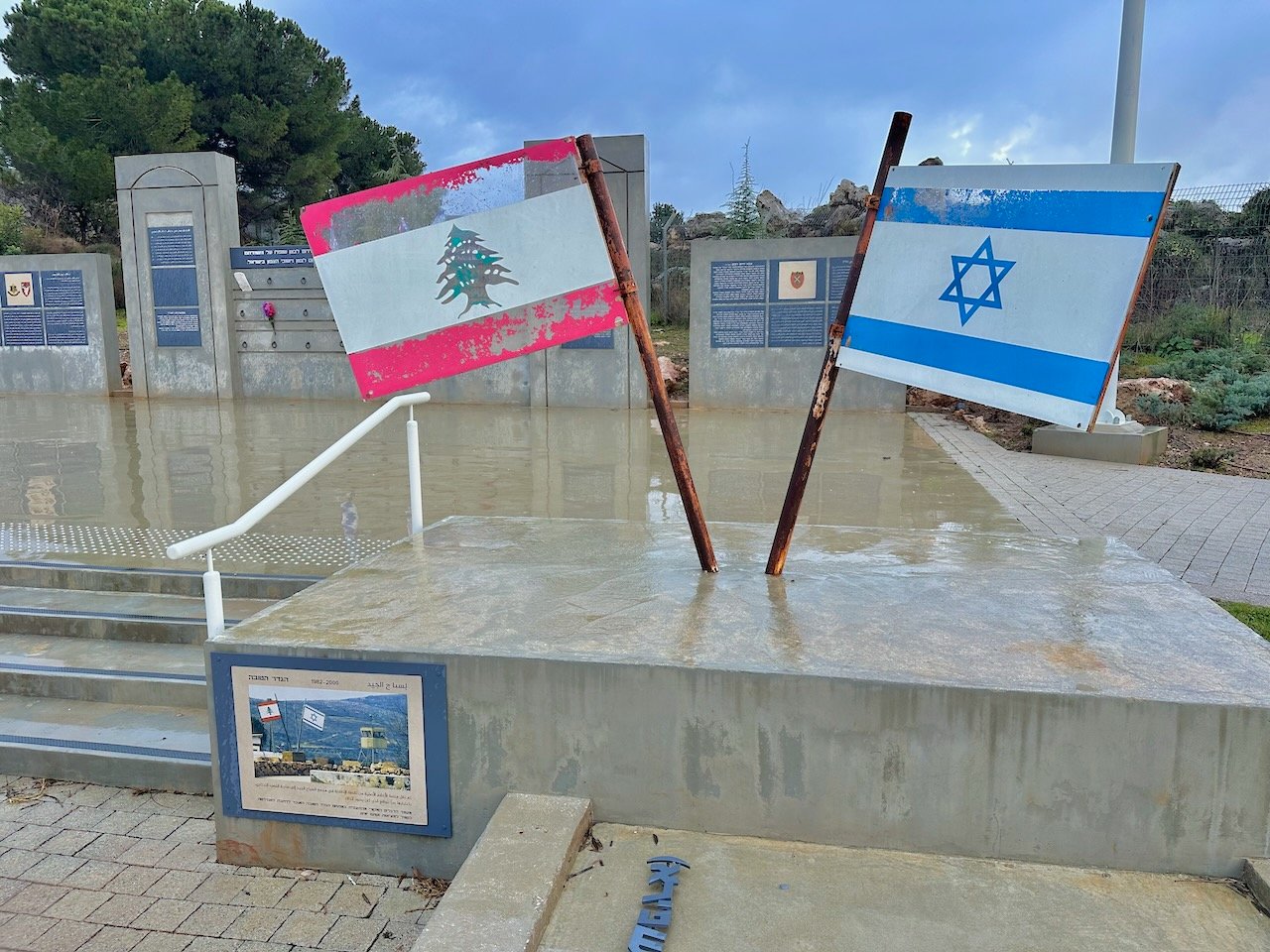
Because of the cloud cover, we decided to forego our visit to Misgav Am (high on the hills of the Naphtali range) and instead drover to the very northern Israeli town of Metula. Shlomo shared both the past history and the current situation with Lebanon. We saw the border and a Memorial here.
We drove back south along the Huleh Valley back to our hotel, passing the Canaanite city of Hazor on the way. Once again, we enjoyed a huge dinner and a free evening. Despite the weather, we still saw a lot!
Day 10 – Monday, January 19: Precipice of Nazareth, Megiddo, Mt. Carmel, Caesarea, Jerusalem
Today was a sunny day once again. The rains stopped last evening. While it was cooler (highs in upper 50s), we enjoyed clear and very visible skies!We read portions of Mathew 6-7 (more of the Sermon on the Mount) as we checked out of the hotel, loaded the bus, and departed at 7:30.
Precipice of Nazareth
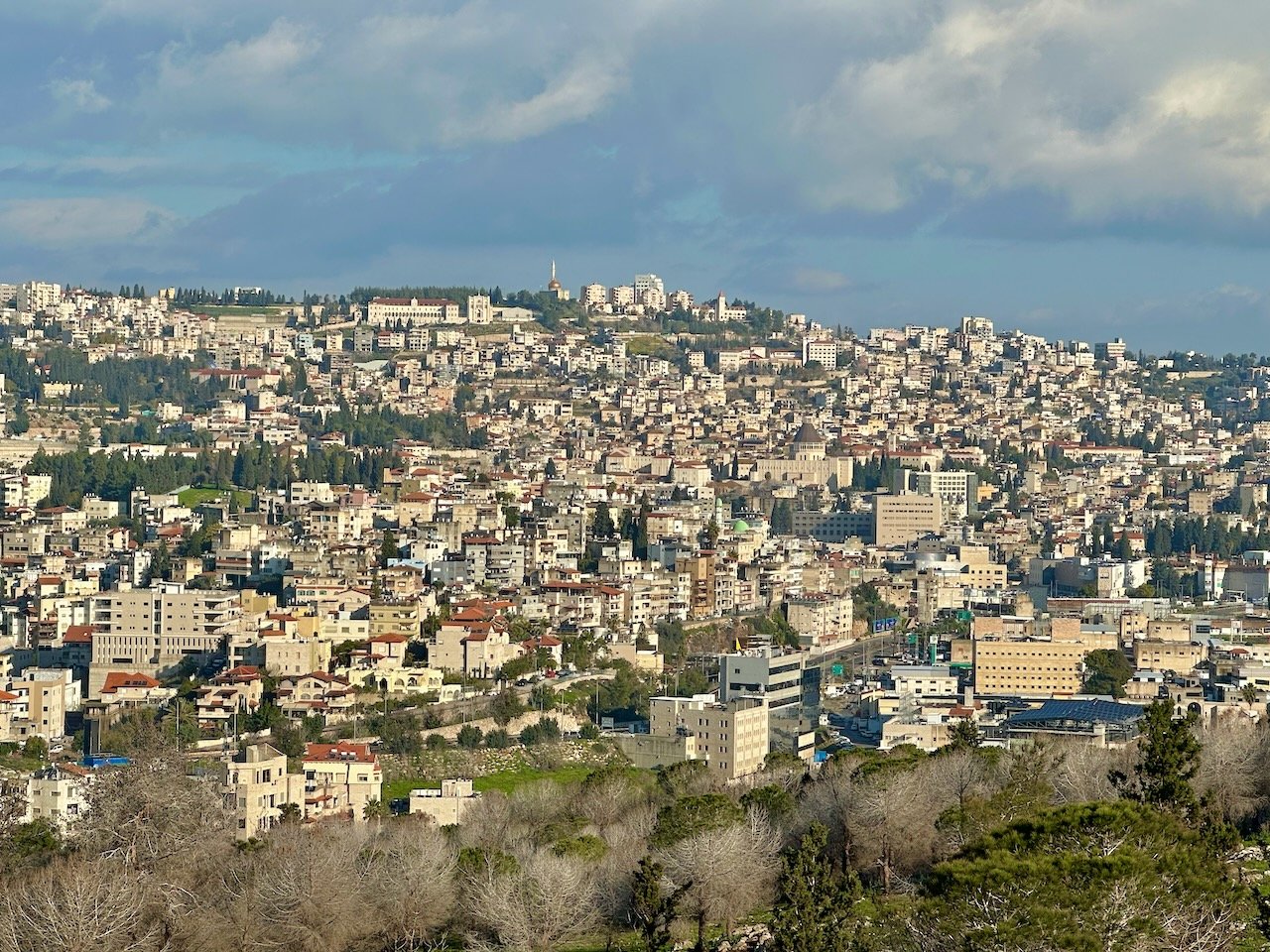
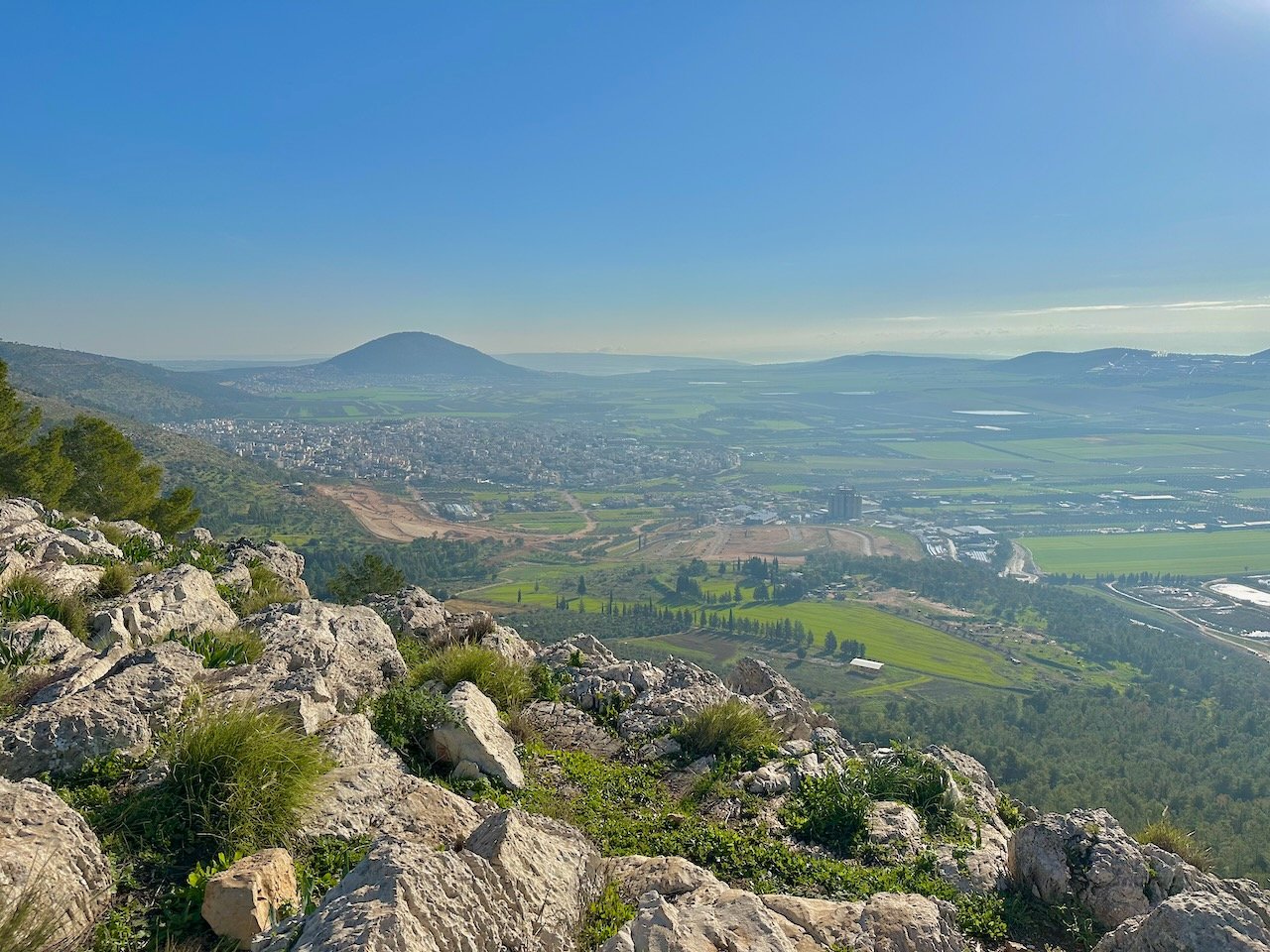
We drove south through the modern town of Cana (the real Cana is located in the Lower Galilee along the Beit Natofa Valley) to get to the Precipice of Nazareth. The visibility from here permitted us to see Mt. Tabor (Judges 4), the Hill of Moreh (Judges 7), Afula (“Ophrah,” the home of Gideon, Judges 6), and even Mt. Carmel to the west (1 Kings 18). We considered the life of Jesus as read from Luke 4 and John 1. We were encouraged by the words of Philip who said, “Come and see!” In response to Nathaniel’s question, “What good can come out of Nazareth?” (John 1). We enjoyed listening to “Jesus Messiah” here before we walked on the trail leading back to the bus.
Megiddo
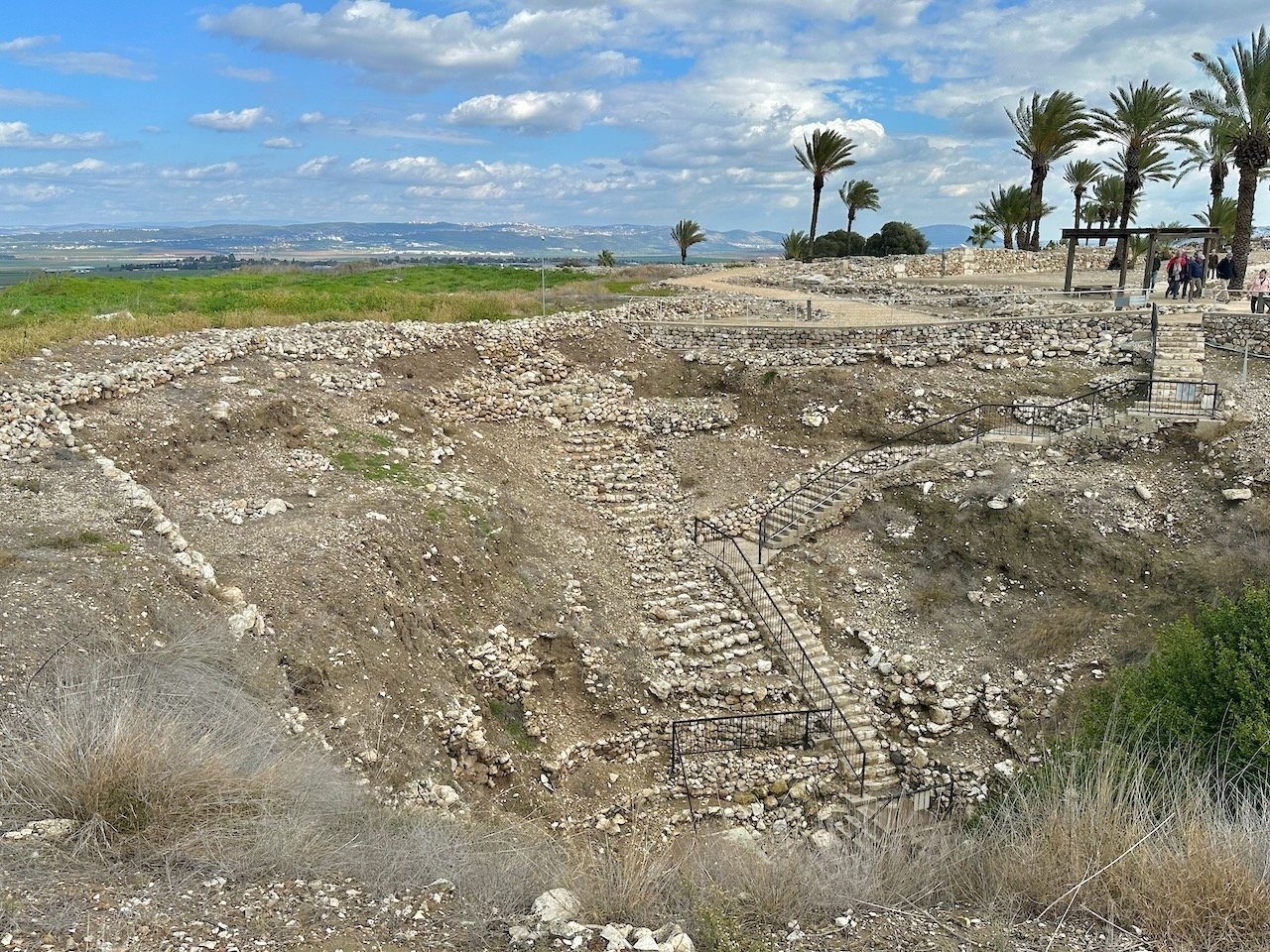
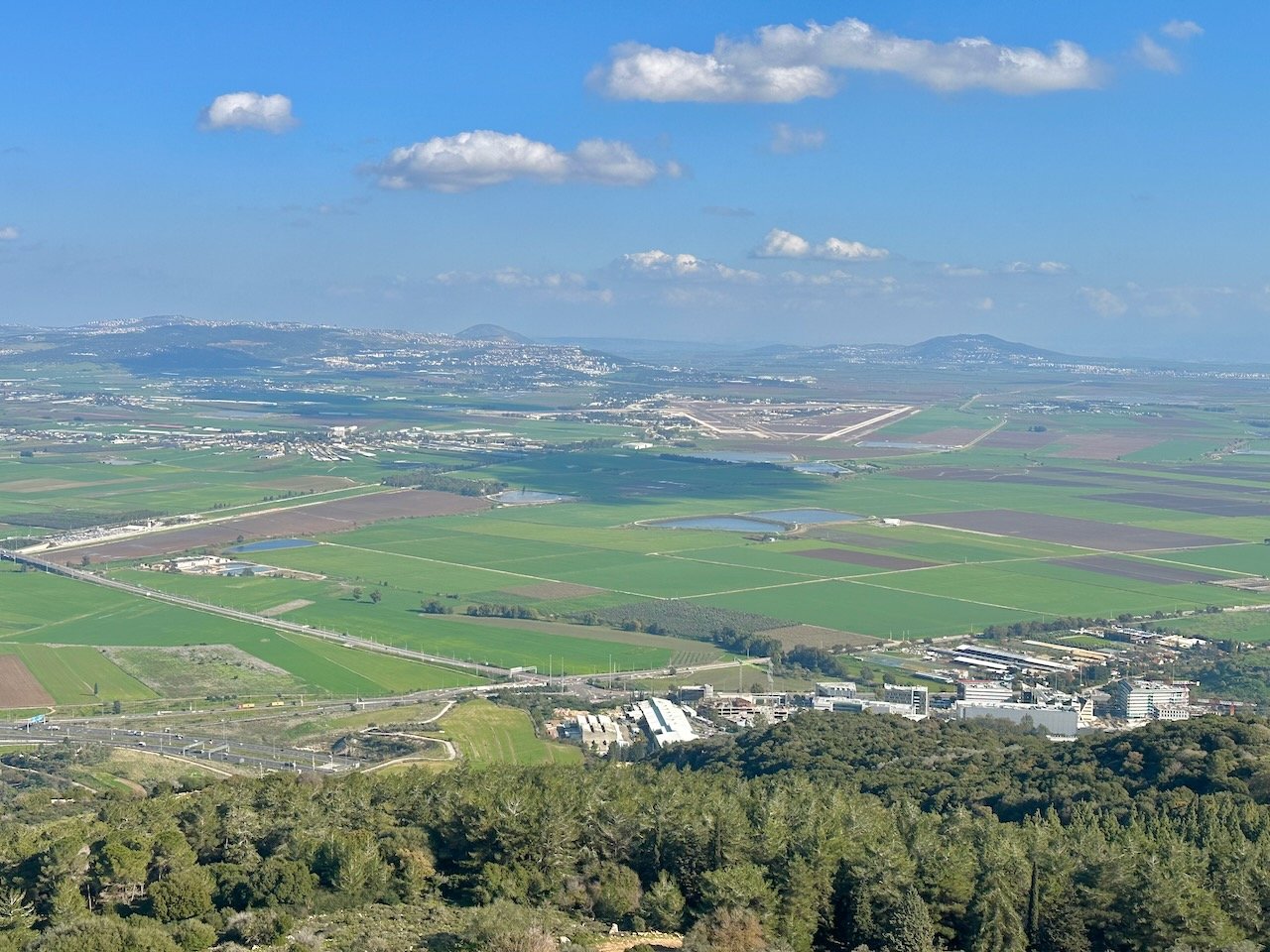
We descended down off the Precipice and drove through the heart of the Jezreel Valley. Located along the edge of the valley and guarding an important natural pass from the Sharon Plain to the southwest is Megiddo. This archaeological site was about 25 layers of occupation spanning a period of about 2,500 years! It was a Canaanite and Israelite city. Pharaoh Thutmose III conquered it in 1468 BC (according to conventional dating). Climbing the site, we saw 3 series of city gates, Solomon’s stables and palace, a sacrificial altar from the Early Bronze Period, and a grain silo. We also had a great view from the top of the tel of the Jezreel Valley referred to as the Valley of Armageddon in Revelation 16. In the end, God wins when Jesus returns! We left the walking to the water system that was engineered to bring water safely inside the walls of the city. We walked down 180 steps and then back up 77 steps on the other side.
Mt. Carmel/Muhraqa
Our next first destination was to Mt. Carmel, a mountain range overlooking the Jezreel Valley on one side and the Mediterranean Sea on the other. After lunch (at the Mitzpe Carmel, owned by a Druze family), we ascended to the top of this ridge to a place called Muhraqa. We went into the Carmelite chapel to read passages such as Isaiah 35, Amos 1 & 9, 2 Kings 4 (Elisha) , Songs of Songs 7, and 1 Kings 18. This last narrative is about the confrontation between Elijah and the prophets of Baal! We enjoyed singing a few songs too! What wonderful harmony! Also, we walked to the rooftop for the view of the Jezreel Valley. The clear skies allowed us to see Nazareth, Mt. Tabor, the Hill of Moreh, the Gilboa Range, and even Caesarea on the coastline of the Med Sea.
Caesarea
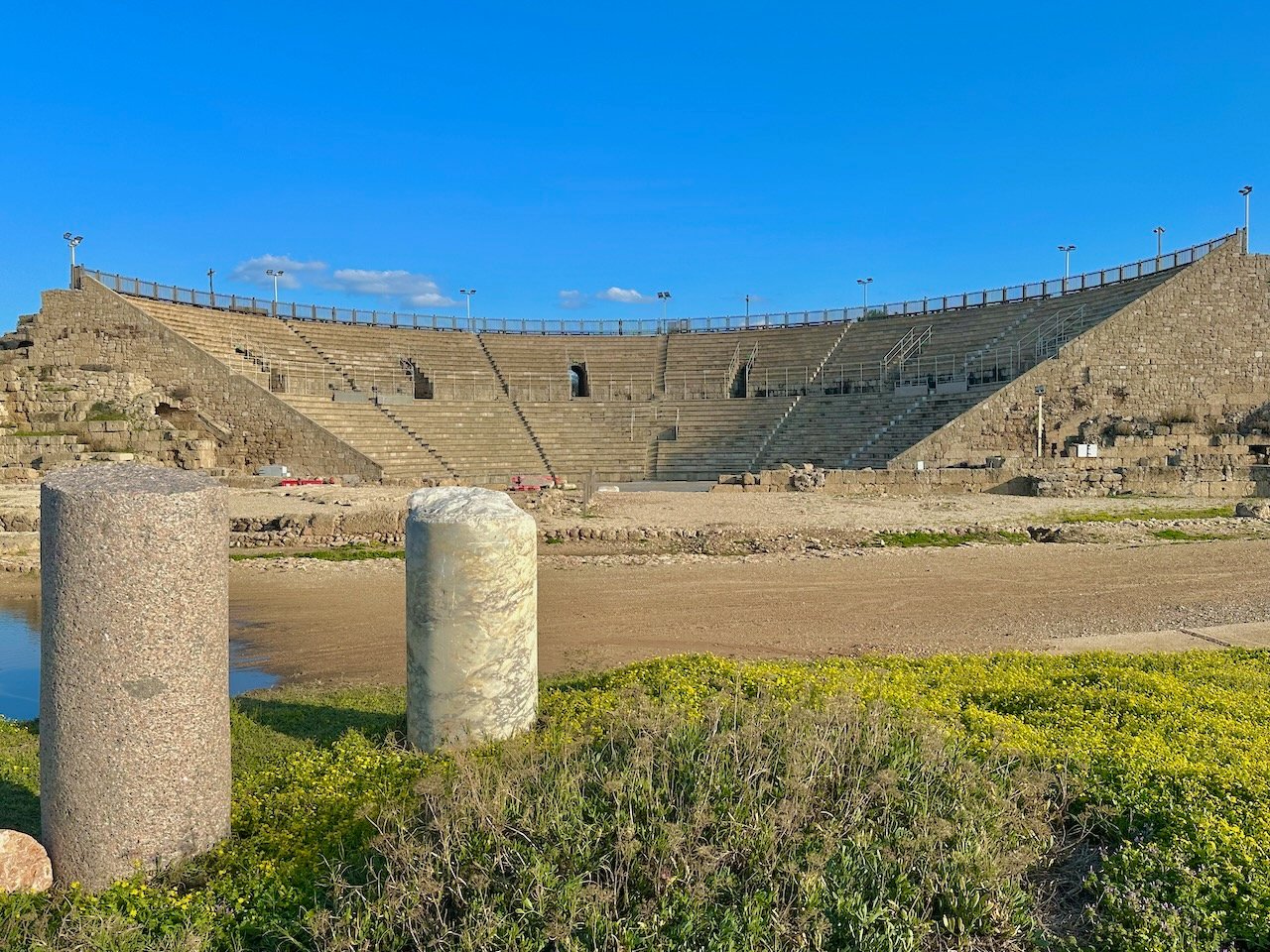
To end the day, we descended down to the Sharon Plain to Caesarea. This was a city built by Herod the Great over a 12 year period (22-10 BC). In the theater we read from Acts 8 (Philip), Acts 9 (Paul), Acts 10 (Peter), Acts 12 (Agrippa 1), Acts 21 (Philip), and Acts 26 (Paul). From here we walked across the city to see the palace, hippodrome, the location of the grand harbor, and the Crusader gate, wall, and mote. We drove to the aqueduct on the north end of the site. The sunset was stunning!
Jerusalem
The drive to Jerusalem was to take about two hours. However, David’s bus had a significant leak os some kind, and the owner of the bus company did not allow us to use this bus on the drive to Jerusalem. So another bus was arranged. It came within 15 minutes! Praise God! After transferring all the luggage, we made the drive to our hotel in Jerusalem. We enjoyed a late but great dinner. Because of our late arrival, we postponed our walk to the Western Wall until tomorrow night. God was with us all day long, especially watching out for us this afternoon! We all are looking forward to seeing Jerusalem over the next 2 days!
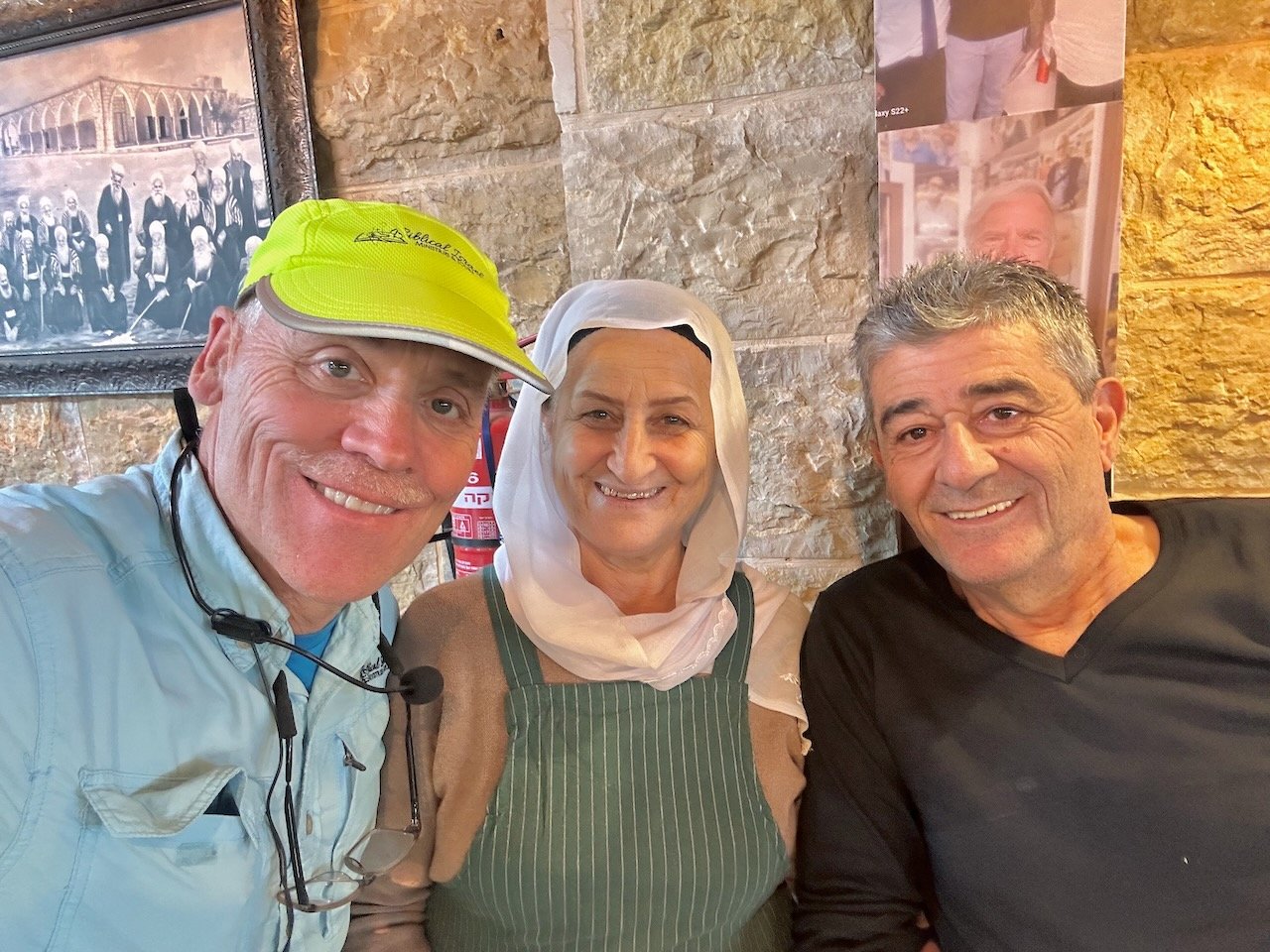
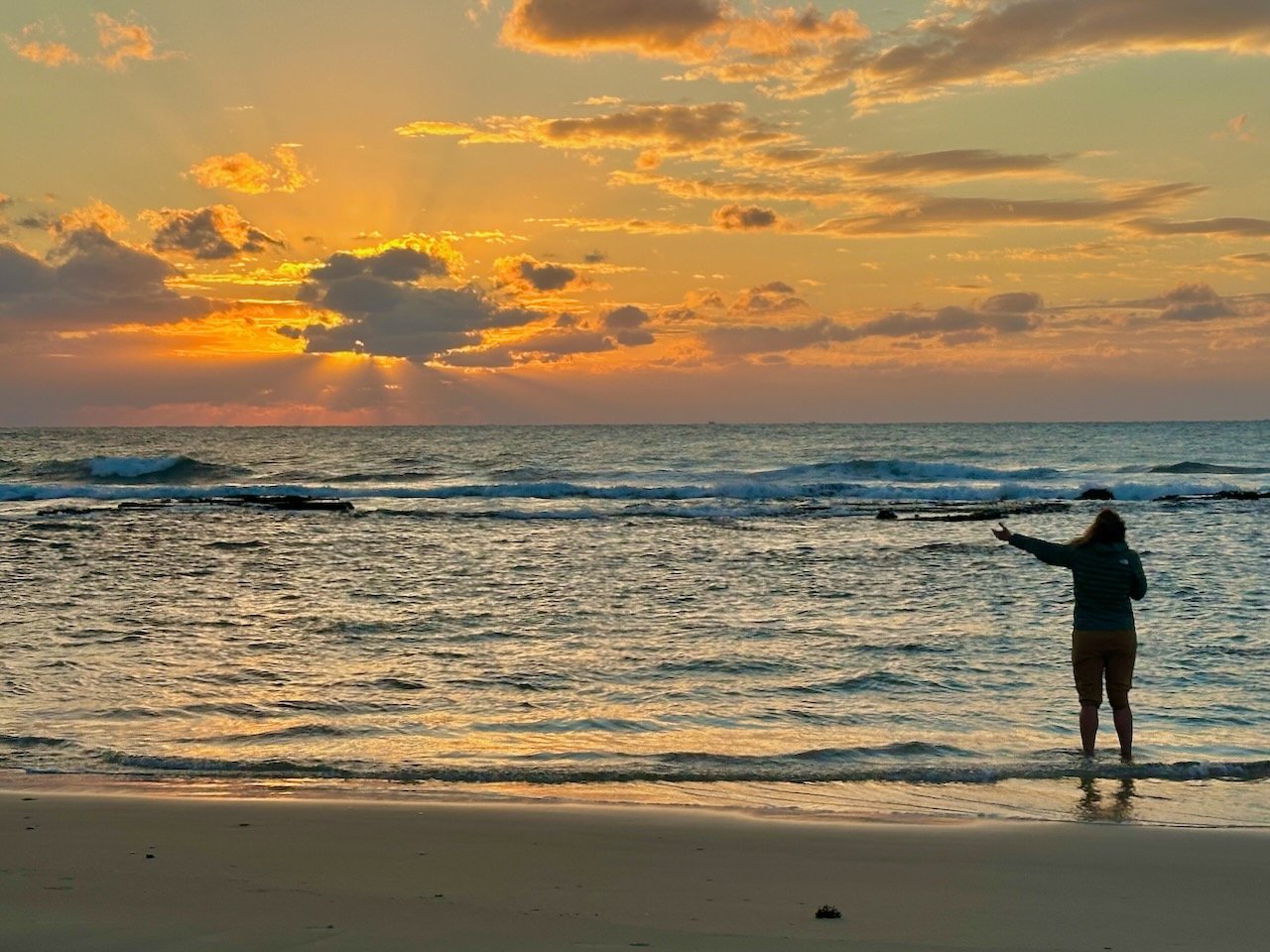
Day 11 – Tuesday, January 20: Jerusalem: Mt. of Olives, Garden of Gethsemane, Ein Gedi, Jericho, Dead Sea
Today was our first full day in Jerusalem and surrounding area. The sun was once again shining bright all day, with only a few clouds in the sky. Temps in the morning were on the cool side (40s). This afternoon down at the Dead Sea it was warmer (around 60). After breakfast, we left the hotel around 7:35, reading Psalm 122 as we departed for the Mt. of Olives.
Mt. of Olives/Gethsemane
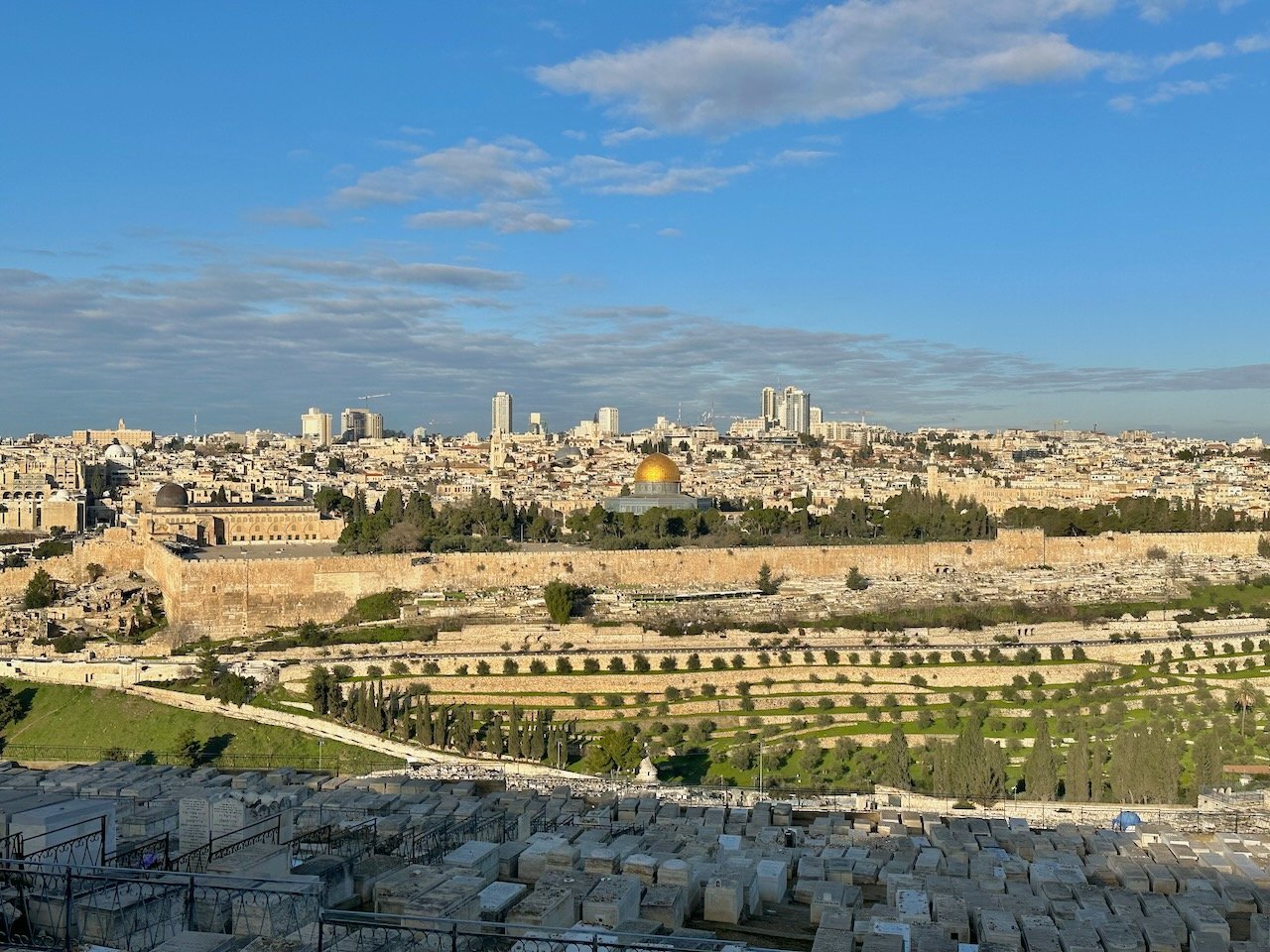
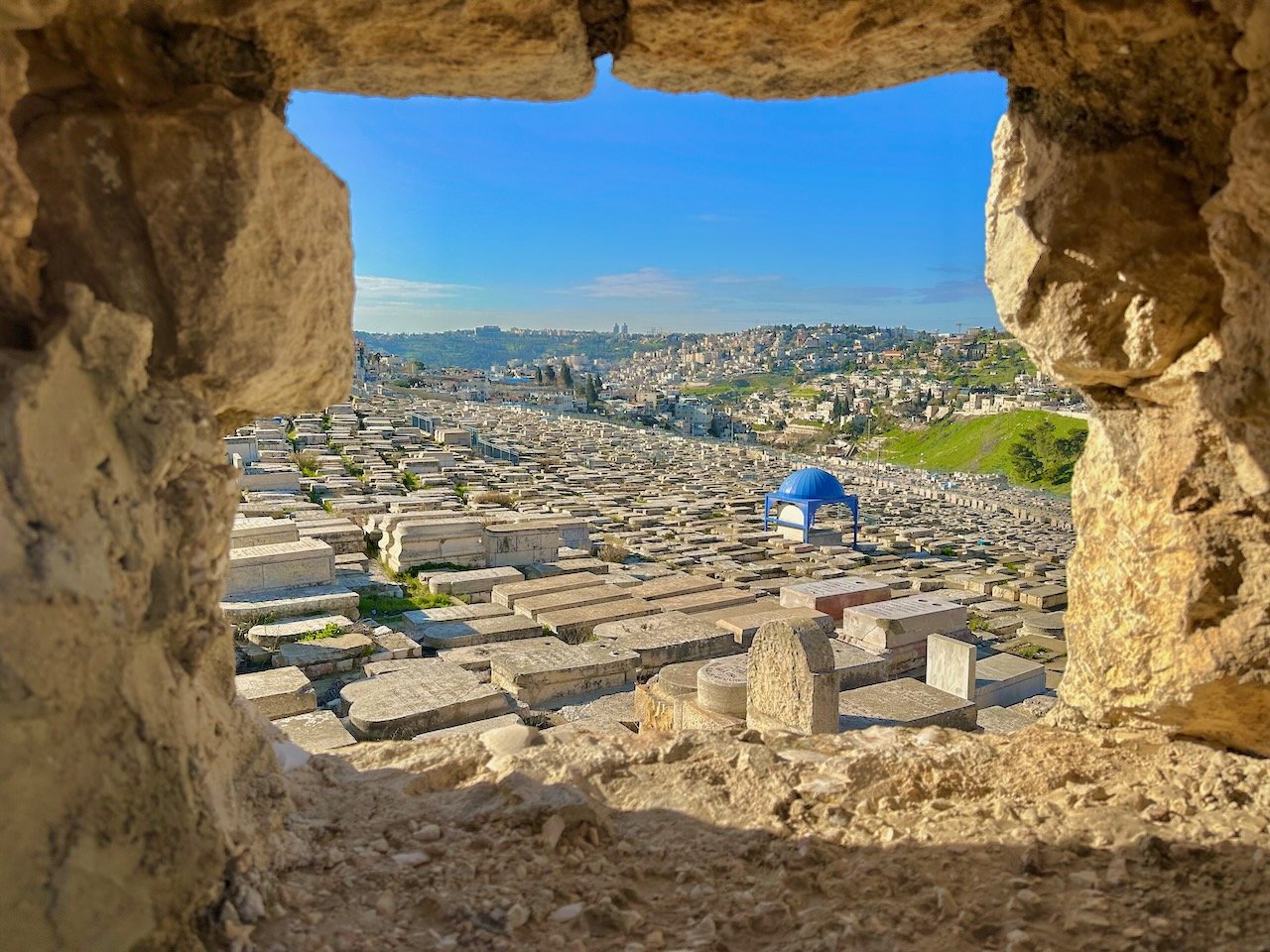
Our first stop of the day was the Mt. of Olives. We drove around the north side of the Old City, passing the Damascus and Herod Gates on the way on the north side of the Old City (walls date to 1537-44 AD, built by the Turks). Cresting the Mt. of Olives we drove to a spectacular view across the Kidron Valley of the Old City and Temple Mount below. From here we walked down to Dominus Flavet, a small chapel where we enjoyed singing a few songs together. Here we read from Luke 19 (Palm Sunday), Acts 1 (Christ’s ascension), and Zechariah 14 (about the return of Christ). Continuing down the slope towards the Church of All Nations (the traditional Garden of Gethsemane. We walked up a short distance to a private park to consider the Passion of Jesus (Luke 22). We then walked back down into the courtyard of the church to see the very old olive trees.
Ein Gedi
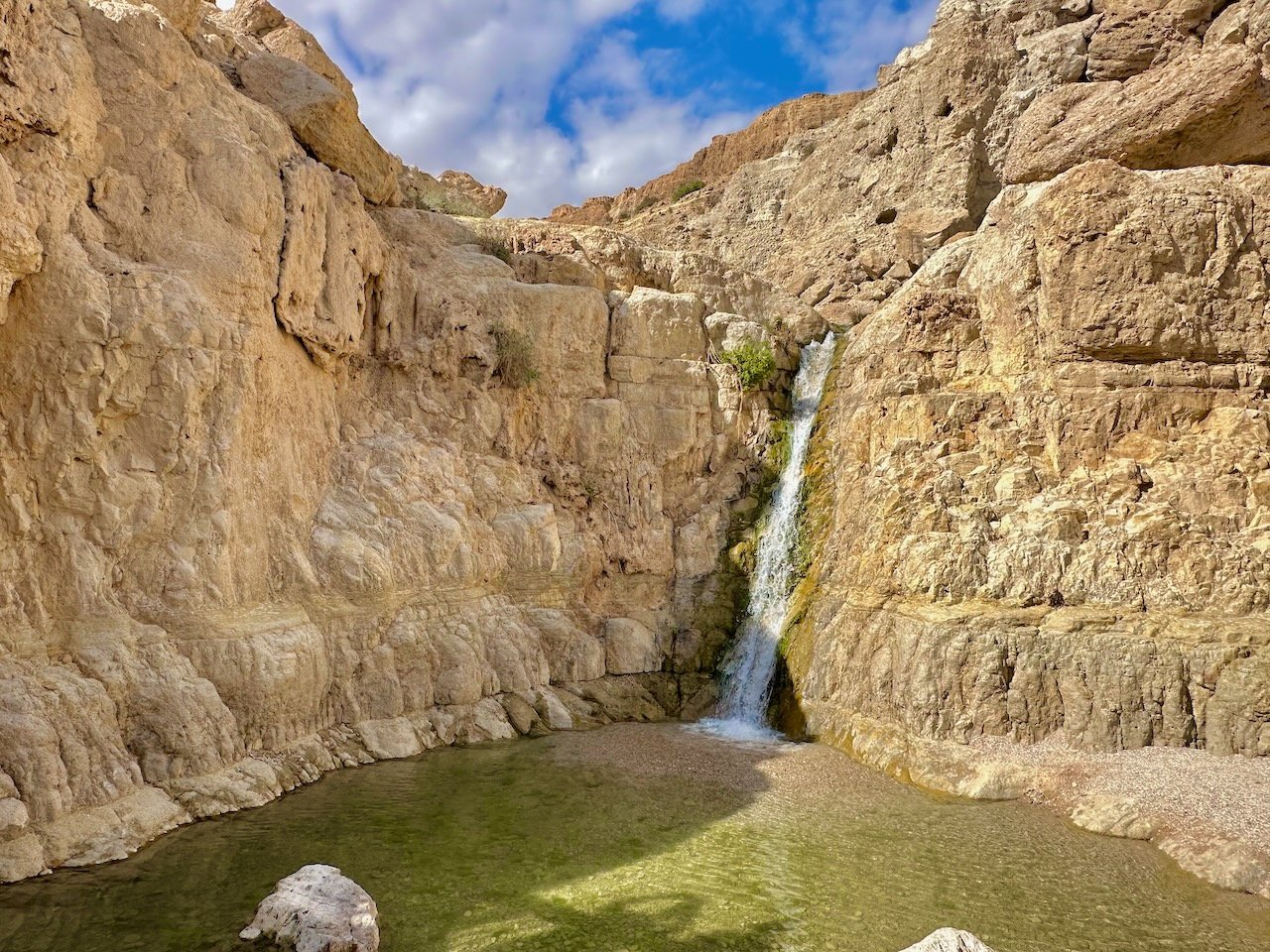
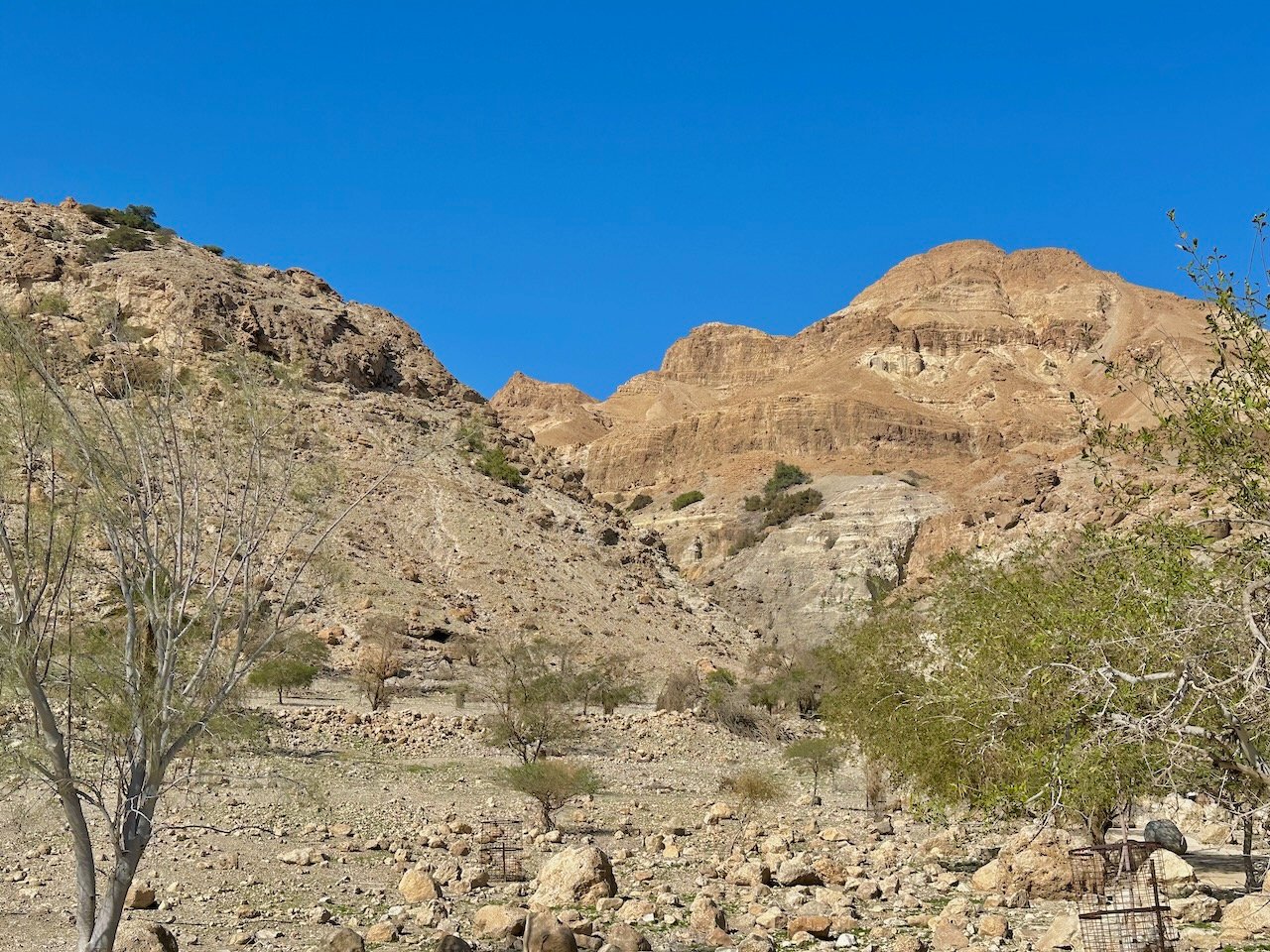
From here we drove northward on Rt. 90 along the western shoreline of the Dead Sea to Ein Gedi. As we drove we read from Ezekiel 47 (about how one day the Dead Sea will become fresh). Together we walked into the canyon (Wadi David) where we stopped to read from Song of Songs 1 (mentioning the henna blossoms), 2 Chronicles 20 (mentioning the “Ascent of Ziz”), and 1 Samuel 24 (the David and Saul “cave encounter”). We all walked back to the first falls where Graydon and Leisa got wet! :). The trail back to the furthest falls in this canyon is still closed since last May).
Jericho
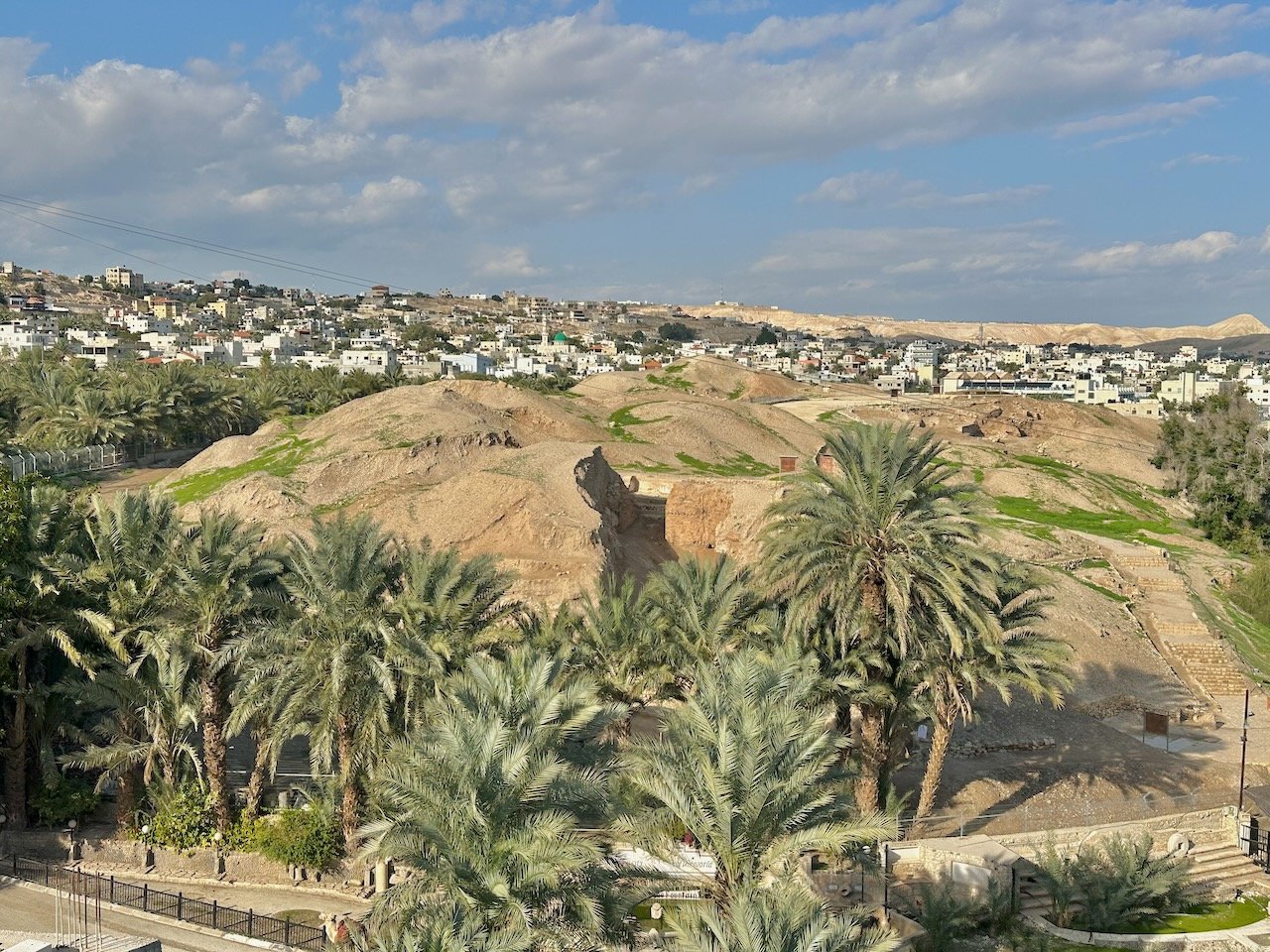
We boarded our bus once again to drove to the northern end of the Dead Sea. We arrived at Tel es-Sultan, or Old Testament Jericho. After a wonderful makluba lunch (chicken and rice prepared together), we climbed the site. We looked east and could see the Jordan Valley the Mt. Nebo on the ridge on the horizon (Dt. 34). Elijah was taken to heaven in the area across the river (2 Kings 2). Jesus was baptized in the Jordan River at “Bethany Beyond the Jordan” (John 1). Looking south we could see the area of NT Jericho (where Zachaeus and Bartimeaus lived, and where Herod the Great died in 4 or 1 BC).
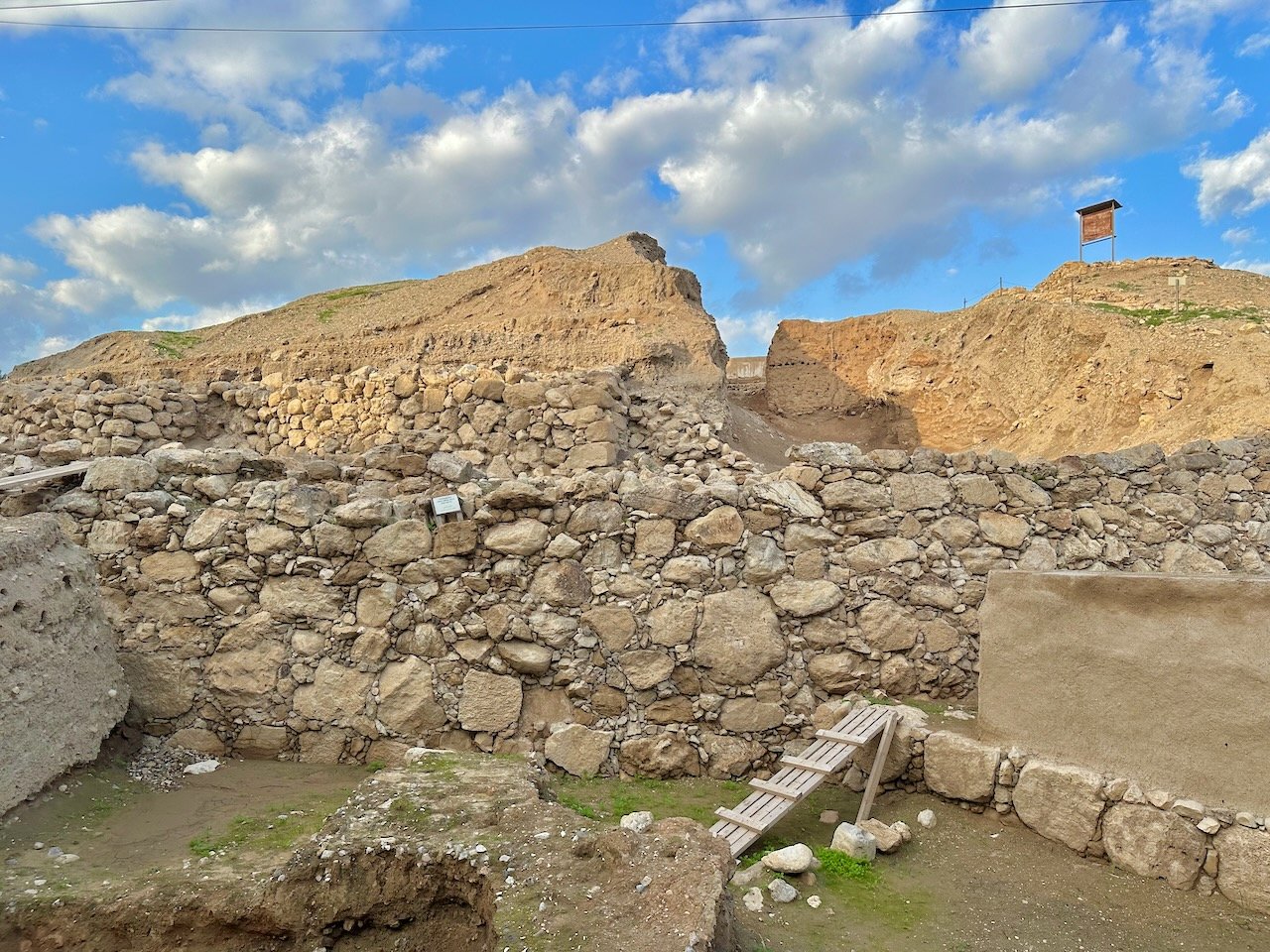
We then turned our attention to the ancient OT site of Jericho. The archaeology of this ancient site of Jericho supports and confirms the Bible’s historicity. Besides seeing the oldest structure (a round tower) in Israel, on the southern end we saw the double retaining walls of this Canaanite city taken by Joshua (Joshua 6). A mud brick wall once stood on top of these stone walls. They came tumblin down.
Dead Sea
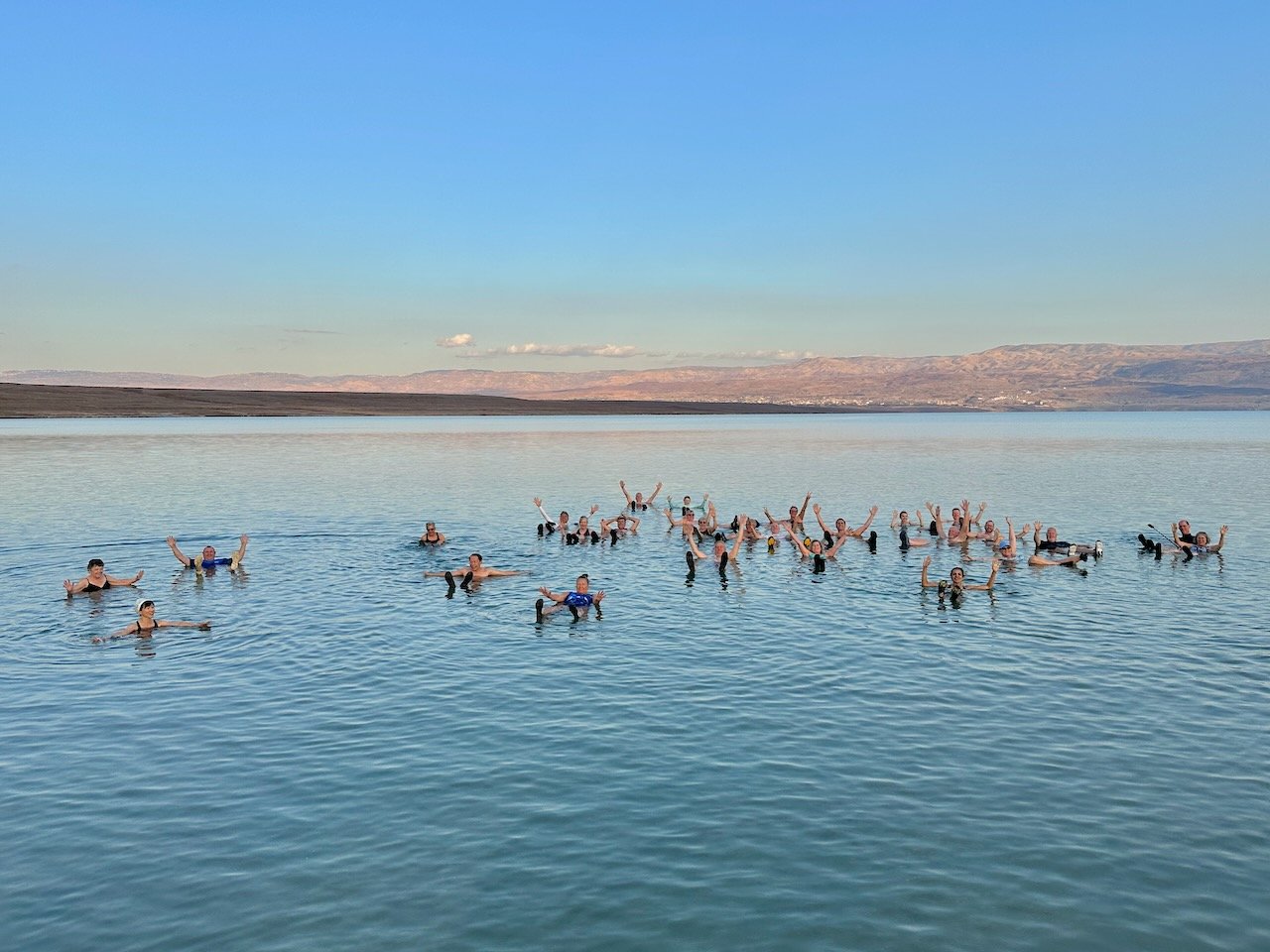
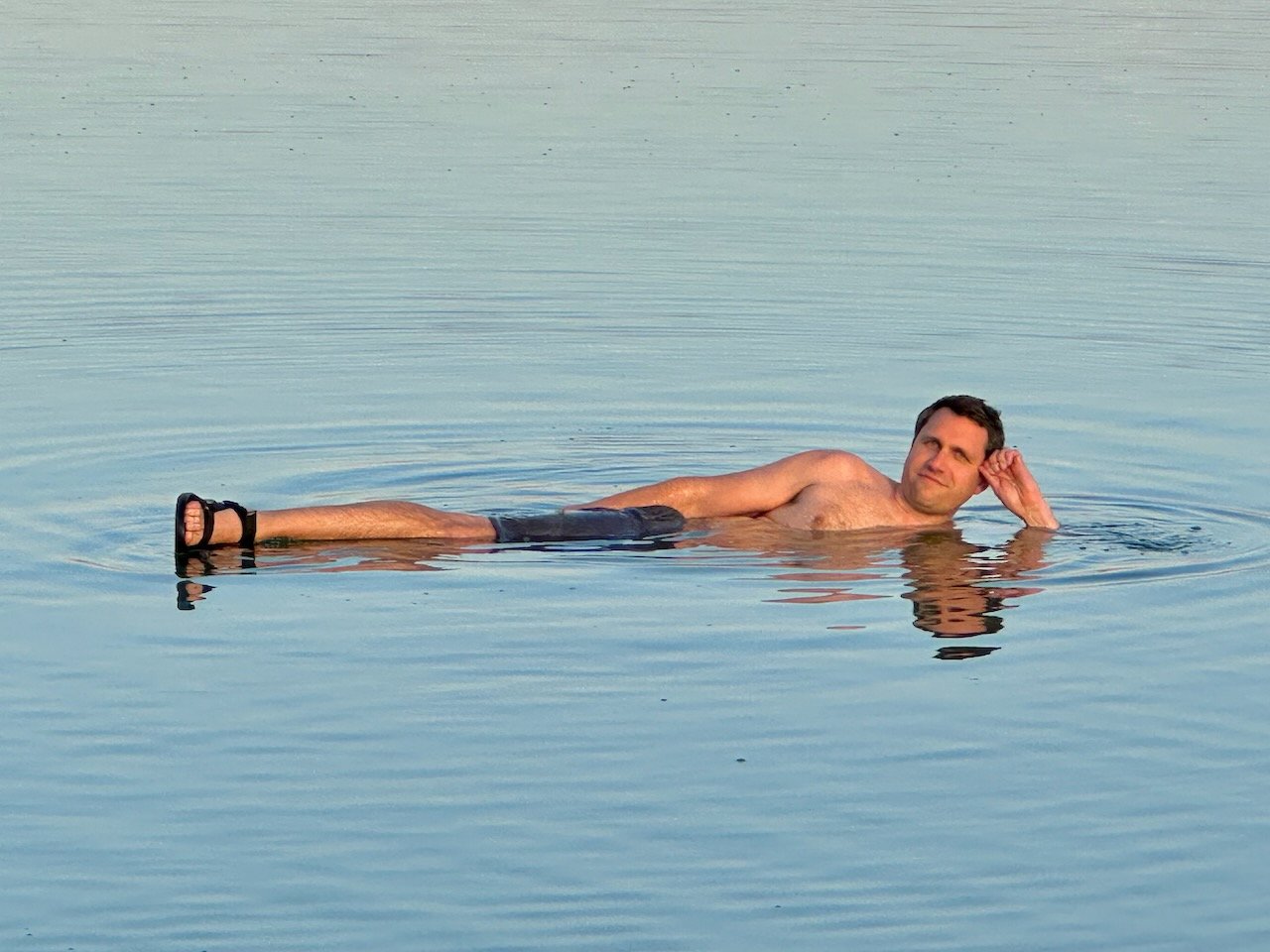
Our last experience of the day was to float in the Dead Sea. We enjoy floating in this unique body of water (33% salt and minerals). We drove to our hotel at Qumran close by for dinner and overnight.
Jerusalem / Western Wall
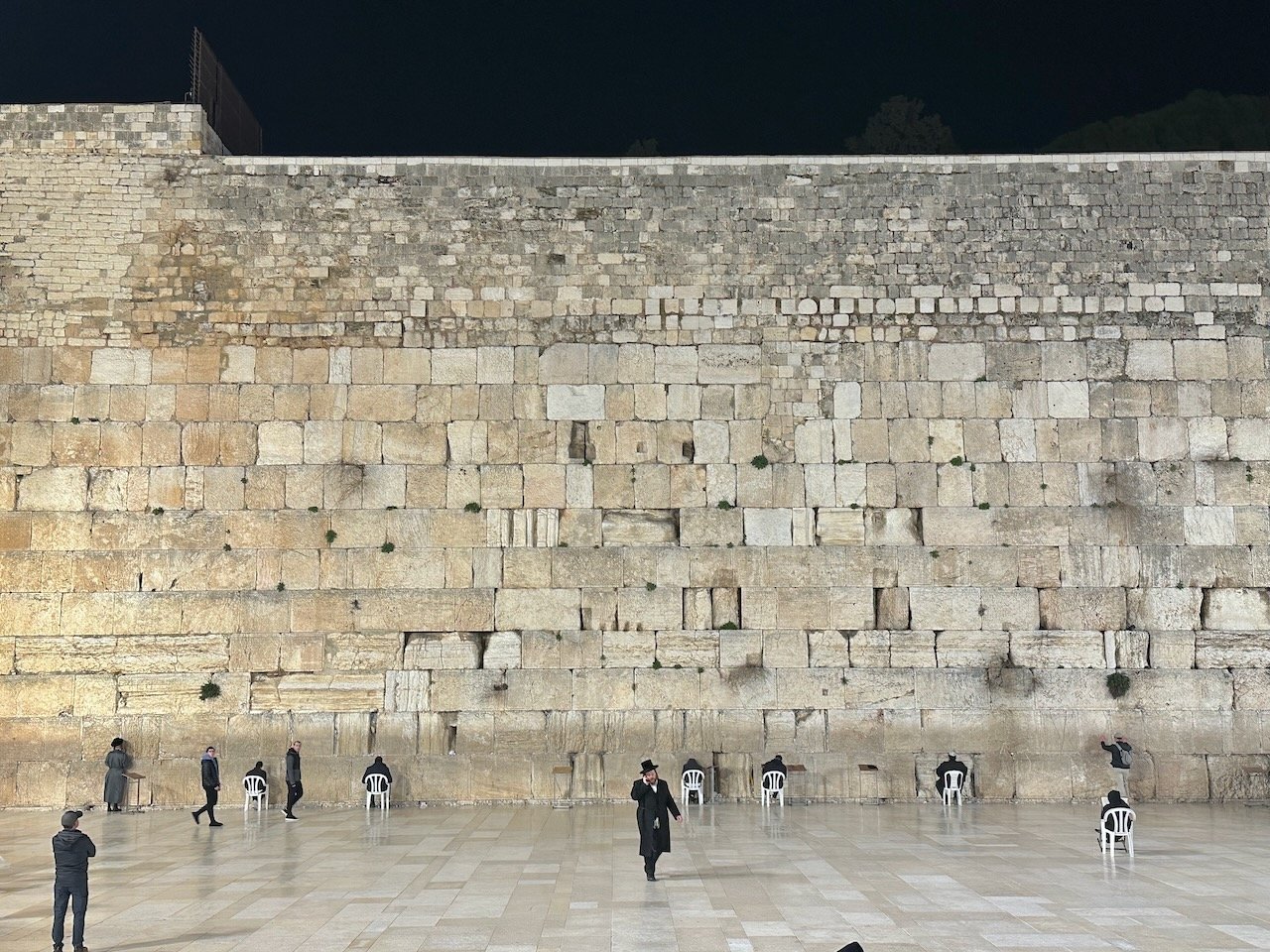
We returned back to Jerusalem for dinner. Most in the group then enjoyed an optional walk to the Western Wall, the most holy place for Jews today! This wall served as one of the four retaining walls built by Herod in order to support the expanded platform of the Temple (Herod actually doubled the size of the Temple). The Temple Mount today is large enough for about 12 football fields!
We walked back to the hotel for overnight.
Day 12 – Wednesday, January 21: Yad Vashem, City of David, Southern Excavations, Western Wall, Holy Sepulcher Church
Today was another full day here in Jerusalem. The weather was overcast most of the day, with a very cold start (40 degrees). In the afternoon it warmed to around 50, with partly sunny skies. This morning we started with a solemn visit to Israel’s Holocaust Museum. We read Psalm 48 and 137 as we left the hotel at 7:35.
Yad Vashem
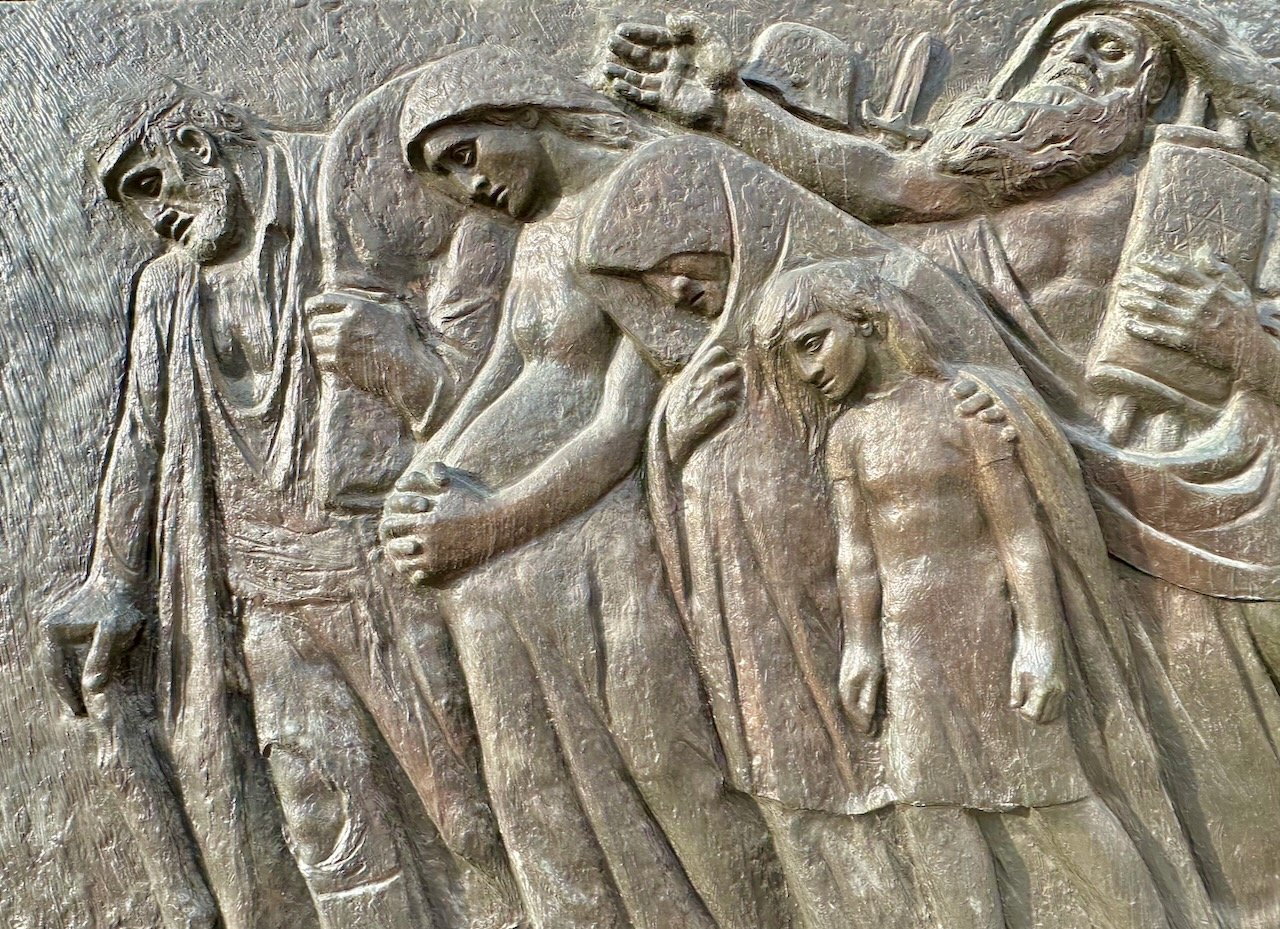
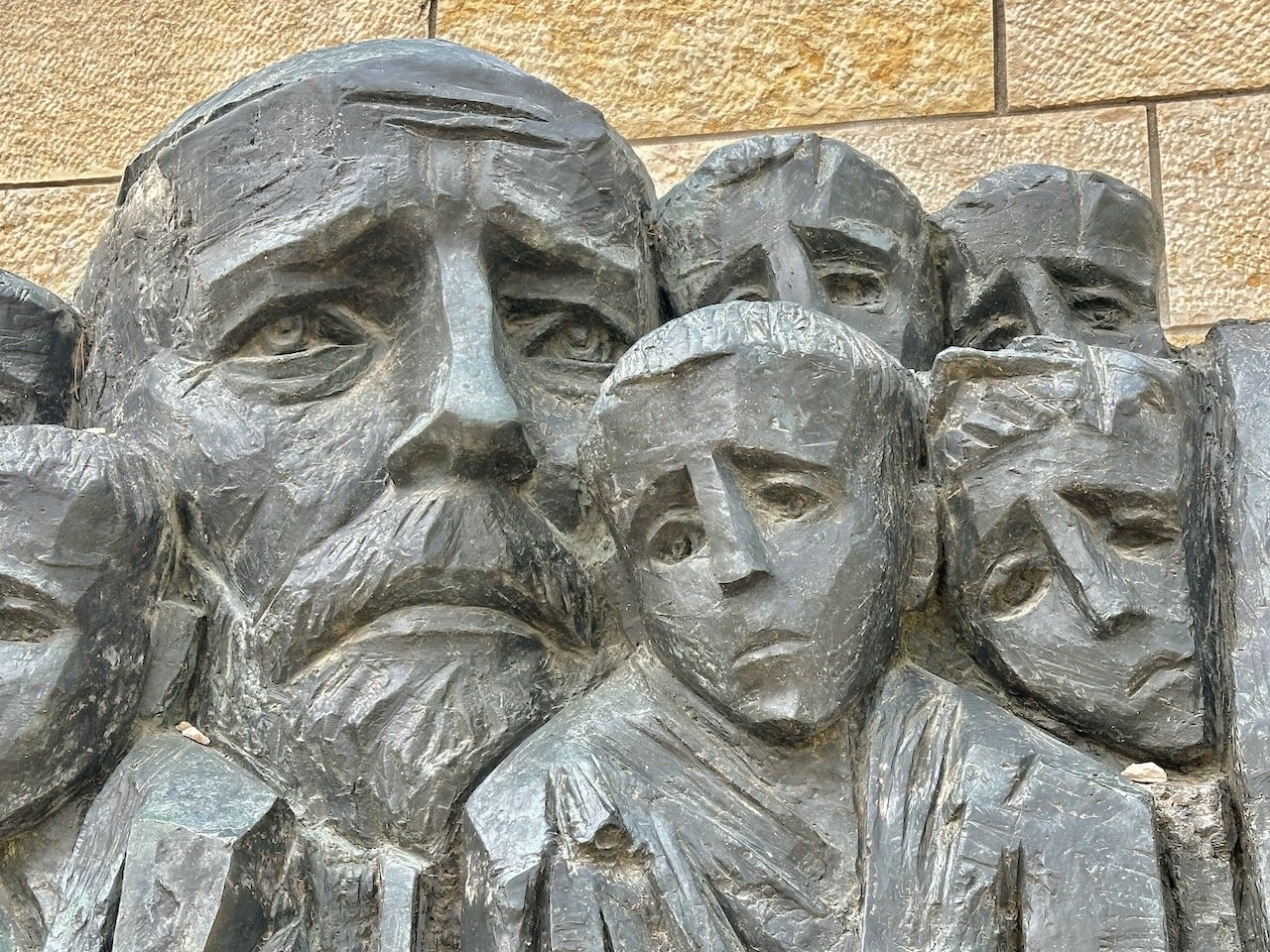
We departed the hotel and drove to West Jerusalem, specifically to Israel’s Holocaust Museum & Memorial. It is called Yad Vashem, named after a verse in Isaiah 56 that mentions the “memorial and a name.” Before the museum opened, we stood in the corner of the entrance building (instead of outside in the cold) as Shlomo introduced to us some of the history of the Holocaust. We also heard from Shlomo his personal story about his family during this tragic event. He lost 12 family members in Vilna, Poland.
We then walked through a part of the Avenue of the Righteous, lined with trees dedicated to righteous gentiles who saved Jews during WW II. This incudes trees dedicated to people like Oscar Schindler and Corrie ten Boom). It was also a somber experience walking through the Children’s Memorial before walking through the main museum on our own, We were reminded of the horrors and atrocities of the Holocaust and the loss of six million Jews. We left the museum around 11 a.m.
City of David
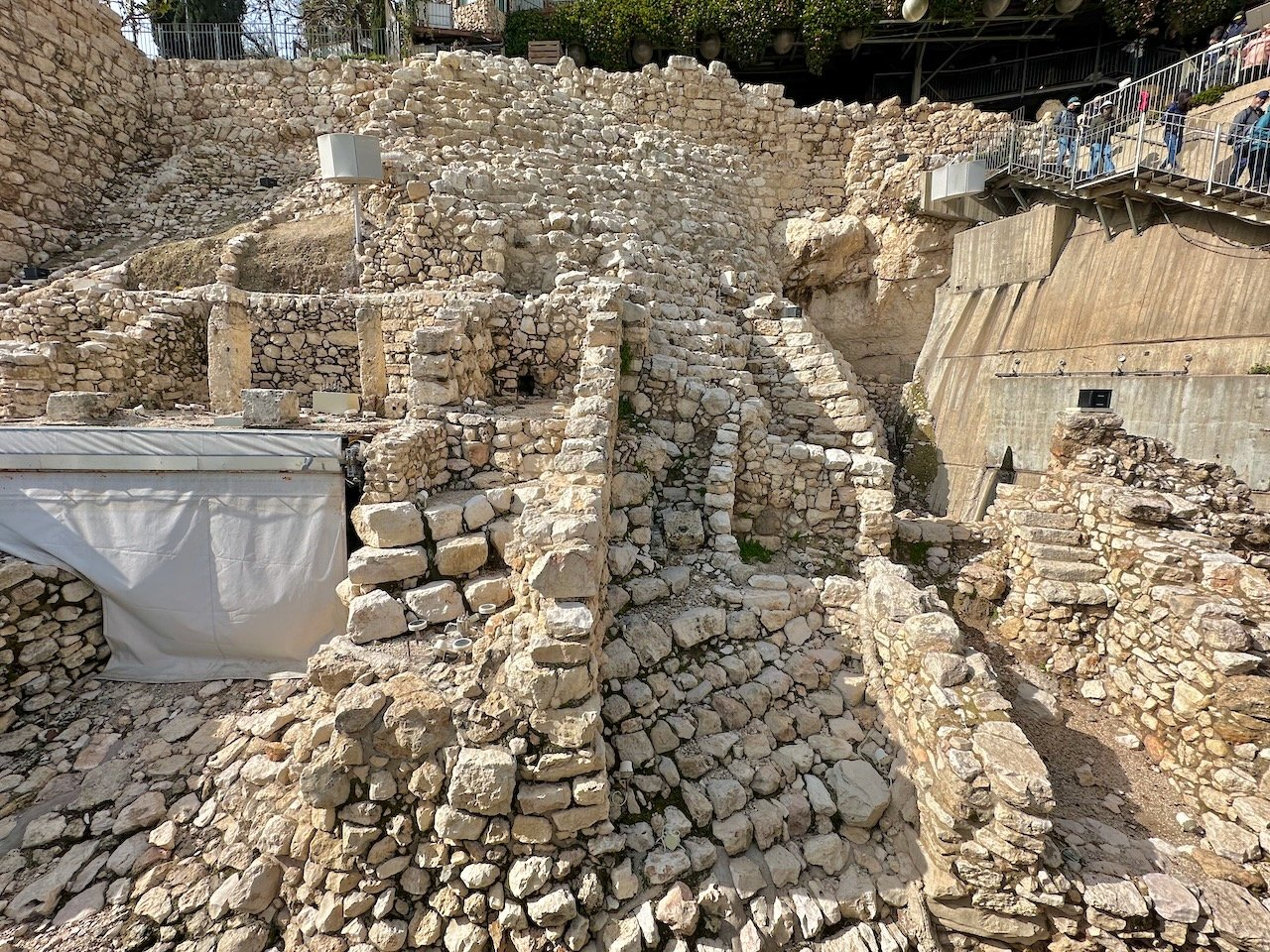
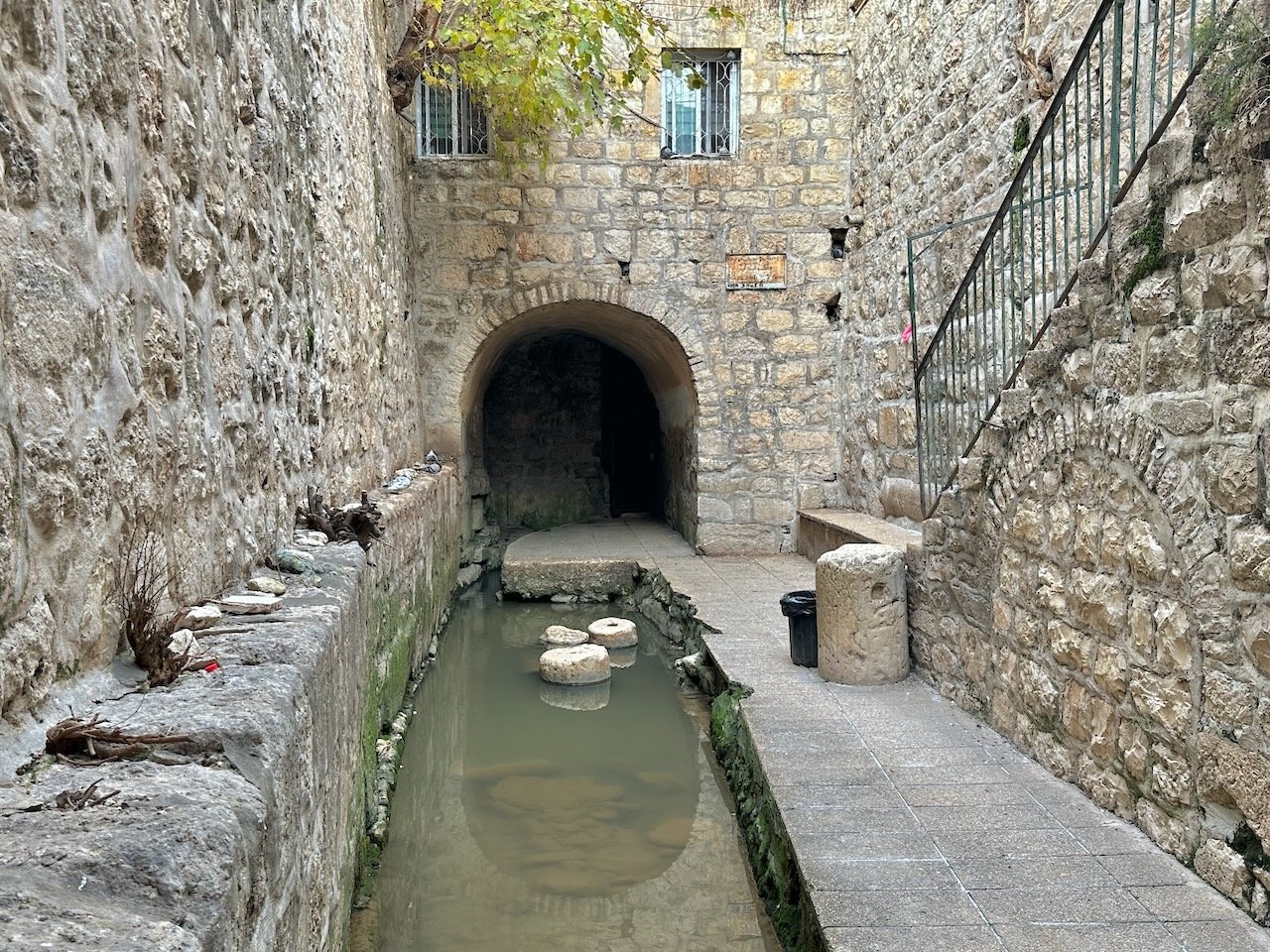
From Yad Vashem we drove back to the Old City and specifically to the City of David (located outside the walls of the Old City today). After gathering on the observation tower, we walked down through the excavations (“Area G”). We saw David’s palace, city walls, and 7th-6th BC house structures. One of them was excavated/uncovered by Dr. John in June-July, 1982, exposing the steps and the fallen stones. We all continued through Warren’s Shaft (2 Samuel 5). The upper part of this discovery was probably used by David but not the vertical 52 foot shaft. Finally, we descended down to the Canaanite/Jebusite pool to the Gihon Spring. Unfortunately the 1,700 foot-long Hezekiah’s Tunnel (2 Kings 20, 2 Chronicles 32) was closed (a rare thing). So we all took the “dry” Jebusite tunnel built 100s of years earlier. This led us to a large pool (perhaps the Pool of Siloam where we recalled the story of John 9. However, the smaller pool (discovered 100 years ago actually and originally thought to be the pool of John 9) where the water flows into through Hezekiah’s Tunnel may have served as the Pool of Siloam (i.e. the “ritual pool”).
Pilgrims Road
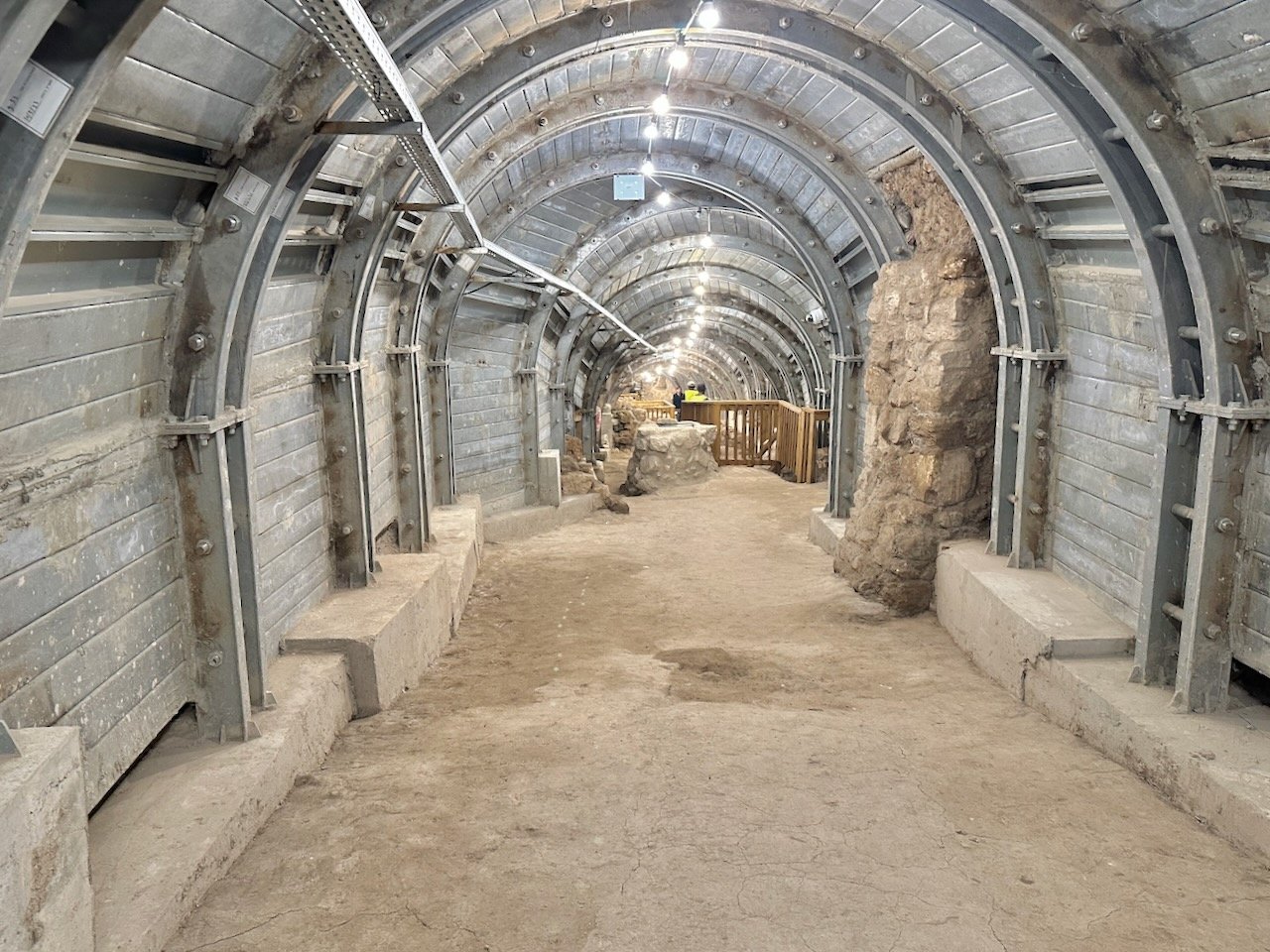
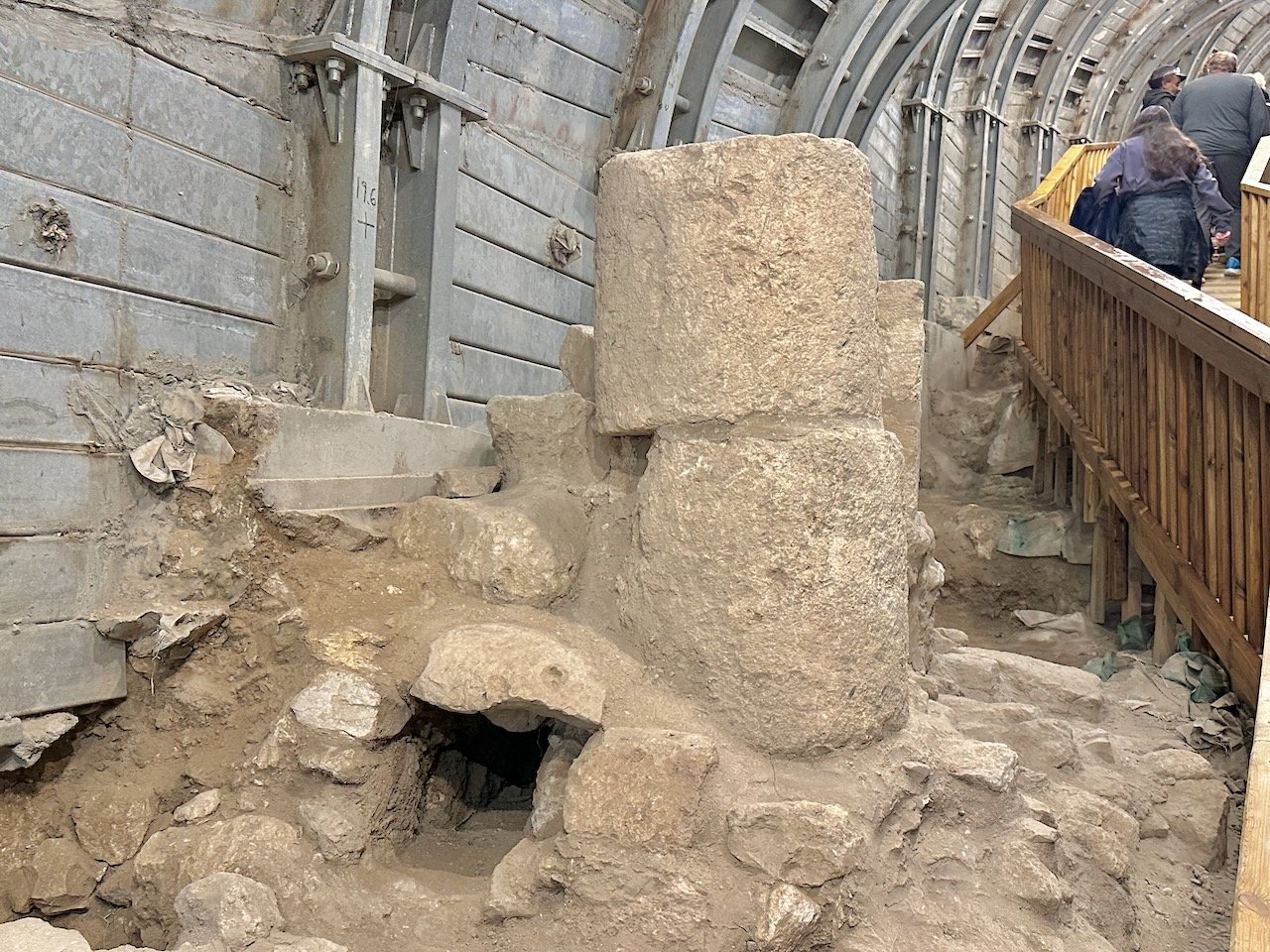
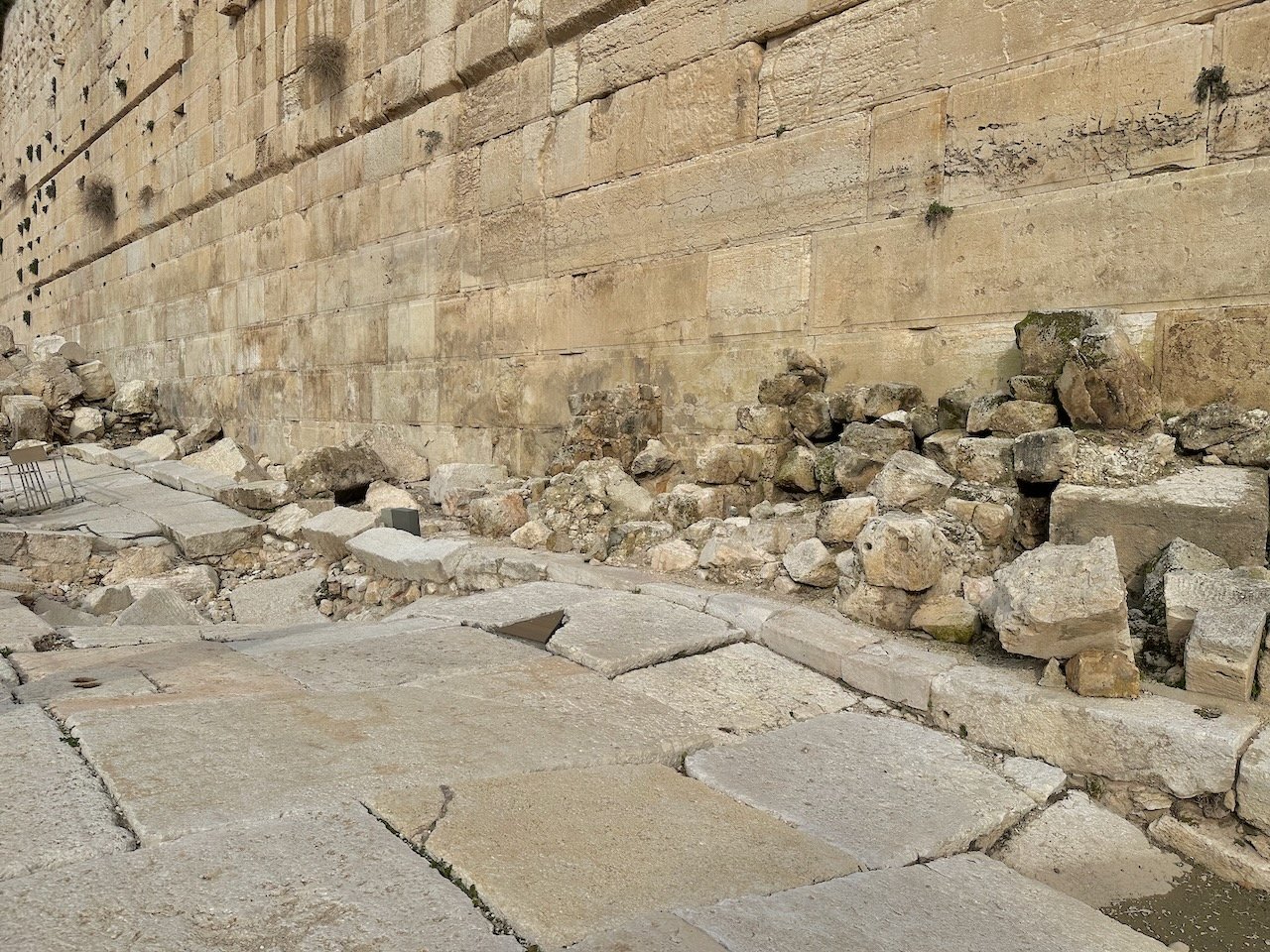
From this southern end of the City of David, we then walked up the newly-opened Pilgrims Road. This pavement dates to the 1st century AD (in fact, completed in 30 AD and probably financed by Pontius Pilate actually). It was a fascinating experience. We walked about 250 yards of this pavement. Jesus would have walked on this pavement! This pavement road openly officially opened to the public yesterday!
Southern Wall Excavations
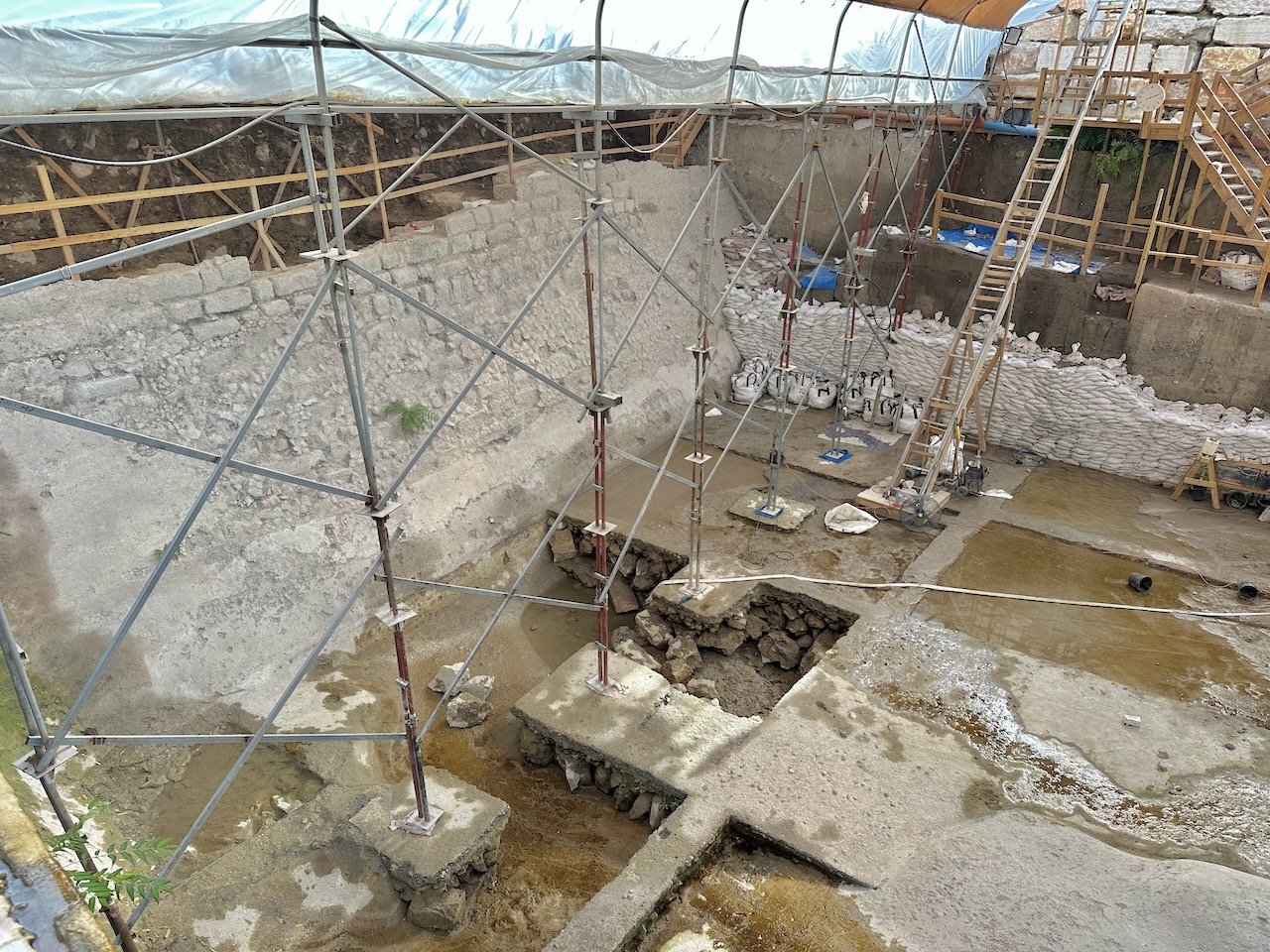
From here we left the Pilgrim Road, exiting at the Givati Excavation (this used to be a parking about lot 15 years ago). We walked further up to the Davidson Center and to the SW corner of the Temple. The SW corner of the Temple may have been the pinnacle of the Temple where Jesus was tempted (Mt. 4). We then walked over to the southern steps. This southern entrance into the Temple was used by commoners in Jesus’ day. Jesus Himself and His disciples would have used these steps to enter the Temple. We recalled the many mentioned in the NT who used these steps (Luke 2, 18; John 2; Mark 13; and Acts 2, etc…). Before leaving the steps, we considered how God wants us to be His spiritual temple (2 Corinthians 3).
Western Wall
Next, we walked a short distance where we entered into the Kotel area. Our visit of the Western/Wailing Wall was fascinating. The Western Wall served as one of four retaining walls to support the expanded Temple Mount platform. Herod’s Temple project (beginning in 20 BC) was expansive! We enjoyed going down to Wall.
Holy Sepulcher Church
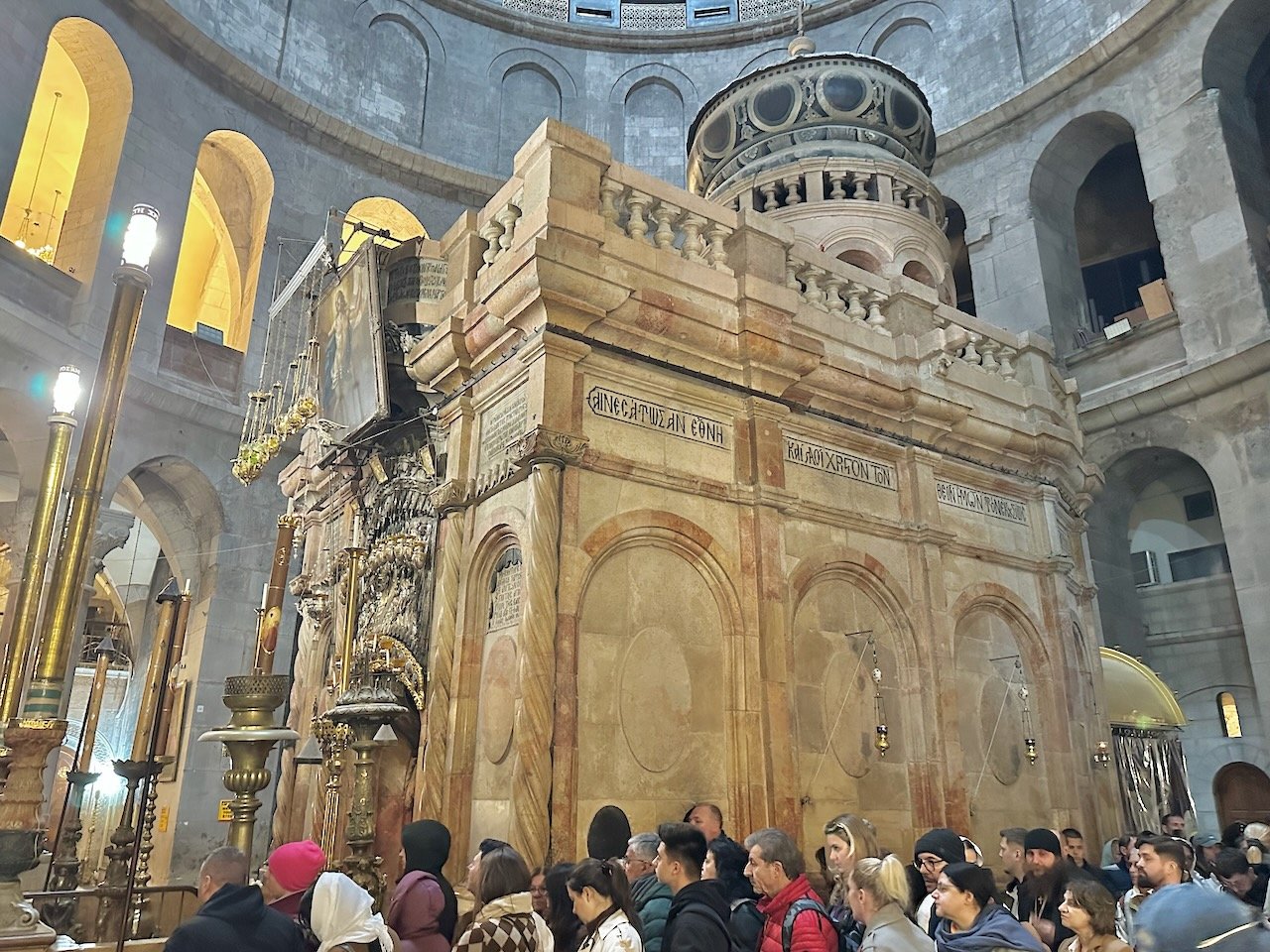
Once both groups converged, we ended the day by visiting the Holy Sepulcher Church. Built in 325 AD, this is the traditional location for the death and burial place of Jesus. It very well could be that Hadrian, the 2nd century AD Roman emperor “tipped us off” where he thought the tomb of Jesus was! The archaeological and historical records strongly favors this site over the Garden Tomb. Because of the lack of people here, there was hardly any line to get into the Edicule (enclosing the suggested tomb of Jesus).
We walked out of the Jaffa Gate where David picked us up to take us back to the hotel. We enjoyed dinner together, with an optional walk after dinner with Graydon to Jaffa Road and Ben Yehuda to get a little taste of modern Israeli life. Our last full day here in Jerusalem is tomorrow!


Day 13 – Thursday, January 22: Garden Tomb, St. Anne’s Church & Pools of Bethesda, Sifting Project, Israel Museum, Hidden Gate, Farewell Dinner
Today was our last full day in Jerusalem and the last day of the trip. We made the most of it was we enjoyed various encounters throughout the day. We began (with a late start) with a brief Worship & Communion service at the Garden Tomb. The weather was again on the cool side, with a high only around 50. We read from two of the “Psalms of Ascent” (Psalm 121 and 134) as we left the hotel at 8:45.
Garden Tomb
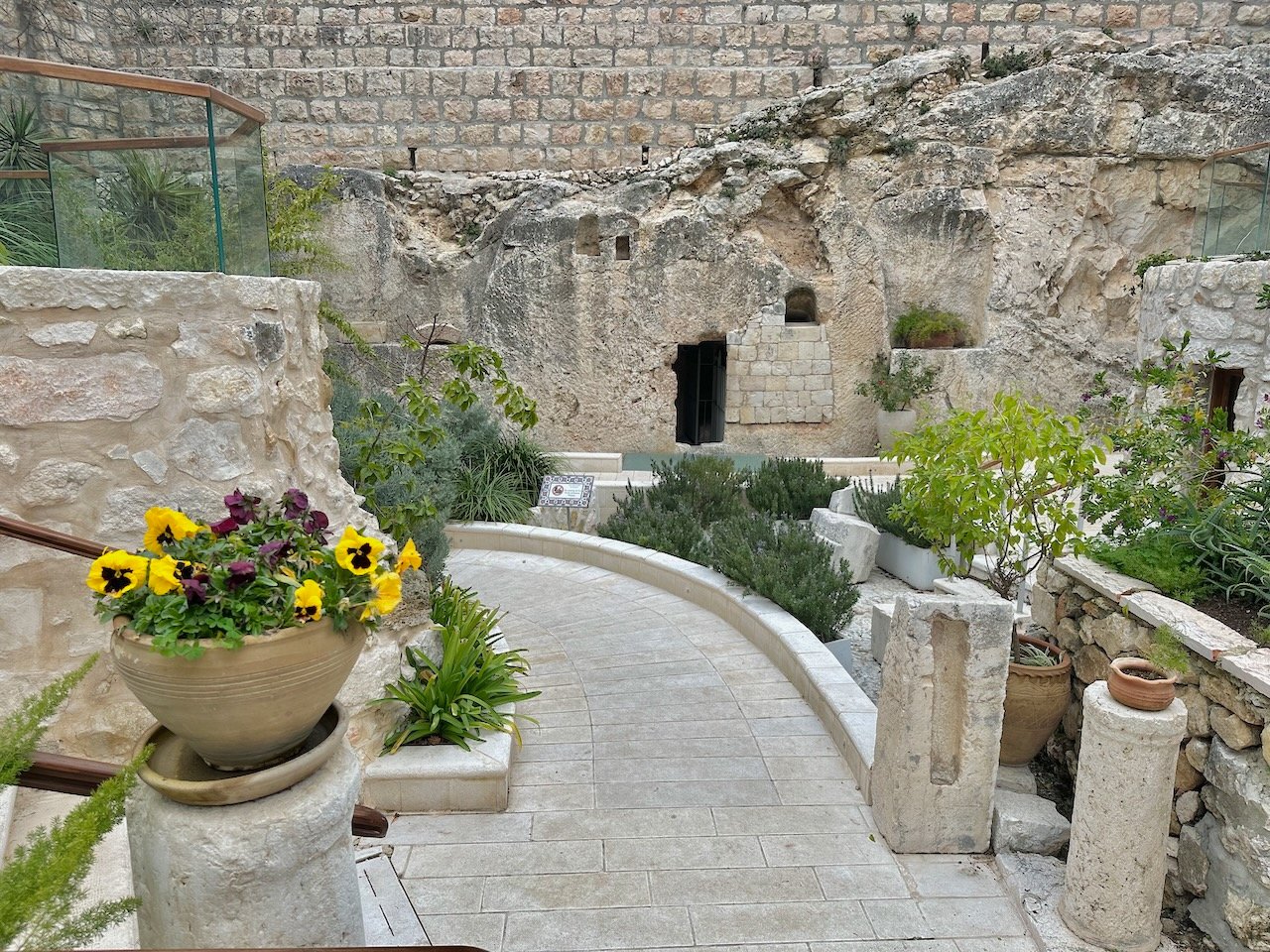
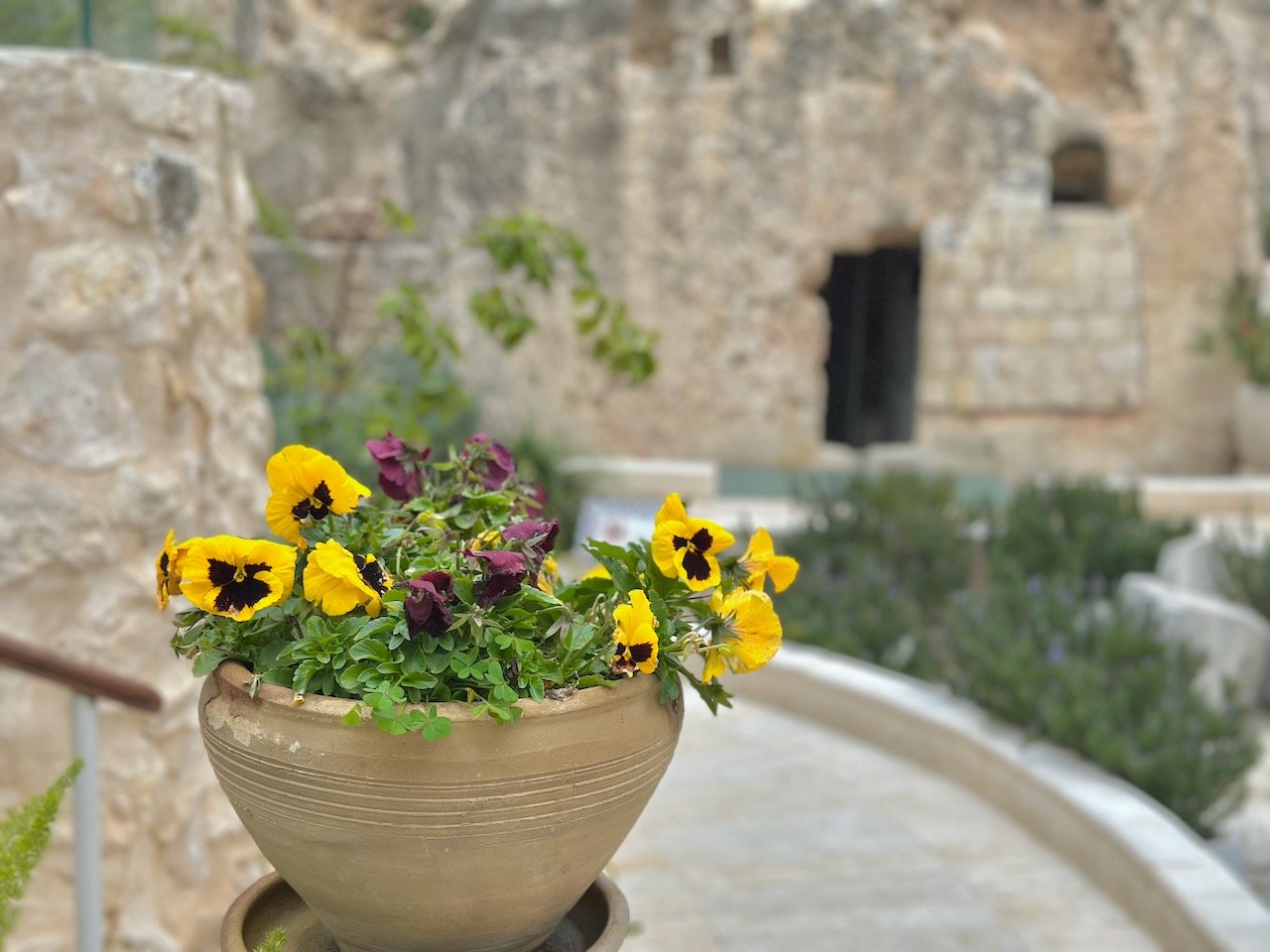
Our first stop was to the Garden Tomb. Located on the north side of the Old City today, this suggested site for the crucifixion and burial site of Jesus didn’t begin until the late 1800s. Today it serves as a Protestant alternative site to the Holy Sepulcher Church. Once we arrived, a local guide showed us the suggested crucifixion site and the tomb. The tomb, however, dates to the First Temple Period, and was one of many other Old Testament tombs in the area. Nonetheless, the Good News of Jesus is shared here, and our time of Worship & Communion service was special! Graydon led us in the observance of the Lord’s Table. It was a meaningful time for all. We worship the Person and not the place.
St. Anne’s Church – Pools of Bethesda
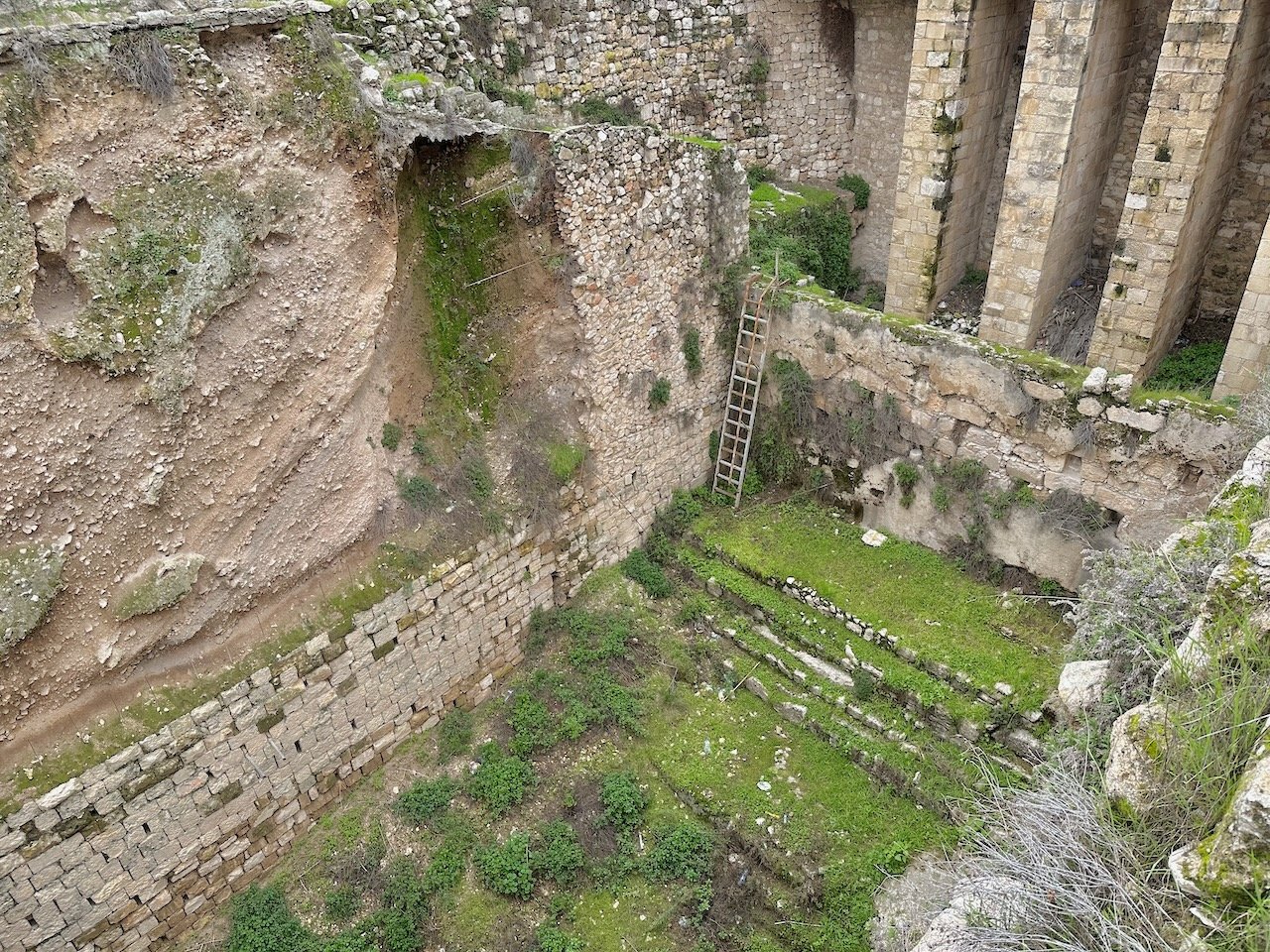
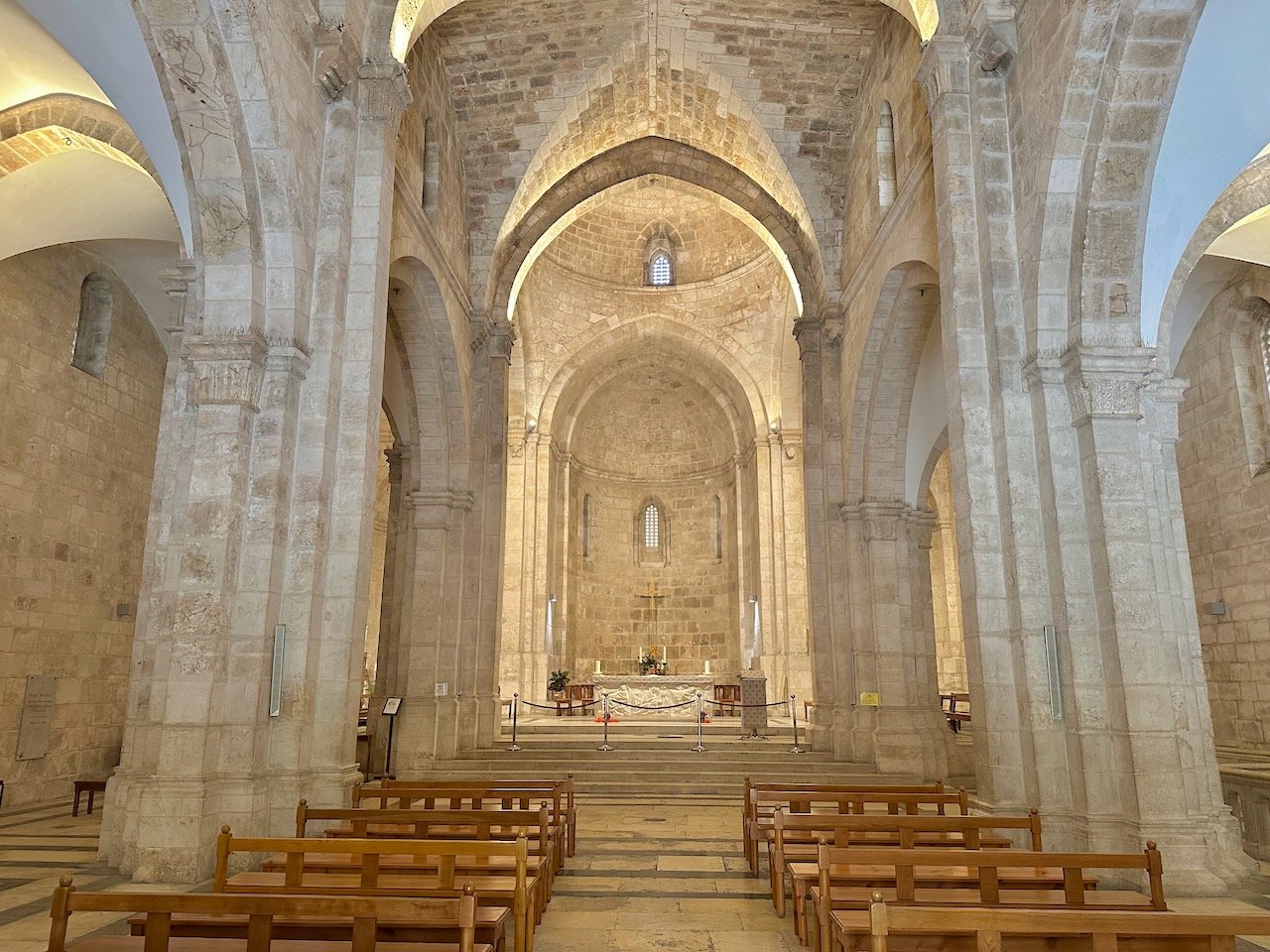
Following our time at the Garden Tomb, we bussed to the NE corner of the Old City where we walked to the only open gate of the Old City on this eastern side. We walked into St. Stephen’s Gate (also called Lion’s and Jericho Gate) and visited St. Anne’s Church, a Crusader Church. The acoustics in the church are incredible, providing a 6-7 second echo. We enjoyed singing here! On the same grounds is also the Pool of Bethesda. We read John 5 of the miracle that took place here. After walked out the same way where David picked us up.
Temple Mount Sifting Project
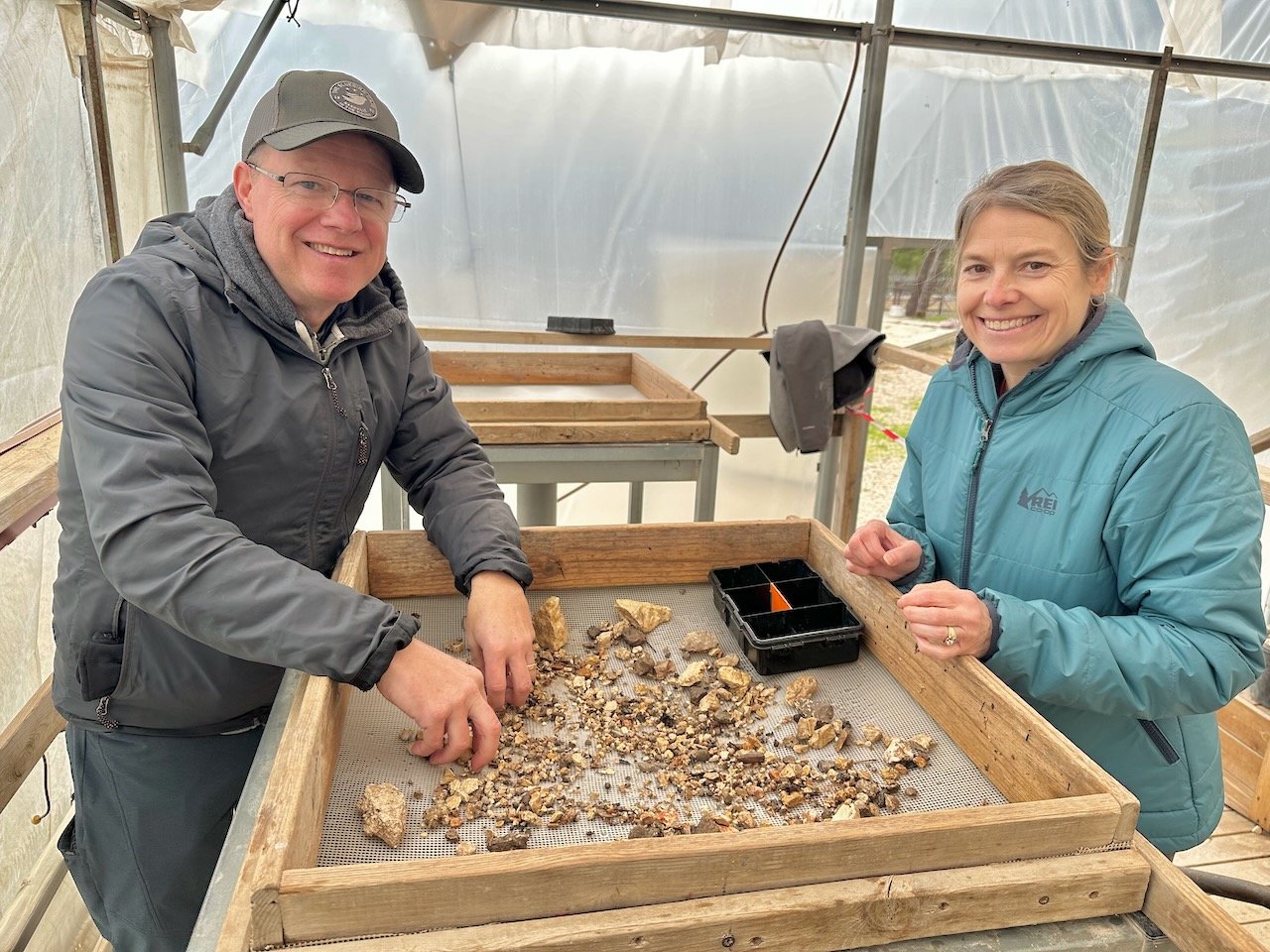
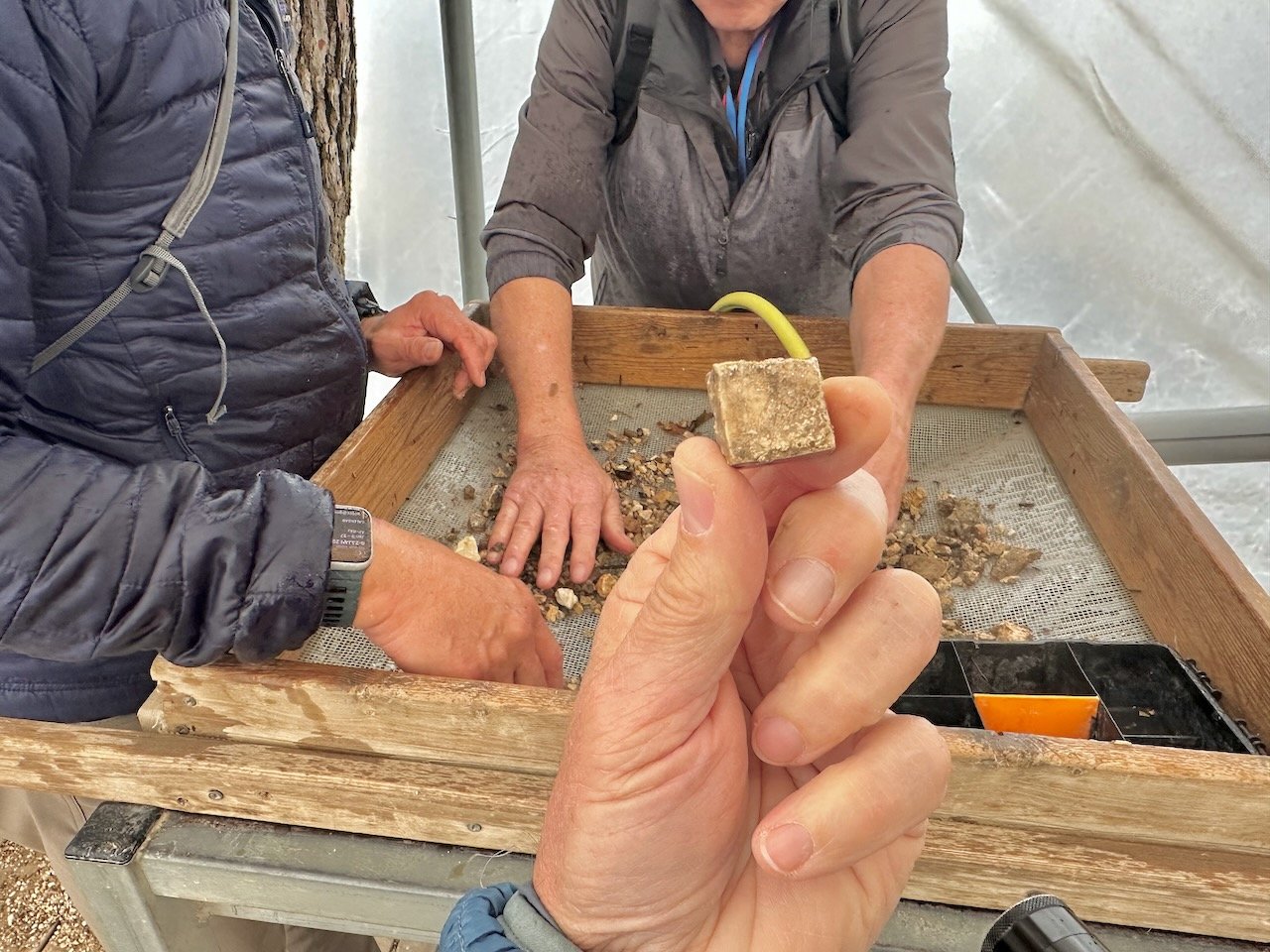
From here we drove to the northern end of the Mt. of Olives for a “hands-on” experience! We participated in the Sifting Project. This was a project of transferring nearly 400 dump truck fills of debris extracted illegally from underneath the Temple Mount (the Arabs did this in 1999 in order to build an underground mosque at the NE corner of the Temple Mount). So following a brief teaching from the local archaeologist, we sifted through some of this material. It was a fun experience for about 45 minutes, with a few of us finding significant things! Our group found a coin (from Early Islamic Period, mosaic stones (tesserae), Roman glass, pottery, among other things.
Israel Museum
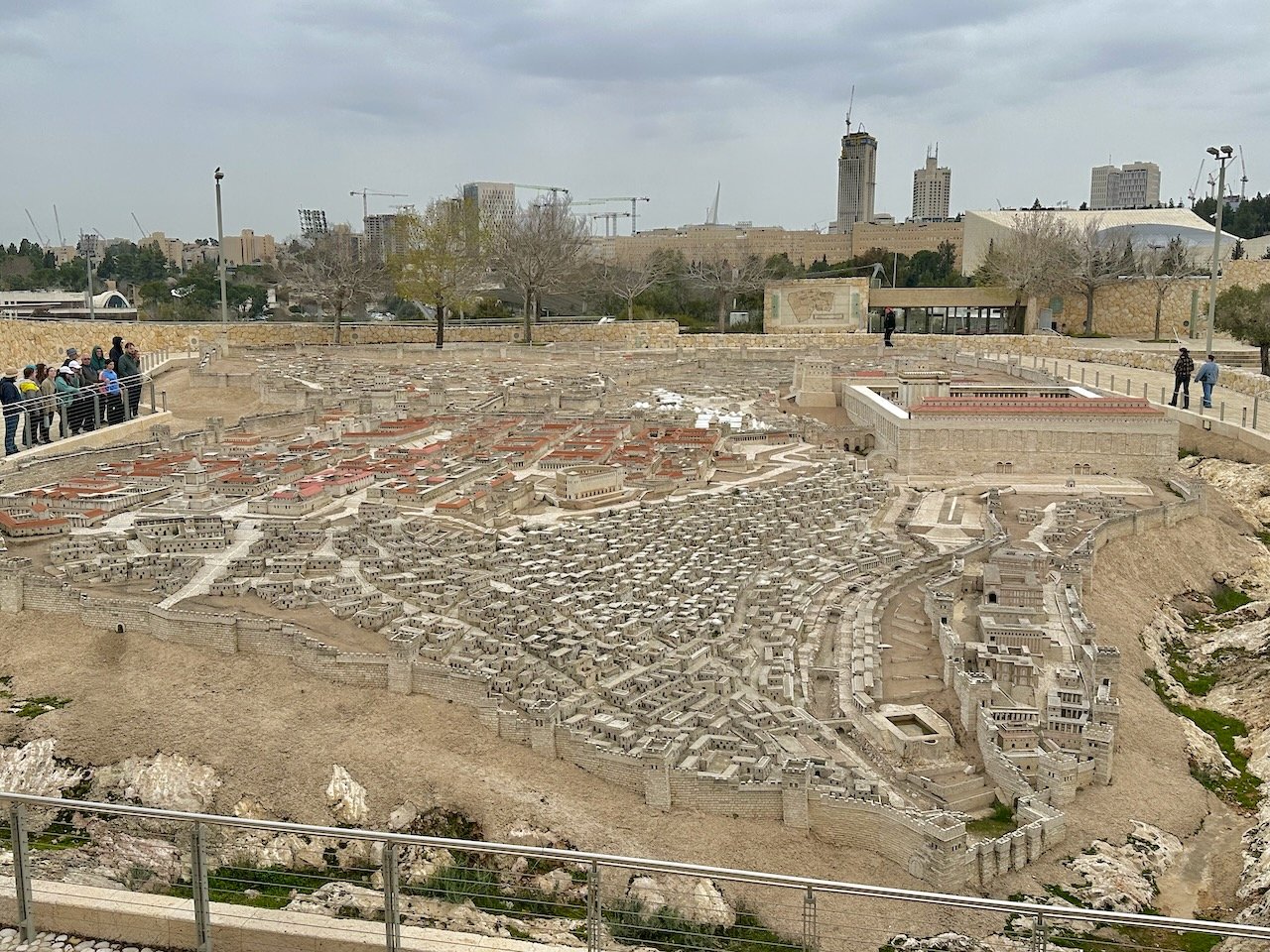
From here we drove to the area of the Knesset, Israel’s parliamentary building. Across the street is the Israel Museum. Here we saw three things. First, a 1:50 scale model of 2nd Temple Jerusalem. The model gives us a good idea of what Jerusalem looked liked during the time of Jesus. Next, we briefly walked through the Shrine of the Book where some of the Dead Sea Scrolls are on display. Lastly, we saw the highlights within the archaeological wing of the museum. Among the many things we saw, this included such artifacts like the Arad “Holy of Holies,” the Dan and Pilate Inscriptions, Lachish Letter #4, the Ketaf Hinnom inscription (Numbers 6), Herod’s sarcophagus, and the “pie plate” from the 2nd century AD. 🙂
“Hidden Gate” (Optional)
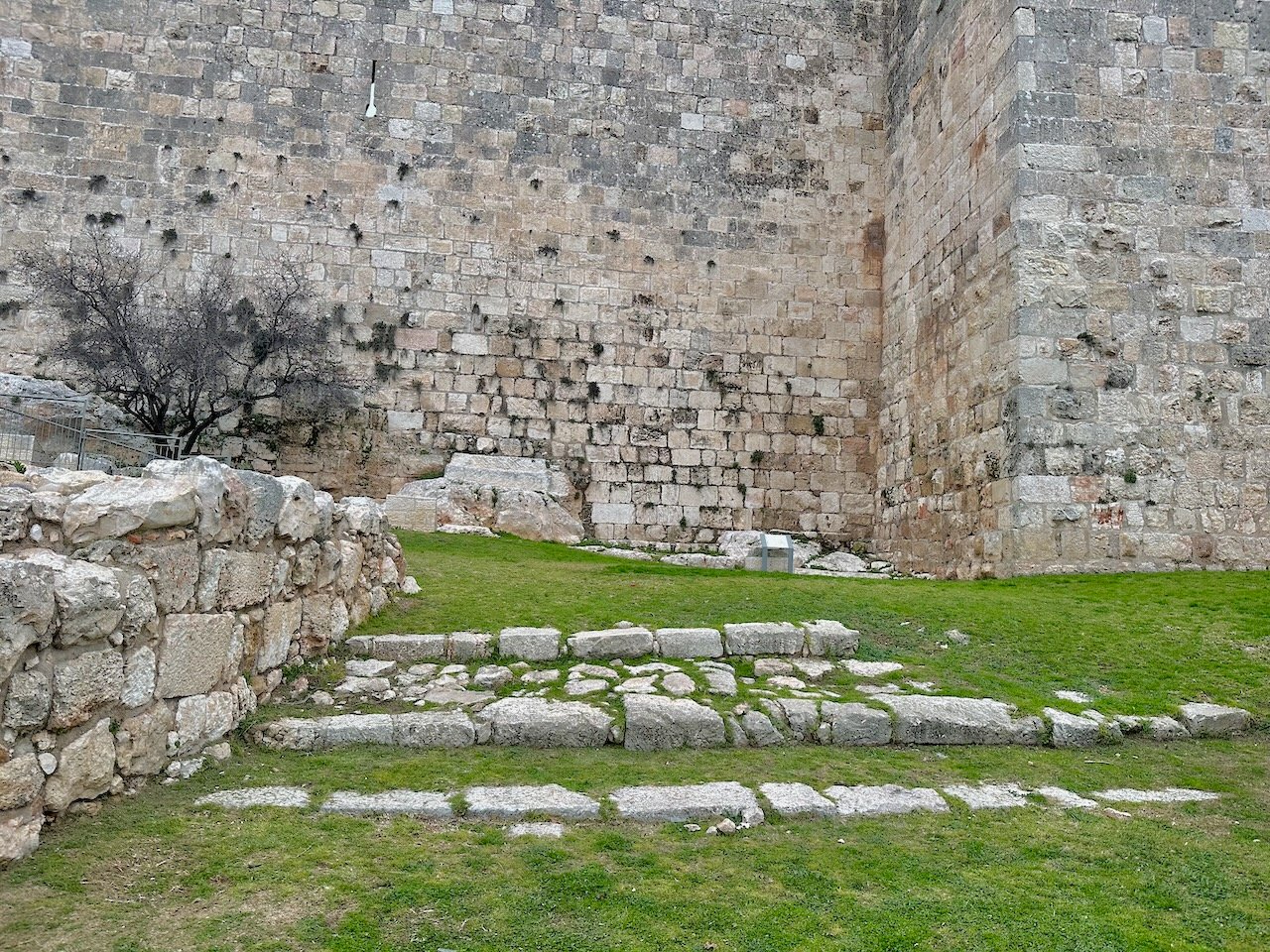
We returned to the hotel from here. About half of the group called it a day, while others continued to the Jaffa Gate area. We walked to the southern area of the western side of the Old City to see what is called the “Hidden Gate.” This may have been the “lithostrotos” (“stone pavement”) upon which Jesus stood when Pilate presented Him to the religious of Jerusalem who wanted Jesus crucified. Some of the original steps leading up to this gate (that was there 2000 years ago) can be seen today.
We drove back to the hotel (again) for our “Farewell Dinner.” It was a good time of sharing around the table some of our “highlight” moments of the trip. For many of us, our flights have been changed because of Lufthansa canceling flights. Most in the group fly out tomorrow morning or afternoon. Others in the group will stay in Jerusalem another day or two.
Day 14 – Friday, January 23: Ben Gurion Airport, Flights Back to the U.S
Various flights we used to get us all back to the US. It was a great trip with a great group!
Hike Up Arbel
One of our optional hikes is to the top of Mt. Arbel. Located on the NW corner of the Sea of Galilee, the hike offers a wonderful view of the region. We ascend 800 feet to the top (for those not inclined to hike the bus takes people to the top from the other side).
The cliffs of Arbel has historical significance too. Jews during both the 1st century BC and later in AD 66-67 found refuge in these caves.