
Tour Experiences for our “Granddaddy” 17 Day Combined Biblical Egypt, Jordan, and Israel Tour
November 7-23, 2025
(This page is now updated through Day 16, Saturday, November 22)
"Life transforming Israel tours & teaching in the context of the land of the Bible"
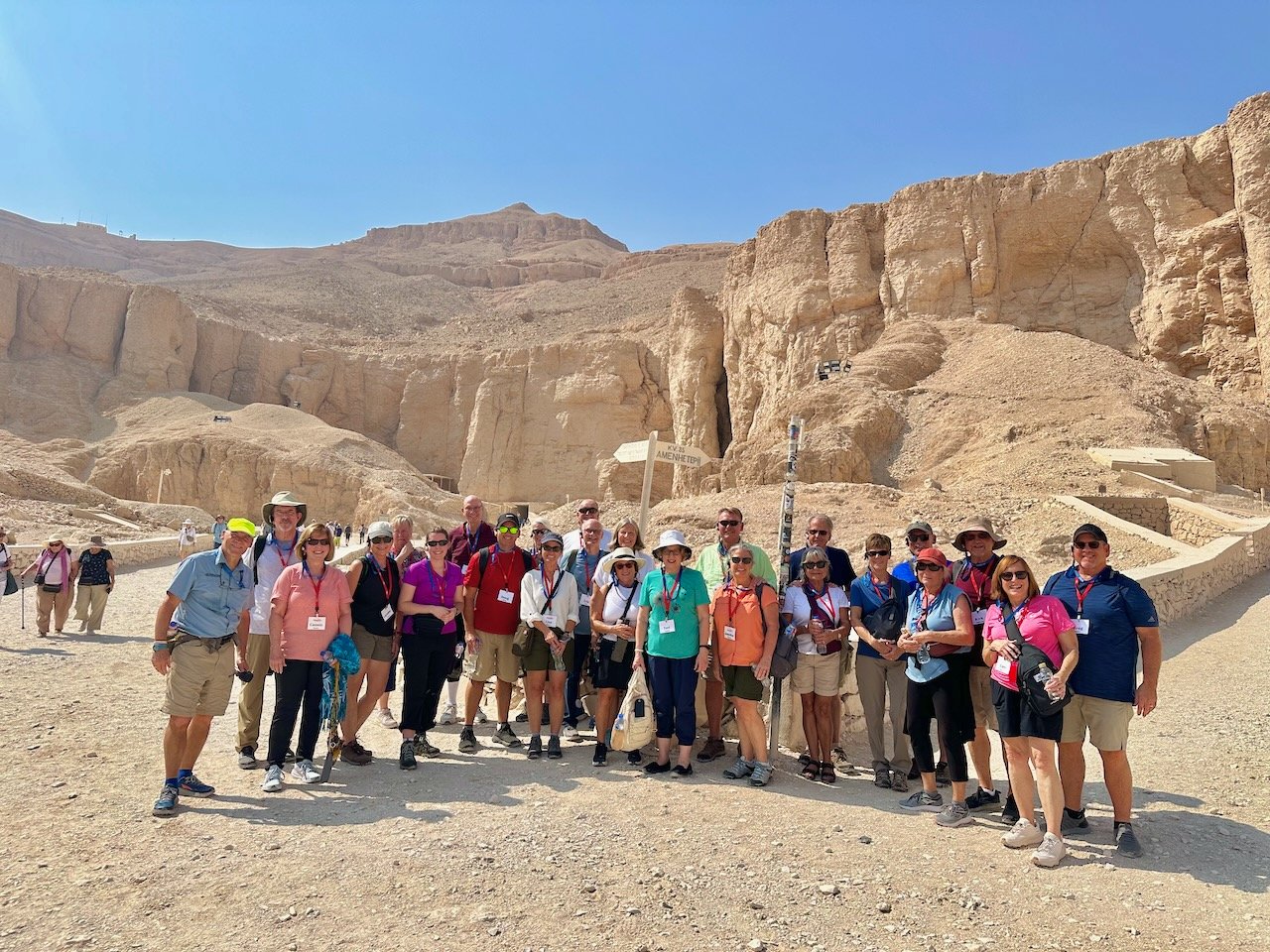
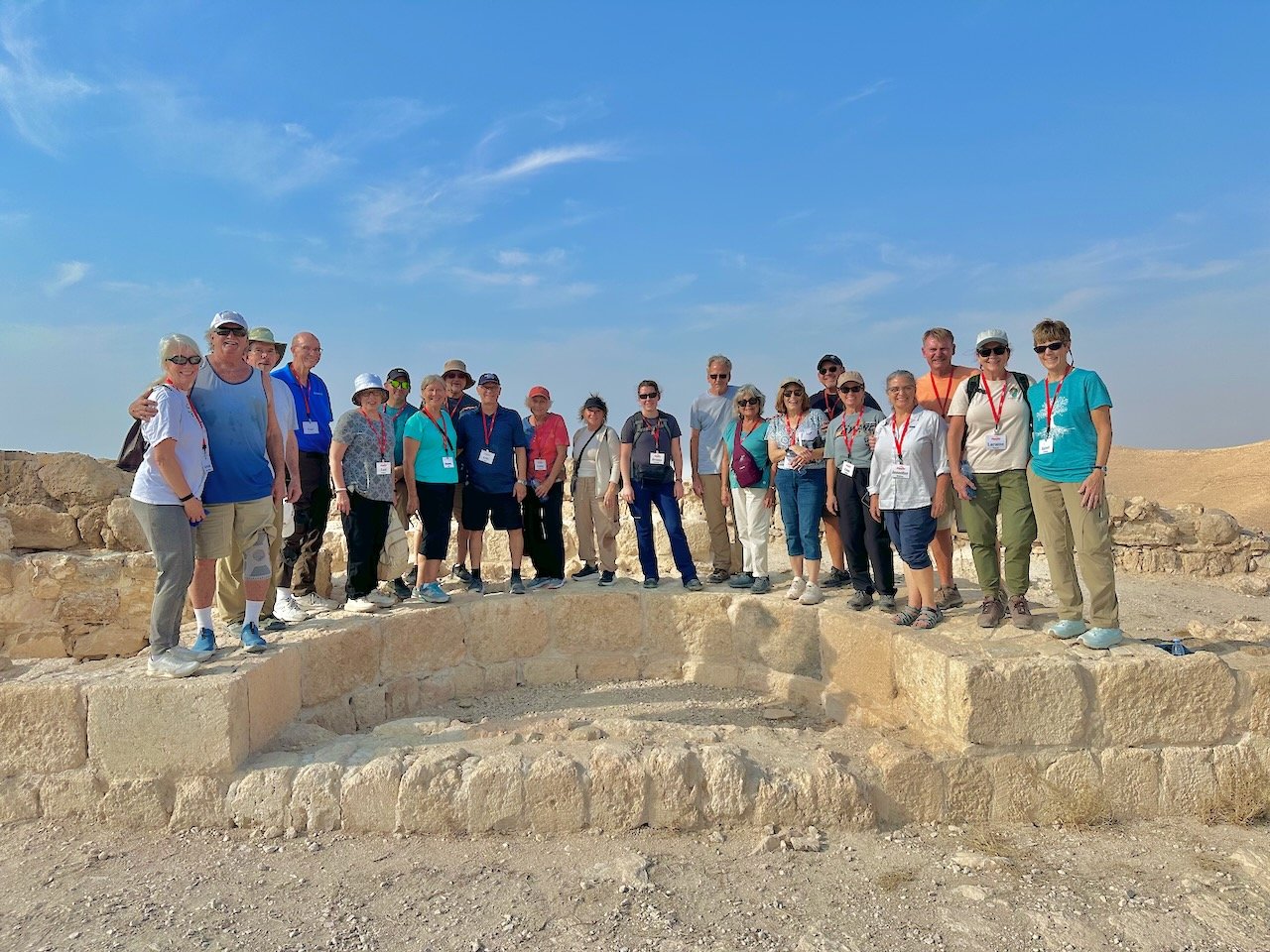
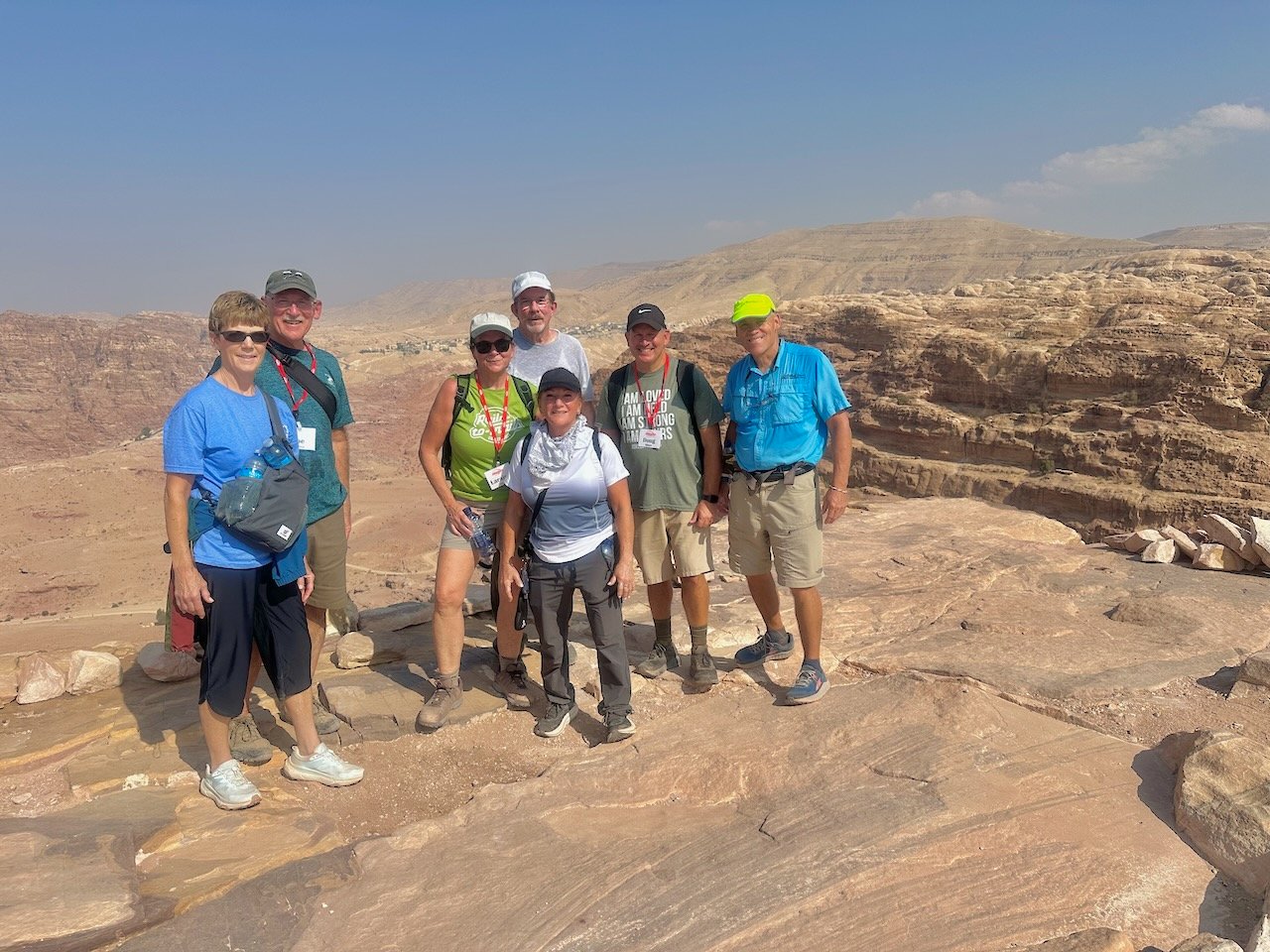
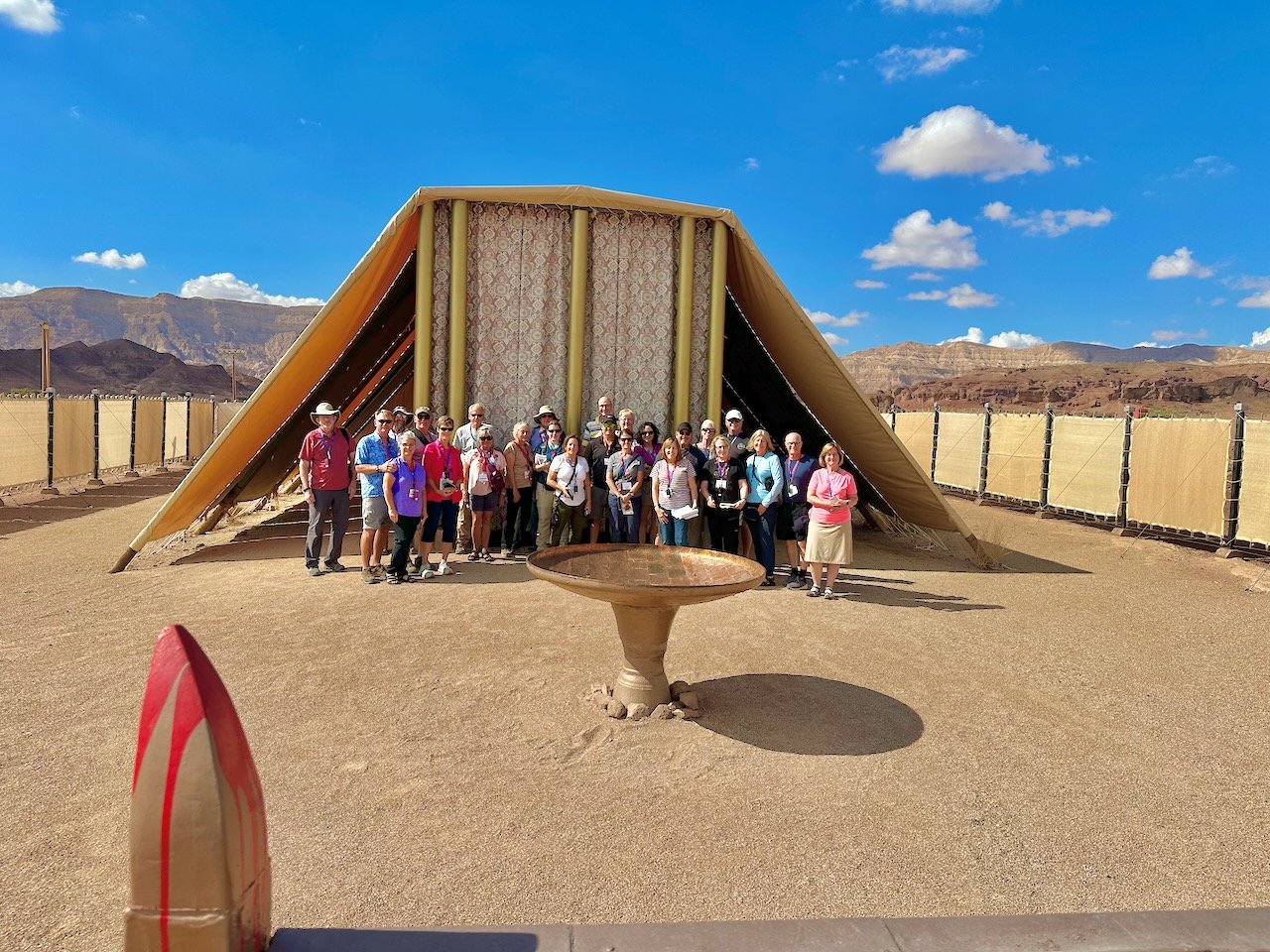
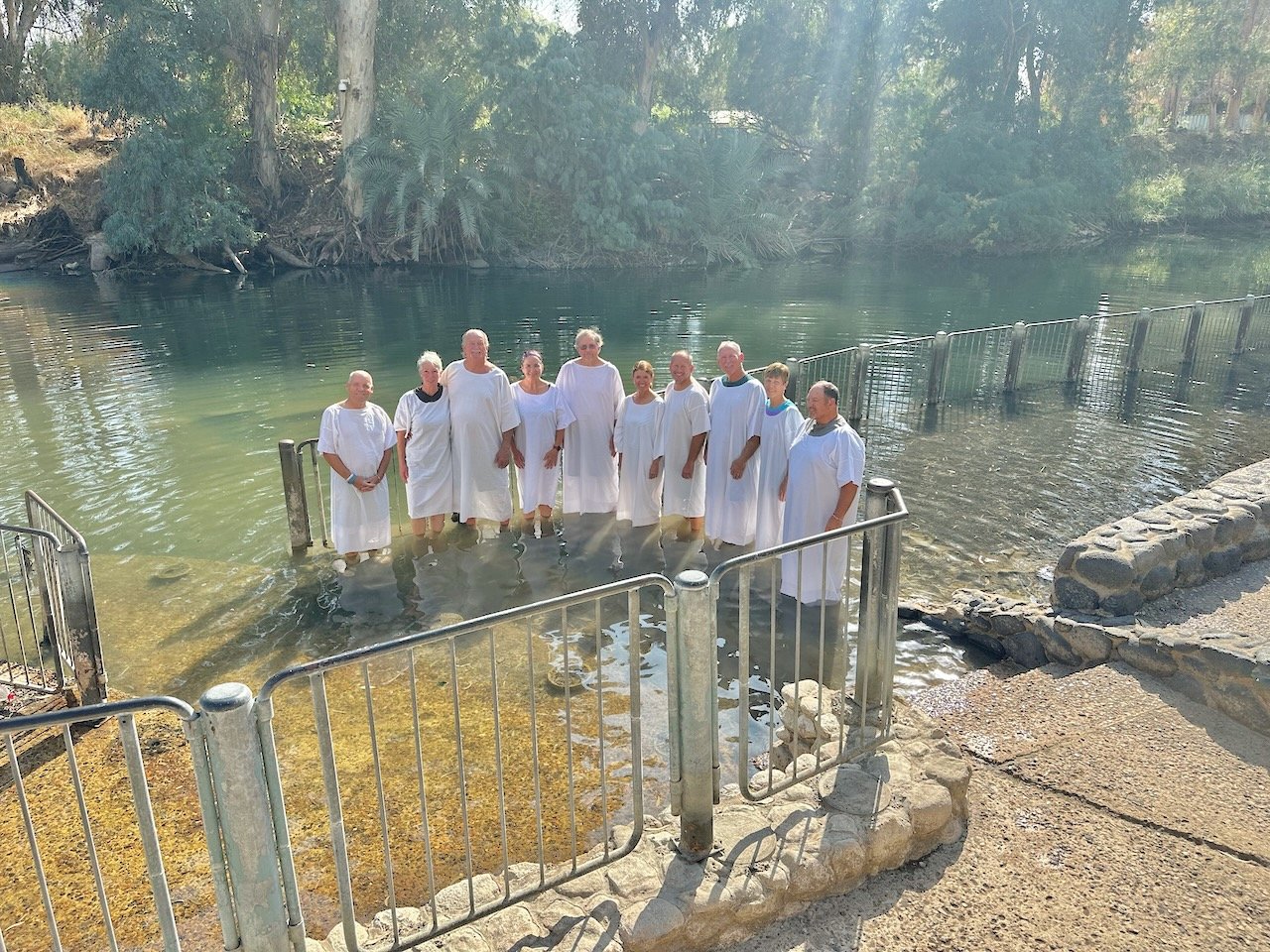
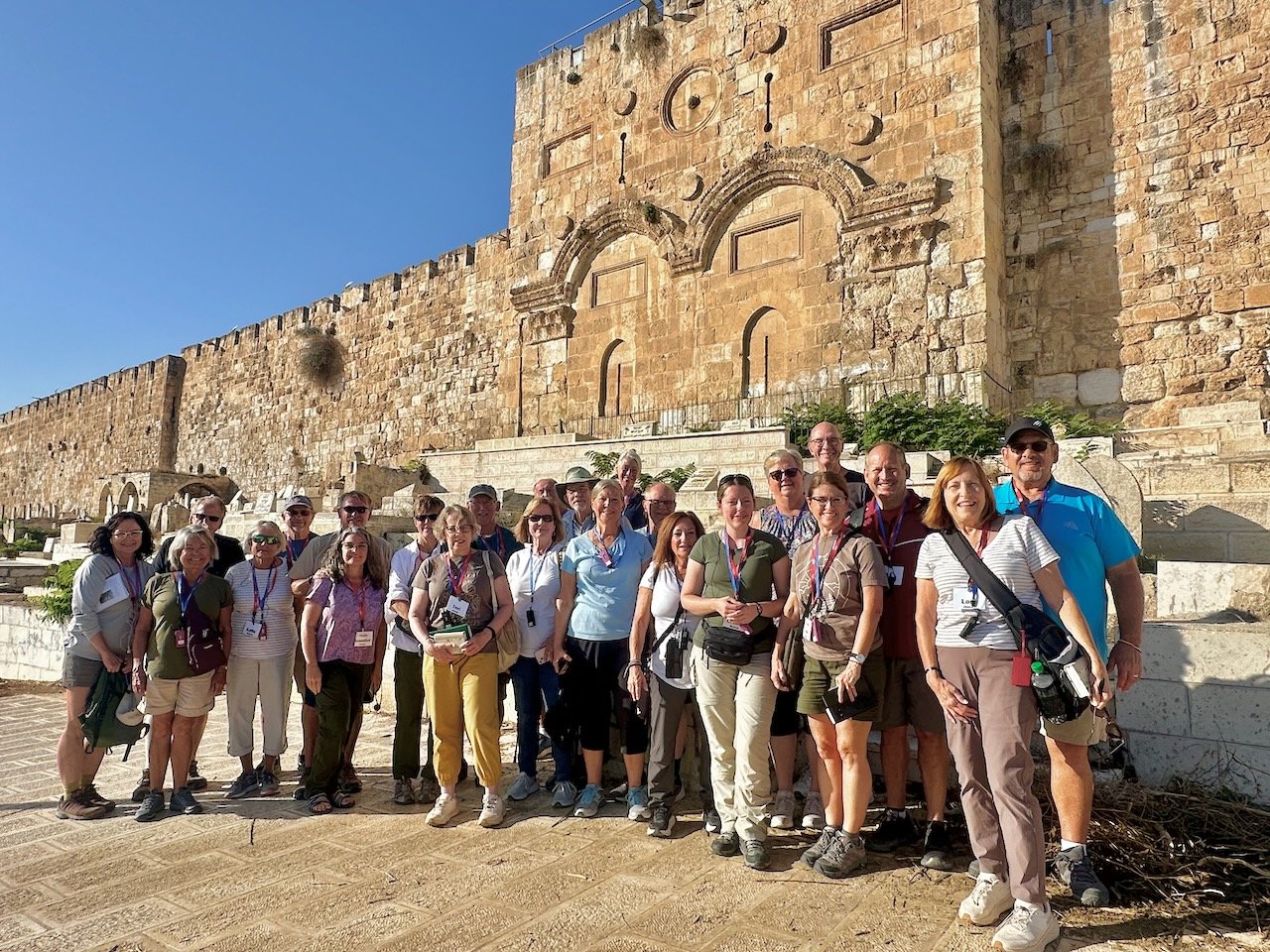
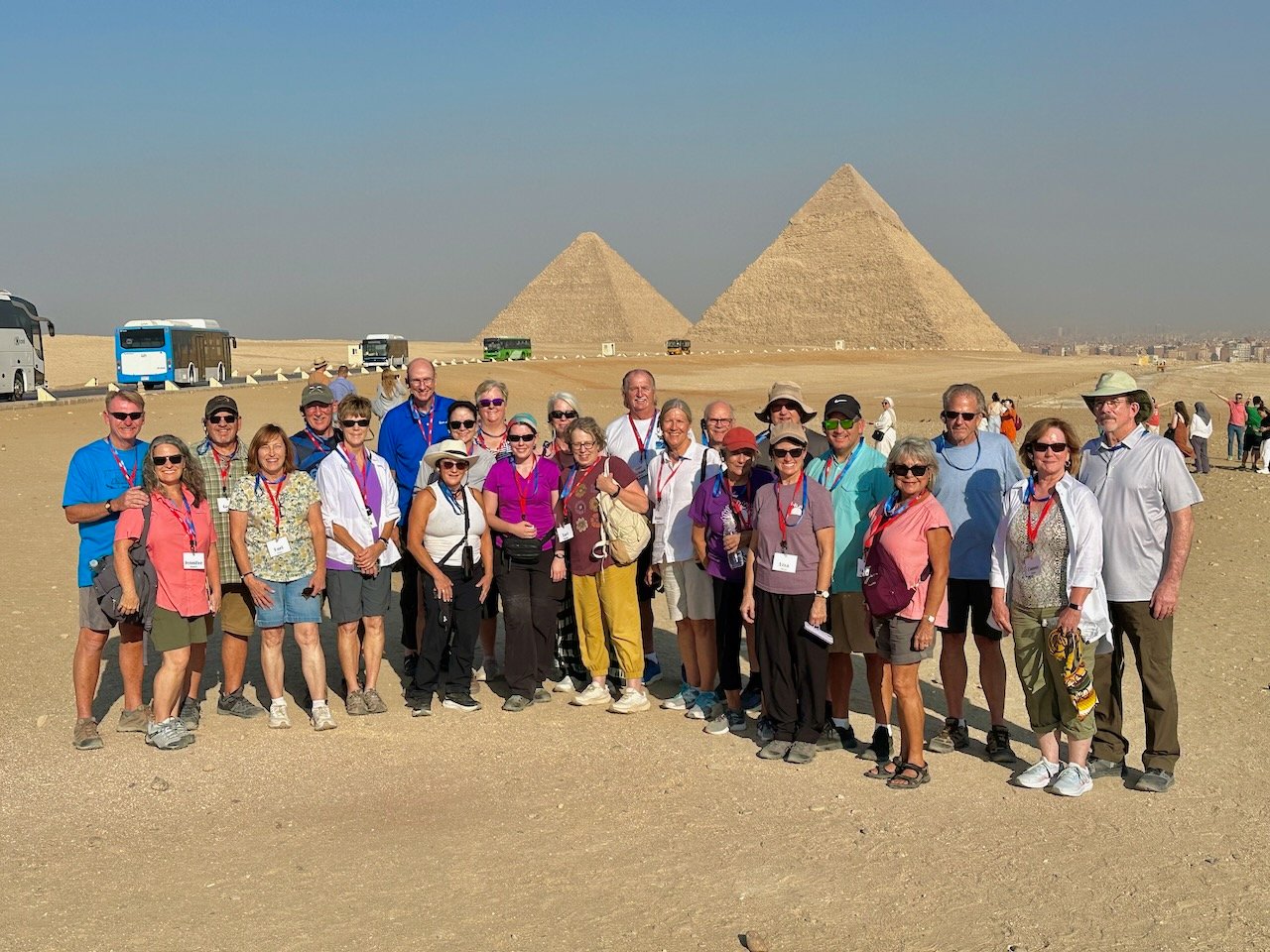
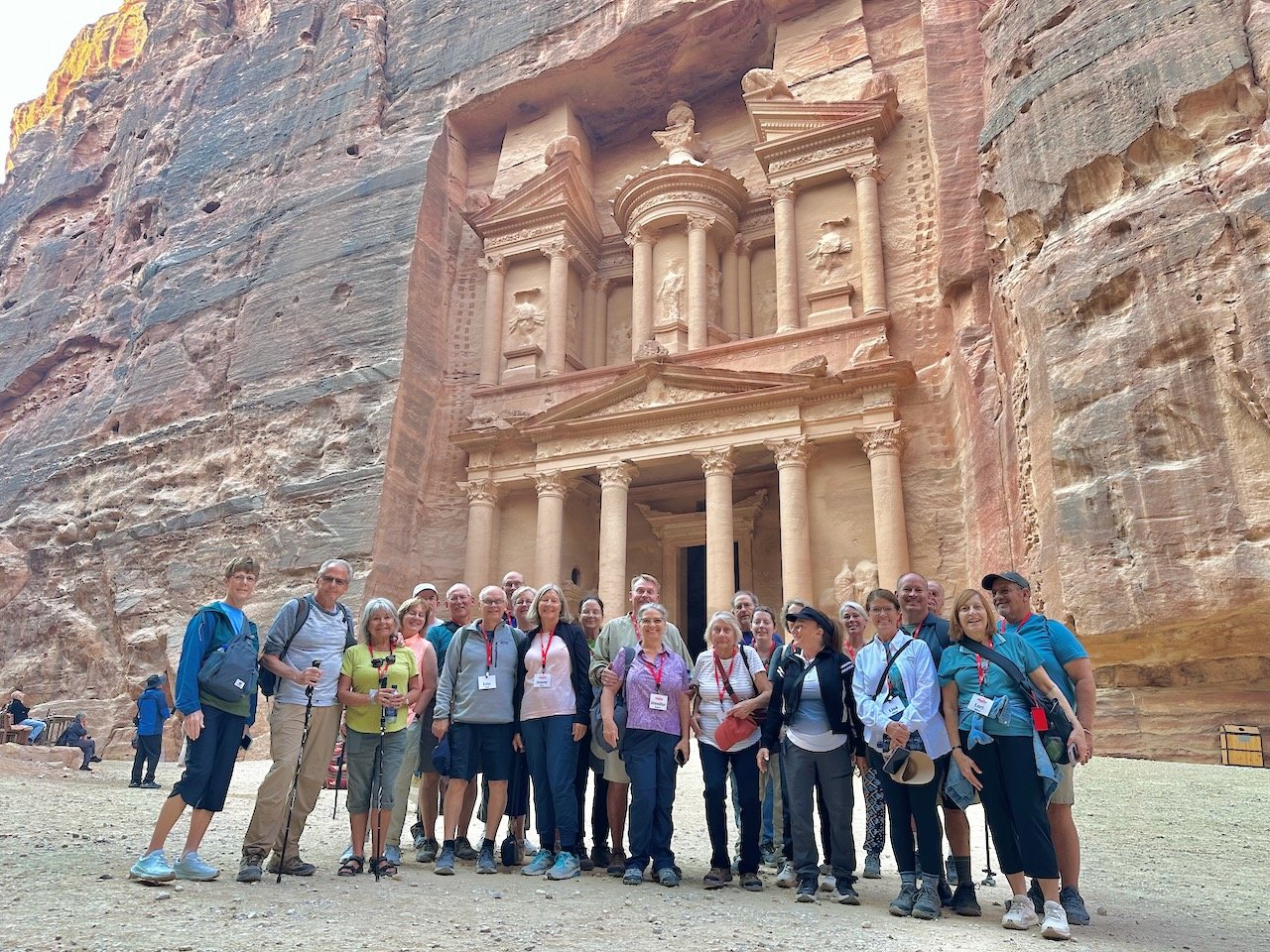
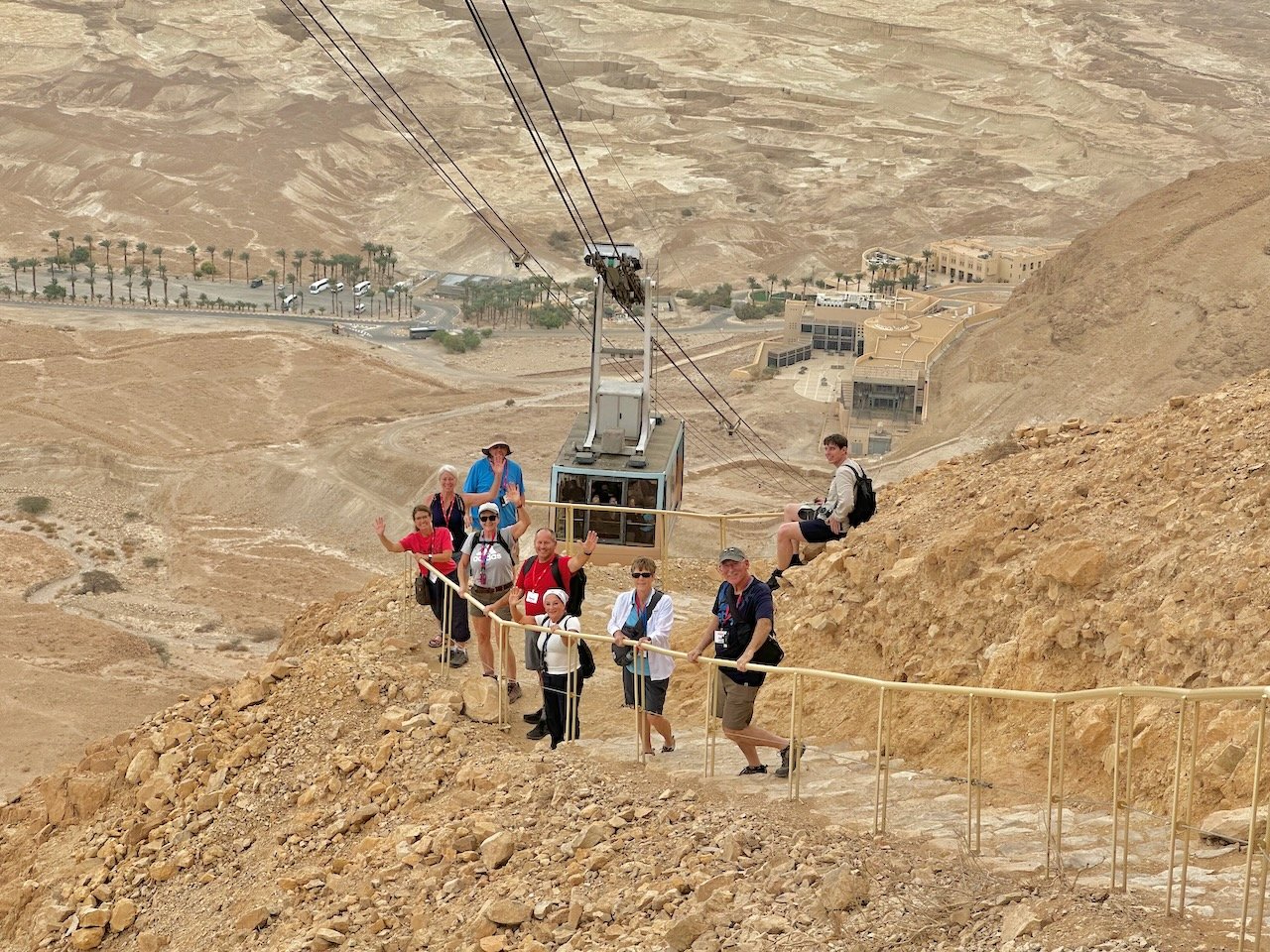
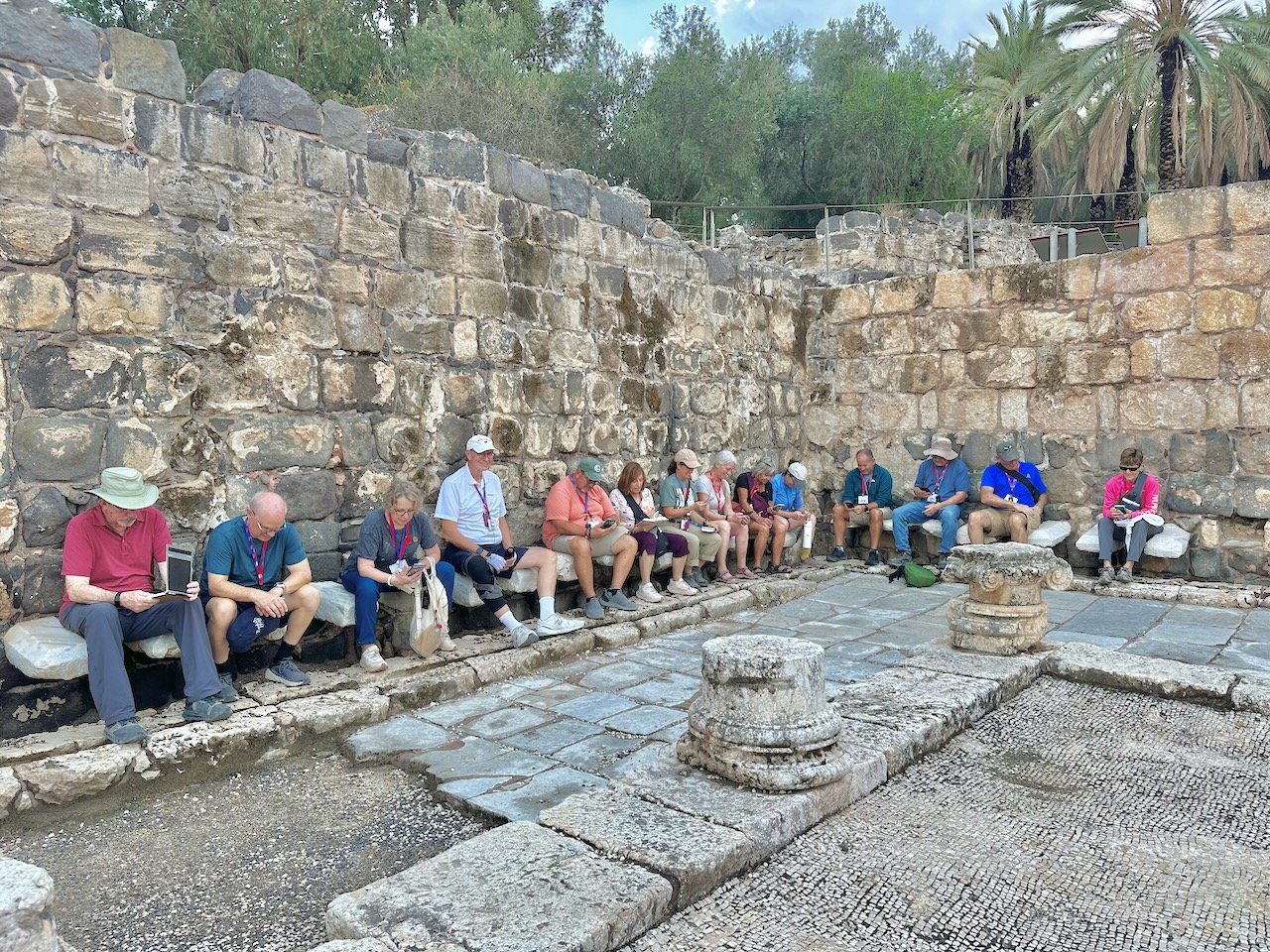
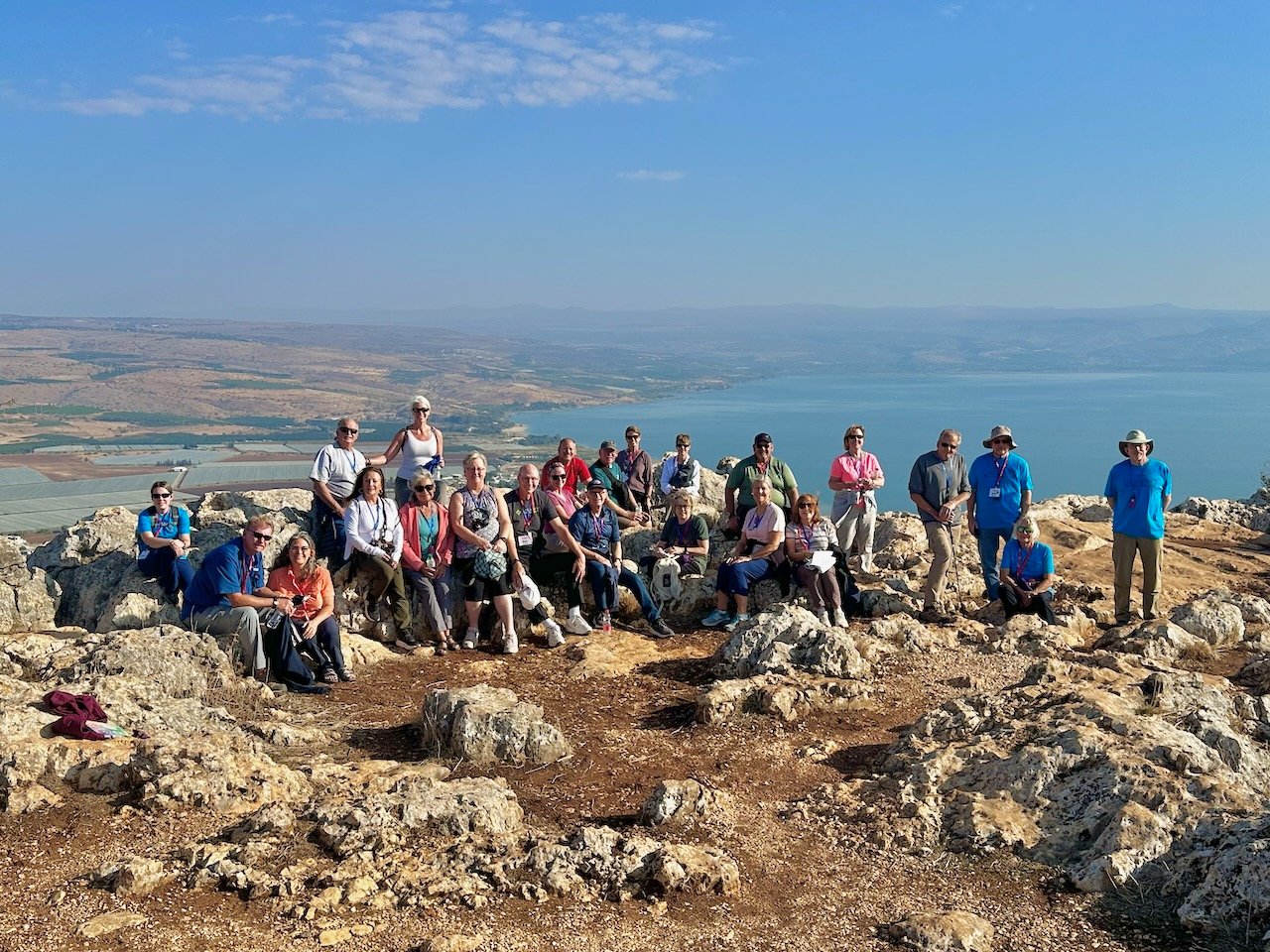
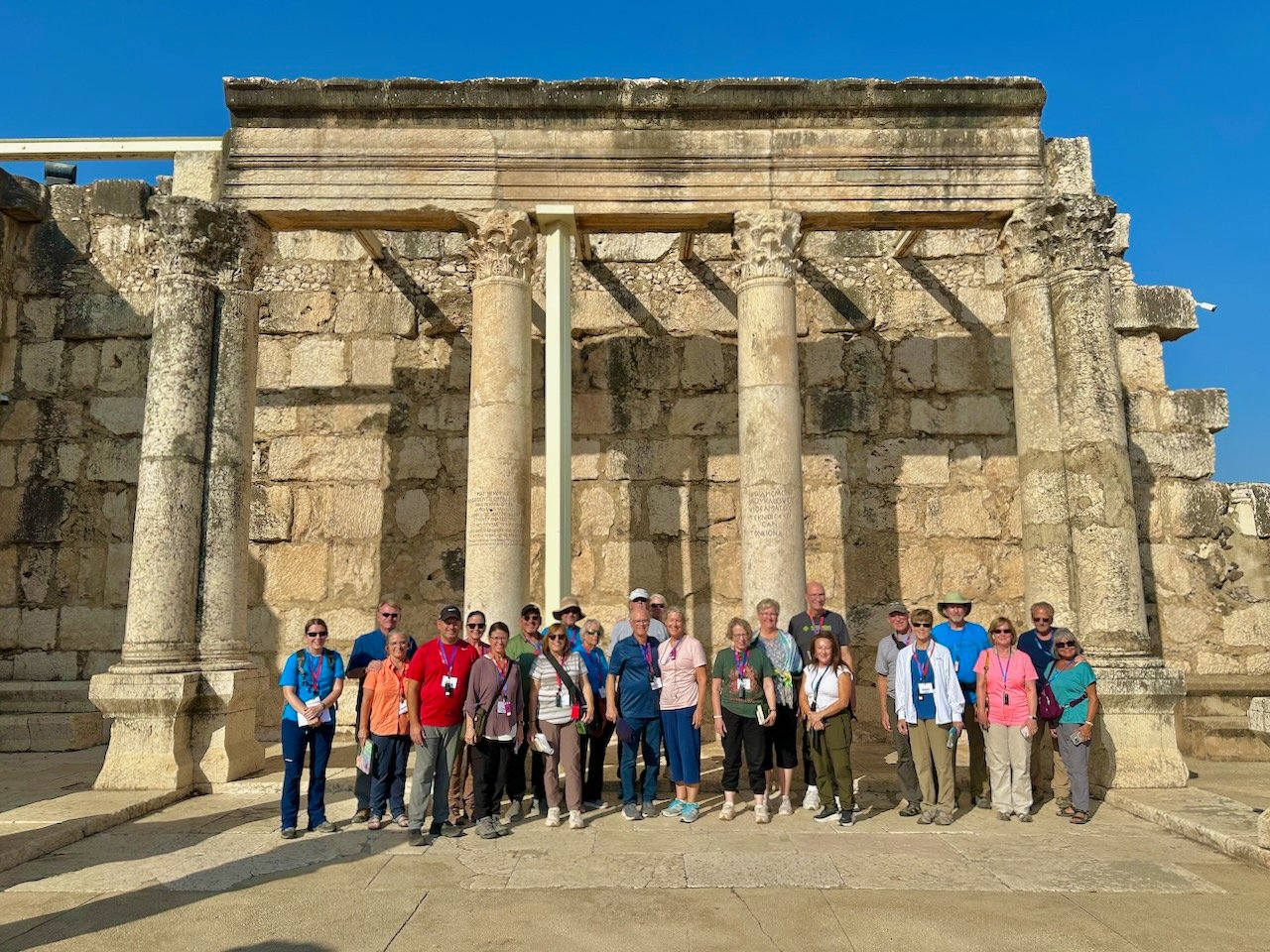
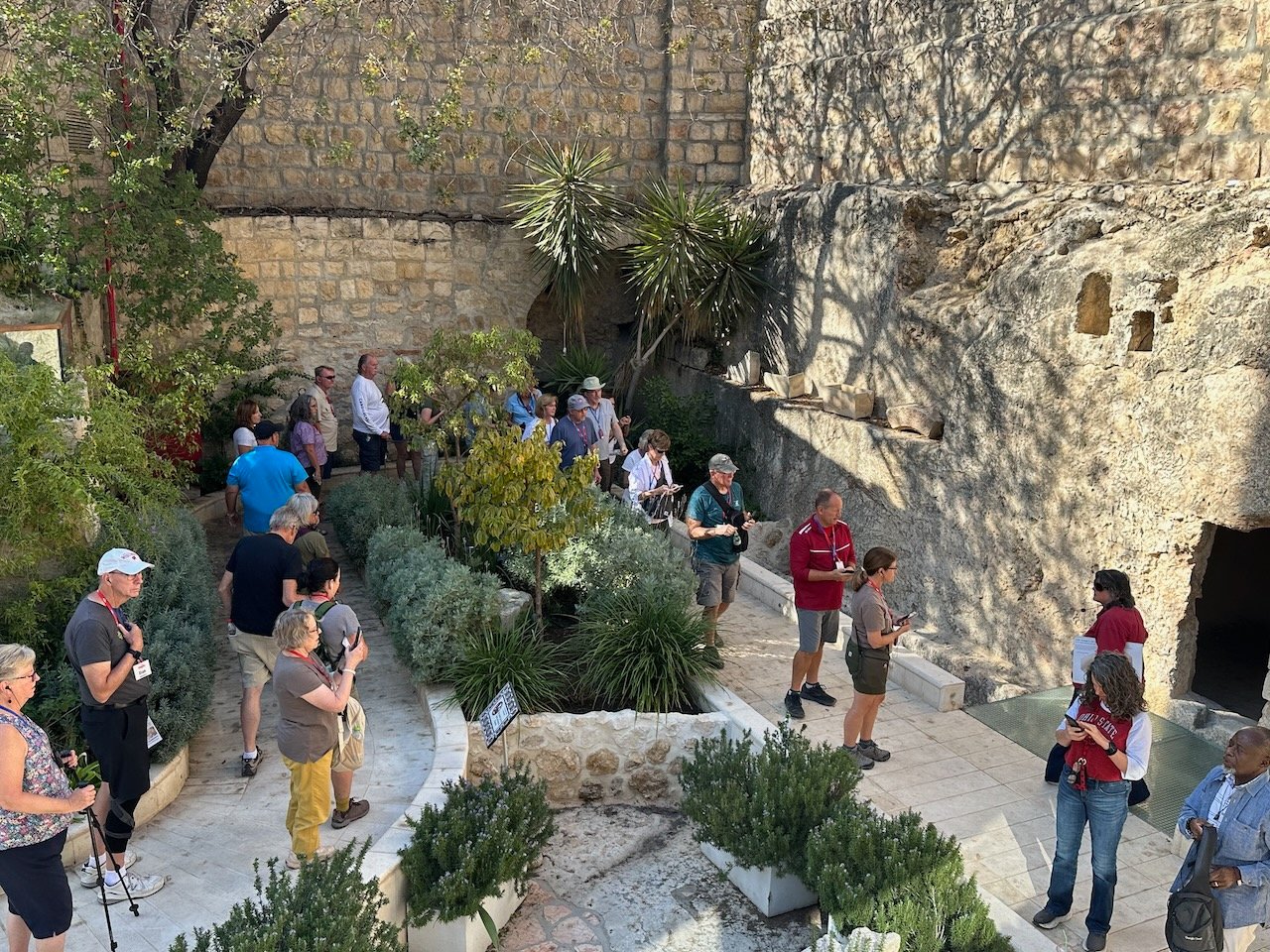
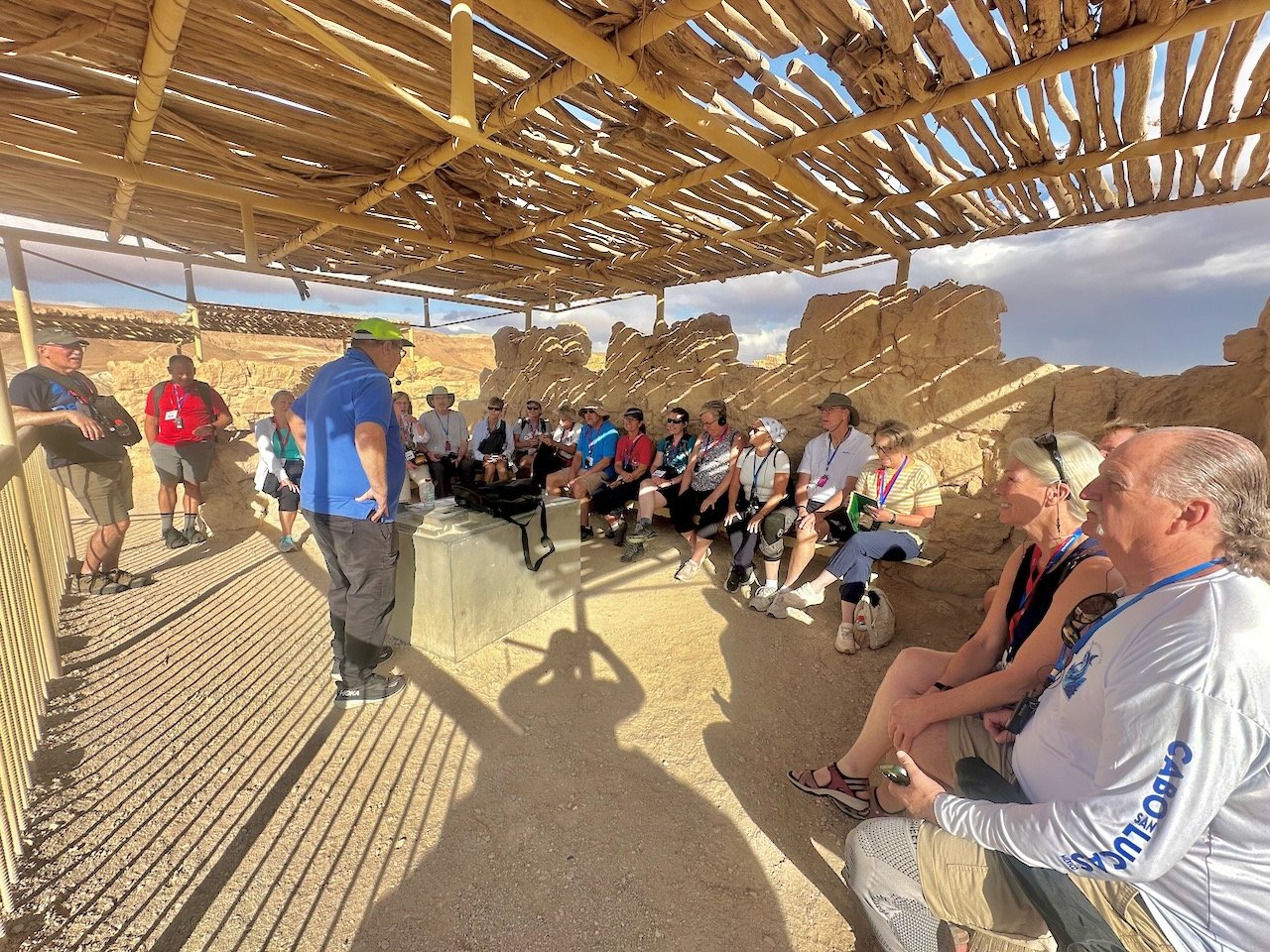
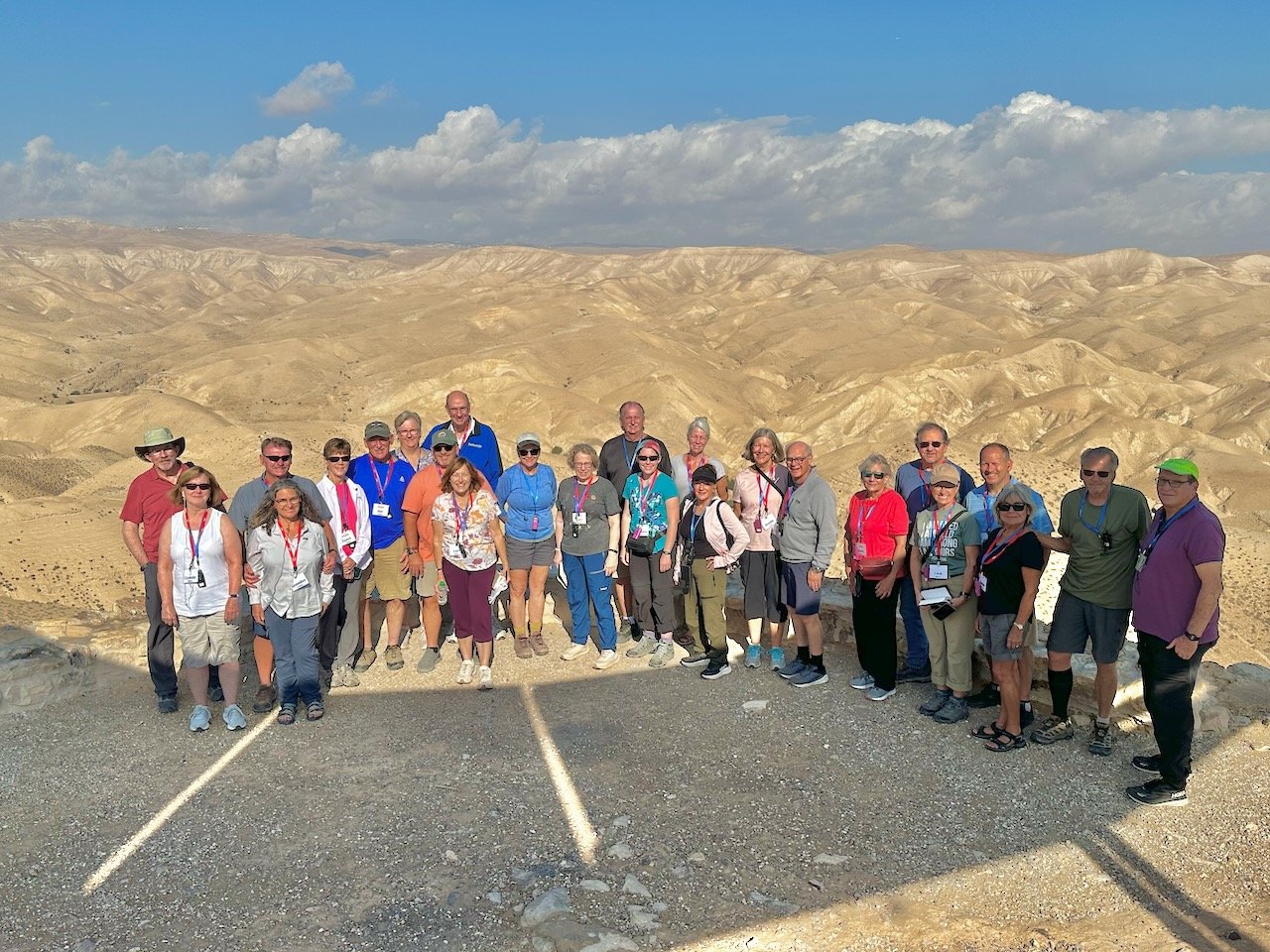
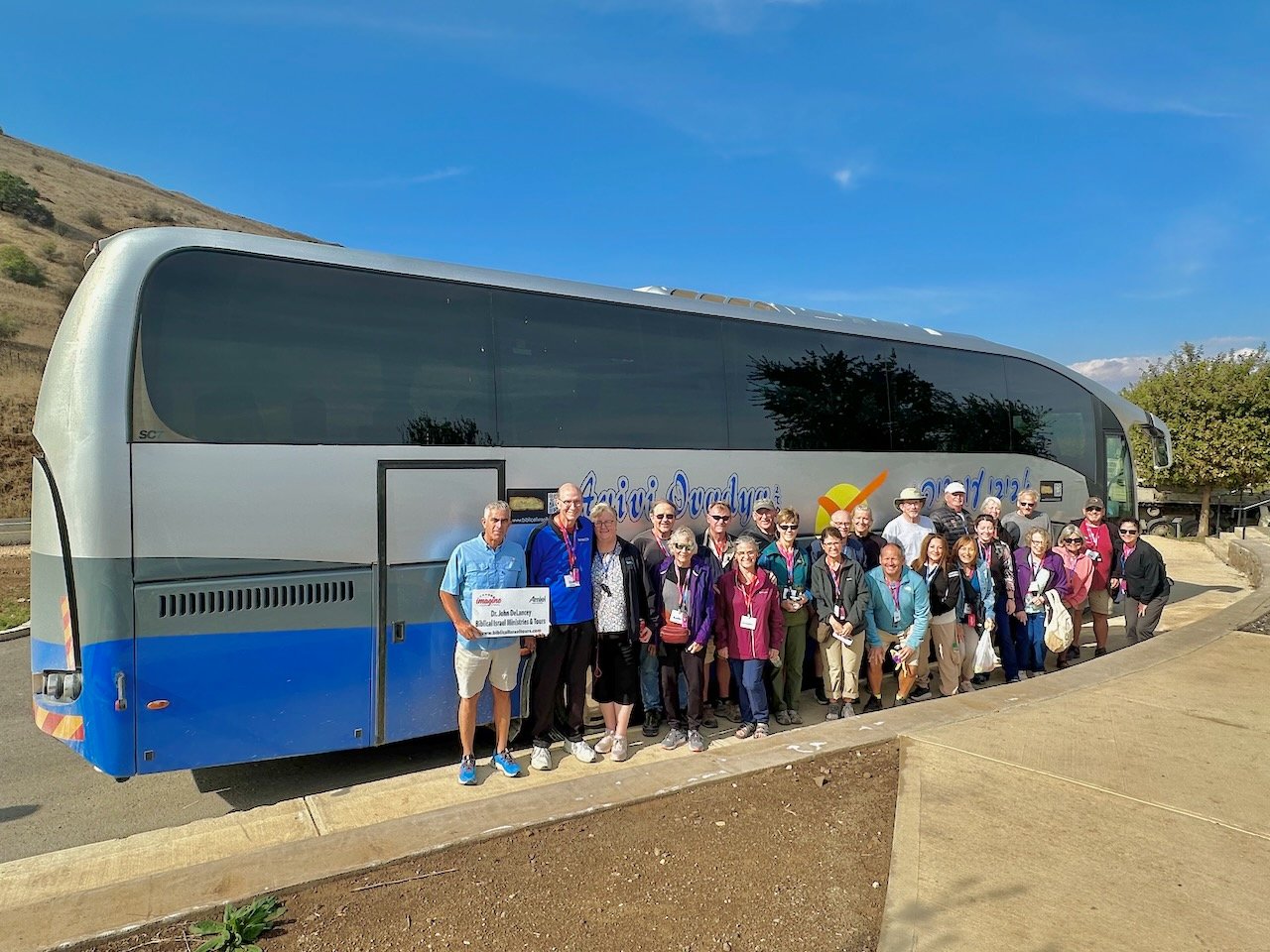
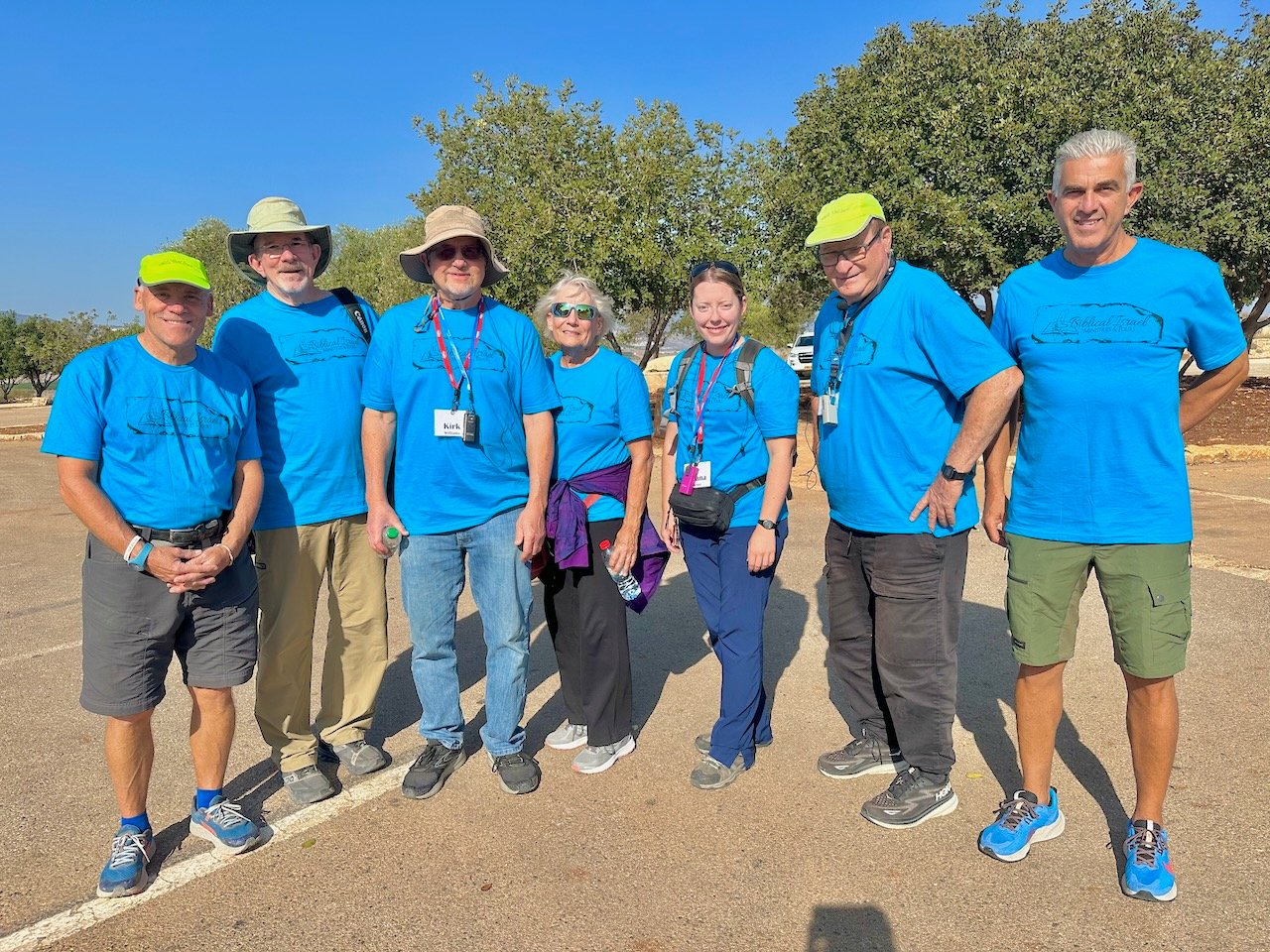
Group Photos








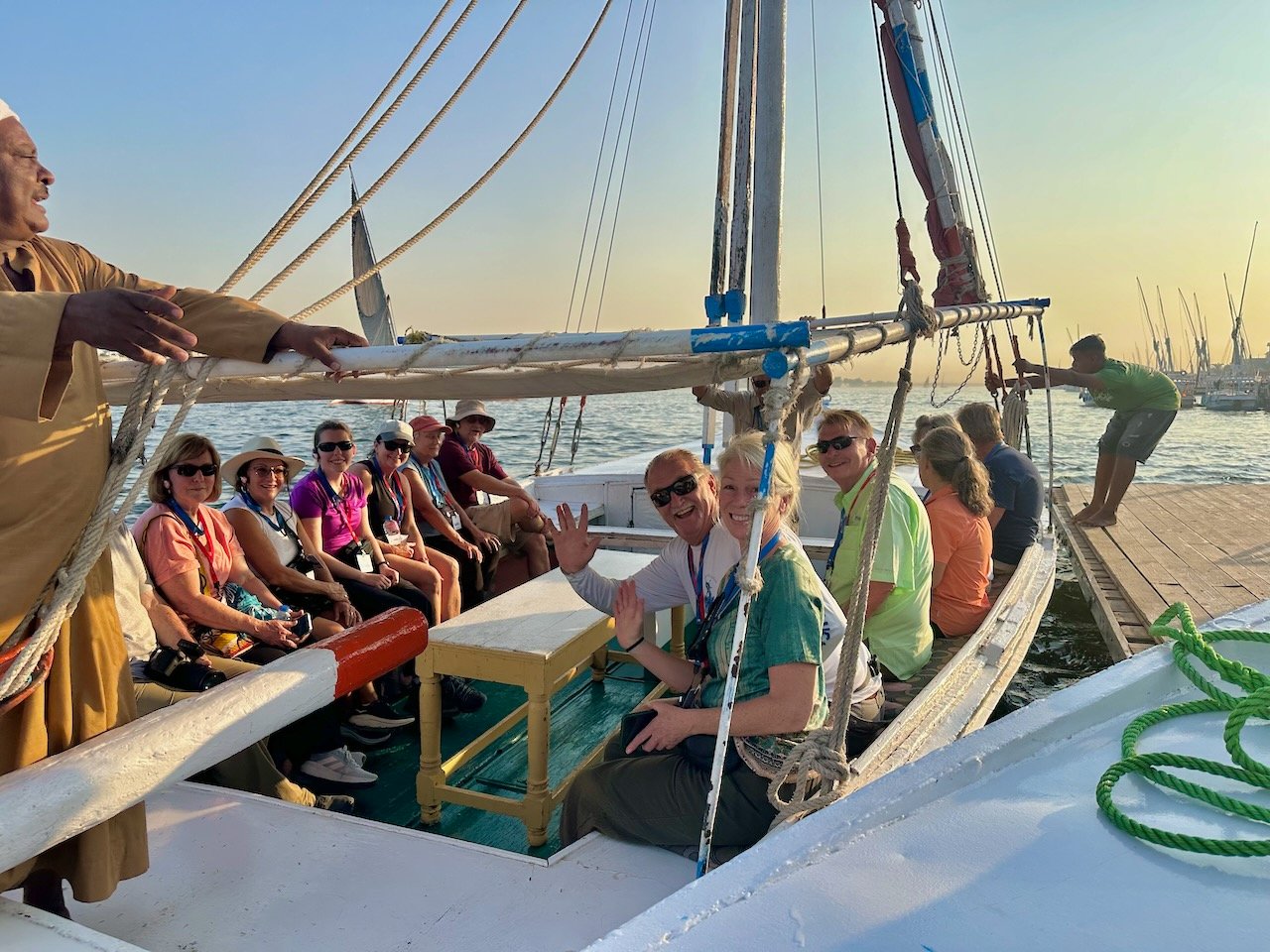

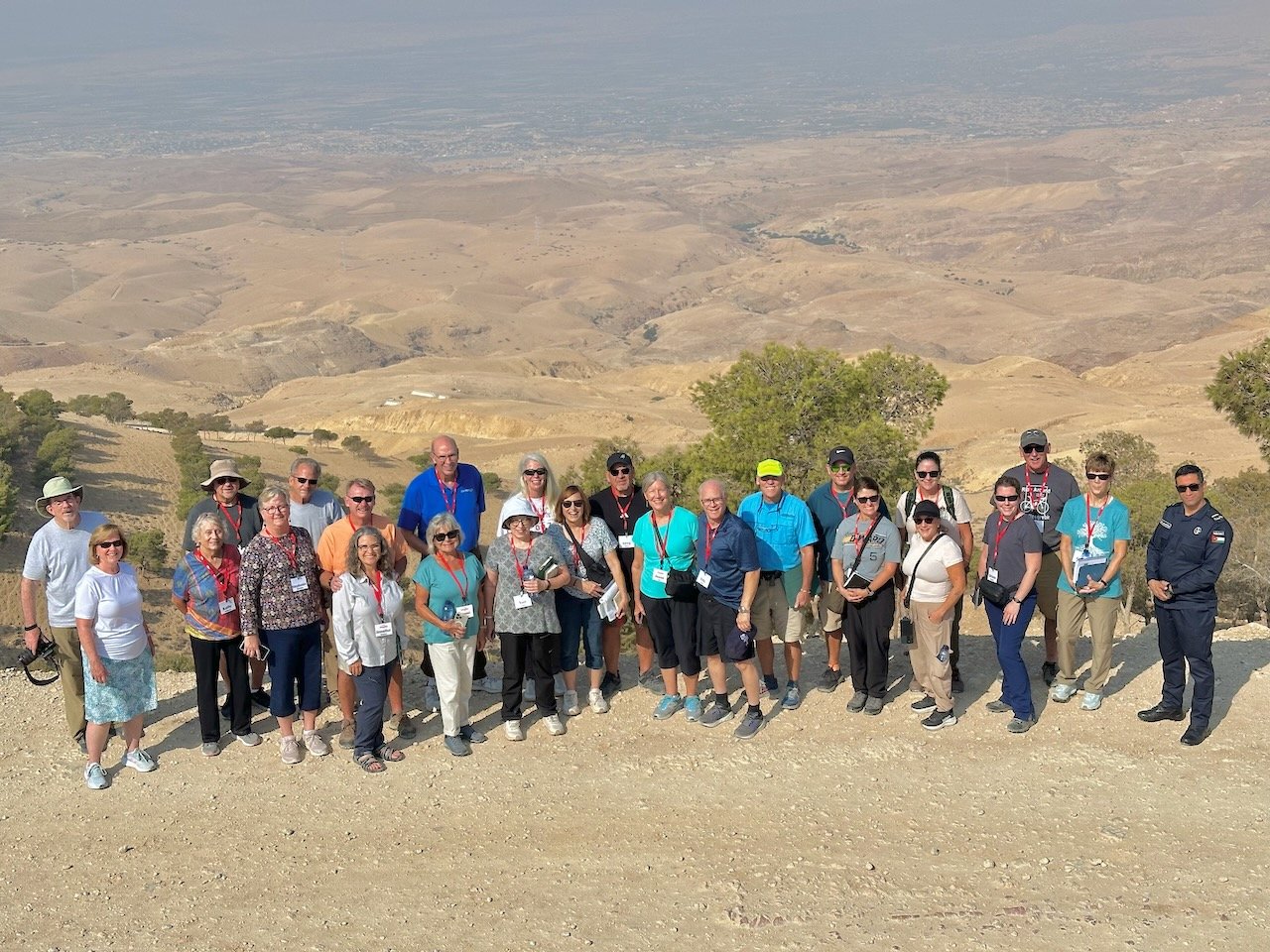
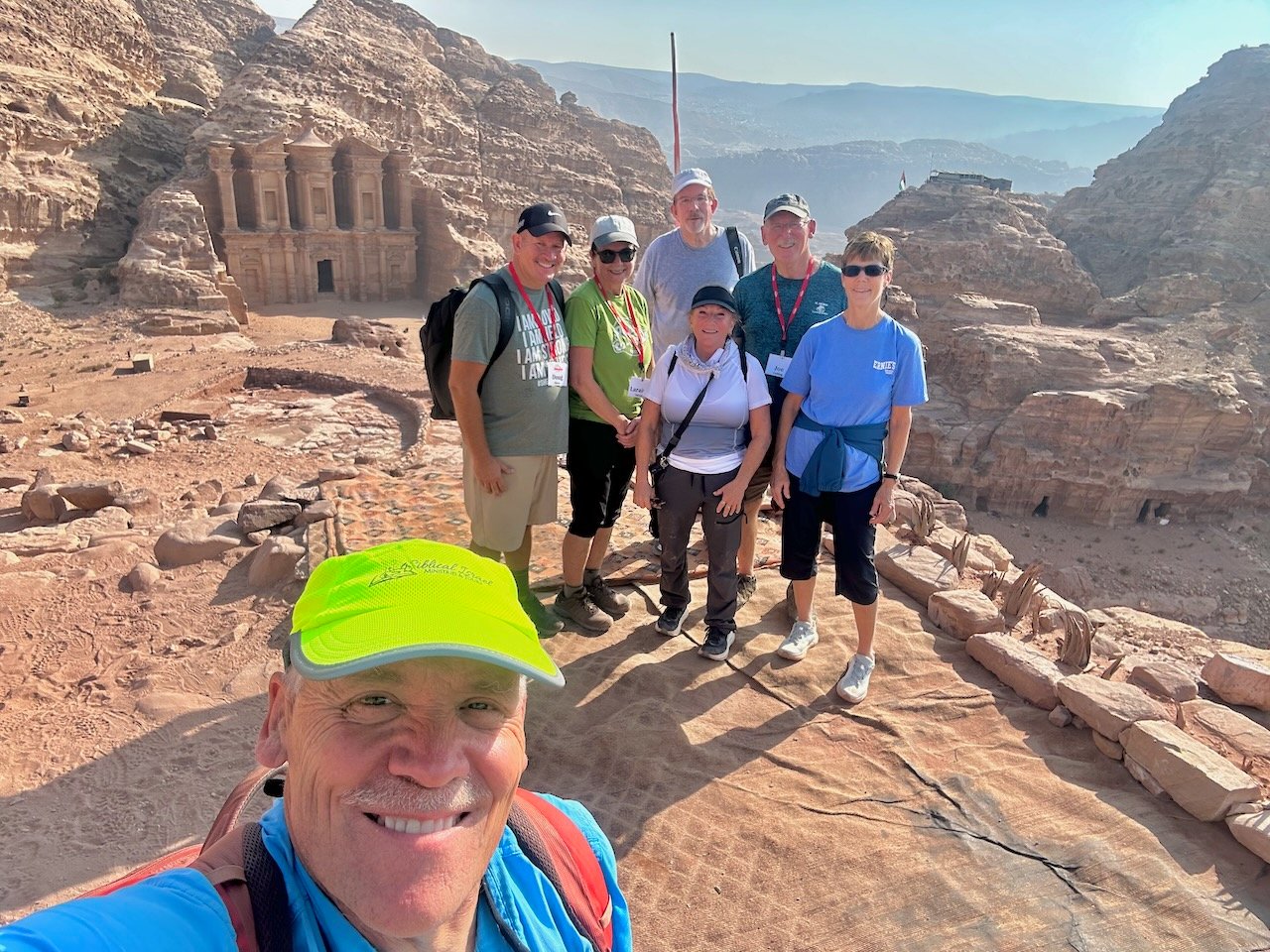
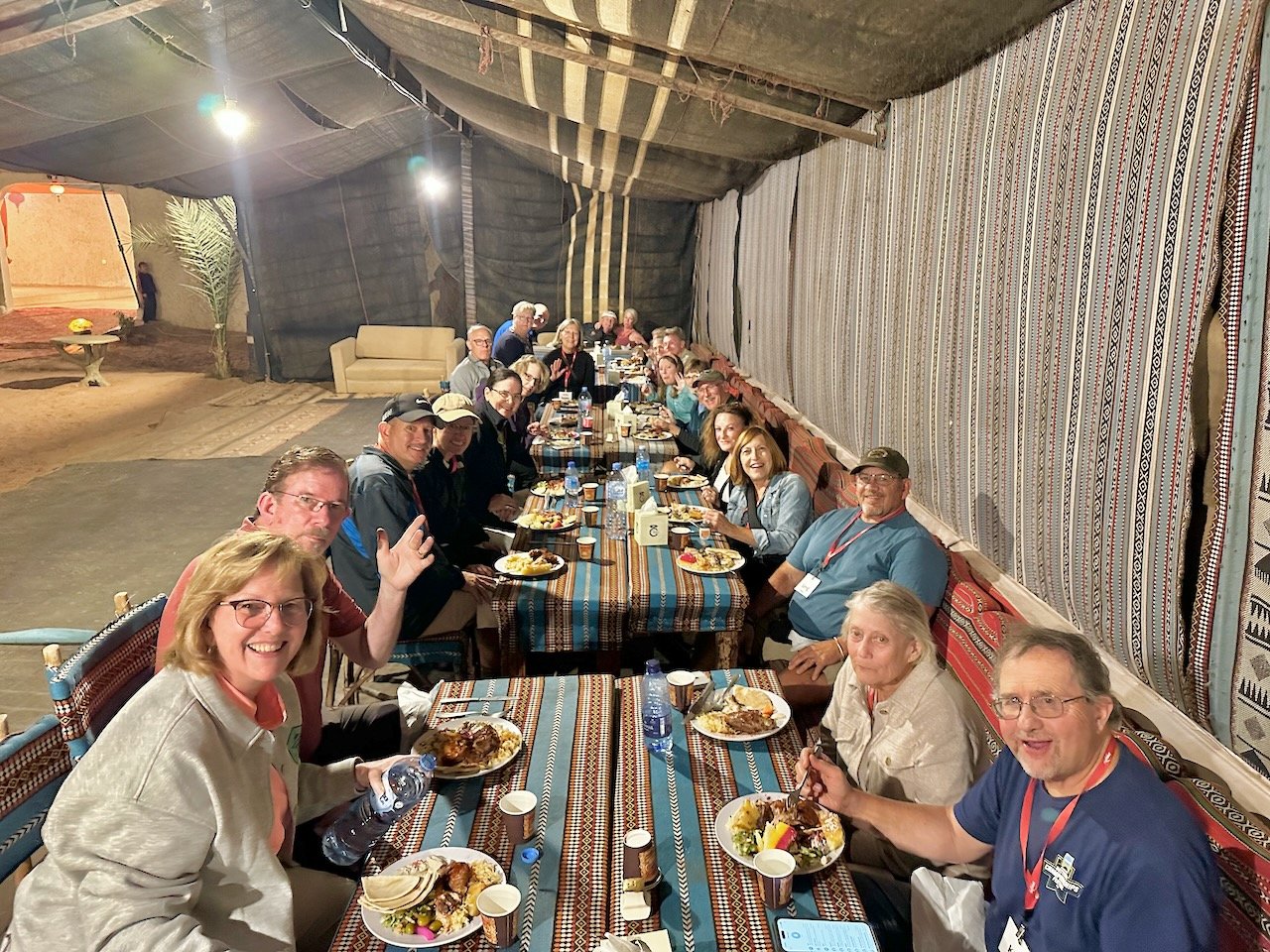


360 Photos
The Egypt-Jordan-Israel Tour:
Days 1 & 2 – Friday-Saturday, November 7-8: Flight from U.S. to Egypt, Hotel in Cairo
Our day of departure finally came. God brought together a total of 25 for this “Granddaddy” tour of Egypt, Jordan, and Israel. Using a few different airlines (and re-scheduled flights from canceled ones), it is only a miracle from God that we all made it to Cairo, a city of about 22 million people (the entire population of Egypt is 110 million).
We arrived at the Cairo Airport where we went through the customary Passport & Visa procedures. Our Meryland Tours agent, Yady, helped us through the process. We also met Dr. Moses, our Egyptologist/guide for our time here in Egypt. We enjoyed dinner together at the airport hotel (the Meridian… very nice). We are all looking forward to this trip of a lifetime that begins with an early 7 a.m. flight to Luxor (about 480 miles south).
(Note: the few photos posted are from a previous trip flying into Cairo)


Day 3 – Sunday, November 9: Monday, November 10: Morning Flight to Luxor, Valley of Kings, Temples of Medinet Habu, Hatshepsut, Luxor, Felucca Boat Ride on Nile River, Overnight Luxor
Today was our first full day, and it began with an early 7 a.m. flight to Luxor. Because of jet-lag, it wasn’t too bad waking up at 3:45, with breakfast at 4. Most were up anyway! The weather in Luxor was hot, with temps around 90 in the afternoon. But what a great first day seeing ancient Egypt at its best!
Luxor: Valley of the Kings
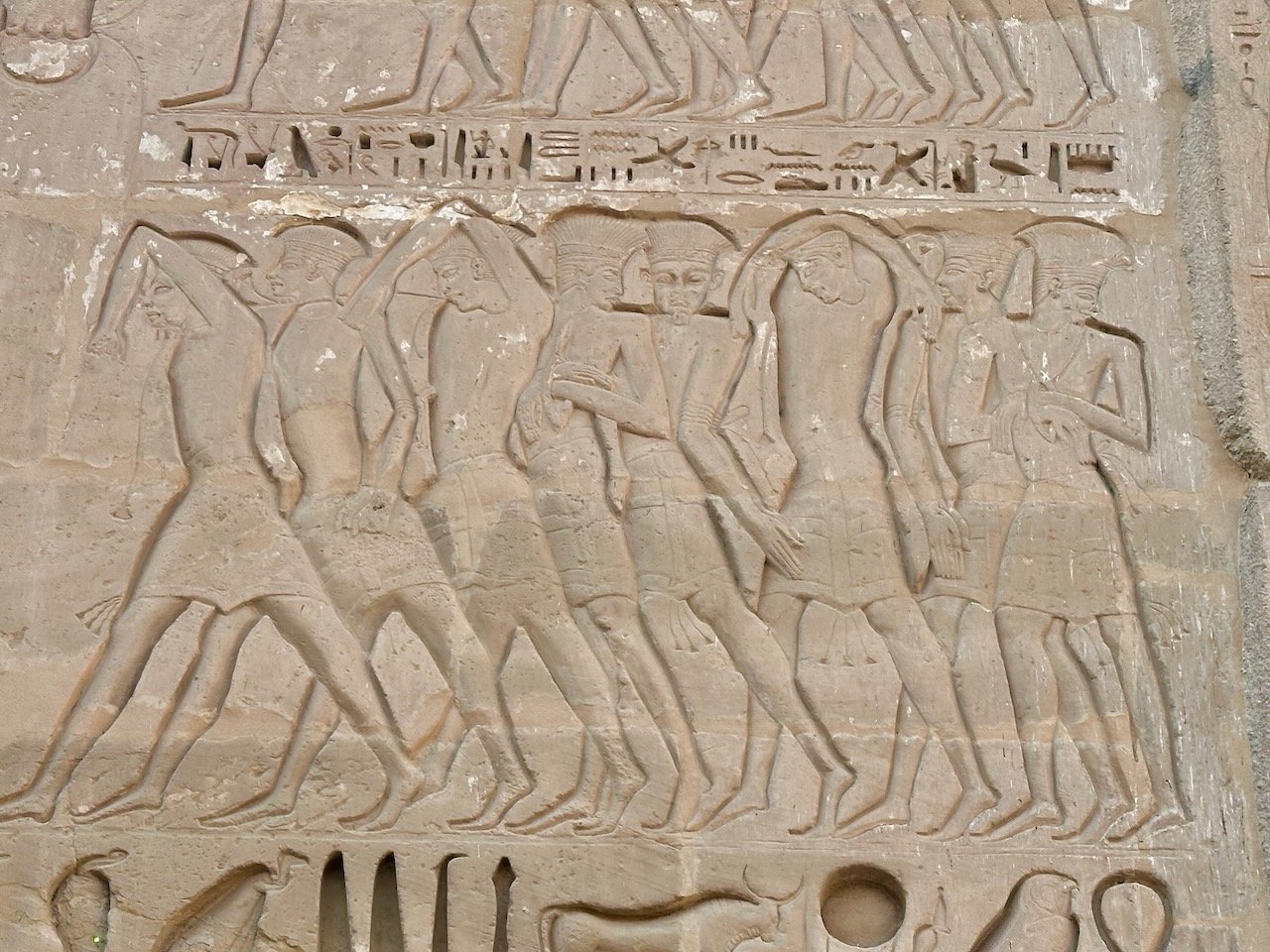
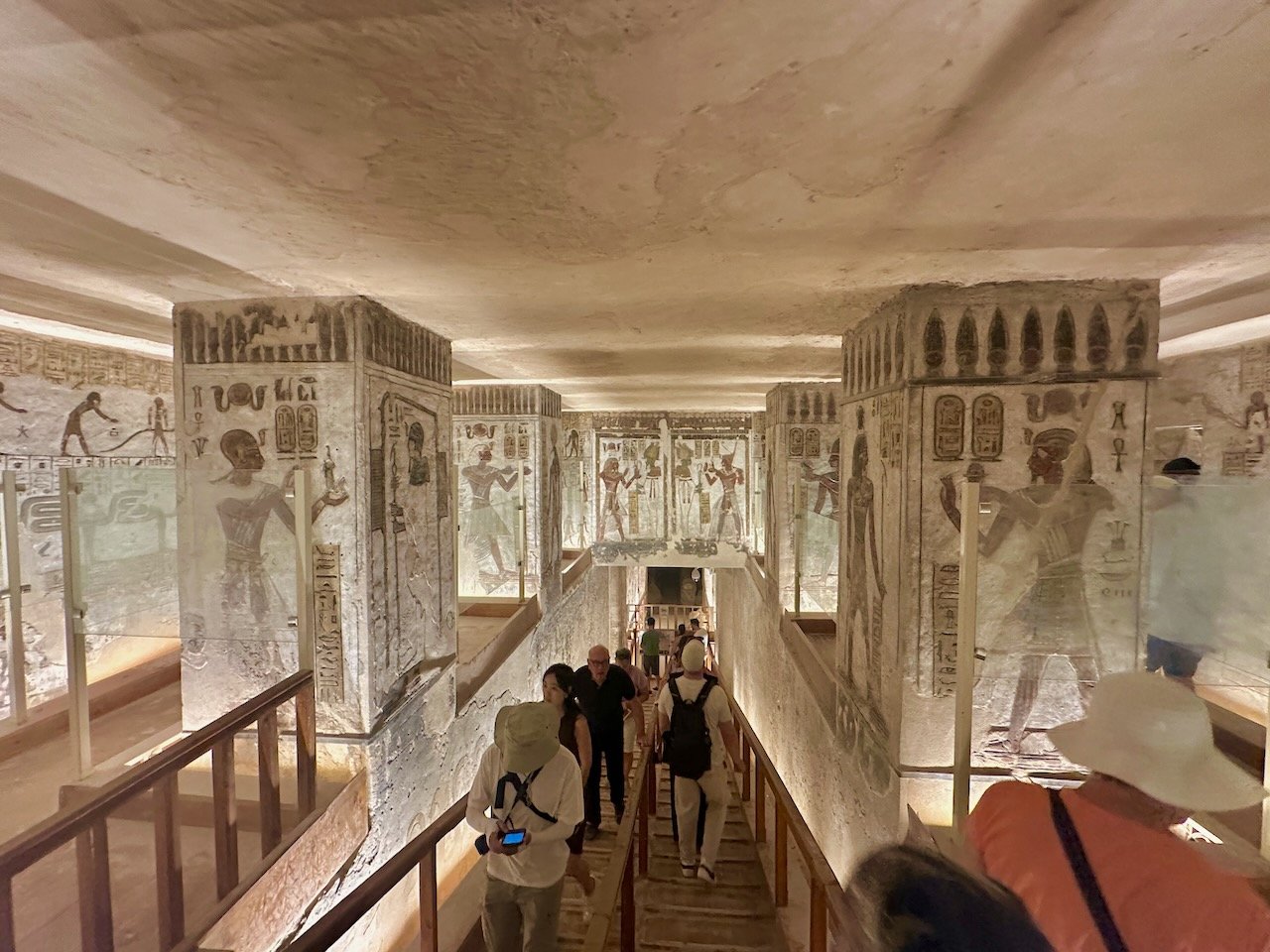
We arrived in Luxor about 8:15, we loaded and boarded the bus and drove directly to the Valley of the Kings. 63 pharaohs have been buried here since the start of the New Kingdom. Most of us went into three tombs: the tomb of Ramses IV (a Pharoah of the 20th Dynasty), the tomb of Ramses III (the one who defeated the Sea Peoples), and Merneptah (the son of Ramses II). A few in the group also purchased an extra ticket to see the tomb of the famous King Tut’s (his tomb is included in the photos below). His actually mummy is on display here as well as his sarcophagus. The well-preserved colors in all the tombs of the wall reliefs were stunning to see. The religious focus within the Egyptian belief system upon the after-life is plain to see in all these tombs! It took between six months and three years to build these tombs, some even more time because of their complex. They began building these tombs once the Pharoah became king.
Alabaster Shop/Store
Close by are many alabaster shops. We went to one whose owner and his workers were quite the comedian. It was interesting to see how some of the vessels are made. The final products made from stone and onyx were impressive.
Temple of Hatshepsut
On the opposite side of the cliff of the Valley of the Kings is the Temple of Hatshepsut. The temple was built in 1470 BC (conventional dating). Based on an early dating for the Exodus and Conquest, it is suggested Hatshepsut was the Pharaoh’s daughter who rescued Moses (Exodus 2). She was the daughter of Thutmose I and reigned for over 20 years. She was despised by those who succeeded her, with her image and cartouches eliminated and/or scratched away (perhaps both Thutmose III and Amenhotep II did this?).
Temple of Medinet Habu
The last temple on the western side we saw was the Medinet Habu. This was a dedicatory temple built in honor of Ramses III. Depicted on the pylons is the defeat of his enemies, including the Nubians and the “Sea Peoples” (i.e. the Philistines of the Bible). Ramses defeated the Sea Peoples in 1177 BC. The wall reliefs show Ramses holding the heads of his defeated enemies by the hair. He also cut off their hands and men’s “private part” to humiliate them.
Felucca Boat Ride on Nile River
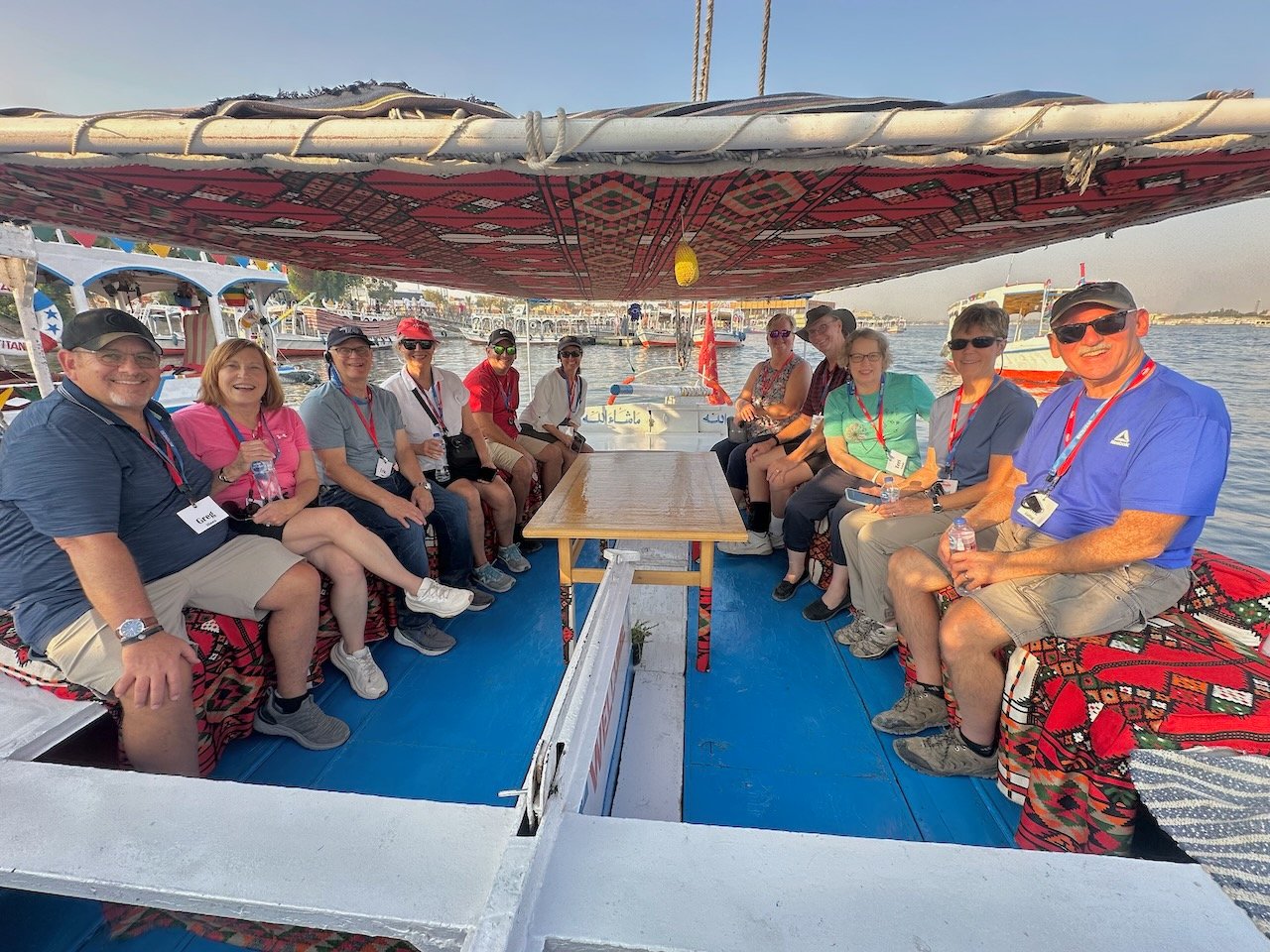
In the mid afternoon, we enjoyed a felucca boat ride on the Nile River. It was a relaxing time of experiencing the river just as the ancients did. We drove directly to a papyrus store to see how ancient “paper” was made.
Temple of Luxor at Night
We ended the day with a early evening visit to the Luxor Temple. This temple is primarily in honor of Ramses II, although built before him by Amenhotep III. Ramses, one of the most famous of them all, was the great Egyptian pharaoh of the 13th century BC (1280s-1220s). To see this temple eliminated with lights at night was spectacular.
We drove to our hotel. It was a tiring but amazing first day! Following check-in, another wonderful buffet dinner awaited us. It was “early-to-bed” after dinner, with many in the group waking up early again tomorrow morning for the optional sunrise hot-air balloon ride on the west side of the Nile River. We leave the hotel tomorrow morning at 4:40. It will be worth it!






Day 4 – Monday, November 10: Optional Hot Air Balloon Ride, Temple of Karnak, Flight to Cairo, Grand Egyptian Museum, Overnight in Cairo
Following a longer night’s sleep, almost the entire group departed from our hotel at 4:45 a.m. for a unique and amazing hot-air balloon ride experience. It was another great day here in Egypt. The weather was predictably sunny again, with highs in the 80s.
Hot Air Balloon Ride
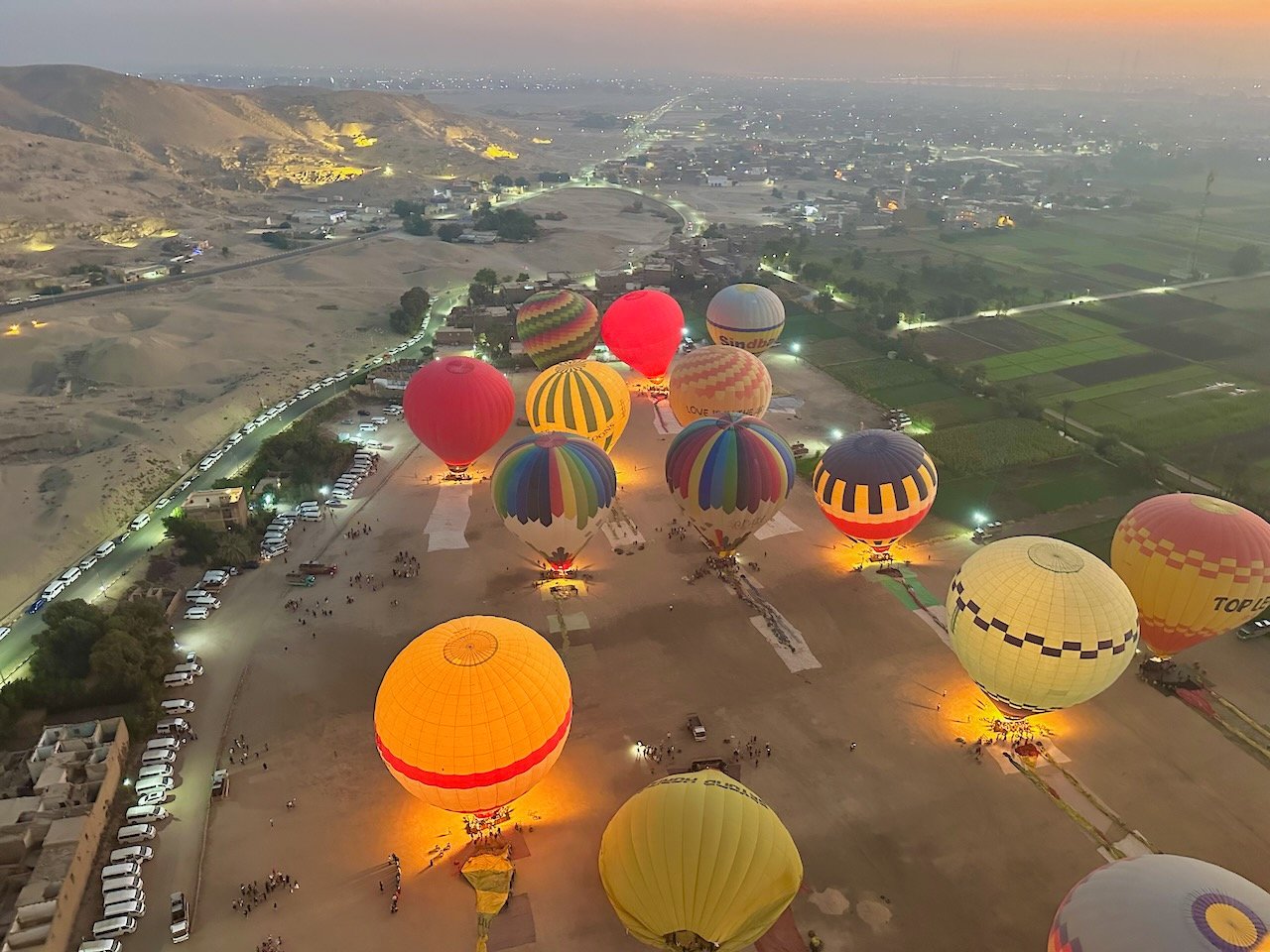
An early morning hot-air balloon ride was made available to us for $130/each. Although it required another early-morning rise, the experience was spectacular! We enjoyed seeing the sunrise as we floated about the Nile River, Valley of the Kings, and the mortuary temples located on this western side of the river. We ascended up to about 1,600 feet high above ground below. The bright colors of the balloons along with the contrasting green of the Nile Valley and glowing brown of the desert made the flight scenic. It was a once-in-a-lifetime experience for sure! We were all glad we did it! We returned to the the hotel for a quick breakfast before departing the hotel at 8. We read part of the Joseph story from the end of Genesis as we left for the
Temple of Karnak
It took only 15 minutes from the hotel to arrive at the Karnak Temple. It is really a massive complex of five temples. This temple was first built around 2100 BC (conventional dating). Many Pharaohs are honored here, including Thutmose III (who had 18 military victorious campaigns and took Megiddo in Israel), Seti I, Ramses II (who reigned 67 years and lived until 91 years of age, 1303-2113 BC, conventional dating). We also saw the many pylons, the Hypostyle Hall (built by Seti I, later refined by Ramses II, It consists of 134 columns), the obelisk of Hatshepsut (the largest one), the Sacred Lake, and the relief of Shoshenk. Some suggest he was one in the same as the Pharoah called “Shishak” in the Bible (I Kings 14:25-28 – although there are historical and archaeological inconsistencies with this theory). Another biblical connection included Tim (2 Kings 19:9 – “Tirhakah, the king of Cush” was the Pharoah who served to threaten Sennacherib, the Assyrian, during the days of Hezekiah). The grandeur of Karnak was incredible!
We left Karnak at 10:20 and drove directly to the Luxor Airport for our flight back to Cairo.
Cairo
The flight to Cairo was delayed close to two hours. This caused us to re-arrange our program today (we will visit to the new Grand Egyptian Museum until tomorrow afternoon before our evening flight to Amman, Jordan). So as we landed in Cairo slightly after 4 p.m., we drove directly to Sovatel Hotel in downtown Cairo. The Cairo traffic and “culture” was interesting to encounter! The hotel (another beautiful one!) is located right on the Nile River.


Day 5 – Tuesday, November 11: Sakkara, Egyptian Museum, Camel Rides, Pyramids, and Sphinx, Evening Flight to Amman, Jordan
This morning began with a departure at 6:45 a.m. (it felt like sleeping in!). Following a very full and eloquent breakfast (again), we drove directly to Sakkara, the oldest necropolis of Egypt. The weather was again perfect, with sun (as expected here) and highs around 80. It was our last day here in Egypt before flying to Amman tonight. We read from Genesis 50 and Exodus 1 as we left the hotel.
Sakkara
We beat most of the morning Cairo traffic this morning as we drove directly to Sakkara, the ancient necropolis of the Old Kingdom capital of Memphis. Here we saw the impressive Stepped Pyramid of Djoser (or Zoser). It dates to around 2,700 BC (conventional dating). It is the oldest of all pyramids (now totally 134), predating Abraham by about 700 years! After seeing the Stepped Pyramid, we entered a small pyramid for Unas from the 5th Dynasty (about 2350 BC). We also entered a mastaba (the tomb of Seshseshet Idut, c. 2345-2323 BC). Leaving Sakkara, we made an interesting stop at a local carpet school en route to the new museum.
National Egyptian Museum
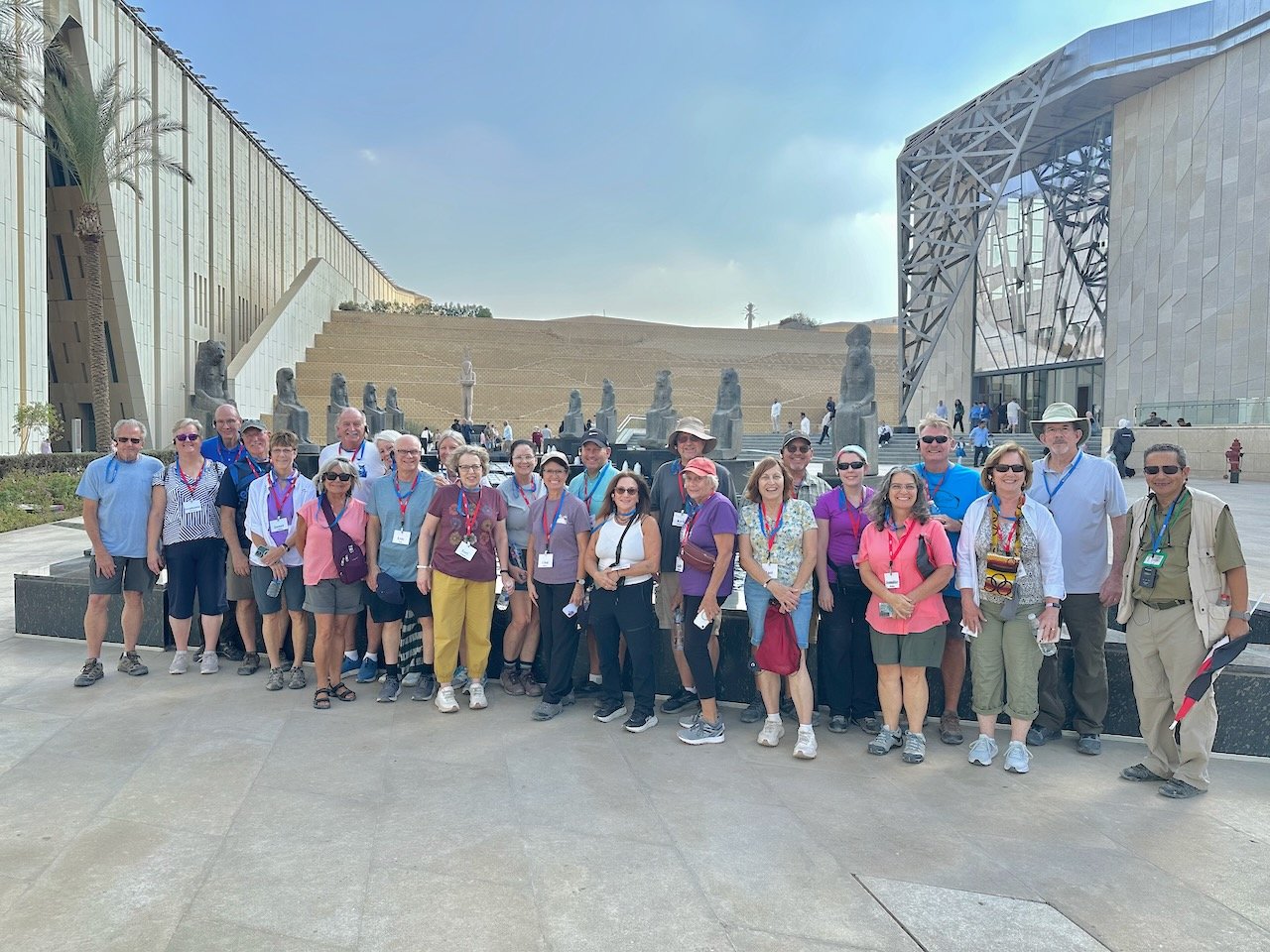
We were delighted to spend about two and a half hours inside the brand new Grand Egyptian Museum. The museum cost $1.2 Billion and took 23 years to build. It is quite massive, covering 117 acres. It officially opened just last month!
While some of the artifacts are still in the Old Museum (i.e. the Merneptah Stele and the Amarna Letters), there are about 55,00 items displayed. We followed Moses (our guide) around this newly-designed museum. We made many biblical connections. We saw statutes of Ramses II, Amenhotep II (the likely pharaoh of the Exodus based on conventional dating), Thutmose III, the head and sphinx of Hatshepsut, colorful jewelry, to name just a few. The colors of some of the artifacts (e.g. the “sitting scribe”) were astonishing! The grand display featured the collection (5,400 items) of all of King Tutankhamen, including his gold coffins and mask. It was incredible. The museum is one of there best in the world!
Great Pyramids of Giza / Camel Ride, Great Sphinx
Next, we drove to the Great Pyramid (also known as the Pyramid of Cheops or Khufu and constructed around 2,600 BC), with the Pyramid of Khafre (or Chephren) and the Pyramid of Menkaure built shortly after. Two of them stand nearly 500 feet high. Most likely it took 200,000 men 20 years to build. The Great Pyramid was built with 2.3 million stones, with the average weight of each stone around two-three tons (the stones weigh between one and 60 tons).
First, we enjoyed a panoramic view of the pyramids as well as a short camel ride. No one fell off! Then we drove down to get a closer look at the Khufu pyramid. Many in the group walked in and up to the center of the Great Pyramid while others walked around the pyramid (each base is 750 feet long). Slightly below the pyramids is the Great Sphinx. It is 240 feet in length and 66 feet high. A stele (called the Dream Stele) was erected in front of it by Thutmose IV. It still stands there today!
Airport/Flight to Amman
Leaving the pyramids area, we made a quick stop at an Egyptian cotton shop before driving to the airport. We checked in and waited for our 8:15 p.m. light to Amman.
We arrived in Jordan’s capital city where we secured our luggage and drove directly to the hotel. It was a late night, but we are thankful for the safe flight. The tour now transitions to learning about the biblical connections with Jordan, with our first full day in Jordan!


Day 6 – Wednesday, November 12: Bethany Beyond the Jordan, Mt. Nebo, Madaba (Medeba), Machaerus, Petra
We enjoyed our first full day here in Jordan. Following a good but short night’s sleep, we enjoyed a modest breakfast together before checking out. The weather was perfect, with lows in the 50s and highs around 70. The air was cooler and cleaner here in Jordan than Egypt. We read from Numbers 22-24 as we left the hotel at 8 a.m.
Bethany Beyond the Jordan
Leaving the hotel at 8 a.m., we descended down to the Jordan Valley to a location called Bethany Beyond the Jordan. This area is known for where Elijah ascended into heaven in a fiery chariot (2 Kings 2), and where Jesus was baptized (John 1). We walked down a nice path all the way to the river. Jesus also came to this area of Perea on occasion, especially where John was baptizing (John 10).
Mt. Nebo
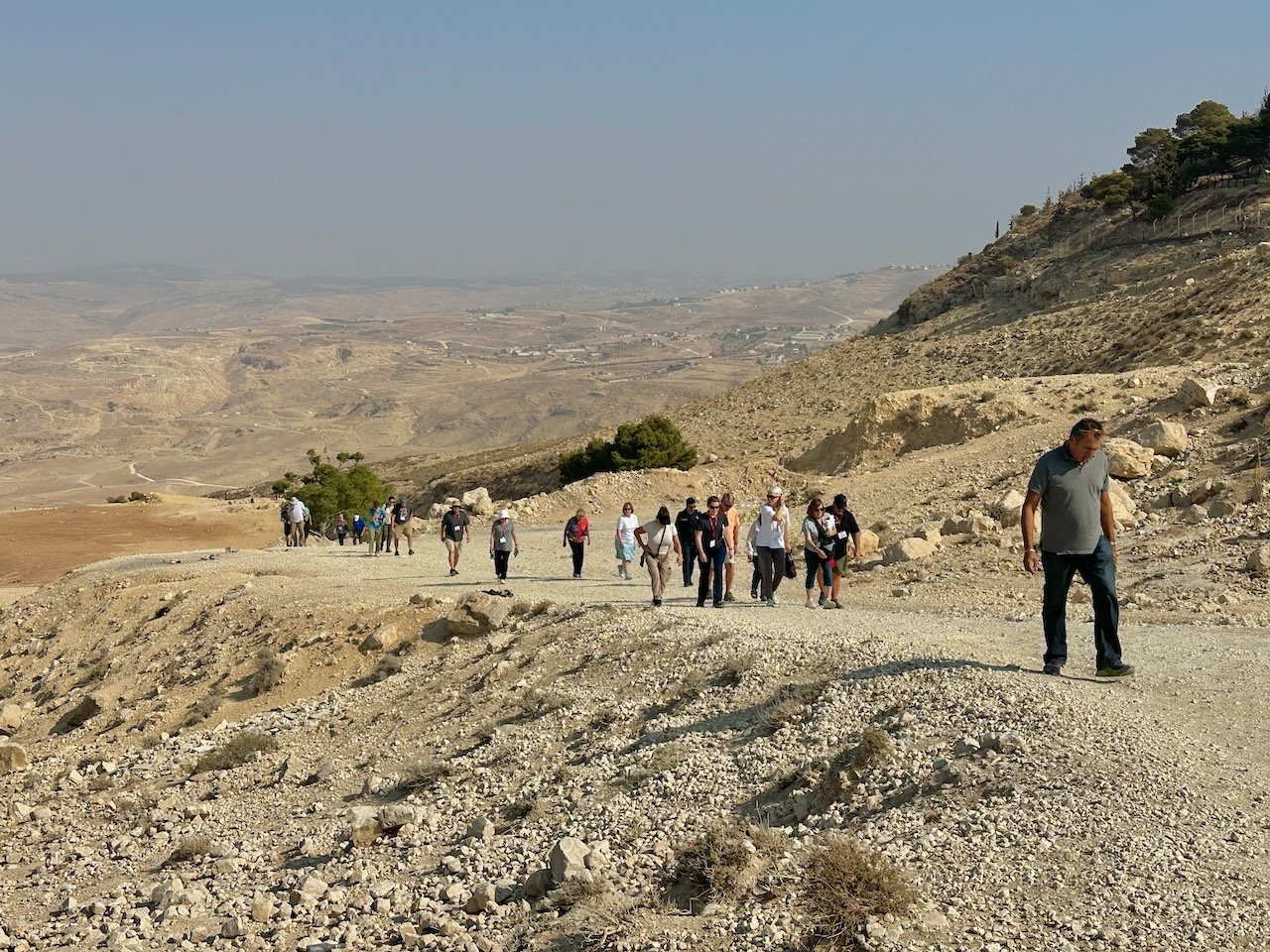
From here we ascended from the Plains of Moab to Mt. Nebo, part of the Pisgah Range. We walked together outside the traditional location (and Greek Orthodox Church) to a nice overlook. We read from Deuteronomy 31-34 and Joshua 1 about the transition of leadership from Moses to Joshua. The visibility looking westward to the Dead Sea and Jericho was only fair. However we could still see Jericho on the west side of the valley and the outline of the Dead Sea. This was Moses’ view before he died at 120 years of age.
Madaba/Medeba
Next, we added an extra stop to the program by visiting the St. George Church in Madaba/Medeba. Here, the amazing 6th century A.D. map of the region is preserved. It offers us specific detail about the area of the “Holyland,” including the city of Jerusalem. Among other things, the “Cardo” and the Holy Sepulcher Church (from the 4th century) is highlighted. On the way back to the Visitor Center, we stopped by Sam’s family store where we met his wife.
Machaerus
Our last stop of the day was Machaerus. This was a palace-fortress built by Herod (but previously built by the Hasmeans). When we arrived at Machaerus, we recalled the story from Matthew 14 (also recorded in Mark 6) about how John the Baptizer was beheaded here. Josephus tells us it happened here (Antiquities 18.5.2). About two-thirds in the group climbed to the top of this palace-fortress built by Herod the Great. With the hazy skies, we could barely see the Dead Sea from here. However, we saw the suggested “throne area” of the palace where Herod Antipas received the head of the Baptizer as well as a few ritual baths and columns. Later, Machaerus fell to the Romans in 71 AD.
Petra
From Machaerus, we had a long drive to Petra. For the most part, we used the newly-paved Desert Highway before exiting on to the King’s Highway (Numbers 21-22). We arrived at our hotel for a late dinner. We start early tomorrow morning (6:50 a.m.) for the ancient site of Petra, one of the 7 Wonders of the World!



Day 7 – Thursday, November 13: Petra, Wadi Rum, Captains Bedouin Village
What a remarkable day it was today! Following a good (and longer) night’s sleep here in Wadi Musa (Petra) and a great breakfast, we checked out of the hotel. This was followed by walking to the site of ancient Petra at 7:00 a.m. The weather was ideal, with full sun again! We enjoyed the cool morning temps (50s) and the warming temps throughout the day (around 70). We prayed and sang our “Oh, the Sun’s Coming Up” song as we walked to the entrance of the site.
Petra
Petra, this ancient Nabatean city was built within the Seir Mountains, the land of the Edomites (Deuteronomy 2, 33; Ezekiel 35) is one of there seven Wonders of the World. Because of the brand new Jordan government restrictions of the local Bedouin being able to sell things inside Petra (they literally bulldozed and dismantled the shops, combined with the very low tourism currently now, we essentially had the entire site to ourselves!
We all thoroughly enjoyed the spectacular scenery and tombs/ruins of this red-rose ancient city. Once we entered the site, we all walked through the Siq (canyon) which brought us to the first monument, “The Treasury” (“Al-Khazneh”). This well-preserved monumental tomb appeared in the movie “Indiana Jones and the Last Crusade.” It was the tomb of the Nabatean King named Aretas III (Paul mentions his son, Aretas IV in 2 Cor. 11:32). His daughter (or granddaughter – depending on dating) was the former wife of Herod Antipas, see Matthew 14).
From the Treasury we now began our walk into the city. Besides passing by many of the Nabatean tombs, we walked by a 3,000-seat theater carved into the sandstone, one of the largest theaters in Jordan. From here, many in the group walked to the Monastery Tomb at the far west side of Petra, while others explored on their own (e.g. the Royal Tombs). The Aravah and Negev of Israel could be seen to the west from the area of the Monastery. Seven in the group also hiked to the High Place (using the back trail) far above the site. We all made it back by 1:30 p.m. where we began our drive south to Wadi Rum.
Wadi Rum
Driving on portions of the King’s Highway (Numbers 20, Deuteronomy 2) and then again accessing the Desert Highway led us south to Wadi Rum in southern Jordan. Upon arriving in this area made famous by Sir Lawrence of Arabia during WWI (this British officer helped the Bedouin fight against the Turks), five jeeps (e.g. pickup trucks) were awaiting us to take us through the desert. It was a lot of fun driving through the sand. The views were amazing as well. We stopped by a Bedouin tent for tea and coffee. We made it to a rocky hill where we enjoyed a wonderful sunset. The jeeps then took us to Captain’s, our “Bedouin-style camp” for the night. Following a unique dinner (prepared underground), we enjoyed a free evening and campfire before retiring to our small bungalows.
We cross into Israel tomorrow morning! Yipee!


Day 8 – Friday, November 14: Southern Border Crossing into Israel, Red Sea, Timnah, Dead Sea
Staying here in the desert of last night was really a fun experience. While it got cooler last evening in the desert of Wadi Rum, our bungalows were warm. We awoke to clear skies and a warming sun throughout the day, with highs around 75. Following breakfast, we left Wadi Rum shortly after 8 a.m. and drove to the southern border to cross into Israel. We read from Obadiah 1 about the Edomites who lived in this area.
Rabin Southern Border Crossing
It took about an hour to arrive at the border crossing. Located at the northern end of the Gulf of Aqaba, we cross from Aqaba, Jordan to Elat, Israel. The border here is named after the late Israeli Prime Minister Yitzhak Rabin. The border crossing (we walked across to Israel) was very easy and quicker than normal, with no issues.
Coral Beach/Red Sea
Once we crossed, we met Shlomo (our Israeli guide) and David (our Israeli driver). We drove through Elat, Israel’s most southern city, to Coral Beach. Here, we enjoyed the beautiful waters of the Red Sea. The clarity of the water and the color of all kinds of fish was stunning! It was a fun time of swimming (about half the group) and relaxing.
Timnah/Tabernacle Model
From here, we drove north through the Aravah (Rift Valley) to Timnah. In ancient days (14th-12th century BC), this was a copper mine of the Egyptians. Here we walked through a full-size replica of the Old Testament. A Messianic (Marco) did a wonderful job guiding us through the model. Inside the “Holy of Holies,” we read portions of Hebrews 9. Where is the Ark today? Jeremiah 3 tells us that it would “no longer be used nor would it be remembered.”
Yotvata & the Dead Sea
From here we drove to Yovata about 15 minutes north of Timnah. We enjoyed lunch and especially the ice cream here at this “dairy kibbutz.” Shlomo’s sister lives here. With content stomachs, we drove about 1:45 hours north up Rt. 90 to the southern end of the Dead Sea (33% salt and minerals).
We checked into our hotel in Ein Bokek and then enjoyed floating in this unique body of water. The floating was not the only unique experience. The very dark clouds to the north was also an unusual scene! Dinner and a free evening at our leisure followed our “floating” back at the hotel. We are here at this hotel for two nights. Tommorrow we continue northward along the shoreline of the Dead Sea.


Day 9 – Saturday, November 15: Masada, Ein Gedi, Qumran, Judean Desert, Jericho
We left the hotel at 7:45 this morning following a “Shabbat”breakfast. Today was “desert day” here in the Judean Desert. The weather was actually overcast most of the day (unique for the Dead Sea area), with breaks of sun throughout the day. We even had a few showers towards the end of the day. We read Psalm 18:1-2 as we left the hotel, focusing on the word the Hebrew word metzada (“fortress”).
Masada
The site of Masada (metzada, in Hebrew) was our first site and only a 15 minute drive from our hotel. This was built in the early 30s BC as a palace-fortress by Herod the Great. We took the cable car to the top and began seeing the ruins from the 1st century. We saw huge cisterns, the western and northern palaces, the Roman Ramp, the synagogue, and the bathhouse. In 70 AD, this was the location where 967 Jews found refuge from the Romans following the destruction of the Temple. The holdout lasted about three years until all by five of these Jews (a few women and children) took their own lives. It is a story of bravery and courage! Nine in the group walked down the Snake Path. It took a little over 30 minutes.
Ein Gedi
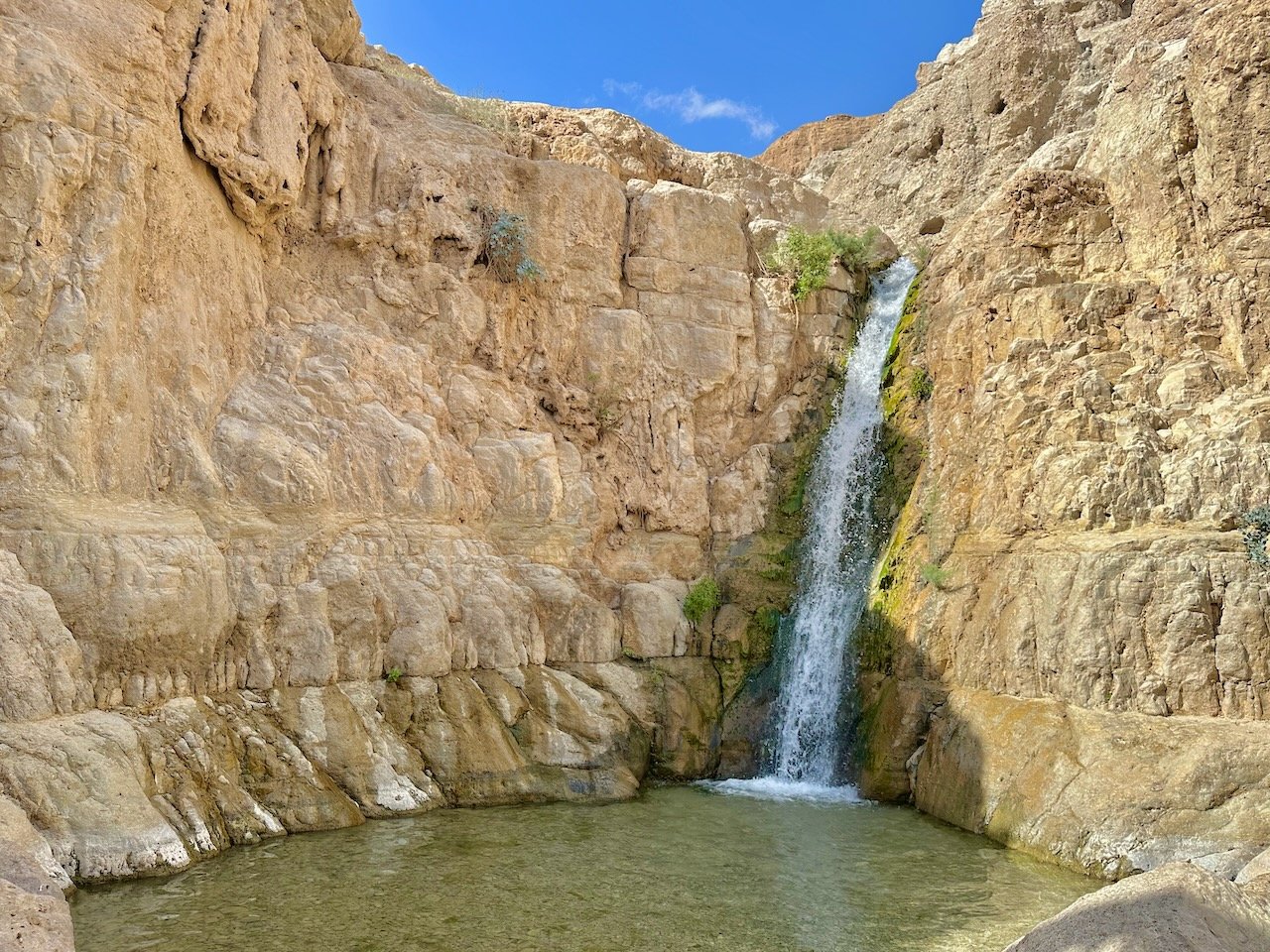
From here we drove about 20 minutes north of Masada to get to Ein Gedi, one of only a few oasis here in the edge of the Judean Desert. We read from Song of Songs 1, 2 Chronicles 20 (the “Ascent of Ziz”) and 1 Samuel 24 (David hid from Saul here). Since the flash flood this past Spring causing the trail to be unsafe, we could only walk back to the first water falls. It was still beautiful to see this and the canyon beyond.
Qumran
Qumran is the most important site in Israel because of what was discovered here! When we arrived, we walked directly to the cliff area of the desert to get a glimpse of Cave 6 (one of 12 caves in which fragments of ancient scrolls were discovered). We also saw the beginning of the aqueduct system that brought rain/flood water into the site.
It was here at Qumran where the Dead Sea Scrolls were found! The discovery began in 1947, while the excavation took place through 1956. We walked through the limited ruins where a small community of Essenes lived (or retreated here from Jerusalem, as a new theory suggests). To date, about 930 scrolls and fragments of texts scrolls have been discovered. The scrolls/texts date primarily from the late 3rd century BC – 1st century AD. At the small archaeological site we saw cisterns, ritual baths (mikvot), and the scriptorium. We read from the Essenes’ “Nine Beatitudes” text (“Blessing are you …” it sounds very similar to Jesus’ “Nine Beatitudes.” In front of “Cave 4” (where the majority of texts were found), we read from “Psalm 151,” and Psalm 19. We celebrated the perseverance of God’s Word! We were invited to take joy in God’s Word.
Jericho
Next, we drove into Jericho. We walked to the archaeological site of Old Testament Jericho, Tel es-Sultan. After we climbed the site. We looked east and could see the Jordan Valley the Mt. Nebo on the ridge on the horizon (Dt. 34). Elijah was taken to heaven in the area across the river (2 Kings 2). Jesus was baptized in the Jordan River at “Bethany Beyond the Jordan” (John 1). Looking south we could see the area of NT Jericho (where Zachaeus and Bartimeaus lived, and where Herod the Great died in 4 BC). We then turned our attention to the ancient OT site of Jericho. The archaeology of this ancient site of Jericho supports and confirms the Bible’s historicity. Besides seeing the oldest structure (a round tower) in Israel, on the southern end we saw the double retaining walls of this Canaanite city taken my Joshua (Joshua 6). A mud brick wall once stood on top of these stone walls. This wall was the wall that came tumblin down.
While still in the area of Jericho, we visited the site of “New Testament” Jericho. Specifically, we look down upon the winter palace of Herod the Great from an older Hasmonean tower. Herod the Great died here in 4 BC (some suggest 1 BC), and his body was transported to Herodoum (9 miles SE of Jerusalem) for burial.
We drove back to our hotel in Ein Bokek for dinner and our second overnight here. Tomorrow we end the day at our hotel in Tiberias where we will enjoy three nights!




Day 10 – Sunday, November 16: Wadi Qelt, Shiloh, Beth Shean, Tiberias
We headed north today, with our final destination to Tiberias on the Sea of Galilee. On the way we saw more sites and regions connected with the Bible. The weather was perfect, with partly sunny skies, with highs around 70. We left the hotel at 7:45 following breakfast and checkout. We read Matthew 3 and Luke 10 as we started out!
Wadi Qelt
We drove along the western coastline of the Dead Sea (again) towards Jericho before turning west to begin our ascent towards our first stop. This stop provided a wonderful view of a specific part of the Judean Desert called the Wadi Qelt. The view of the Wadi Qelt was spectacular. Here we heard the “prophet Isaiah” (all dressed up in a robe, headscarf, and beard HA) as he shared the powerful words, “Prepare the way for the Lord…” (from Isaiah 40). John the Baptizer would echo the exact same words here in the same place 700+ years later (see Matthew 3). Also, Shlomo sang in Hebrew Psalm 23. It was a great way to begin the day!
Shiloh
Next, we drove into the Hill Country of Ephraim to Shiloh. On the way, we drove through the Desert of Pareth (Parat) where Jeremiah hid the linen belt (Jeremiah 13). We even saw a few gazelle’s on the way as well as the backside of the Mt. of Olives further to the west. We also past by Mishmash (1 Samuel 13-14), Bethel (Genesis 12) and Ai (Joshua 7-8).
When we arrived at Shiloh, we made our way up this ancient site where the Tabernacle once stood here for over 300 years. We passed under the almond trees (Jeremiah 1) as we walked to the top of the site. Shiloh was destroyed by the Philistines (1 Samuel 4). We saw a very good video before walking through some of the ruins. Most importantly, we saw what is suggested by Dr. Scott Stripling and the ABR team) as the Holy of Holies area of the Tabernacle. Further below we saw a massive Middle Bronze wall that was incorporated into the Israelite site as well as the gate complex (where Eli died?, 1 Samuel 4). It was young Samuel who said, “Hineni” (“Here I am!”) When God called Him into service. Abraham (Genesis 22), Moses (Exodus 3) Isaiah (Isaiah 6), and God (Isaiah 65:1) used this word. Jesus may have used it too (see Hebrews 10 quoting from Psalm 40). Before leaving Shiloh.
Descending off the site, about half in the group enjoyed the hamburgers we ordered for lunch from nearby Eli (an Israeli community). Before we left Shiloh, we watched a hologram about the Tabernacle.
Beth Shean
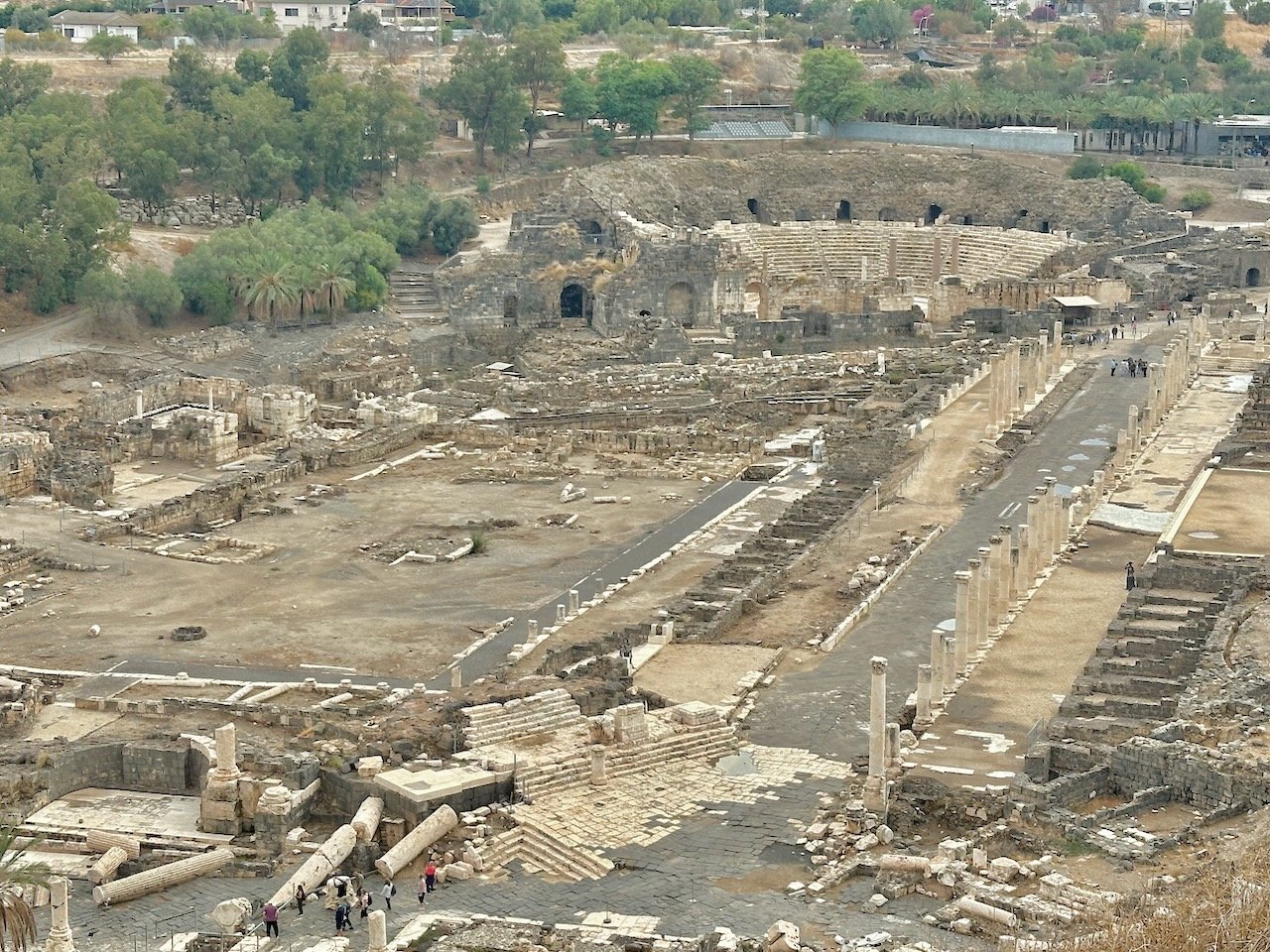
Leaving Shiloh, we traveled through the Desert of Samaria to Beth Shean. The ride took about an hour and a half. This ancient site is an incredibly large site, with many ruins from the Roman Period. We saw colonnaded streets, the bathhouse, agora, public latrenes, and the theater. Some in the group climbed to the top of the OT site. According to 1 Samuel 31 (and 1 Chronicles 10), the body of Saul was hung on the walls of the town square after he died on near by Mt. Gilboa. The men from Jabesh Gilead (located on the east side of the Jordan Valley), came at night to rescue the body of Saul. In the theater we enjoyed the singing of group members.
From here we drove to our hotel on the northern end of Tiberias (Ron Beach). We checked into our hotel and enjoyed a wonderful dinner together at 6:30. We are looking forward to spending three nights here along the shoreline of the Sea of Galilee and two full days here in the north.




Day 11 – Monday, November 17: Hippos, Qatzrin, Syrian Border, Mt. Hermon, Caesarea Philippi, Dan, Misgav Am/Lebanon Border
Today was a Golan Heights day. We visited sites on the northern borders with Syria and Lebanon. The weather was perfectly sunny, with nice temps in the morning (50s), but with warming temps in the afternoon (70s). We really enjoyed being in the Golan Heights for the sites, the views, and the perspectives. We read from Matthew 4 as we left the hotel at 7:15.
Hippos/Sussita
Our first site of the day was Hippos/Sussita. We first drove around the northern end of the Sea of Galilee (near Bethsaida where the Feeding of the 5000 took place, Luke 9) before turning south down the eastern side. On the way we made a brief stop to see the cliffs mentioned in Mark 5.
At Hippos (a Decapolis city), we saw many Roman ruins. During the Byzantine Period (4th-6th centuries AD), there were no less than a half a dozen churches were built here. With a great view of the entire lake (13 miles long), we read the transformational story of the demoniac from Mark 5.
Katzrin
Next, we drove back north to Katzrin, the largest city in the Golan Heights. We visited the Talmudic Village that is here (from about the 3rd-8th centuries AD). We saw good examples of olive presses, the synagogue, and other house structures. We then gathered in a completely-restored stone house where we read from Mark 2. We could see the story unfolding before our eyes!
Syrian Border
Continuing northward, we stopped for a brief stop to look over into Syria. We drove to an area right below Mt. Bental, an old military outpost used in the 1967 war. We enjoyed a nice view into Syria from here (including the city of Kuneitra). As of the last five months or so, Israel now controls more of the buffer area, including the outskirts of Quneitra. They also control the highest peak of Mt. Hermon (9,200 feet).
Caesarea Philippi
Driving through a few Druze cities and past the snow-capped Mt. Hermon, we drove down to the slopes of the Golan Heights to Caesarea Philippi.
This was a pagan city in the days of Jesus that included temples to Augustus, Zeus (Jupiter), and Nemesis. The Pan deity was especially honored here. It was good to see that recent excavations of the Augustus Temple revealed amazing mosaics and other structures. The Banias Spring begins here, one of the three tributaries of the Upper Jordan River. It was in the region of this city that Jesus asked, “Who do you say I am? (Matthew 16). We also recalled the Transfiguration of Jesus (Matthew 17) that took place perhaps on the slopes of Mt. Hermon, or further south (or Nimrod? Arbel?).
Tel Dan
Our last archaeological site of the day was Tel Dan. We walked through the beautiful nature preserve along the Dan Spring. We stopped by the water to read from Psalm 42. Shlomo also played a ballad on his recorder for us. We continued our walk to the culture center. Here, Jeroboam built an altar and set a golden calf on the high place. Sitting on the steps of the high place, we read from Judges 18 and 1 Kings 12. A pattern of disobedience here led to the end of Dan in 734 BC. We also overlooked the border with Lebanon. Before leaving, we walked past the Canaanite mud brick gate (that was most likely a ceremonial gate built after the time of Abraham). As we left the site we got a quick glimpse of the Israelite gate complex (9th century BC).
Misgav Am/Lebanon Border
Before beginning our drive back to Tiberias, we added an extra stop to Misgav Am, a kibbutz established in 1949. It’s located right the border with Lebanon! First, we considered the story from 2 Samuel 20 that took place at Abel Beit Macaah (a site Dr. John dug at). The site is located near the border on the northern end of the Huleh Valley. We then took a look at today’s border with Lebanon. Shlomo shared both past and present history with Lebanon. The view into Lebanon was incredible, with very clear visibility!
From here we drove south along the Huleh Valley back to our hotel, passing the Canaanite city of Hazor on the way. Once again, we enjoyed a huge dinner and a free evening.



Day 12 – Tuesday, November 18: Arbel Hike/Walk, Boat Ride, Capernaum, Jordan River/Yardenit, Kinneret Cemetery, Magdala, Tiberias
Today we spend our time visiting sites in, around, and even on the Sea of Galilee. It was a special day retracing the footsteps of Jesus. Weather wise, it was another wonderfully cloudless-sunny day, with temps around 75. We also enjoyed another wonderful sunrise! We read the “kingdom parables” from Matthew 13 as we left the hotel at 7:30.
Mt. Arbel
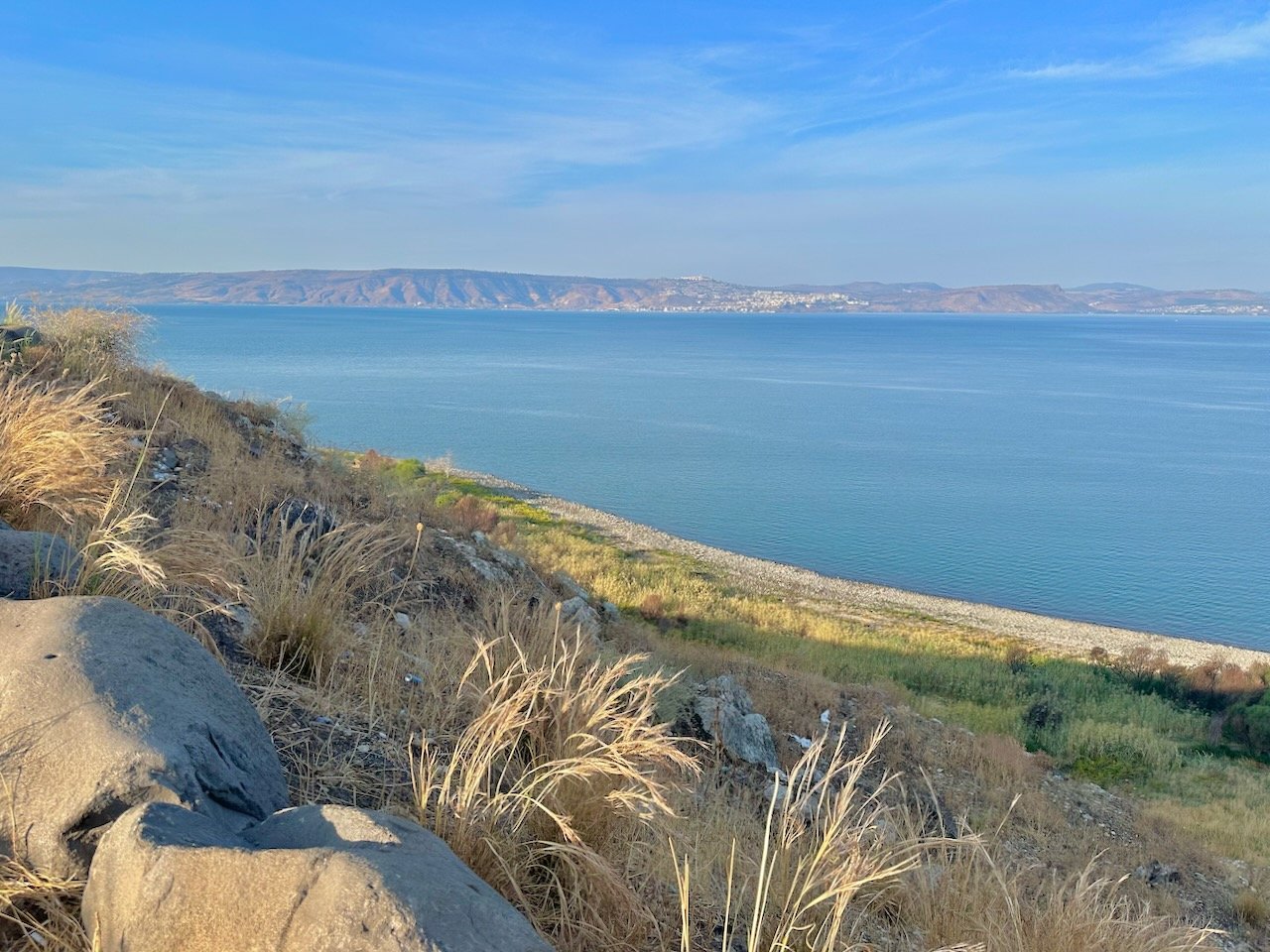
We first drove north to the trailhead for the path that ascends to the top of Mt. Arbel. There were five in the group who climbed 1,100 feet to the top of this stand-alone mountain. The rest of the group bussed around the other side and walked up the path. Both groups converged at the top where the view of the Sea of Galilee and surrounding area was stunning! While we cannot be sure (since Arbel is not mentioned in the Gospels, although Josephus mentions Arbela in Antiquities 14.415), maybe this was where the Jesus’ Transfiguration took place (Mt. 17), or where he taught (perhaps on the lower northern slopes) the Sermon on the Mount (Mt. 5-7). It is also very possible that on top of Arbel was where Jesus met His disciples following His resurrection and shared the Great Commission (Mt. 28). We spent some reflection time also on the topic of Jesus calling us (i.e.“Come follow me … “Lech Acharai,” a very rabbinic way of calling “Talmidim” / disciples). We left the top and walked back down to the visitor center where we were treated to ice cream! ????
Yardenit/Jordan River
Next, we drove directly to the southern end of the lake to Yardenit. This is the baptismal site here in the north. In the waters of the Jordan, Nine in the group in the group reaffirmed their faith. The water level was very low and “refreshing cool” but we all survived. It was a special time for everyone, setting ourselves apart for service in God’s kingdom.
Kinneret Cemetery
From the southern end of the lake we now drove north (around noon) along the southwestern shoreline of the lake. We included an extra stop at the Kinneret Cemetery. This is where an early Jewish pioneer woman named “Rachel” is buried. Shlomo shared about her life. She was an Ukrainian Jew who wrote poems, some of which were put to songs. She died in 1931.
Ancient Boat
We drove back through Tiberias to Nof Ginnosar on the western side of the lake. In the museum here we saw an ancient 1st century wooden boat that was discovered in 1986. It was no doubt a fishing boat like this that was used by the fishermen Jesus called (i.e. Peter, Andrew, James, and John – Matthew 4).
Capernaum
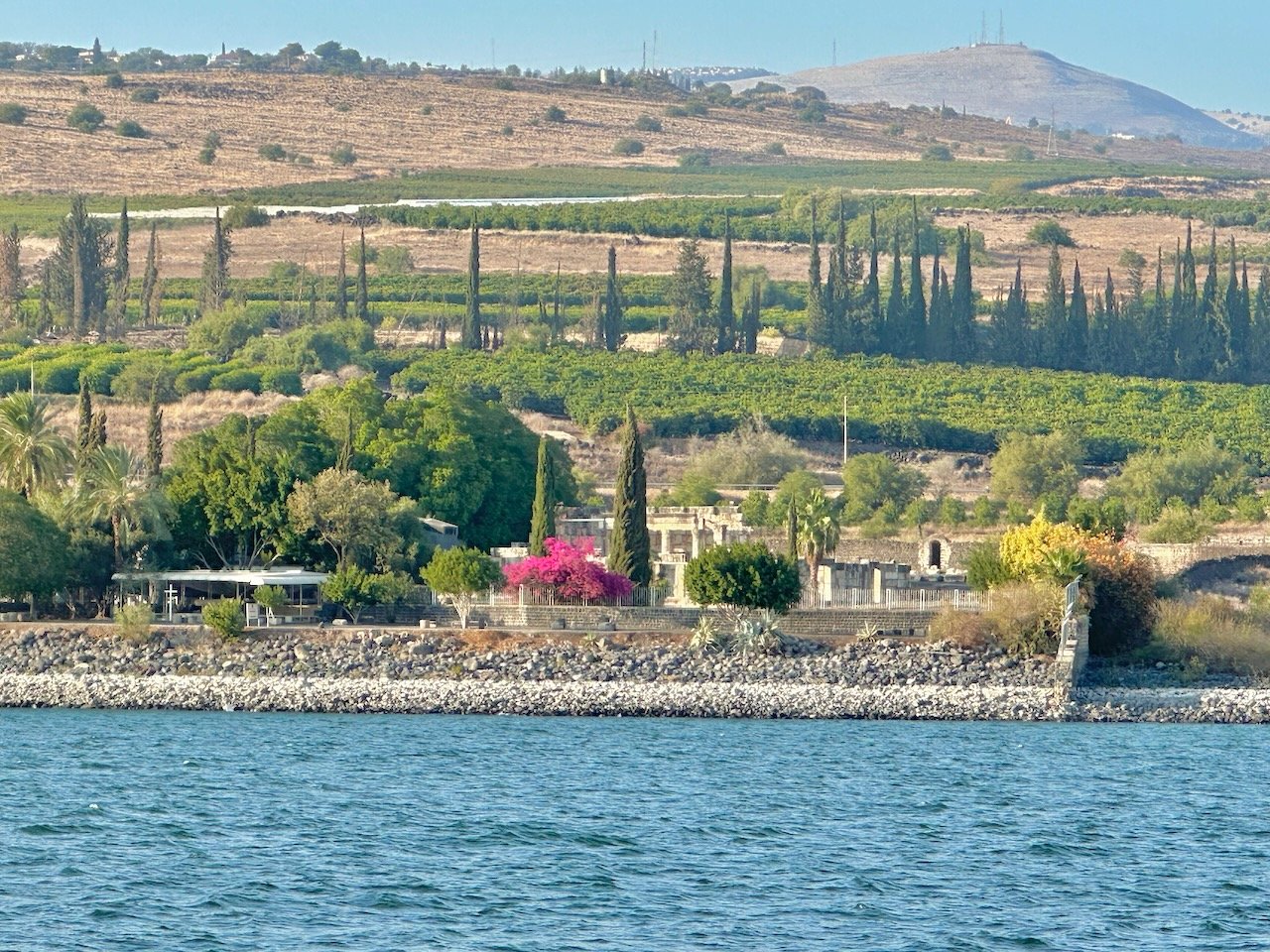
Following see the ancient boat, we visited the ancient site of Capernaum. Located on the NW corner of the lake, this Jewish town served as Jesus’ “home base” for His Galilean ministry. In the late 4th/early 5th century synagogue, we read from Mark 1, 2; Luke 7, 8; and John 6. We also saw the Byzantine church, octagonal in shape, that dates to about the same time period. This ancient church surrounds a 1st century house structure suggested, by tradition and archaeology, to be Peter’s house. Down on the lakeshore, we finished up with reading from Mark 9. Serving in Christ’s kingdom requires a heart of humility and servanthood.
Boat Ride
Next was our boat ride! Because of the predicted higher winds this afternoon (they never happened), our boat ride began at Capernaum. The time of worship songs, reading, and reflection was special. We read from Mark 4 and Matthew 14 about how Jesus calmed the waters of the lake. We were inspired to keep our eyes on Jesus! He is the One who brings peace to our lives!
Magdala
We ended the day by driving back south along the shoreline of the lake. This took us to the ancient site of Magdala. This was a large Jewish city in the days of Jesus. We saw a modest 1st century synagogue here. Although the city is only mentioned once (the end of Matthew 15 after Jesus fed the 4,000), Jesus must have taught here at Magdala and in this modest synagogue! We saw a few more ritual baths as well. We also enjoyed seeing the mosaic murals in the chapel. A beautiful mural of the Luke 8 story (woman who touched the hem of Jesus’ garment) was stunning! We also sang a few songs in the rotunda of the chapel. We sounded like angels!
We drove back to our hotel in Tiberias, arriving at 5:30. We enjoyed an amazing dinner together at 6:30 (with ice cream for desert for the third straight night!) followed by another free evening. What a great day re-tracing Jesus’ footsteps! We leave the Galilee tomorrow morning as we head towards Jerusalem.




Day 13 – Wednesday, November 19: Precipice of Nazareth, Megiddo, Mt. Carmel, Caesarea, Jerusalem, Optional Western Wall Walk
This morning we depart the Galilee towards Jerusalem. We checked out of our hotel at 7:30 enroute to the area of Nazareth. The weather was perfect throughout the day, with a warmer morning, full sun, fairly good visibility, and afternoon highs in the mid 70s. We read portions of Matthew 5-7 as we departed.
Precipice of Nazareth
We drove south through the Lower Galilee to the Precipice of Nazareth. The visibility from here was fairly good, allowing us to see Mt. Tabor (Judges 4), the Hill of Moreh (Judges 7), Mt. Gilboa (1 Samuel 31), and Mt. Carmel to the west (1 Kings 18). This was essentially the “backyard” of Jesus while He grew up in Nazareth. We considered the life of Jesus as read from Luke 4. Jesus came for the purpose of offering redemption to both Jews and Gentiles alike. While Nathaniel questioned “What good can come from Nazareth?,” Philip responded, “Come and see!” (John 1).
Megiddo
Located along the edge of the Jezreel Valley is Megiddo. We drove across this broad Jezreel Valley to get here. This archaeological site was about 25 layers of occupation spanning a period of about 2,500 years! It was a Canaanite and Israelite city. Pharaohs like Thutmose III conquered it in about 1468 BC. Climbing the site, we saw 3 series of city gates, Solomon’s stables and palace, a sacrificial altar from the Early Bronze Period, and a grain silo. We also had a great view of the Jezreel Valley referred to as the Valley of Armageddon in Revelation 16. In the end, God wins when Jesus returns! We walked to the water system that was engineered to bring water safely inside the walls of the city. It was fascinating as we took about 180 steps down and 50 steps back up on the other (outer) side of the site. The bus picked us up here.
Mt. Carmel
Driving along the “byways” (edge) of the valley, we then ascended to Mt. Carmel. This is actually more a mountain range that overlooks the Jezreel Valley on one side and the Mediterranean Sea on the other. We first enjoyed a wonderful buffet lunch at a Druze restaurant.
Then we drove a bit further to the highest peak of the Carmel Range called Muhraha. Here we stood on the roof of the chapel and saw the Jezreel Valley (again). Looking west we could see Caesarea. We then entered a Carmelite chapel. The passages of Amos 1 and 9, Isaiah 35, and Songs of Songs 7 all refer to Carmel. The primary story (1 Kings 18) involved Elijah who confronted the 450 prophets of Baal, the Phoenician/Canaanite god of rain and thunder! Elisha was also on this mountain range (2 Kings 4).
Caesarea
Next, we descended down to the Sharon Plain to Caesarea. In the theater of this city built by Herod the Great in 22-10 BC, we read from Acts 8 Philip), Acts 9 (Paul), Acts 10 (Peter), Acts 12 (Agrippa 1), Acts 21 (Philip again), and Acts 26 (Paul). We then walked across this ancient city to see the palace, hippodrome, the location of the grand harbor, and a movie about Herod the Great. We left the site through the Crusader gate, wall, and mote. Before leaving the site we saw the aqueduct and enjoyed sticking our feet in the Mediterranean Sea. The sunset was amazing!
Jerusalem/Western Wall
In the late afternoon (4:25), we began our drive around Tel Aviv before we ascended to Jerusalem. We entered this magnificent city and saw our first glimpse of the Old City. We checked into our hotel and enjoyed an later dinner. Following dinner, almost everyone walked to the Western Wall, the most holy place for Jews today! We are looking forward to our first full day in Jerusalem tomorrow, Israel’s capital!


Day 14 – Thursday, November 20: Jerusalem, Mt. of Olives, Gethsemane, Herodium, Shepherds’ Fields, Bethlehem
Today was our first full day in Jerusalem. This is the first of three full days here in Jerusalem’s ancient and modern capital. We began on the Mt. of Olives, and ended at Shlomo’s community of Har Gilo outside of Bethlehem. The weather was perfect once again, with full sun and highs in the mid 70s. We read from Psalm 122 (in English and Hebrew) as we began at 7:30.
Mt. of Olives/Gethsemane
From our hotel we drove around the northern end of the Old City to the Mt. of Olives. Cresting the Mt. of Olives we drove to a spectacular view across the Kidron Valley of the Old City and Temple Mount below. From here we walked down to Dominus Flavet, a small chapel where we enjoyed singing a chorus together. Here we celebrated Christ’s kingship as we remembered Luke 19 (Palm Sunday), Acts 1 (Christ’s ascension), and Zechariah 14 (about the return of Christ). Continuing down the slope and then up to a private garden where we considered the passion of Jesus in Gethsemane (Luke 22). From here we walked down to the Church of All Nations (the traditional Garden of Gethsemane) where we saw olive trees hundreds of years old!
Herodium
We then boarded the bus and drove southeast of Jerusalem to Herodium (we saw a gazelle when we entered the site). This was a palace-fortress built by Herod the Great. He was also buried in 4 BC. The site was incredible, with many new renovations and displays. Inside the well-preserved official’s chamber where we saw a wonderful presentation. We then walked up through the royal arches to the top where we saw the bathhouse, synagogue, impressive frescoes, and a great view of Jerusalem. We left the site by carefully walking down through the cistern system.
Shepherds’ Fields/Bethlehem
Just to the west of Herodium and east of Bethlehem is Beit Sahour (an eastern adjacent Arab town). Located here are the traditional shepherds’ Fields. After lunch across the street, we entered a cave where we recalled the words of Micah 4 and 5 as well as Luke 2 about the birth of Jesus. It was “just at the right time God sent His Son” (Galatians 4:4). We also went into the Chapel of the Shepherds where we enjoyed singing Christmas carols.
From here we drove into Bethlehem where we visited an olive wood factory and store owned by the Nissan Brothers. These olive wood products were impressive. These olive wood products were impressive and so well crafted.
Har Gilo
En route back to our hotel, we made a special extra stop at Shlomo’s community. We saw his home and enjoyed a wonderful view of Jerusalem! We drove back to our hotel for dinner and another optional walk (to Jaffa Road and Ben Yehuda). It was great day first day here in Jerusalem! We have two more full days left on the tour.


Day 15 – Friday, November 21: Yad Vashem, City of David, Southern Excavations, Western Wall, Holy Sepulcher Church
Today was our second full day here in Jerusalem. The day included an emotional visit to Yad Vashem and some adventure (Hezekiah’s Tunnel, Rampart Walls), plus a few other experiences! We had perfect weather day, with full sun and warmer temps around 75. We read from Psalm 137 as we left the hotel. Shlomo also sang this psalm in Hebrew!
Yad Vashem
Our first stop in the morning required us to drive to West Jerusalem. Here we visited the Israel’s Holocaust Museum & Memorial. It is called Yad Vashem, named after a verse in Isaiah 56:5 that mentions the “memorial and a name.” We first entered and walked through the start of the Avenue of the Righteous. About 28,000 “Righteous Gentiles” are recognized as saving the lives of Jews. We saw trees dedicated to Oscar Schindler and Corrie ten Boom. We also heard the personal story from Shlomo about his family during this tragic event. He lost 12 family members in Vilna, Poland (pictured). We then walked through the Children’s Memorial and the museum itself. On our own, we ended our visit by walking through the museum. It was a somber experience recalling the horrors of the Holocaust and the loss of six million Jews.
City of David/Hezekiah Tunnel
Next, we drove back towards the Old City and specifically to the City of David. After gathering on the observation tower and learning about the surrounding area, we walked down through the excavations (“Area G”). We saw David’s palace, city walls, and 7th-6th BC house structures (one of them was excavated/uncovered by Dr. John in June-July, 1982). We all continued through Warren’s Shaft (2 Samuel 5). The upper part of this discovery was probably used by David but not the vertical 52 foot shaft. Finally, we descended down to the Canaanite/Jebusite pool to the Gihon Spring. We then saw a newer movie about how Hezekiah’s Tunnel was chiseled out of stone before most in the group braved the waters of the 1,710 foot-long tunnel (2 Kings 20, 2 Chronicles 32). Others took the “dry” Jebusite tunnel built 100s of years earlier.
Both groups met at the Pool of Siloam where we recalled the story of John 9 (blind man being healed by Jesus). More of the pool (or or was it a reservoir pool?) as been exposed, but without finding any more of the steps of the pool. It could be that the smaller pool (found in the clearly 1900s) outside the end of Hezekiah’s Tunnel may have been the “ritual pool” in the John 9 story (?). Time will tell with how things will be interpreted. 🙂
Southern Steps
From the Pool of Siloam some in the group walked up the “Drainage Channel” while others bussed north (and up) to the “Davidson Center.” Here, we walked on the Herodian pavement used no doubt by Jesus. The SW corner of the Temple may have been the pinnacle where Jesus was tempted (Mt. 4). We then walked over to the southern steps used by commoners. Jesus Himself (and His disciples, and Paul) would have used these steps to enter the Temple. We recalled the many mentioned in the NT who used these steps (Luke 2, 18; John 2; Mark 13; and Acts 2, etc…). Before leaving the steps, we considered how God wants us to be His spiritual temple (2 Corinthians 3).
Western Wall
Following our time on the southern steps of the Temple, we walked to the Kotel and the Western Wall. Seeing this massive retaining wall (one of four on each side) of Herod’s Temple was impressive. Herod built these walls in order to double the size of the Temple platform.
Holy Sepulcher Church
From the Western Wall we walked part of the traditional Via Dolorosa. This led us to the Christian Quarter where we visited the Holy Sepulcher Church. Built in 325 AD, this is the traditional location for the death and burial place of Jesus. The archaeological and historical records favor this site. We saw the Ediculae that has enclosed the suggested tomb of Christ for now nearly 1600 years. While parts of the church were being renovated and excavated, we were still able to go inside the suggested tomb of Jesus. While we waited we listened to the singing and praying of about 100 Franciscan priests.
We walked back to the Jaffa Gate where David picked us up to take us back to the hotel. We enjoyed dinner and a free evening (with a few visiting the famous King David Hotel to see the “signature floor.” It was another great day here in Jerusalem! One more day to go!


Day 16 – Saturday, November 22: Eastern/Golden Gate, St. Anne’s Church/Pools of Bethesda, Israel Museum, Garden Tomb, Rampart Walk, Free time in Old City
Today was Shabbat and our last full day of the trip (and our third day in Jerusalem). It was a wonderful day once again, with perfect weather (sun and warm temps in the 70s). We have been blessed with great weather throughout the trip! We read from Psalm 48 as we left the hotel at 8:00 a.m.
Eastern Gate & St. Anne’s / Pool of Bethesda
We drove once around around the northern part of the Old City. Before we entered the Old City, we walked to the Eastern Gate (also called Golden Gate). This gate has been closed since 810 AD. Ezekiel 44 mentions a gate on this eastern side.
From here we walked through the St. Stephen’s Gate (also called the Lion’s and Jericho Gate) and went to the St. Anne’s Church. This is a Crusader Church that is known for it’s 7-8 second echo. We enjoyed singing a number of songs together, sounding like a heavenly choir again! How incredible our worship was! On the same grounds is the Pool of Bethesda. We read John 5 while overlooking the actual steps of this double-pool.
Israel Museum
Just a short distance away (still in Western Jerusalem) is the Israel Museum. First, we saw 1:50 scale model of 2nd Temple Jerusalem. This is what Jerusalem looked like prior to 70 AD. Next, we walked briefly through the Shrine of the Book (where some of the Dead Sea Scrolls are displayed). We saw a few examples of scrolls. Lastly, we walked to the archaeological wing of the museum to see some of the “highlight artifacts” related to the Bible. We saw such artifacts such as the Dan Inscription, the silver amulet inscribed with the earliest name of “Yahweh,” The Pilate Inscription, Herod’s coffin, and the famous 1900 year-old “pie plate.” “HA
Rampart Walk
We returned to the Old City once again. We were dropped off at the Jaffa Gate. Here, we accessed the entrance to the Rampart Walls for our walk around part of the Old City on top of the walls. These walls date to the Turkish/Ottoman Period, being built by Suleiman the Great (1520-1566) between 1537-1544 AD. The view from high on these walls was quite interesting! We walked from the area of the Jaffa Gate past the Zion’s Gate on the south side of the Old City. We exited the ramparts within the Jewish Quarter before walking to the Christian Quarter.
Christian Quarter / Old City
Before we walked back through Jaffa Gate to get our bus back to the hotel, we enjoyed some free time in the Christian Quarter. It was quite empty with tourists.
We arrived back at the hotel for some rest time before dinner at 6:30. Because of Lufthansa canceling one of the regularly-scheduled morning flight, 10 in the group left the hotel at 9 p.m. for an earlier flight. Others in the group will head to the airport at 2:15 a.m. for their 6 a.m. flight.


Day 17 – Sunday, November 23: Flight Back Home
Egypt’s Pyramids
To date, over 120 pyramids have been uncovered in Egypt. This video features the pyramids of Cairo. This includes the stepped pyramid at Sakkara as well as the famous Giza pyramids. These date to the mid 2000s BC, predating even Abraham. The largest pyramid stands nearly 500 feet high.
Ancient Egypt is a marvel to see!