Day 12 – Friday, June 24: Wadi Qelt Hike, Shiloh, Samaritan Village, Mt. Gerizim, Samaria
Today we spent the day first driving east from Jerusalem and then north well into the Hill Country of Samaria. The sun greeted us as we left at 7 a.m., starting our day with a hike in the Judean Desert. It was a unique day going to where most groups don’t go!
Wadi Qelt/St. George Monastery
Leaving the hotel we read from Psalm 61-63 and Luke 10 as we drove around the northern part of the city before turning east to the Wadi Qelt in the heart of the Judean Desert. This was our second time here in this region. However, we drove to see the St. George Monastery built in the side of the cliff. Some in the group hiked down the steep descent to the bottom of the wadi to see it. The hike back up was challenging.
Shiloh
We continued our drive north through the Desert of Parath (Jeremiah 13) and past Michmash (1 Samuel 13-14), Bethel (Genesis 12), and Ai (Joshua 7-8) into the Hill Country of Samaria/Ephraim to Shiloh. The Tabernacle once stood here for over 300 years. It was destroyed by the Philistines (1 Samuel 4). We watched a short movie about the events that took place here. We also read from 1 Samuel 3 (the call of Samuel, “hineni”) and Jeremiah 7. We also saw the excavations of the site. This season revealed more evidence of the Tabernacle. Dr. Scott Stripling, Director of Associates of Biblical Research, just completed another season of digging here this week.
Samaritan Village
We drove to the outskirts of Shechem (modern Nablus) where we enjoyed a great lunch owned by one of the few who claim to be descedents of the ancient Samaritans. Nearby we visited the Samaritan Village where the 85 year old Samaritan priest greeted us. Every Passover they sacrifice lambs as part of their ongoing practice on Mt. Gerazim.
“I love that we continue to go to places hardly visited by other groups. Today we went into the region of Samaria, taking less-traveled roads, and seeing more and more things related to the Bible. Wonderful!”

Mt. Gerazim
We drove to the top of Mt. Gerizim, a high mountain above ancient Shechem below. We saw the ruins of a large Byzantine church here. Down below we could see the Jacob’s Well Church (the location of Sychar, John 4) as well as the ancient site of Shechem (Tel Balata) where Abraham, (Genesis 12) and Jacob (Genesis 34) were. On the other side is Mt. Ebal. Blessings and curses were shared back and forth on these two mountain (Deuteronomy 11, 27). Joshua’s altar was found in Mt. Ebal in the 1980s (Joshua 8), with Dr. Scott Stripling recently discovering what it believed to be a “curse tablet.”
Samaria / Sebaste
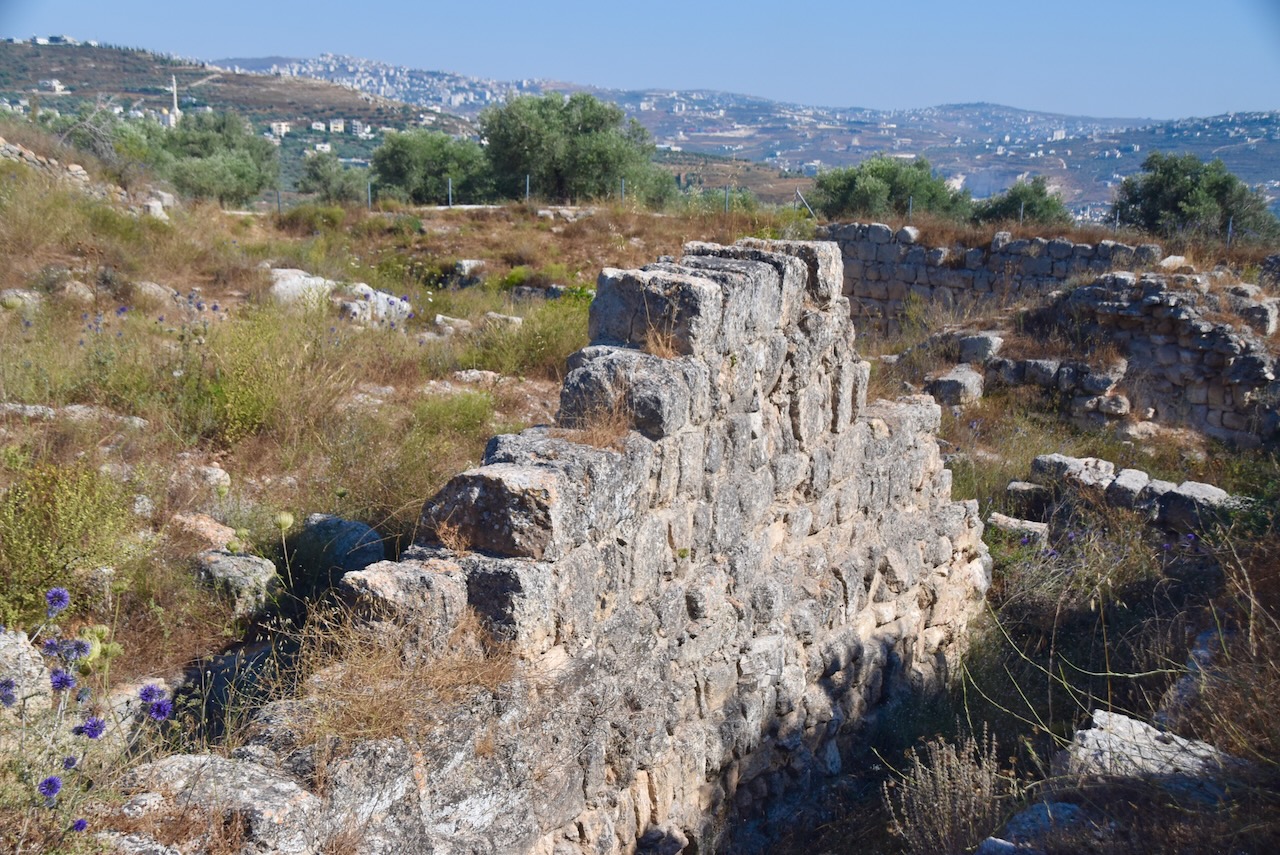
On the way back to Jerusalem we made a brief stop at the ancient city of Samaria. This was the final capital of the northern kingdom of Israel before it was destroyed in 732 BC. Among the ruins of this OT city we saw the walls of the palace of Kings Omri and his son Ahab. Much later, Herod the Great built a temple in honor of Augustus here in 27 BC. We saw the massive steps and platform of this structure, as well as an impressive theater.
It took about an hour and a half to drive south back to our hotel in Jerusalem for dinner and a free evening.
Day 13 – Saturday, June 25: Garden Tomb, David’s Citadel, Herodium, Bethlehem, Farewell Dinner